Colorado Wetland Information Center Logo Colorado Wetland Information Center Logo CWIC
  • About
    • What Are Wetlands?
    • Why Are Wetlands Important?
    • Colorado Wetland Plan
    • Wetland Partners
  • Wetland Types
    • Overview
    • Ecological Systems
    • Natural Plant Communities
    • Fen Mapping
  • Wetland Condition
    • Overview
    • Ecological Condition
    • Habitat Quality
    • Biodiversity Significance
    • Colorado Wetland Assessment Projects
    • National Wetland Condition Assessment
    • BLM Assessment Inventory and Monitoring
  • Protection & Conservation
    • Overview
    • Conservation
    • Restoration
    • Regulation
    • Best Management Practices
    • Funding and Technical Support
  • Data & Tools
    • Wetlands Mapper
    • Floristic Quality Calculator
    • Landscape Summaries
    • Watershed Toolbox
    • Wetland Plots Database
  • Library
    • Wetland Reports
    • Potential Conservation Areas
    • County Survey Reports
    • Field Guides and App
    • Field Manuals
    • Educational Resources
  • CNHP Home

National Wetland Condition Assessment

The National Wetland Condition Assessment (NWCA) is a collaborative survey of the nation's wetlands coordinated and funded by the U.S. Environmental Protection Agency as part of a program called the National Aquatic Resource Surveys. The NWCA examines the chemical, physical and biological integrity of wetlands through a set of commonly used and widely accepted indicators.

CNHP Field Technicians sample a wetland beneath Wilson Peak, San Miguel County, for the 2016 National Wetland Condition Assessment. Sarah Marshall, CNHP.

NWCA sampling takes place every five years. The first survey was conducted in 2011 and successive surveys were conducted in 2016 and 2021. Numerous state agencies, tribes, and cooperators participated in both surveys, including CNHP. During each survey, data are collected from over 1,000 wetlands within the lower 48 states. The survey employs a probabilistic random design that allows results to be extrapolated to all wetlands within the contiguous U.S. The target population for NWCA includes all tidal and non-tidal wetlands with rooted vegetation and open water less than one meter deep. Farmed wetlands not currently in crop production are also sampled.

Key Findings from the 2011 NWCA:

  • Nearly half of wetland area (48%) is in good condition, 20% is in fair condition, and 32% is in poor condition.
  • Physical disturbances to wetlands and their surrounding habitat are the most widespread problems across the country, such as compacted soil, ditching, and removal or loss of vegetation. Wetlands with high levels of compacted soil are about twice as likely to have poor plant communities.
  • Nonnative plants are a problem across the country, particularly in the interior plains and west. 46% of wetland area in the interior plains and 72% of wetland area in the west have high or very high levels of stress from nonnative plants.
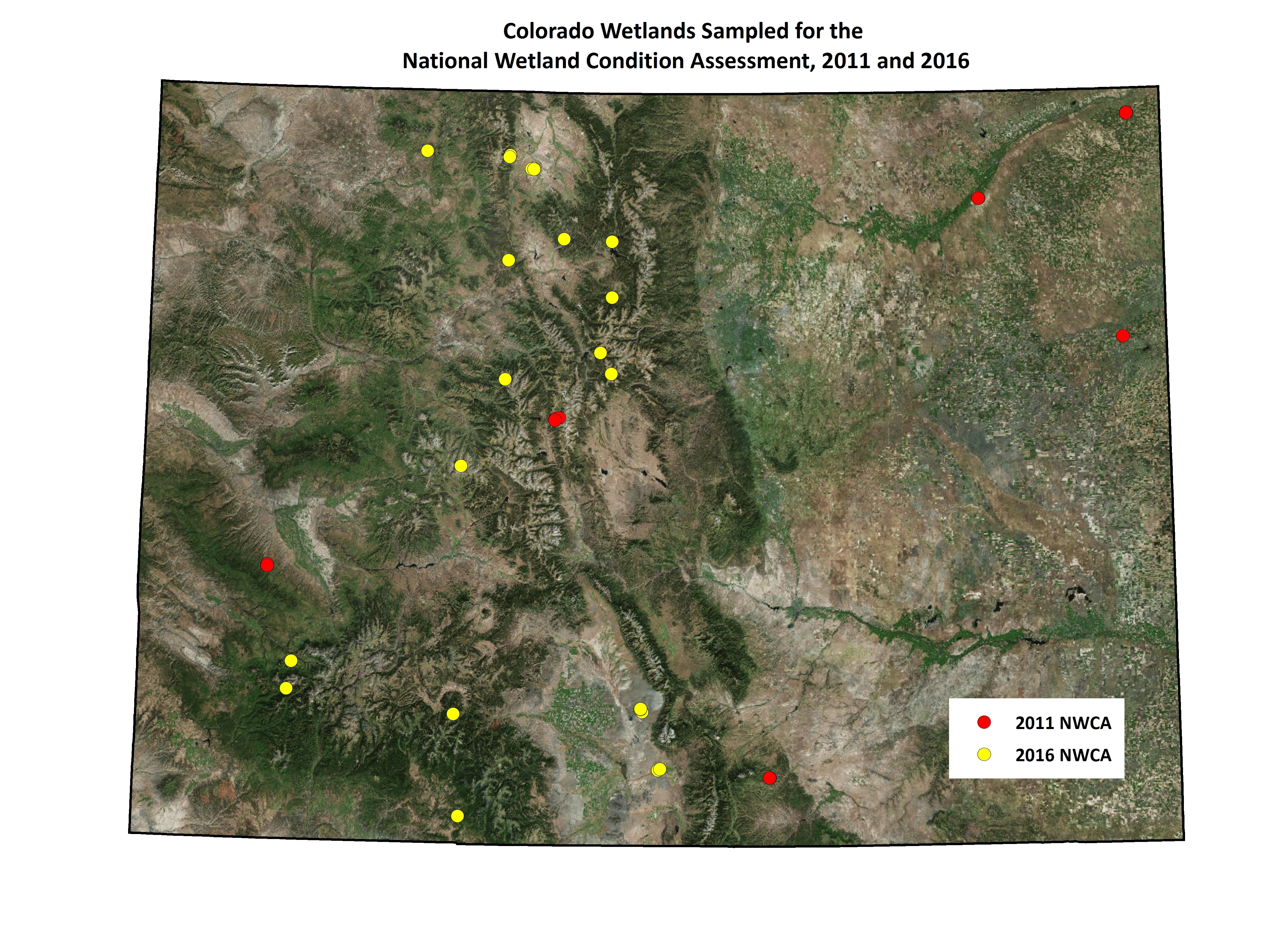
Map of wetlands sampled in Colorado for the National Wetland Condition Assessment, 2011 and 2016. Points may represent more than one sampled wetland site.

For the 2011 NWCA, CNHP carried out all site evaluation and field sampling for Colorado and Wyoming because of our experience conducting wetland condition assessment projects in the Rocky Mountains. This included 12 randomly selected sites in Colorado and 9 in Wyoming. Two random sites from each state were sampled twice to determine intra-annual variability. In addition, CNHP sampled four reference sites in Colorado, one in Wyoming, and one in Utah. Reference sites were handpicked wetlands known to be in good condition. Data from reference sites will help set condition thresholds for the randomly selected sites.

For the 2016 NWCA, CNHP carried out site evaluation and field sampling for all randomly selected sites in Colorado. This included 24 sites, two of which were sampled twice. The number of randomly selected sites in Colorado and all western states was much higher in 2011 than in 2016 because the 2011 results indicated that western wetlands face more stress than those in other regions. Western states, including Colorado, encouraged EPA to add additional sites in the West to better understand the condition and specific stressors to western wetlands.

For the 2021 NWCA, CNHP again carried out site evaluation and field sampling for all randomly selected sites in both Colorado and Wyoming. This included 22 sites in Colorado and 19 in Wyoming. For 2021, CNHP applied for an EPA Regional Wetland Program Development Grant to add 28 additional Colorado sites, bringing the total number of sites to 50. This will allow us to estimate the condition of all wetland acres in Colorado when the data are fully analyzed.

For more information on the NWCA:

  • EPA’s National Wetland Condition Assessment website
  • National Wetland Condition Assessment 2011 Report
  • National Wetland Condition Assessment 2011 Fact Sheet
For information, contact Joanna Lemly.

Wetland Condition

Overview
Ecological Condition
Habitat Quality
Biodiversity Significance
Colorado Wetland Assessment Projects
National Wetland Condition Assessment

Related Topics

Wetland Reports
PCA Reports
County Survey Reports
Field Guides and App
Field Manuals
Educational Resources
Watershed Toolbox

Web Projects

  • CODEX - Colorado’s Conservation Data Explorer
  • Rare Plant Guide Online
  • Colorado Wetland Info Center
  • COMaP - Colorado Protected Lands
  • Colorado Bat Working Group
  • STReaMS - Endangered Fishes Database
  • Colorado Native Plant Database Data Portal

About Us

  • About Us
  • Conserving Biodiversity
  • Contact Us
  • Staff Directory
  • Careers
  • Site Map
Warner College of Natural Resources Logo
  • Apply to CSU
  • Equal Opportunity
  • Disclaimer
  • Privacy Statement
  • Search CSU
  • CSU Land Acknowledgement
  • CSU Principles of Community
© 2026 Colorado Natural Heritage Program
Colorado State University Logo
  • About
    ▼
    • What Are Wetlands?
    • Why Are Wetlands Important?
    • Colorado Wetland Plan
    • Wetland Partners
  • Wetland Types
    ▼
    • Overview
    • Ecological Systems
    • Natural Plant Communities
    • Fen Mapping
  • Wetland Condition
    ▼
    • Overview
    • Ecological Condition
    • Habitat Quality
    • Biodiversity Significance
    • Colorado Wetland Assessment Projects
    • National Wetland Condition Assessment
    • BLM Assessment Inventory and Monitoring
  • Protection & Conservation
    ▼
    • Overview
    • Conservation
    • Restoration
    • Regulation
    • Best Management Practices
    • Funding and Technical Support
  • Data & Tools
    ▼
    • Wetlands Mapper
    • Floristic Quality Calculator
    • Landscape Summaries
    • Watershed Toolbox
    • Wetland Plots Database
  • Library
    ▼
    • Wetland Reports
    • Potential Conservation Areas
    • County Survey Reports
    • Field Guides and App
    • Field Manuals
    • Educational Resources
  • CNHP Home
  • About
    ▼
    • What Are Wetlands?
    • Why Are Wetlands Important?
    • Colorado Wetland Plan
    • Wetland Partners
  • Wetland Types
    ▼
    • Overview
    • Ecological Systems
    • Natural Plant Communities
    • Fen Mapping
  • Wetland Condition
    ▼
    • Overview
    • Ecological Condition
    • Habitat Quality
    • Biodiversity Significance
    • Colorado Wetland Assessment Projects
    • National Wetland Condition Assessment
    • BLM Assessment Inventory and Monitoring
  • Protection & Conservation
    ▼
    • Overview
    • Conservation
    • Restoration
    • Regulation
    • Best Management Practices
    • Funding and Technical Support
  • Data & Tools
    ▼
    • Wetlands Mapper
    • Floristic Quality Calculator
    • Landscape Summaries
    • Watershed Toolbox
    • Wetland Plots Database
  • Library
    ▼
    • Wetland Reports
    • Potential Conservation Areas
    • County Survey Reports
    • Field Guides and App
    • Field Manuals
    • Educational Resources
  • CNHP Home
  • About
    ▼
    • What Are Wetlands?
    • Why Are Wetlands Important?
    • Colorado Wetland Plan
    • Wetland Partners
  • Wetland Types
    ▼
    • Overview
    • Ecological Systems
    • Natural Plant Communities
    • Fen Mapping
  • Wetland Condition
    ▼
    • Overview
    • Ecological Condition
    • Habitat Quality
    • Biodiversity Significance
    • Colorado Wetland Assessment Projects
    • National Wetland Condition Assessment
    • BLM Assessment Inventory and Monitoring
  • Protection & Conservation
    ▼
    • Overview
    • Conservation
    • Restoration
    • Regulation
    • Best Management Practices
    • Funding and Technical Support
  • Data & Tools
    ▼
    • Wetlands Mapper
    • Floristic Quality Calculator
    • Landscape Summaries
    • Watershed Toolbox
    • Wetland Plots Database
  • Library
    ▼
    • Wetland Reports
    • Potential Conservation Areas
    • County Survey Reports
    • Field Guides and App
    • Field Manuals
    • Educational Resources
  • CNHP Home