Hi! My name is Abby Kogan, and I’m a fourth-year undergraduate student at Colorado State University studying wildlife biology alongside microbiology and infectious diseases. This summer, I had the opportunity to work as a Siegle Conservation Intern with the Colorado Natural Heritage Program (CNHP), supporting fieldwork on the EDGE project, which investigates plague resistance in prairie dogs.
Coming into this internship, my understanding of infectious disease was largely shaped by coursework and lab-based thinking. I was used to viewing disease through a microscopic lens: pathogens, hosts, immune responses, and genetic mechanisms. While those concepts are critical, working in the field this summer reshaped how I think about disease entirely. I learned that wildlife disease is not just a biological interaction between a host and a pathogen, but a complex system shaped by landscapes, human activity, and collaboration across people and institutions.
The EDGE project focuses on understanding resistance to sylvatic plague in black-tailed and Gunnison’s prairie dogs using genomic approaches. Sylvatic plague, caused by the bacterium Yersinia pestis, is transmitted primarily by fleas and is notorious for wiping out entire prairie dog colonies during epizootics. From a microbiology standpoint, it is a highly virulent pathogen with devastating efficiency. From a field perspective, its impacts are impossible to ignore.
Standing in active prairie dog colonies versus areas recently impacted by plague made those consequences tangible. Healthy colonies were loud and bustling towns, full of movement with chirps, barks, and alarm calls filling the air. In contrast, plague-affected areas felt eerily quiet. Prairie dogs are often described as keystone species, but it wasn’t until I spent time in these landscapes that I fully understood what that meant. Their burrows provide shelter for countless other species, and their presence shapes vegetation structure and predator-prey dynamics. When prairie dogs disappear, the effects ripple outward in ways that are both immediate and long-lasting.
As someone interested in disease ecology, I was especially struck by how prairie dog colonies function as interconnected disease systems. Fleas act as vectors, colonies act as hubs, and movement across the landscape determines how plague spreads and persists. Resistance, which is central to the EDGE project, is not an on-or-off trait. Instead, it exists along a spectrum and varies across space and time. Understanding where resistant genetic variants occur, how common they are, and how they change through time requires extensive sampling across many colonies and regions.
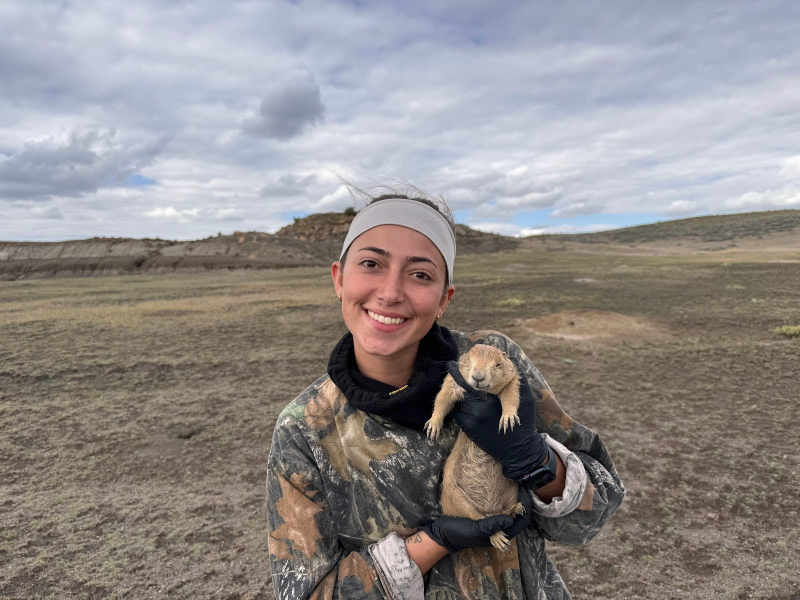
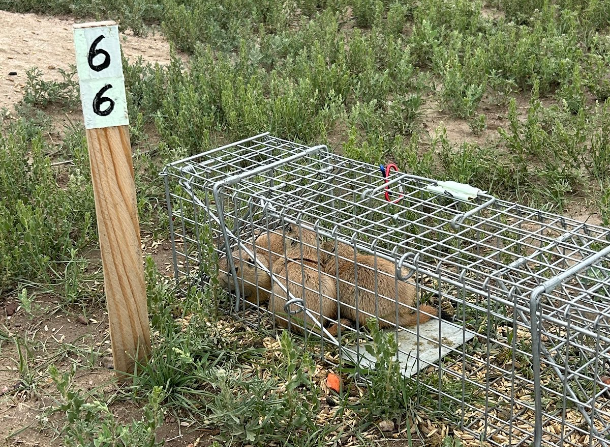
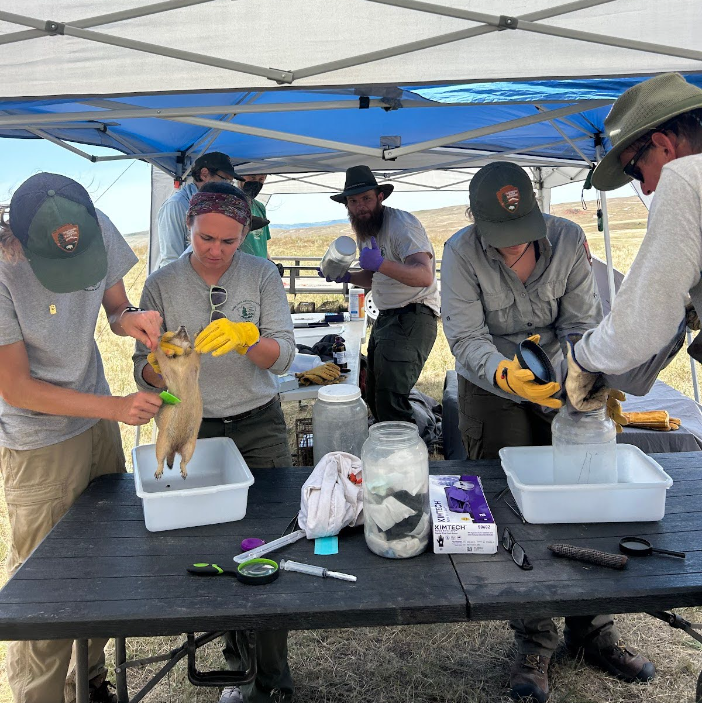
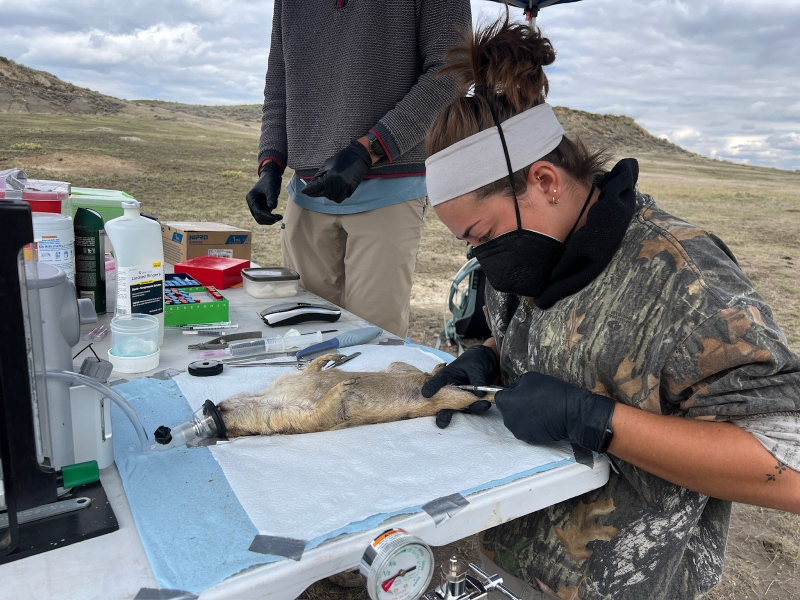
During the summer, I assisted with trapping and processing prairie dogs at two long-term study sites: the Semi-Arid Grasslands Research Center in northern Colorado and Thunder Basin National Grasslands in northeast Wyoming. These sites are sampled repeatedly over time, allowing researchers to track genetic changes within colonies and better understand the microevolution of resistance. In addition to this long-term work, I also traveled with the field crew across Colorado, Wyoming, Nebraska, Montana, North Dakota, and South Dakota to sample colonies with a more spatial focus. Sampling across such a broad geographic range highlights how disease dynamics differ depending on landscape context, recent plague history, and human land use.
From the outside, genetic research can sound abstract or removed from reality. In practice, collecting the data needed to answer these questions requires early mornings, long days, and a lot of coordination. My role as a field technician involved setting and baiting traps, safely handling and processing prairie dogs, collecting biological samples, and releasing animals back at their burrows. While the physical work was demanding, it was also deeply rewarding to know that each sample contributed to a larger effort to inform proactive conservation strategies.
One of the most valuable lessons I learned this summer had little to do with bacteria or genetics and everything to do with people. Wildlife disease research does not happen in isolation. Much of our fieldwork depended on collaboration across agencies, land managers, private landowners, and researchers. Many of the prairie dog colonies we sampled were located on working livestock pastures, private property, or protected lands with different management goals. Gaining access required communication, trust, and careful planning long before traps were ever set.
This behind-the-scenes coordination is easy to overlook, but it is essential. Managing disease in wildlife populations is as much a social challenge as it is a scientific one. Conservation decisions must balance ecological goals with land use, economics, and human values. Being part of a project that navigates these realities showed me how interdisciplinary conservation truly is and how important organizations like CNHP are in bridging science and management.
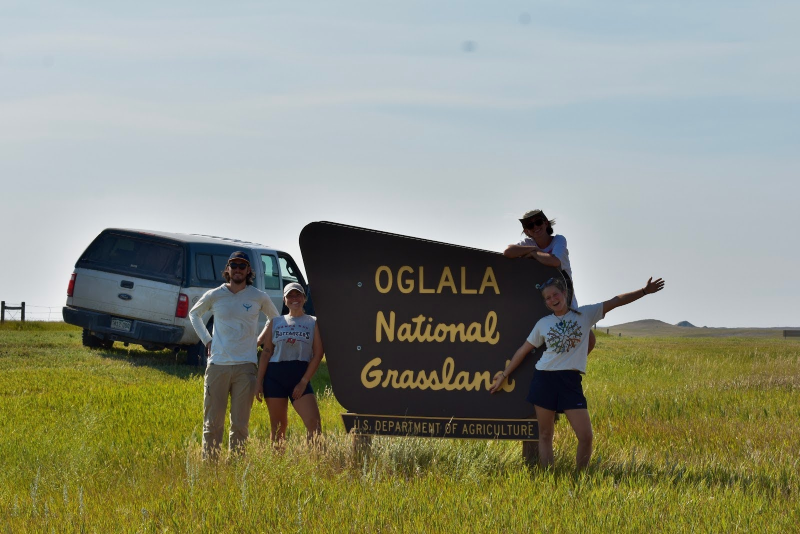
Traveling across the Great Plains also reinforced how much landscapes matter in disease ecology. Prairie dog colonies differed widely in size, disturbance, vegetation, and surrounding land use. These differences shape flea communities, host density, and ultimately disease risk. Seeing these patterns firsthand helped connect the theoretical models I had learned about in class to real-world systems that are far more complex and variable.
This internship fundamentally changed how I think about infectious disease. It taught me that understanding pathogens requires stepping outside the lab and into the ecosystems where disease actually unfolds. Integrating microbiology, wildlife biology, and conservation is not just useful, it is necessary if we want to develop effective, long-term solutions for managing wildlife disease.
I am incredibly grateful to CNHP and the EDGE project team for the opportunity to gain this perspective! This experience more than confirmed my interest in wildlife disease ecology and showed me how meaningful interdisciplinary conservation work can be.

Prairie dogs may be small, but the systems they are part of, and the lessons they offer about disease, collaboration, and ecosystems, are anything but.