My summer was largely spent at the Air Force Academy in Colorado Springs collecting data pertaining to the Preble’s meadow jumping mouse (Zapus hudsonius preblei), a small mammal listed as threatened under the Endangered Species Act.
Here I describe one of my typical summer days working as an intern for the Colorado Natural Heritage Program.
Around 5:30 AM the crew’s alarms sound, as small mammal trapping demands the cool hours of the morning to check traps and release our catch before the sun heats up the day. I unzip my tent and hear the hustle and bustle of I-25 and the train transporting its daily deliveries of coal south of the Air Force Academy. Despite the perpetual road noise, the streams that neighbor these busy highways are full of life, even the rarer kinds.
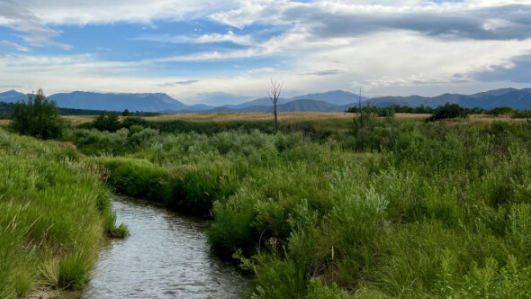
I go through my mental list of things to pack for the first part of the day. I gather my hip waders, gloves, water bottles, snacks, rain jacket, and sunscreen. I’ve learned that you never know what kind of weather you’ll get out in the field, especially with Pike’s Peak so close to the Academy. We hop in the truck, and head to our first of three sites. The tall grasses and willow saplings are almost always covered in dew in the mornings, so a rain jacket and hip waders are essential to stay dry while bushwacking through the vegetation.
Once we arrive at our site, we start checking the Sherman traps we baited the night before. Deer mice (Peromyscus maniculatis), Meadow voles (Microtus pennsylvanicus), and Bushy-tailed woodrats (Neotoma cinerea) are the most common of the small mammals that find their way to the oats and horse feed used to bait the traps. Less common are the shrews, weasels, and Western harvest mice (Reithrodontomys megalotis) that stay the night. An occurrence of one of these species calls for a prompt eviction from the trap (no matter how cozy they may look in the polyfill bedding). We jot down their occurrence and keep our eyes on the prize.

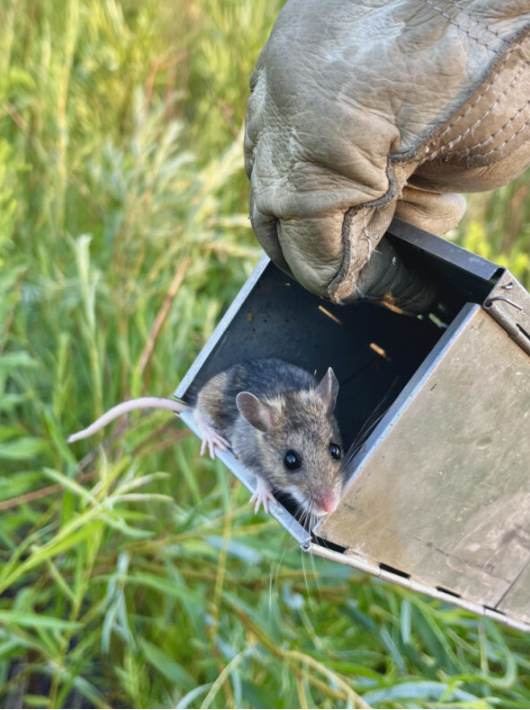
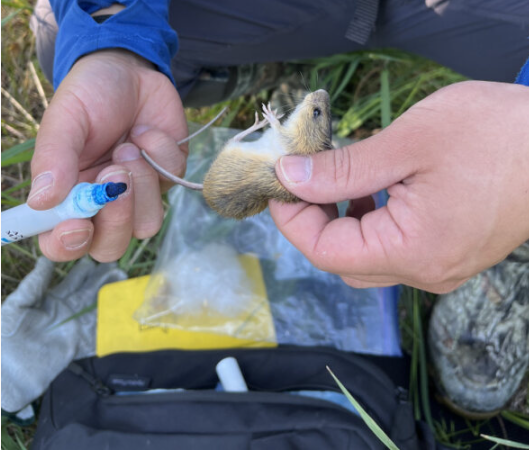
“I got a jumper!” is the phrase of excitement used to let the team know it’s time to process a Preble’s meadow jumping mouse (PMJM). As our species of interest, we collect weight measurements, sex and reproductive status of the individual, and then mark the base of their tails with animal safe markers so if they find themselves in a trap again, we will know it was a recapture.
3 sites and 240 traps later, it’s time for vegetation surveys. The vegetation we stomped through earlier in the morning now becomes important data and measurements. We conduct stem counts, take the diameter of living and downed woody debris, estimate canopy cover with a densiometer, and take many other measurements. These efforts are all in hopes to adequately portray the vegetation structure and abundance in areas, to then compare it to abundance of PMJM.
After the long morning of estimating ground cover and counting herbaceous stems, it’s time for lunch and a long break. Not much can be done out in the field during the afternoons, but there is always plenty of data entry and sorting through camera-trap data to pass the time. If we are craving a little more excitement, Garden of the Gods and some local lakes are the go-to for a quick hike or swim.
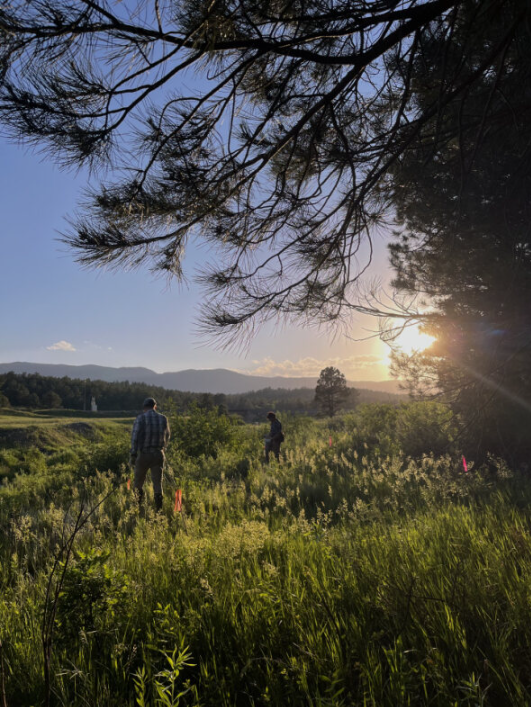
When 5pm rolls around, it’s time to set traps again. We put on our nail bags filled with bait, and stuff our pockets full of polyfill. We open each trap, refill with bedding and food if needed, and place them in the tall grasses. We are often out to see the sun setting, and of course the trains that never seem to take a break.
After setting traps, we finish the day with a shower, dinner, chatting, and card games till it’s time to head to our tents for the night. I enjoy evenings like these where I get to learn from my coworkers and their experiences. Reflecting on the work we are doing makes me appreciative to be in this field and to have been provided such an incredible opportunity by Colorado Natural Heritage Program.