By Savanna Smith
(former CNHP work study)
As a Chicago Botanic Garden Conservation and Land Management botany intern at the Shoshone Field Office of the BLM, my love for plants has grown exponentially this summer. I’ve gotten to know the best method for beating the seeds off a Purshia tridentata bush, smelled many a sagebrush, and puzzled over whether or not a Penstemon’s anthers dehisced from the center or the sides. However, I can’t deny my roots in the field of wildlife biology, which is what I studied as an undergraduate. As a climber, it seemed natural to be interested in bats since they often roost in the cracks and crevices only accessible to rock climbers. (For any other wildlife-enthusiast climbers out there, you should check out Climbers for Bat Conservation on Facebook, a cool citizen science project!) My undergraduate thesis research dealt with the acoustic side of bat science, but I didn’t participate in any of the field work for the data. So, you can imagine my excitement when I learned that I would get to assist in several bat-related projects this summer.
The first project involved setting up stationary acoustic bat detectors with Ross from Idaho Fish & Game – this work was conducted for the North American Bat Monitoring Program, a continent-wide protocol aimed at gathering data on the status and trends of bat populations across North America. After securing these detectors during the daylight, we waited until nightfall to conduct mobile acoustic surveys. This involves attaching a bat detector on top of the truck and driving at a constant speed for at least 25 km, all while recording the bats flying overhead. This was fun because I got to watch the calls coming in on a spectrogram in real time.
Last week, myself and other interns had the opportunity to attend a bat bioblitz – an event where scientists attempt to capture all the biodiversity in an area. We set up triple-high mist nets over the river and patiently waited for bats to fly in. We saw and recorded many bats, but only managed to trap two in the nets. Regardless, it was really cool seeing them up-close and learning how to take measurements. At our station, we captured an adult female silver-haired bat (Lasionycteris noctivagans) and a juvenile male Yuma myotis (Myotis yumanensis).
We camped out after the bioblitz and got a quick night of sleep before returning to the office for a day of caving in Gypsum lava tube, the second largest lava tube in the continental US! This was a new experience for me, and I enjoyed the pressing silence and impenetrable darkness that each bend in the passage concealed. In the tube, we found pack rats, a jackrabbit carcass, and even a few bat friends hanging out almost two miles into the tube! It was a great experience to put myself in such a different environment.
I’m thankful that this internship has allowed me to gain experience in a variety of areas, especially since bats are creatures I’ve been interested in for a long time. I only have six more weeks left here in Idaho, and I’m excited to see what’s next.
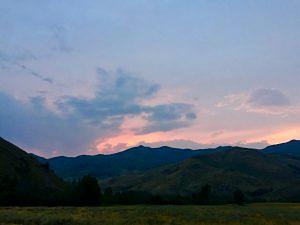 |
| Sunset view before the mobile acoustic transect. |
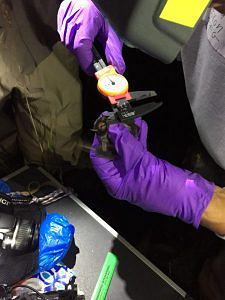 |
| Adult female silver-haired bat. |
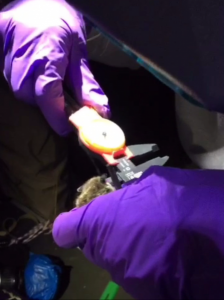 |
| Juvenile male Yuma myotis. |
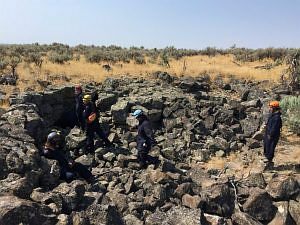 |
| The entrance to Gypsum lava tube. |
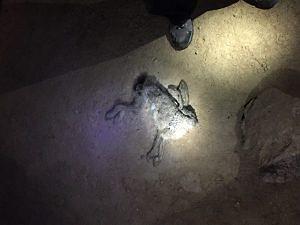 |
| Jackrabbit carcass. |
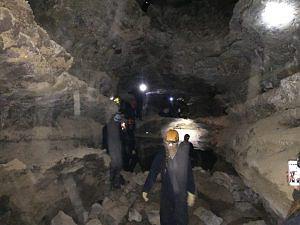 |
| Kind of low quality photo of the inside of the tube – check out the multiple levels! |