by David Anderson, CNHP Director
On March 7th and 8th, Susan Spackman Panjabi, Pam Smith, Joanna Lemly, Rob Schorr, and David Anderson spent two days with the 20 wonderful Master’s Degree Students in the Conservation Leadership Through Learning (CLTL) Program at CSU. The CLTL is an innovative graduate program in which students confront conservation challenges and sustainability from a variety of perspectives. It is unique in that the students spend two semesters at CSU, followed by two semesters at ECOSUR in Chiapas, Mexico. They will receive degrees from both universities when they complete the 17-month program. As a part of the program they are working in groups to complete “synergistic projects” in communities that will connect them with ongoing conservation efforts.
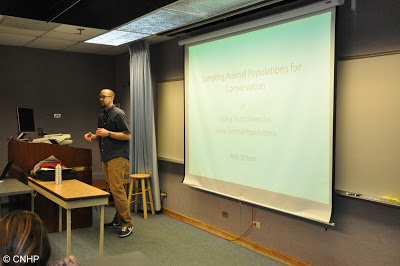 |
| Zoologist Rob Schorr in the classroom
|
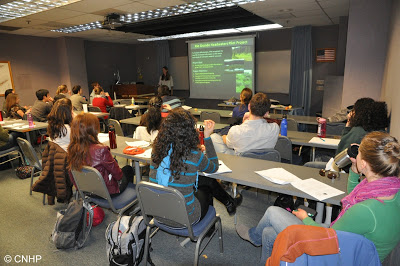
On March 7th we spent the day in Drs. Mike Gavin and Jennifer Solomon’s class with the students talking about conservation and ecological research. Susan gave them a wonderful overview of the work that the Colorado Natural Heritage Program and other programs like ours do worldwide, and how our biodiversity data translates into conservation action. I talked about methods used in ecological research and decision making. Then Rob introduced the students to some of the ways that animals are studied. He helped us understand how to deal with the problems associated with the probability of detecting organisms in the environment that, whether we like it or not, cannot be avoided! Then Joanna gave us an overview of the wetland assessment and mapping projects that she is leading, focusing on how we are working through partnerships to put science to work in conserving Colorado’s wetlands.
 |
|
Ecologist Joanna Lemly telling the class about her wetlands work
|
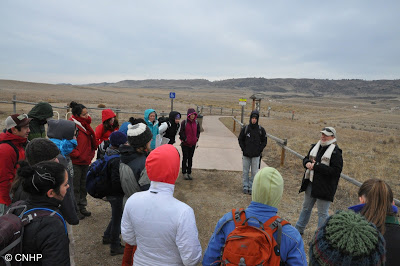
On March 8th, we spent a day in the field at Coyote Ridge Natural Area, in the expert care of Eduardo Boné Moron, who helped field trip logistics. This site, on the southwest edge of Fort Collins, is part of the City of Fort Collins Natural Areas system and is important for the conservation of many rare species and communities. One of these species, the Bell’s twinpod, is known only from Larimer and Boulder Counties, and Coyote Ridge is home to one of the two largest populations of this species on Earth. We were joined there by Crystal Strouse, Botanist with the City of Fort Collins, who gave us a wonderful overview of the area.
 |
|
Crystal Strouse (at right) shared her wisdom with us
when we arrived at Coyote Ridge on Friday.
|
At Coyote Ridge, the CLTL Students were divided into groups and had five tasks to complete while they were there. They did a fantastic job of learning to sample vegetation, document natural history observations, use a GPS to mark locations, and collect quantitative and qualitative biodiversity information in the field. For many of the students, this was their first chance to experience rare plants and wildlife, including the charming and eminently watchable prairie dogs that live in this natural area.
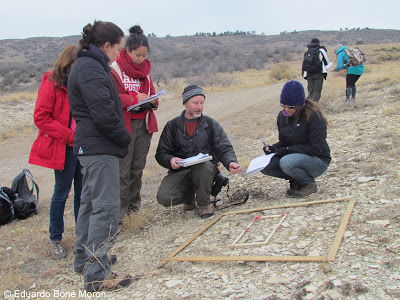 |
| The students work on practicing quadrat sampling with Dave’s help at Coyote Ridge |
We all wish the very best to the students in the CLTL program, and it was truly wonderful to spend two days with you! We hope that you’ll stay in touch with us.
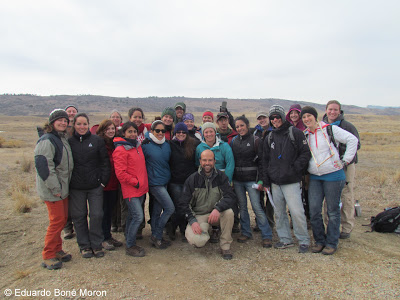 |
| Everyone still looks happy at the end of the field trip! |