Colorado Natural Heritage Program Logo Colorado Natural Heritage Program Logo CNHP
  • About Us
    • About Us
      • Biennial Report
      • Strategic Plan
    • Conserving Biodiversity
    • Contact Us
    • Staff Directory
    • Careers
      • Employment
      • Internship
      • Volunteer
    • Meetings
    • The NatureServe Network
    • Partners
  • Our Work
    • Ecology
    • Wetlands
    • Plants
    • Animals
    • Climate Change
    • Education
    • Invasive Species
  • Our Services
    • Database Development
    • GIS Analysis & Modeling
    • Mapping
    • Surveys & Inventories
    • Monitoring & Assessment
    • Conservation Planning
  • Our Data
    • About CNHP Data
    • Request Data
    • Contribute Data
    • Download Data
    • Tracking Lists
    • PCA Reports
    • Help & Documentation
  • Maps
    • CNHP Spatial Layers
    • Wetlands Mapper
    • COMaP
    • Conservation Environmental Review Tool
  • Library
    • Reports
    • PCA Reports
    • Tracking Lists
    • Field Guides
      • Rare Plant Guide
      • Colorado Wetland Field Guides
  • Blog
  • Donate Now

Botany A to Z: Astragalus

December 6, 2011

By Karin Decker
is for Astragalus
I have no idea why this is, but there are more rare plant species names in the first third of the alphabet than in the remaining two thirds. The letters A through G account for half of all plant species tracked by CNHP.  By far the most frequent genus name on the tracking list is Astragalus, the milkvetches, which are members of the pea family.
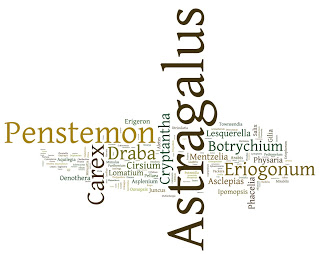
Astragalus rules! (thanks to www.wordle.net)
Dr. Rupert Barneby provided a wealth of information on this genus in his 1964 two-volume Atlas of North American Astragalus.  Duane Isely and Stanley Welsh have also published more recent comprehensive work on the genus. The origin of the generic name Astragalus is thought to be the Greek word astragalos, meaning ankle-bone.  These bones were apparently once used as a form of dice, and the rattle of dry seeds in the pod of Astragalus mimicked the sound of dice in the cup.
Worldwide, there are perhaps up to 2000 species of Astragalus, and they are especially common in southwestern Asia. Western North America, including Colorado, is also a center of diversity for this genus.  Our state is home to more than 150 different species of milkvetch; CNHP tracks 45 of these species (see map below).
Most of our species are found on the west slope; species on the eastern plains are common in states further east, but are at the edge of their distribution in Colorado. Ten Astragalus species are endemic to Colorado – found nowhere else in the world.
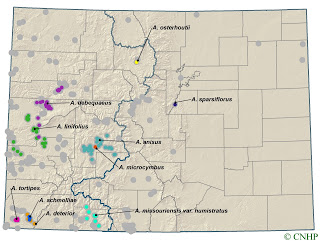
Documented locations of rare Astragalus species in Colorado. Endemic species are colored and labeled, non-endemic are gray.
Although most species of Astragalus have fairly showy flowers with the wings and keel that are typical of pea flowers, it is by their fruits that you will know them. Barneby noted that “Perhaps the most remarkable single characteristic of the genus Astragalus as a whole, and it is especially marked in North America, is that there are hardly two species, even very closely related, which do not differ one from another in form or structure of the fruit”.  This characteristic allows for easy description of individual species. Botanists scheduling their field trips are torn between the prospect of getting a pretty photo of a flowering Astragalus, and the need for mature fruits to make sure they’ve got the correct species. Sometimes you luck out and get both.
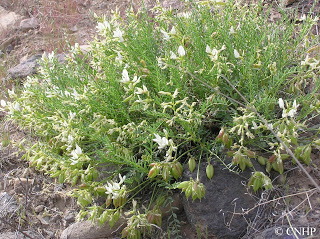
Astragalus debequaeus
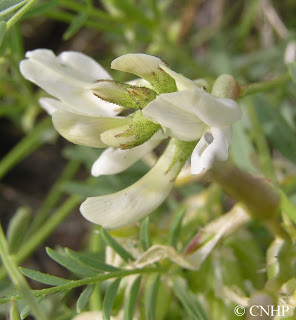
Astragalus debequaeus, closeup of flowers.
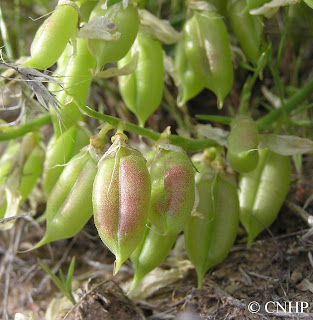
Astragalus debequaeus, closeup of fruits.

SHARE
FACEBOOK
TWITTER
LINKEDIN
REDDIT
EMAIL
Filed Under: Botany

2011 Wetland Condition Assessments – Successfully Profiling a Broad Range of Wetland Conditions
Potential ACEC designation for three endangered plant species

About Us

About Us
Conserving Biodiversity
Contact Us
Staff Directory
Careers
Employment
Internship
Volunteer
Meetings
The NatureServe Network
Partners

Our Work

Ecology
Wetlands
Plants
Animals
Climate Change
Education
Invasive Species

Blog Archive

Blog Categories

Web Projects

  • Rare Plant Guide Online
  • Colorado Wetland Info Center
  • COMaP - Colorado Protected Lands
  • Colorado Bat Working Group
  • STReaMS - Endangered Fishes Database

About Us

  • About Us
  • Conserving Biodiversity
  • Contact Us
  • Staff Directory
  • Careers
  • The NatureServe Network
  • Partners
  • Site Map
Warner College of Natural Resources Logo
  • Apply to CSU
  • Equal Opportunity
  • Disclaimer
  • Privacy Statement
  • Search CSU
  • CSU Land Acknowledgement
  • CSU Principles of Community
© 2026 Colorado Natural Heritage Program
Colorado State University Logo
  • About Us
    ▼
    • About Us
      ▼
      • Biennial Report
      • Strategic Plan
    • Conserving Biodiversity
    • Contact Us
    • Staff Directory
    • Careers
      ▼
      • Employment
      • Internship
      • Volunteer
    • Meetings
    • The NatureServe Network
    • Partners
  • Our Work
    ▼
    • Ecology
    • Wetlands
    • Plants
    • Animals
    • Climate Change
    • Education
    • Invasive Species
  • Our Services
    ▼
    • Database Development
    • GIS Analysis & Modeling
    • Mapping
    • Surveys & Inventories
    • Monitoring & Assessment
    • Conservation Planning
  • Our Data
    ▼
    • About CNHP Data
    • Request Data
    • Contribute Data
    • Download Data
    • Tracking Lists
    • PCA Reports
    • Help & Documentation
  • Maps
    ▼
    • CNHP Spatial Layers
    • Wetlands Mapper
    • COMaP
    • Conservation Environmental Review Tool
  • Library
    ▼
    • Reports
    • PCA Reports
    • Tracking Lists
    • Field Guides
      ▼
      • Rare Plant Guide
      • Colorado Wetland Field Guides
  • Blog
  • Donate Now