Colorado Natural Heritage Program Logo Colorado Natural Heritage Program Logo CNHP
  • About Us
    • About Us
      • Biennial Report
      • Strategic Plan
    • Conserving Biodiversity
    • Contact Us
    • Staff Directory
    • Careers
      • Employment
      • Internship
      • Volunteer
    • Meetings
    • The NatureServe Network
    • Partners
  • Our Work
    • Ecology
    • Wetlands
    • Plants
    • Animals
    • Climate Change
    • Education
    • Invasive Species
  • Our Services
    • Database Development
    • GIS Analysis & Modeling
    • Mapping
    • Surveys & Inventories
    • Monitoring & Assessment
    • Conservation Planning
  • Our Data
    • About CNHP Data
    • Request Data
    • Contribute Data
    • Download Data
    • Tracking Lists
    • PCA Reports
    • Help & Documentation
  • Maps
    • CNHP Spatial Layers
    • Wetlands Mapper
    • COMaP
    • Conservation Environmental Review Tool
  • Library
    • Reports
    • PCA Reports
    • Tracking Lists
    • Field Guides
      • Rare Plant Guide
      • Colorado Wetland Field Guides
  • Blog
  • Donate Now

Ecological Systems: Sagebrush Shrublands

November 29, 2011

There are two major types of sagebrush ecological systems in Colorado: big sagebrush shrublands and montane sagebrush steppe. These shrublands occur throughout much of the western United States. Although they can be found on Colorado’s east slope, the largest occurrences are on the western slope. North Park, Middle Park, and the upper Gunnison Basin have extensive stands of sagebrush shrublands.
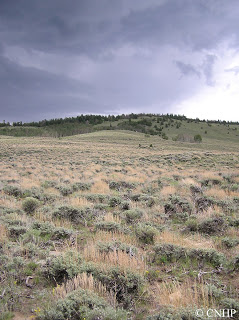
     Big sagebrush shrublands in western Colorado.

Big sagebrush shrublands are typically found in broad basins between mountain ranges, on plains and foothills. Big sagebrush shrublands are characterized by a dense stands of taller sagebrush species with a significant herbaceous understory, and are generally found at elevations from 5,000 to 7,500 feet. Taller shrubs distinguish the big sagebrush shrubland ecological system from the montane sagebrush steppe shrublands, which are dominated by shorter sagebrush species.
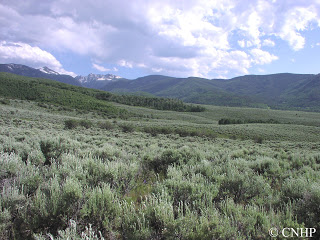
Montane sagebrush, Gunnison County, Colorado.

Montane sagebrush steppe primarily occurs on ridges, near flat ridgetops, and mountain slopes. Montane sagebrush stands are usually found at elevations from 7,000 to 10,000 feet, often adjacent to the lower elevation big sagebrush shrublands.

Sagebrush shrublands provide food and shelter for many small mammal and bird species. The most significant at-risk animal species in Colorado’s sagebrush ecosystem is the Gunnison Sage Grouse, ranked “critically imperiled” (G1S1) by the Colorado Natural Heritage Program, and listed as a Tier 1 Species of Greatest Conservation need by the Colorado Division of Wildlife. Other Tier 1 Species of Greatest Conservation Need that are found exclusively (or almost exclusively) in sagebrush habitats are Greater Sage Grouse, Brewer’s Sparrow and Sage Sparrow. In addition, several of Colorado’s rarest plants are found primarily in sagebrush habitats. These include the federally listed (Endangered) Osterhout’s milkvetch, as well as several other globally rare members of the milkvetch family (Gunnison milkvetch, violet milkvetch, and skiff milkvetch). Other rare Colorado plants that are most commonly found in sagebrush habitats are the globally rare narrow-leaf evening primrose, Bessey locoweed, Fremont’s beardtongue, and Harrington’s beardtongue.

Many of Colorado’s sagebrush shrublands are vulnerable to changes induced by domestic livestock grazing. Over the past century the condition of much of Colorado’s sagebrush shrubland has been degraded due to fire suppression and heavy livestock grazing. Although many livestock operations are now more sensitive in their treatment of sagebrush habitats than they once were, recovery in these systems is slow. Furthermore, many remaining sagebrush patches are now being fragmented by fast-paced and widespread energy development.
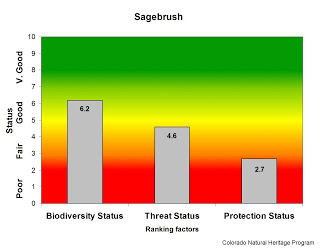
Overall biodiversity, threat, and protection status scores for sagebrush shrubland in Colorado.
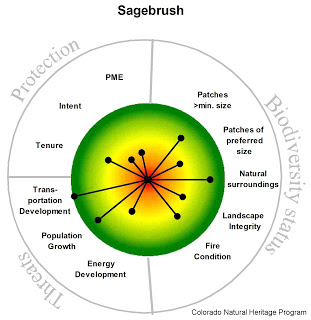
 A “windrose” graph depicting sagebrush status for individual scoring factors.

SHARE
FACEBOOK
TWITTER
LINKEDIN
REDDIT
EMAIL
Filed Under: Biodiversity Scorecard, Conservation Planning, Ecology

Potential ACEC designation for three endangered plant species
Cool Climate Collaboration

About Us

About Us
Conserving Biodiversity
Contact Us
Staff Directory
Careers
Employment
Internship
Volunteer
Meetings
The NatureServe Network
Partners

Our Work

Ecology
Wetlands
Plants
Animals
Climate Change
Education
Invasive Species

Blog Archive

Blog Categories

Web Projects

  • Rare Plant Guide Online
  • Colorado Wetland Info Center
  • COMaP - Colorado Protected Lands
  • Colorado Bat Working Group
  • STReaMS - Endangered Fishes Database

About Us

  • About Us
  • Conserving Biodiversity
  • Contact Us
  • Staff Directory
  • Careers
  • The NatureServe Network
  • Partners
  • Site Map
Warner College of Natural Resources Logo
  • Apply to CSU
  • Equal Opportunity
  • Disclaimer
  • Privacy Statement
  • Search CSU
  • CSU Land Acknowledgement
  • CSU Principles of Community
© 2025 Colorado Natural Heritage Program
Colorado State University Logo
  • About Us
    ▼
    • About Us
      ▼
      • Biennial Report
      • Strategic Plan
    • Conserving Biodiversity
    • Contact Us
    • Staff Directory
    • Careers
      ▼
      • Employment
      • Internship
      • Volunteer
    • Meetings
    • The NatureServe Network
    • Partners
  • Our Work
    ▼
    • Ecology
    • Wetlands
    • Plants
    • Animals
    • Climate Change
    • Education
    • Invasive Species
  • Our Services
    ▼
    • Database Development
    • GIS Analysis & Modeling
    • Mapping
    • Surveys & Inventories
    • Monitoring & Assessment
    • Conservation Planning
  • Our Data
    ▼
    • About CNHP Data
    • Request Data
    • Contribute Data
    • Download Data
    • Tracking Lists
    • PCA Reports
    • Help & Documentation
  • Maps
    ▼
    • CNHP Spatial Layers
    • Wetlands Mapper
    • COMaP
    • Conservation Environmental Review Tool
  • Library
    ▼
    • Reports
    • PCA Reports
    • Tracking Lists
    • Field Guides
      ▼
      • Rare Plant Guide
      • Colorado Wetland Field Guides
  • Blog
  • Donate Now