Colorado Natural Heritage Program Logo Colorado Natural Heritage Program Logo CNHP
  • About Us
    • About Us
      • Biennial Report
      • Strategic Plan
    • Conserving Biodiversity
    • Contact Us
    • Staff Directory
    • Careers
      • Employment
      • Internship
      • Volunteer
    • Meetings
    • The NatureServe Network
    • Partners
  • Our Work
    • Ecology
    • Wetlands
    • Plants
    • Animals
    • Climate Change
    • Education
    • Invasive Species
  • Our Services
    • Database Development
    • GIS Analysis & Modeling
    • Mapping
    • Surveys & Inventories
    • Monitoring & Assessment
    • Conservation Planning
  • Our Data
    • About CNHP Data
    • Request Data
    • Contribute Data
    • Download Data
    • Tracking Lists
    • PCA Reports
    • Help & Documentation
  • Maps
    • CNHP Spatial Layers
    • Wetlands Mapper
    • COMaP
    • Conservation Environmental Review Tool
  • Library
    • Reports
    • PCA Reports
    • Tracking Lists
    • Field Guides
      • Rare Plant Guide
      • Colorado Wetland Field Guides
  • Blog
  • Donate Now

Southeast Colorado Canyon Country Views

March 16, 2011

On February 28th, CNHP Director Dave Anderson, Ecologist/ Conservation Planner Renée Rondeau, and FWCB Department Head Ken Wilson flew with Steve Paul, a volunteer pilot with Lighthawk, a non-profit group that volunteers their flight services to conservation groups throughout the U.S.
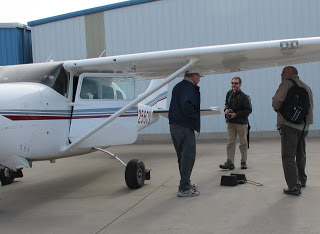
Steve, Dave, and Ken getting ready to fly.

CNHP has been working in Southeast Colorado since 2007 when we conducted a biological inventory of the area. The results of that inventory have kept CNHP involved with the ranching community as they develop management and conservation plans to maintain biological integrity while making a viable living from ranching. Southeast Colorado provides a dramatic contrast to most of the rest of Colorado’s eastern plains, which are dominated by tilled agricultural fields. The majority of the landscape is privately owned, with with little to no formal protection, and it supports a rich and diverse flora and fauna that merits conservation. The core of the area that we flew over was the canyon country of the Purgatoire River and Chacuaco Canyon, where perennial streams support native fishes and do not have any exotic species.

We first flew south along the mountain front from Broomfield – getting great views of the interface between the prairie and the high peaks.
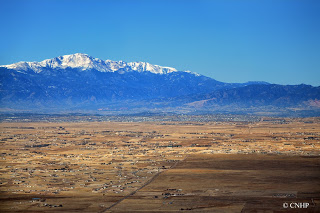
Pikes Peak overlooks the eastern plains.

Prairie fragmentation close to the Front Range was obvious from our 9,000 foot elevation, but as we moved out into the plains we flew over large unfragmented grassland landscapes with the occasional small river breaking up the scenery Although the grass is still dormant at this time of year, the large landscape really caught our attention.
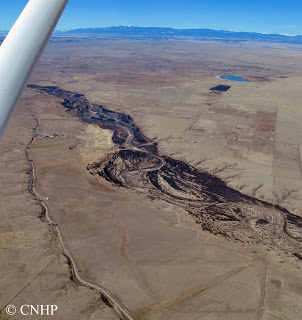
 View of the Huerferno River

After about an hour we started seeing small white hills with juniper trees dotting the prairie. These shale barren hills are important Colorado rare plant habitat, where Oenothera harringtonii, Oonopsis foliosa var. monocephala, Lesquerella parviflora, Asclepias macrotis, and occasionally, Oxybaphus rotundifolius are found.
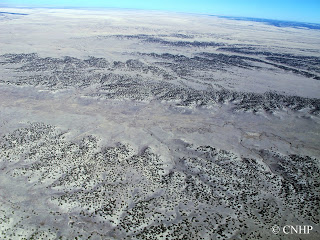
Shale barren habitat.

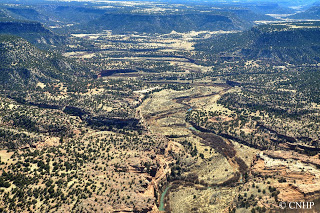
Soon the Purgatoire Canyon Country came into view. Even our pilot was surprised to find the “boring” prairie dissected by these red rock canyons. I knew we had found something exciting when Steve Paul took out his camera and started flying hands-free while taking pictures! Comments about the astounding scenery, the quality of the lands, the beauty of the rocks, and the abundant mesas were common throughout this part of the flight. This rapid view of such an expansive and little known landscape gave all of us an appreciation of the uniqueness of this area. Surrounded by shortgrass prairie, these canyonlands are like an oasis for many large mammal species that we seldom associate with grasslands, such as black bear, big horn sheep, and elk.
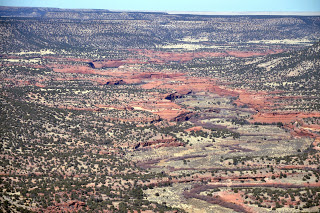
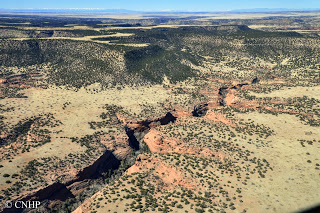
Canyon views.

The return flight was quite an experience, given the turbulent air that is often associated with the Front Range. Can you say BUMPY? Dave and Renée were very grateful to get their feet back on stable ground but Steve Paul and Ken Wilson hardly took note of the rough flight. We are grateful to have had yet another marvelous opportunity to work with Lighthawk, whose generous assistance has provided CNHP and FWCB with a greater appreciation for the conservation value of southeast Colorado.
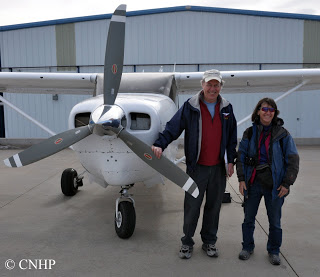

 Steve & Renée – back on the ground.

SHARE
FACEBOOK
TWITTER
LINKEDIN
REDDIT
EMAIL
Filed Under: Collaborations, Conservation Planning, County Inventory

Welcome new wetland team members!
Ecological Systems: Shrub-Steppe

About Us

About Us
Conserving Biodiversity
Contact Us
Staff Directory
Careers
Employment
Internship
Volunteer
Meetings
The NatureServe Network
Partners

Our Work

Ecology
Wetlands
Plants
Animals
Climate Change
Education
Invasive Species

Blog Archive

Blog Categories

Web Projects

  • Rare Plant Guide Online
  • Colorado Wetland Info Center
  • COMaP - Colorado Protected Lands
  • Colorado Bat Working Group
  • STReaMS - Endangered Fishes Database

About Us

  • About Us
  • Conserving Biodiversity
  • Contact Us
  • Staff Directory
  • Careers
  • The NatureServe Network
  • Partners
  • Site Map
Warner College of Natural Resources Logo
  • Apply to CSU
  • Equal Opportunity
  • Disclaimer
  • Privacy Statement
  • Search CSU
  • CSU Land Acknowledgement
  • CSU Principles of Community
© 2026 Colorado Natural Heritage Program
Colorado State University Logo
  • About Us
    ▼
    • About Us
      ▼
      • Biennial Report
      • Strategic Plan
    • Conserving Biodiversity
    • Contact Us
    • Staff Directory
    • Careers
      ▼
      • Employment
      • Internship
      • Volunteer
    • Meetings
    • The NatureServe Network
    • Partners
  • Our Work
    ▼
    • Ecology
    • Wetlands
    • Plants
    • Animals
    • Climate Change
    • Education
    • Invasive Species
  • Our Services
    ▼
    • Database Development
    • GIS Analysis & Modeling
    • Mapping
    • Surveys & Inventories
    • Monitoring & Assessment
    • Conservation Planning
  • Our Data
    ▼
    • About CNHP Data
    • Request Data
    • Contribute Data
    • Download Data
    • Tracking Lists
    • PCA Reports
    • Help & Documentation
  • Maps
    ▼
    • CNHP Spatial Layers
    • Wetlands Mapper
    • COMaP
    • Conservation Environmental Review Tool
  • Library
    ▼
    • Reports
    • PCA Reports
    • Tracking Lists
    • Field Guides
      ▼
      • Rare Plant Guide
      • Colorado Wetland Field Guides
  • Blog
  • Donate Now