Colorado Natural Heritage Program Logo Colorado Natural Heritage Program Logo CNHP
  • About Us
    • About Us
      • Biennial Report
      • Strategic Plan
    • Conserving Biodiversity
    • Contact Us
    • Staff Directory
    • Careers
      • Employment
      • Internship
      • Volunteer
    • Meetings
    • The NatureServe Network
    • Partners
  • Our Work
    • Ecology
    • Wetlands
    • Plants
    • Animals
    • Climate Change
    • Education
    • Invasive Species
  • Our Services
    • Database Development
    • GIS Analysis & Modeling
    • Mapping
    • Surveys & Inventories
    • Monitoring & Assessment
    • Conservation Planning
  • Our Data
    • About CNHP Data
    • Request Data
    • Contribute Data
    • Download Data
    • Tracking Lists
    • PCA Reports
    • Help & Documentation
  • Maps
    • CNHP Spatial Layers
    • Wetlands Mapper
    • COMaP
    • Conservation Environmental Review Tool
  • Library
    • Reports
    • PCA Reports
    • Tracking Lists
    • Field Guides
      • Rare Plant Guide
      • Colorado Wetland Field Guides
  • Blog
  • Donate Now

Ecological Systems: Salt Shrub

January 21, 2011

example of salt shrub

Salt shrubland ecosystem types are typically dominated by saltbush species or other shrubs tolerant of saline or alkaline soils typically derived from marine shales, siltstones and clay. These sparse to moderately dense low-growing shrublands are widespread at lower elevations (generally from 4,500 to 7,000 feet) in Colorado’s western valleys, and are also found in more limited distribution in the southern part of the eastern plains. In addition to mid-height and dwarf saltbush species, the shrub layer may include winterfat, wolfberry, horsebrush, and sagebrush species. Grasses and forbs are generally sparse, and dominated by species tolerant of these harsh soils. Some areas are essentially barren, or very sparsely vegetated.

These arid habitats support desert species such as the lesser earless lizard, desert spiney lizard, and the common kingsnake, but provide limited food and cover for mammal or bird species. White-tailed prairie dogs may be found in areas with sufficient vegetation. These barren and sparse shrubland habitats of shaley soils are one of the most important for Colorado’s rare plants, including the federally listed endangered wild clay-loving buckwheat, and the threatened Mesa Verde cactus and Colorado hookless cactus.

Holbrookia maculata
The lesser earless lizard (Holbrookia maculata)

Sclerocactus mesae-verde
The Sclerocactus mesae-verde (Mesa Verde cactus) in bloom

Salt shrublands cover more than 750,000 acres in Colorado, primarily on federal lands managed by the Bureau of Land Management, and the remainder on private or tribal lands. Protection of these habitats is weak; few salt shrublands are within protected areas with special management in place. A substantial portion of these shrublands have been converted to agricultural use in valley bottoms where irrigation is available. Because remaining occurrances are generally not productive agricultural or ranching lands many are in good condition. Impacts and fragmentation from energy development are the most current threats to this type.
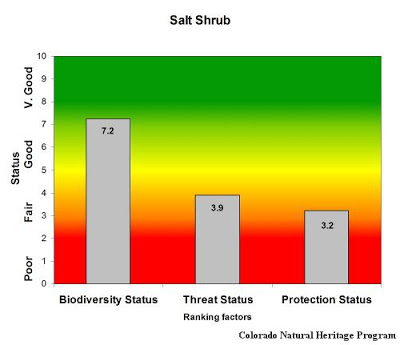
Overall biodiversity, threat, and protection status scores for salt shrub in Colorado.

A “windrose” graph depicting salt shrub status for individual scoring factors.

SHARE
FACEBOOK
TWITTER
LINKEDIN
REDDIT
EMAIL
Filed Under: Biodiversity Scorecard, Conservation Planning, Ecology

Pressed for Success
Supporting Students

About Us

About Us
Conserving Biodiversity
Contact Us
Staff Directory
Careers
Employment
Internship
Volunteer
Meetings
The NatureServe Network
Partners

Our Work

Ecology
Wetlands
Plants
Animals
Climate Change
Education
Invasive Species

Blog Archive

Blog Categories

Web Projects

  • Rare Plant Guide Online
  • Colorado Wetland Info Center
  • COMaP - Colorado Protected Lands
  • Colorado Bat Working Group
  • STReaMS - Endangered Fishes Database

About Us

  • About Us
  • Conserving Biodiversity
  • Contact Us
  • Staff Directory
  • Careers
  • The NatureServe Network
  • Partners
  • Site Map
Warner College of Natural Resources Logo
  • Apply to CSU
  • Equal Opportunity
  • Disclaimer
  • Privacy Statement
  • Search CSU
  • CSU Land Acknowledgement
  • CSU Principles of Community
© 2026 Colorado Natural Heritage Program
Colorado State University Logo
  • About Us
    ▼
    • About Us
      ▼
      • Biennial Report
      • Strategic Plan
    • Conserving Biodiversity
    • Contact Us
    • Staff Directory
    • Careers
      ▼
      • Employment
      • Internship
      • Volunteer
    • Meetings
    • The NatureServe Network
    • Partners
  • Our Work
    ▼
    • Ecology
    • Wetlands
    • Plants
    • Animals
    • Climate Change
    • Education
    • Invasive Species
  • Our Services
    ▼
    • Database Development
    • GIS Analysis & Modeling
    • Mapping
    • Surveys & Inventories
    • Monitoring & Assessment
    • Conservation Planning
  • Our Data
    ▼
    • About CNHP Data
    • Request Data
    • Contribute Data
    • Download Data
    • Tracking Lists
    • PCA Reports
    • Help & Documentation
  • Maps
    ▼
    • CNHP Spatial Layers
    • Wetlands Mapper
    • COMaP
    • Conservation Environmental Review Tool
  • Library
    ▼
    • Reports
    • PCA Reports
    • Tracking Lists
    • Field Guides
      ▼
      • Rare Plant Guide
      • Colorado Wetland Field Guides
  • Blog
  • Donate Now