Colorado Natural Heritage Program Logo Colorado Natural Heritage Program Logo CNHP
  • About Us
    • About Us
      • Biennial Report
      • Strategic Plan
    • Conserving Biodiversity
    • Contact Us
    • Staff Directory
    • Careers
      • Employment
      • Internship
      • Volunteer
    • Meetings
    • The NatureServe Network
    • Partners
  • Our Work
    • Ecology
    • Wetlands
    • Plants
    • Animals
    • Climate Change
    • Education
    • Invasive Species
  • Our Services
    • Database Development
    • GIS Analysis & Modeling
    • Mapping
    • Surveys & Inventories
    • Monitoring & Assessment
    • Conservation Planning
  • Our Data
    • About CNHP Data
    • Request Data
    • Contribute Data
    • Download Data
    • Tracking Lists
    • PCA Reports
    • Help & Documentation
  • Maps
    • CNHP Spatial Layers
    • Wetlands Mapper
    • COMaP
    • Conservation Environmental Review Tool
  • Library
    • Reports
    • PCA Reports
    • Tracking Lists
    • Field Guides
      • Rare Plant Guide
      • Colorado Wetland Field Guides
  • Blog
  • Donate Now

Ecological Systems: Aspen Forests

November 9, 2010

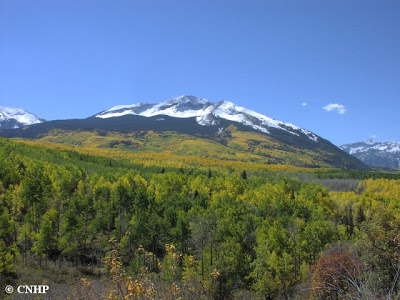
This widespread ecological system occurs throughout much of the western U.S. and north into Canada, although it is more common in the montane and subalpine zones of the southern and central Rocky Mountains. Aspen forests cover more than three and a half million acres in Colorado, including one patch of over half a million acres blanketing the edges of the White River Plateau and Flat Tops. Many people don’t realize that aspen trees form clumps of clones by suckering from underground root systems. Often what appears to be a stand of many trees is actually only one individual tree with many stems. This survival strategy makes aspen well-suited to re-sprouting after large-scale disturbances such as the forest fires that can be so common in some Colorado summers.

Rarity in Aspen Forests

Aspen forests are one of our most species-rich ecosystems. Most of the species that call aspen forests home are relatively abundant and not of significant conservation concern. Rarer species of this system include: purple martin, northern goshawk, Cassin’s finch, olive-sided flycatcher, flammulated owl, and dwarf shrew.

Conservation

Overall, aspen forests in Colorado are in good condition and moderately well conserved. Much of Colorado’s aspen forest is owned and managed by the U.S. Forest Service. This system is not as well represented in the nation’s Wilderness system as the alpine and spruce-fir ecological systems. Primary human activities in this ecological system include cattle and sheep grazing, recreation, and hunting. Some aspen stands are cut for pulp mills (for the making of composite boards such as plywood). Threats to the aspen forests ecological system are comparatively low. However, in some areas of the state, sudden die-offs of aspen stands have been observed. The cause(s) of this die-off are unclear and research is on-going. Currently, sudden aspen death is not widely distributed across the state, but there is potential for this condition to pose a more significant threat to our aspen forests in the future.
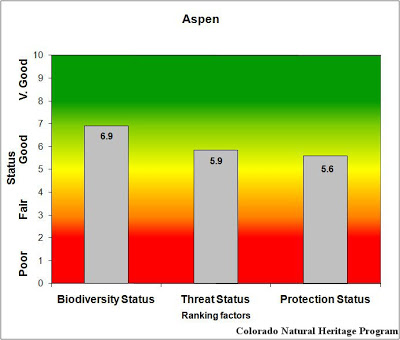
Overall biodiversity, threat, and protection status scores for aspen in Colorado.

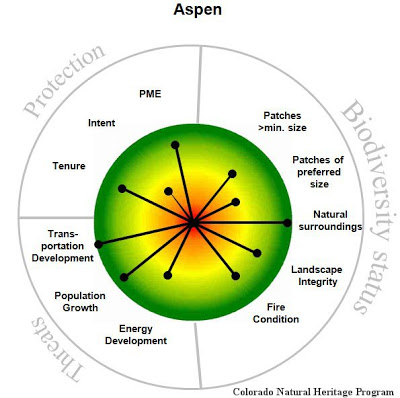
A “windrose” graph depicting aspen status for individual scoring factors.

SHARE
FACEBOOK
TWITTER
LINKEDIN
REDDIT
EMAIL
Filed Under: Biodiversity Scorecard, Conservation Planning, Ecology

CNHP in the November/December issue of the National Wetlands Newsletter
Job Opportunity: Center for Collaborative Conservation Associate Director

About Us

About Us
Conserving Biodiversity
Contact Us
Staff Directory
Careers
Employment
Internship
Volunteer
Meetings
The NatureServe Network
Partners

Our Work

Ecology
Wetlands
Plants
Animals
Climate Change
Education
Invasive Species

Blog Archive

Blog Categories

Web Projects

  • Rare Plant Guide Online
  • Colorado Wetland Info Center
  • COMaP - Colorado Protected Lands
  • Colorado Bat Working Group
  • STReaMS - Endangered Fishes Database

About Us

  • About Us
  • Conserving Biodiversity
  • Contact Us
  • Staff Directory
  • Careers
  • The NatureServe Network
  • Partners
  • Site Map
Warner College of Natural Resources Logo
  • Apply to CSU
  • Equal Opportunity
  • Disclaimer
  • Privacy Statement
  • Search CSU
  • CSU Land Acknowledgement
  • CSU Principles of Community
© 2026 Colorado Natural Heritage Program
Colorado State University Logo
  • About Us
    ▼
    • About Us
      ▼
      • Biennial Report
      • Strategic Plan
    • Conserving Biodiversity
    • Contact Us
    • Staff Directory
    • Careers
      ▼
      • Employment
      • Internship
      • Volunteer
    • Meetings
    • The NatureServe Network
    • Partners
  • Our Work
    ▼
    • Ecology
    • Wetlands
    • Plants
    • Animals
    • Climate Change
    • Education
    • Invasive Species
  • Our Services
    ▼
    • Database Development
    • GIS Analysis & Modeling
    • Mapping
    • Surveys & Inventories
    • Monitoring & Assessment
    • Conservation Planning
  • Our Data
    ▼
    • About CNHP Data
    • Request Data
    • Contribute Data
    • Download Data
    • Tracking Lists
    • PCA Reports
    • Help & Documentation
  • Maps
    ▼
    • CNHP Spatial Layers
    • Wetlands Mapper
    • COMaP
    • Conservation Environmental Review Tool
  • Library
    ▼
    • Reports
    • PCA Reports
    • Tracking Lists
    • Field Guides
      ▼
      • Rare Plant Guide
      • Colorado Wetland Field Guides
  • Blog
  • Donate Now