Colorado Natural Heritage Program Logo Colorado Natural Heritage Program Logo CNHP
  • About Us
    • About Us
      • Biennial Report
      • Strategic Plan
    • Conserving Biodiversity
    • Contact Us
    • Staff Directory
    • Careers
      • Employment
      • Internship
      • Volunteer
    • Meetings
    • The NatureServe Network
    • Partners
  • Our Work
    • Ecology
    • Wetlands
    • Plants
    • Animals
    • Climate Change
    • Education
    • Invasive Species
  • Our Services
    • Database Development
    • GIS Analysis & Modeling
    • Mapping
    • Surveys & Inventories
    • Monitoring & Assessment
    • Conservation Planning
  • Our Data
    • About CNHP Data
    • Request Data
    • Contribute Data
    • Download Data
    • Tracking Lists
    • PCA Reports
    • Help & Documentation
  • Maps
    • CNHP Spatial Layers
    • Wetlands Mapper
    • COMaP
    • Conservation Environmental Review Tool
  • Library
    • Reports
    • PCA Reports
    • Tracking Lists
    • Field Guides
      • Rare Plant Guide
      • Colorado Wetland Field Guides
  • Blog
  • Donate Now

Ecological systems: Spruce-Fir Forests

August 10, 2010

Spruce-Fir

These high elevation forests cover about 5% of Colorado’s landscape, and are characterized by dense stands of Engelmann spruce and subalpine fir. This is one of the few Colorado forest types that is not fire-adapted – the typical fire return frequency is around 400 years! Areas with spruce-fir forest typically receive a lot of precipitation in the form of snowfall and frequent summer showers, but droughts can occur. During drought periods the stressed trees become susceptible to spruce-bud worm outbreaks, which can kill entire hillsides of trees in one summer. In the early 20th century, much of Colorado’s old-growth spruce-fir was cut for timber.

Species characteristic of these heavily wood habitats include pine marten, lynx, red squirrel, snowshoe hare, boreal owls, elk, grey jay, and Clark’s nutcracker. Although much of this system is now made up of younger trees, it is still possible to find very old widely-spaced trees with yellow bark and snags and downed trees that create perfect habitat for cavity-nesting birds and pine martens.

Clark's nutcracker
Clark’s nutcracker.

pine martin
A pine martin tries to avoid having its picture taken.

Although forest habitats including spruce-fir occupy over 20% of Colorado’s landscape, few rare species are found in these habitats. Boreal toads were once a common species in small wetlands within high altitude coniferous forests in the Colorado Rockies. Today very few healthy populations exist; most have apparently succumbed to chytrid fungus infestation. Lynx and boreal owls spend most of their time in or near large stands of spruce-fir forests.
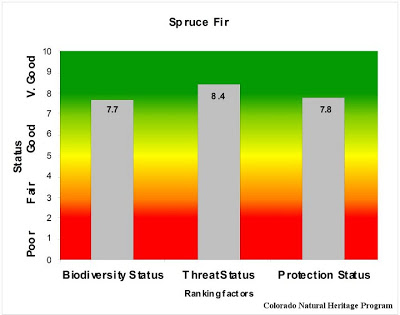
Overall biodiversity, threat, and protection status scores for spruce-fir in Colorado.

As with alpine tundra, Most of spruce-fir forests in Colorado are federally owned and managed by the U.S. Forest Service, with a significant proportion in wilderness status. In general, spruce-fir forests in Colorado are healthy, intact, and well protected. Although this ecological system is heavily used for recreation and other human activities, its overall threat status is generally low. Global climate change may have significant impacts on this system in the future.


A “windrose” graph depicting spruce-fir status for individual scoring factors.

SHARE
FACEBOOK
TWITTER
LINKEDIN
REDDIT
EMAIL
Filed Under: Biodiversity Scorecard, Conservation Planning, Ecology

Rare Plant Conservation Initiative CAP meeting: Gateway
Data on website updated for 2010

About Us

About Us
Conserving Biodiversity
Contact Us
Staff Directory
Careers
Employment
Internship
Volunteer
Meetings
The NatureServe Network
Partners

Our Work

Ecology
Wetlands
Plants
Animals
Climate Change
Education
Invasive Species

Blog Archive

Blog Categories

Web Projects

  • Rare Plant Guide Online
  • Colorado Wetland Info Center
  • COMaP - Colorado Protected Lands
  • Colorado Bat Working Group
  • STReaMS - Endangered Fishes Database

About Us

  • About Us
  • Conserving Biodiversity
  • Contact Us
  • Staff Directory
  • Careers
  • The NatureServe Network
  • Partners
  • Site Map
Warner College of Natural Resources Logo
  • Apply to CSU
  • Equal Opportunity
  • Disclaimer
  • Privacy Statement
  • Search CSU
  • CSU Land Acknowledgement
  • CSU Principles of Community
© 2026 Colorado Natural Heritage Program
Colorado State University Logo
  • About Us
    ▼
    • About Us
      ▼
      • Biennial Report
      • Strategic Plan
    • Conserving Biodiversity
    • Contact Us
    • Staff Directory
    • Careers
      ▼
      • Employment
      • Internship
      • Volunteer
    • Meetings
    • The NatureServe Network
    • Partners
  • Our Work
    ▼
    • Ecology
    • Wetlands
    • Plants
    • Animals
    • Climate Change
    • Education
    • Invasive Species
  • Our Services
    ▼
    • Database Development
    • GIS Analysis & Modeling
    • Mapping
    • Surveys & Inventories
    • Monitoring & Assessment
    • Conservation Planning
  • Our Data
    ▼
    • About CNHP Data
    • Request Data
    • Contribute Data
    • Download Data
    • Tracking Lists
    • PCA Reports
    • Help & Documentation
  • Maps
    ▼
    • CNHP Spatial Layers
    • Wetlands Mapper
    • COMaP
    • Conservation Environmental Review Tool
  • Library
    ▼
    • Reports
    • PCA Reports
    • Tracking Lists
    • Field Guides
      ▼
      • Rare Plant Guide
      • Colorado Wetland Field Guides
  • Blog
  • Donate Now