

Scientific Name : Thelypodiopsis juniperorum
Author : (Payson) Rydb. NatureServe Explorer
Common Name : Juniper Tumble Mustard
 Current Research Activities


☰ Click link below for details.
Taxonomy
Brassicaceae (mustard family)
Ranks and Status
State Rank : S2
State Rank Reason : Thelypodiopsis juniperorum is a Colorado endemic known four counties in western Colorado, USA. There are 18 occurrences in Colorado as of 2023, however 12 have not been observed in over 20 years and are considered historical. Threats include grazing, off-road vehicle use, non-native species invasion, energy development, and fire suppression. Thelypodiopsis juniperorum is also considered to be extremely vulnerable to the effects of climate change.
U.S. Endangered Species Act : none
Colorado Threatened and Endangered List : none
Other Statuses : SWAP SGIN
Description and Phenology
General Description:
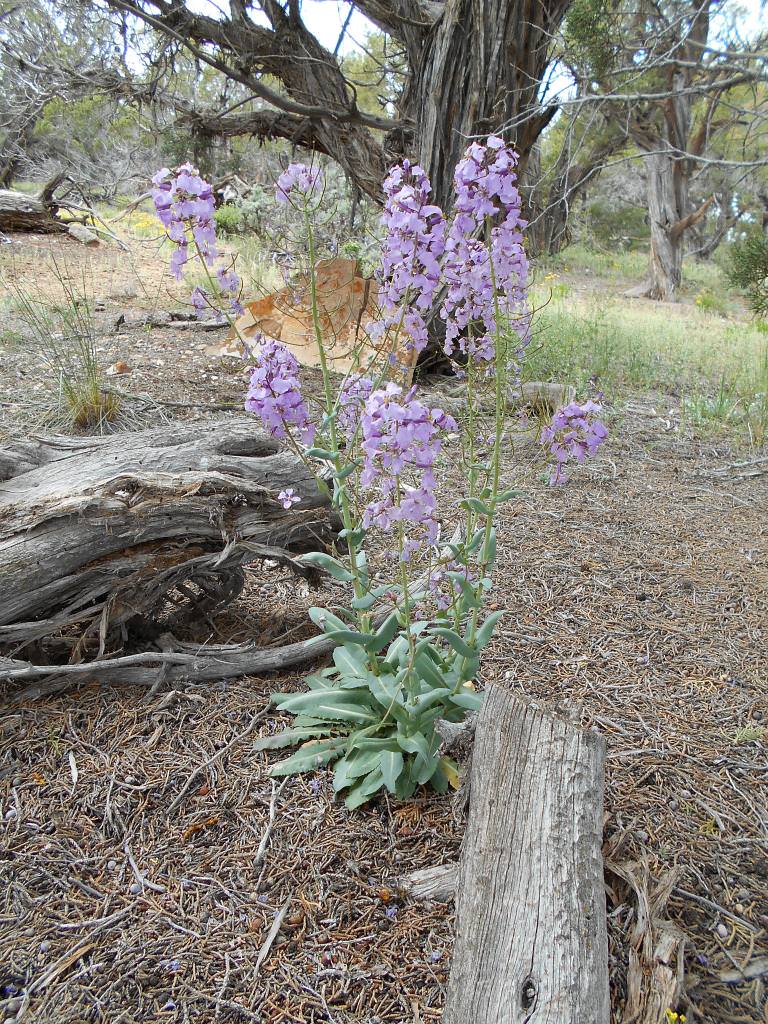
Thelypodiopsis juniperorum is a slender annual, 3-10 dm tall, with a single erect stem or with several branches arising from the base (Rollins 1993). Payson (1922) wrote that T. juniperorum is an annual or perennial, but all subsequent descriptions have stated that it is only an annual. However, some specimens have rather stout roots and many dead leaves giving them the appearance of a biennial, or perhaps a winter annual. The basal leaves are 5-15 cm long (sometimes smaller), entire or irregularly dentate, with a winged petiole (Rollins 1993). The fruit of T. juniperorum is a silique, which in the Brassicaceae is a long, slender almost terete (round) structure. The ascending siliques of T. juniperorum are approximately 1 mm in diameter and 5-9 cm long (Anderson 2004).
Look Alikes:
The most commonly used diagnostic characteristic is the presence of flattened hairs near the base of the stem and at the nodes. This character is useful for distinguishing Thelypodiopsis juniperorum from T. ambigua, which is glabrous throughout. It can be difficult to distinguish Thelypodiopsis juniperorum from T. elegans. The ranges of these species overlap, and T. elegans is highly polymorphic (Rollins 1982, Rollins 1993). Weber and Wittmann (2012) use flower color to distinguish T. juniperorum from T. elegans, noting that T. juniperorum has purple flowers while T. elegans has white to pink flowers. Rollins (1982 and 1993) and Rydberg (1923) also mention only purple flowers for T. juniperorum, but two specimens of T. juniperorum at the Rocky Mountain Herbarium (Payson 97 and Rollins 2110) have purple sepals and white petals. Payson (1922), in describing the species, noted that flowers could be white or purple. The length and thickness of the stipe, a stalk that attaches the fruit to the receptacle, is highly diagnostic in members of the genus Thelypodiopsis, and is used by Rollins (1993) to separate T. juniperorum from T. elegans. The stipe of members of the genus Thelypodiopsis is similar to those seen in members of the genus Stanleya and distinguishes it from many other species in the Brassicaceae. The stipe of T. juniperorum is slender and exceeds 2 mm in length, while that of T. elegans is less than 2 mm or absent, and stout (Rollins 1993). There is often considerable variation in stipe characteristics on single plants of both T. juniperorum and T. elegans, which can make it difficult to identify this species confidently. Payson (1922) notes that T. elegans can sometimes be found within 100 yards of T. juniperorum, but T. elegans is found on barren gypsiferous or ?adobe? substrates while T. juniperorum is found in more densely vegetated sites. Thus fine-scale edaphic characteristics are also useful in distinguishing T. juniperorum and T. elegans (Anderson 2004).
Phenology:
Flowering May thru June (Rollins 1993, Colorado Natural Heritage Program 2012).
Habitat
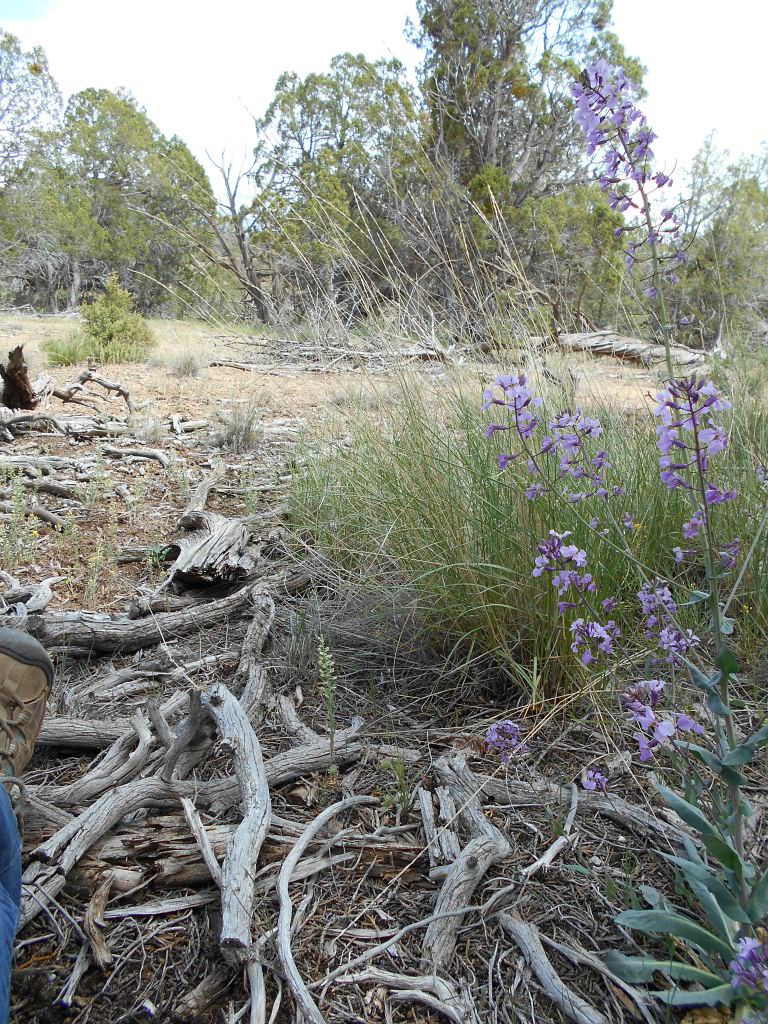
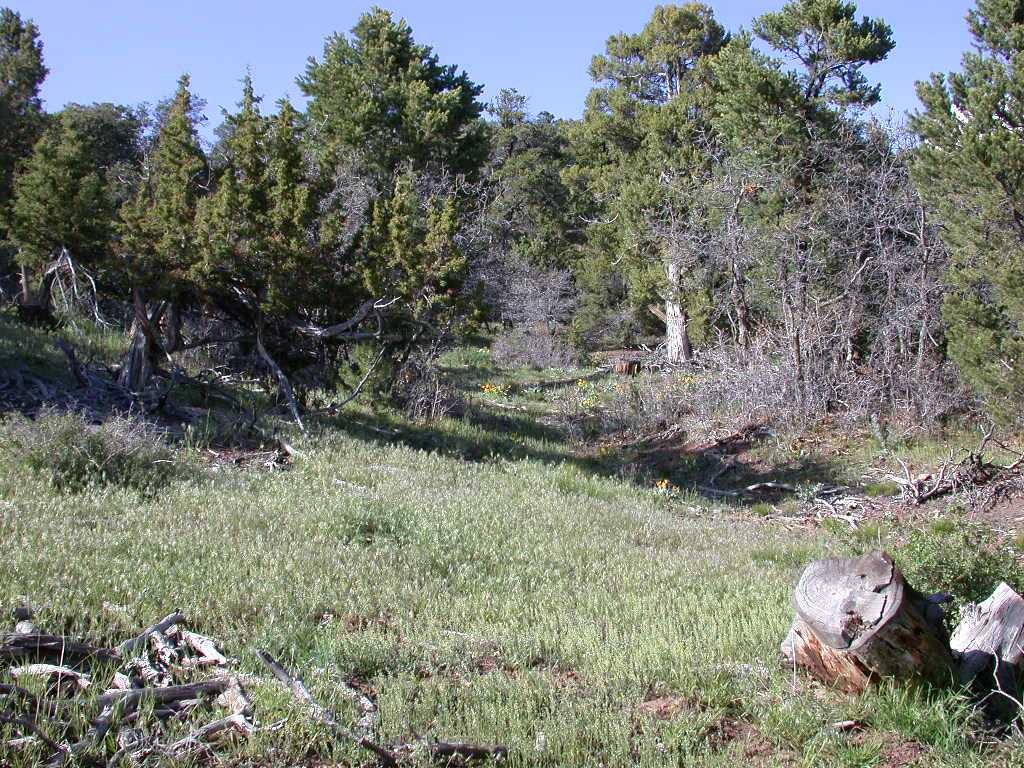
This species is found on dry hillsides, sagebrush and juniper areas, below granitic cliffs, rock slides, pinon-juniper woodlands (Rollins 1993).
click on image to enlarge
 |
Elevation Range:
4,636 - 9,534 feet (1,413 - 2,906 meters)
Distribution
Colorado Endemic:
No
Range:
Thelypodiopsis juniperorum is a Colorado, USA ,endemic and is known from Delta, Garfield, Gunnison and Montrose counties. Estimated range extent in Colorado of 5574 square kilometers was calculated in GeoCAT using occurrence data provided by the Colorado Natural Heritage Program (2023).
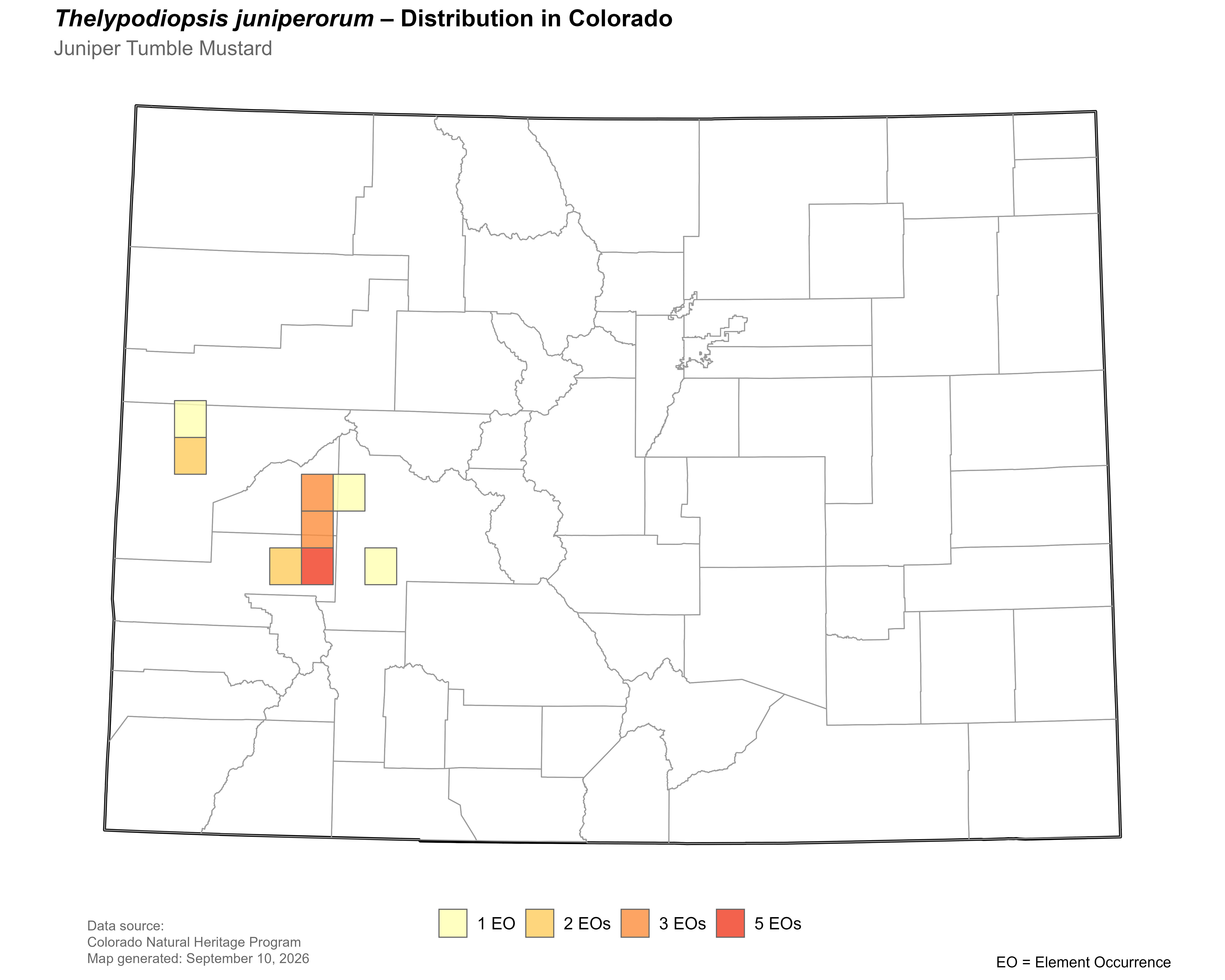
Click on map to enlarge |
Threats and Management Issues
There are several threats to T. juniperorum based on information presented in the USFS species assessment (Anderson 2004). In order of decreasing priority, these are grazing, off-road vehicle use, non-native species invasion, fire suppression, energy development, residential development, pesticide use for range management, hiking, and global climate change. These threats and the hierarchy ascribed to them are speculative due to a lack of information specific to T. juniperorum. Assessment of threats to this species will be an important component of future inventory and monitoring work (Anderson 2004). This species is considered to be extremely vulnerable to climate change (Handwerk et al. 2015).
References
- Ackerfield, J. 2015. Flora of Colorado. BRIT Press, Botanical Research Institute of Texas, Fort Worth, TX. 818 pp.
- Anderson, D.G. 2004. Thelypodiopsis juniperorum (Payson) Rydberg (juniper tumblemustard): a technical conservation assessment. Prepared for the USDA Forest Service, Rocky Mountain Region, Species Conservation Project, October 5, 2004. 43 pp. [http://www.fs.fed.us/r2/projects/scp/assessments/thelypodiopsisjuniperorum.pdf]
- Colorado Natural Heritage Program and the Geospatial Centroid. 2017. The Colorado Ownership and Protection Map (COMaP). Colorado State University, Ft. Collins, CO.
- Flora of North America Editorial Committee (FNA). 2010. Flora of North America north of Mexico. Vol. 7. Magnoliophyta: Salicaceae to Brassicaceae. Oxford University Press, New York. xxii + 797 pp.
- Handwerk, J., L. Grunau, and S. Panjabi. 2015. Colorado Wildlife Action Plan: 2015 Rare Plant Addendum. Colorado Natural Heritage Program, Colorado State University, Fort Collins, Colorado, USA.
- Lyon, P., D. Malone, B. Kuhn, and J. Handwerk. 2013. Rare plant monitoring and database development, Black Canyon of the Gunnison National Park and Curecanti National Recreation Area, 2012. Prepared for Black Canyon of the Gunnison National Park by Colorado Natural Heritage Program, February 2013. 54 pp. [http://files.cfc.umt.edu/cesu/NPS/CSU/2012/12Lyon_BLCA_CURE_monitoring_rare%20plant_rpt.pdf]
- Neely, B., S. Panjabi, E. Lane, P. Lewis, C. Dawson, A. Kratz, B. Kurzel, T. Hogan, J. Handwerk, S. Krishnan, J. Neale, and N. Ripley. 2009. Colorado Rare Plant Conservation Strategy, Developed by the Colorado Rare Plant conservation Initiative. The Nature Conservancy, Boulder, Colorado, 117 pp.
- Rollins, R.C. 1993. The Cruciferae of Continental North America:Systematics of the Mustard Family from the Arctic to Panama. Stanford University Press. Stanford, CA.
- Southwest Environmental Information Network (SEINet). 2020. Collections Databases. Online. Available: http://swbiodiversity.org/seinet/collections/index.php (accessed 2020).
- USDA, NRCS. 2022. The PLANTS Database. National Plant Data Team, Greensboro, NC 27401-4901 USA.
- Weber, W. A. and R. C. Wittmann. 2012. Colorado Flora, Western Slope, A Field Guide to the Vascular Plants, Fourth Edition. Boulder, Colorado. 532 pp.