


Scientific Name : Thalictrum heliophilum
Author : Wilken & DeMott NatureServe Explorer
Common Name : Sun- loving Meadowrue
 Current Research Activities
 1997 profile
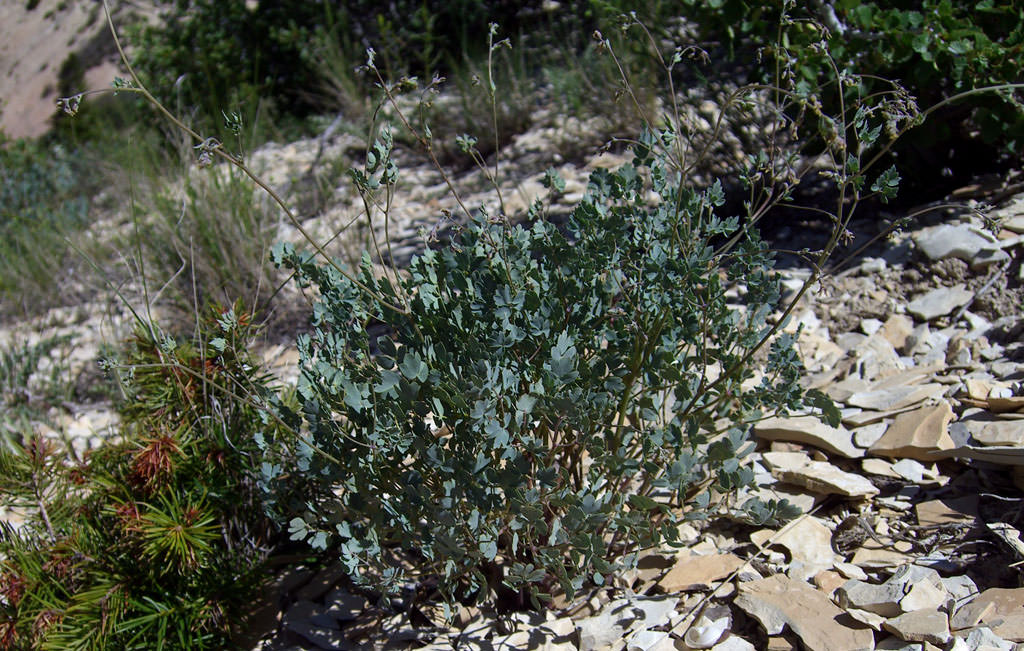
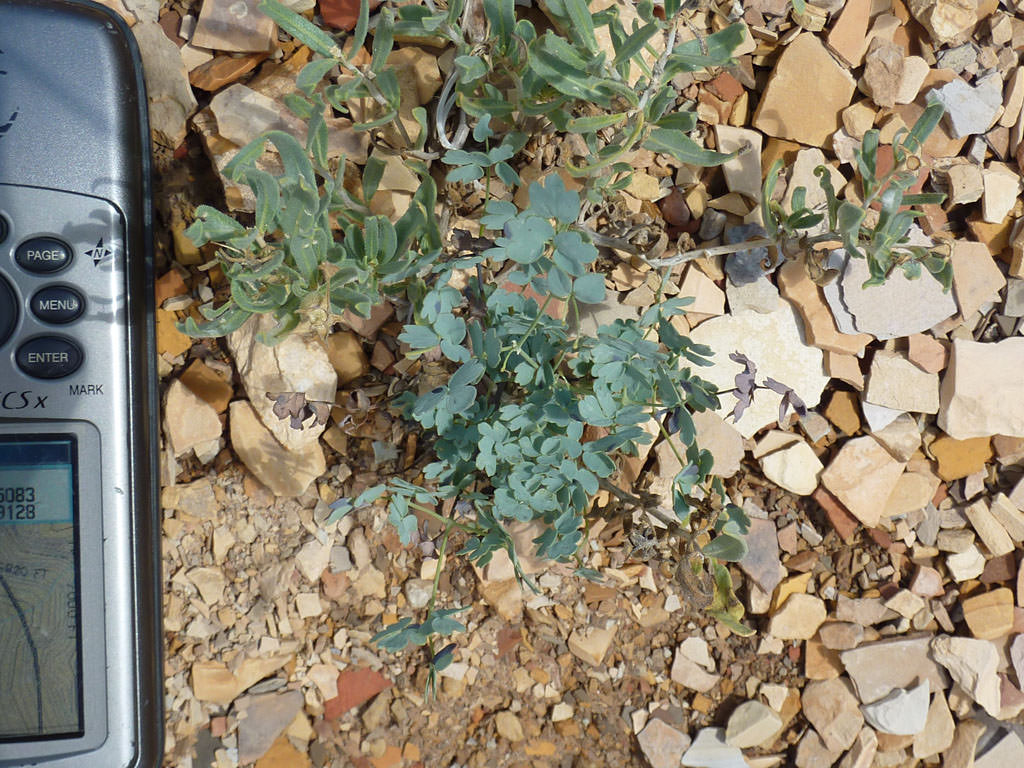
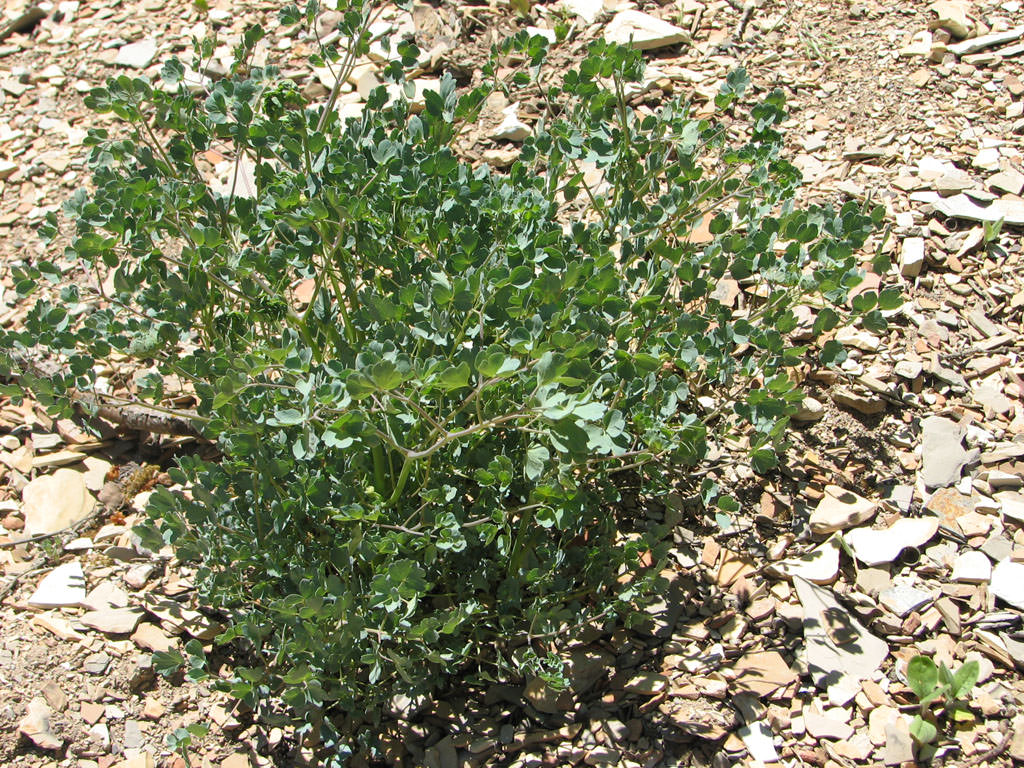


☰ Click link below for details.
Taxonomy
Ranunculaceae (buttercup family)
Ranks and Status
State Rank : S2
State Rank Reason : Thalictrum heliophilum is endemic to northwestern Colorado (USA) where it is known from 32 occurrences within a restricted habitat. Potential threats to the species include oil and gas development, rock slides, and grazing and trampling by livestock and wild ungulates. This species is also considered to be slightly to moderately vulnerable to the effects of climate change.
U.S. Endangered Species Act : none
Colorado Threatened and Endangered List : none
Other Statuses : BLM, SWAP Tier 1, USFS, USFS GMUG
Description and Phenology
General Description:
Dioecious perennial with fibrous-rooted rhizomes and several stout divergent branches to 50 cm in height. Basal and cauline leaves petiolate with ternately compound glabrous, glaucous blades; the cauline ones reduced upward. The leathery leaflets are broadly obovate, 5 to 8 mm long and 4 to 5 mm wide, and apically 3-toothed. Many-flowered panicles of apetalous flowers; nearly sessile achenes.
Look Alikes:
Thalictrum heliophilum grows in open sunny sites (heliophilum = sun loving) while most other Thalictrum spp. prefer at least some shade. Thalictrum fendleri has larger leaflets (10-17 x 8-12 mm) that are not waxy (glaucus), more pistils per flower, and occurs in aspen groves and meadows (pers. comm. Minton 1994).
Phenology:
Flowers from early June to the end of July (Scheck 1994); fruiting from July through August (Colorado Natural Heritage Program 2012).
Habitat
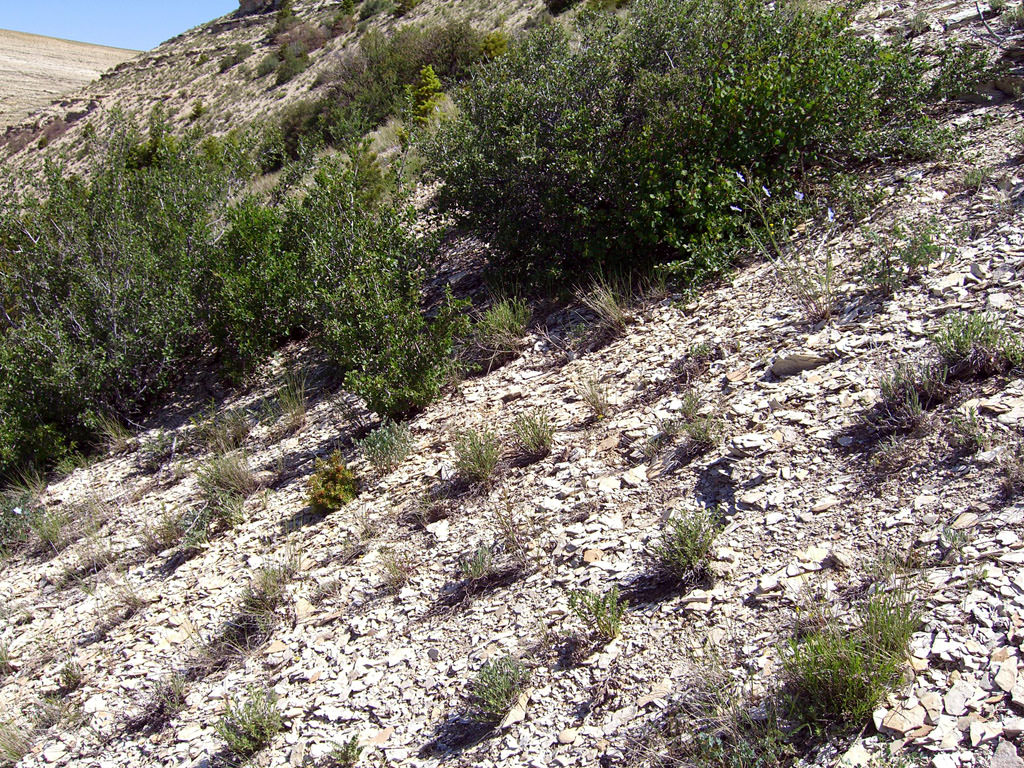
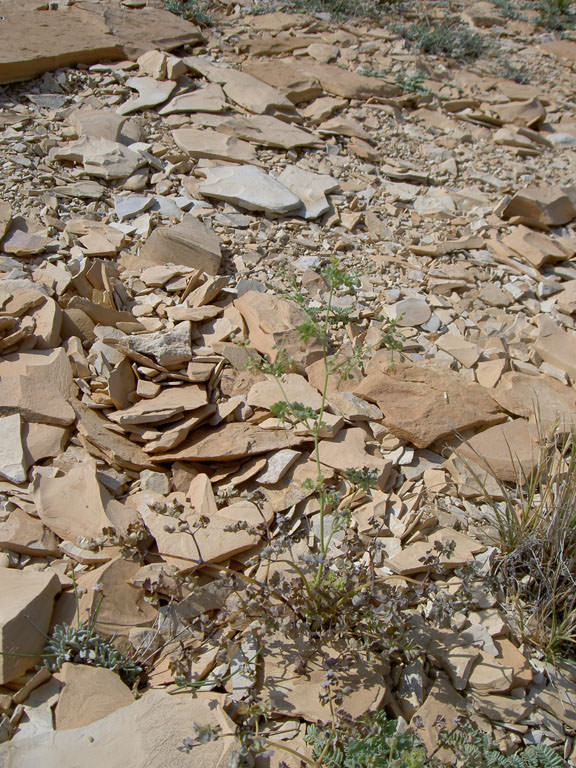
Found in open sunny sites on sparsely vegetated, dry shale slopes. Soils usually consist of Green River Shale Formation. Associated vegetation is usually very sparse, but may consist of rabbitbrush, snowberry, Astragalus lutosus, Mentzelia argillosa and Festuca dasyclada (Scheck 1994, Spackman et al. 1997).
click on image to enlarge
 |
 |
Elevation Range:
6,171 - 8,910 feet (1,881 - 2,716 meters)
Distribution
Colorado Endemic:
Yes
Range:
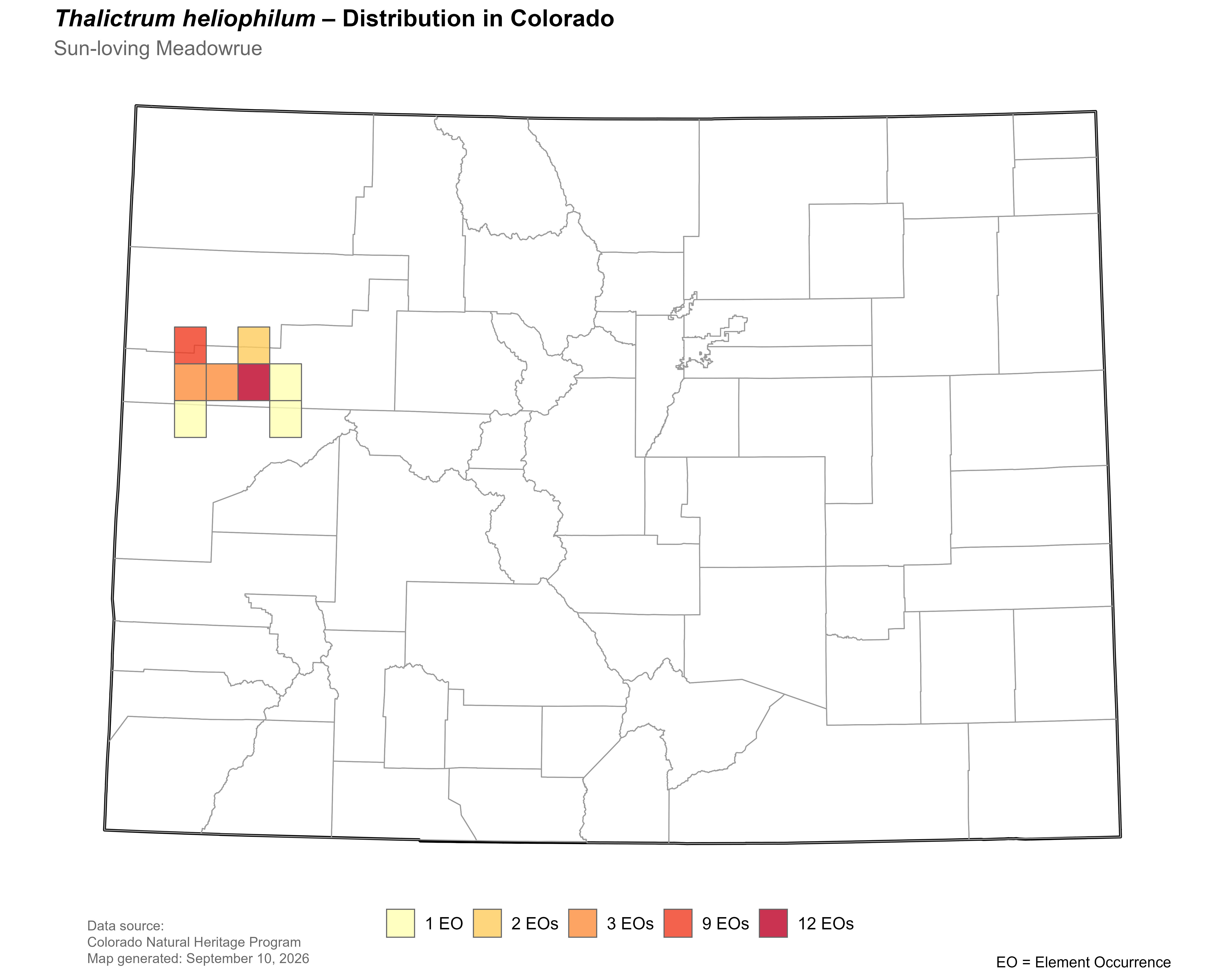
Thalictrum heliophilum is a Colorado (USA) endemic that is known only from Garfield, Mesa, and Rio Blanco counties in northwestern Colorado. Estimated range extent in Colorado of 1791 square kilometers was calculated in GeoCAT using occurrence data provided by the Colorado Natural Heritage Program (2023).
Click on map to enlarge |
Threats and Management Issues
Much of the species range is leased for oil shale mining and oil and gas development, and this is considered as the primary threat to this species, although the time frame is unknown. The species is also threatened by inappropriate livestock grazing, and browsing and trampling by native ungulates, specifically elk (Panjabi and Anderson 2007), although much of its habitat is relatively inaccessible reducing the severity of these threats. However, the steep shale slopes on which this species occurs is subject to landslides that may uproot plants. Long-term drought is widespread throughout this species range.Thalictrum heliophilum is considered to have moderate adaptive capacity and is expected to be slightly to moderately vulnerable to climate change under both RCP 4.5 and 8.5 scenarios, as assessed for the 2025 Colorado State Wildlife Action Plan (CNHP 2025).
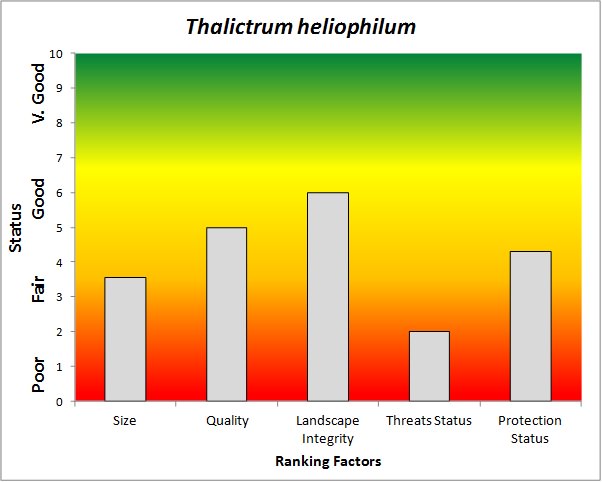
Summary results of an analysis of the status of Thalictrum heliophilum based on several ranking factors. This species was concluded to be weakly conserved. From Rondeau et al. 2011. |
References
- Ackerfield, J. 2015. Flora of Colorado. BRIT Press, Botanical Research Institute of Texas, Fort Worth, TX. 818 pp.
- Colorado Natural Heritage Program (CNHP). 2023. Biodiversity Tracking and Conservation System (Biotics 5). Colorado Natural Heritage Program, Colorado State University, Fort Collins.
- Colorado Natural Heritage Program (CNHP). 2025. Climate Change Vulnerability Assessment of Colorado Tier 1 and Tier 2 Plant Species of Greatest Conservation Need (SCGN) for the 2025 Colorado State Wildlife Action Plan. Colorado Natural Heritage Program, Colorado State University, Fort Collins.
- Elliott, B. A., S. Spackman Panjabi, B. Kurzel, B. Neely, R. Rondeau, M. Ewing. 2009. Recommended Best Management Practices for Plants of Concern. Practices developed to reduce the impacts of oil and gas development activities to plants of concern. Unpublished report prepared by the Rare Plant Conservation Initiative for the National Fish and Wildlife Foundation.
- Handwerk, J., L. Grunau, and S. Panjabi. 2015. Colorado Wildlife Action Plan: 2015 Rare Plant Addendum. Colorado Natural Heritage Program, Colorado State University, Fort Collins, Colorado, USA.
- Kartesz, J.T. 1994. A synonymized checklist of the vascular flora of the United States, Canada, and Greenland. 2nd edition. 2 vols. Timber Press, Portland, OR.
- Neely, B., S. Panjabi, E. Lane, P. Lewis, C. Dawson, A. Kratz, B. Kurzel, T. Hogan, J. Handwerk, S. Krishnan, J. Neale, and N. Ripley. 2009. Colorado Rare Plant Conservation Strategy, Developed by the Colorado Rare Plant conservation Initiative. The Nature Conservancy, Boulder, Colorado, 117 pp.
- O'Kane, S. L. 1988. Colorado's Rare Flora. Great Basin Naturalist. 48(4):434-484.
- Panjabi, S.S. and D.G. Anderson. 2007. Thalictrum heliophilum Wilken & Demott (Cathedral Bluffs meadow-rue): a technical conservation assessment. [Online]. USDA Forest Service, Rokcy Mountain Region.
- Spackman, S., B. Jennings, J. Coles, C. Dawson, M. Minton, A. Kratz, and C. Spurrier. 1997. Colorado rare plant field guide. Prepared for Bureau of Land Management, U.S. Forest Service and U.S. Fish and Wildlife Service by Colorado Natural Heritage Program.
- USDA, NRCS. 2022. The PLANTS Database. National Plant Data Team, Greensboro, NC 27401-4901 USA.
- Weber, W. A. and R. C. Wittmann. 2012. Colorado Flora, Western Slope, A Field Guide to the Vascular Plants, Fourth Edition. Boulder, Colorado. 532 pp.


