


Scientific Name : Stanleya albescens
Author : M.E. Jones NatureServe Explorer
Common Name : Arizona Prince- plume
 Current Research Activities
☰ Click link below for details.
Taxonomy
Brassicaceae (mustard family)
Ranks and Status
State Rank : S3
State Rank Reason : Stanleya albescens is known from Delta, Mesa, and Montrose counties with over 10 occurrences in the CNHP database. An additional 30-40 occurrences are anticipated from herbaria data. Reported as abundant on adobe flats in the Gunnison and Colorado River valleys between Delta and Grand Junction. However, in certain years hardly any are to be seen. Threats include road maintenance, recreational land uses, and potential competition from non-native plant species. Effects from climate change are also a concern.
U.S. Endangered Species Act : none
Colorado Threatened and Endangered List : none
Other Statuses : none
Description and Phenology
General Description:
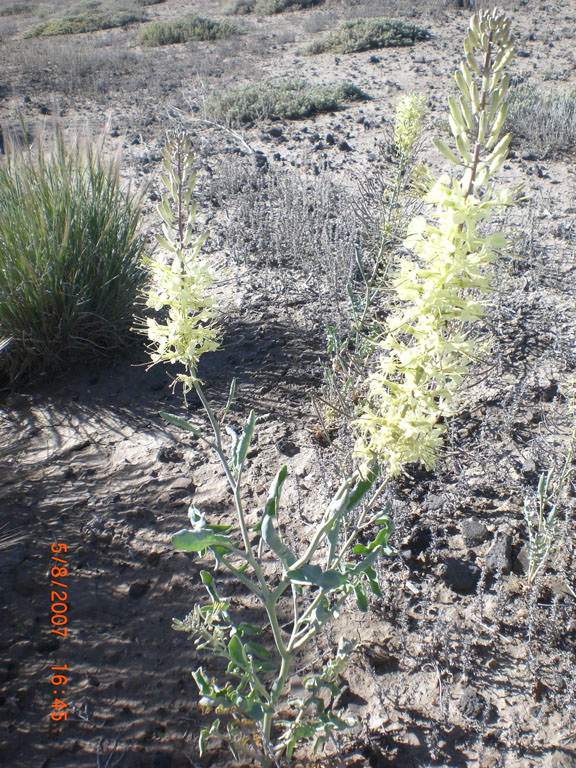
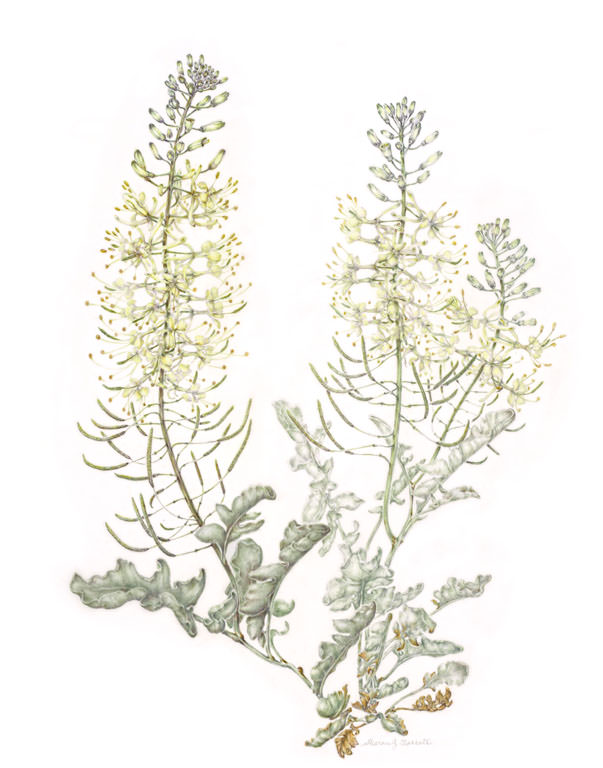
Stanleya albescens plants are biennials; glaucous to mostly glabrous, with yellow to whitish flowers. Stems are unbranched or branched, and are 2-10 dm tall. Leaves are petiolate, fleshy, broadly lanceolate to oblanceolate or ovate in outline, margins lyrate-pinnatifid or runcinate or sometimes entire. Flowers are arranged in somewhat dense racemes. Fruiting pedicels are horizontal to divaricate-ascending. Fruits are suberect to ascending, slightly curved inward, subterete, 2.3-6 cm long by 1-2 mm wide (Flora of North America 2010).
Look Alikes:
Stanleya albescens plants are glaucous and flowers are creamy white, whereas S. pinnata plants are green with bright yellow flowers (Weber and Wittmann 2012).
Phenology:
Plants produce flowers and fruit in May (Colorado Natural Heritage Program 2012).
 |
Habitat
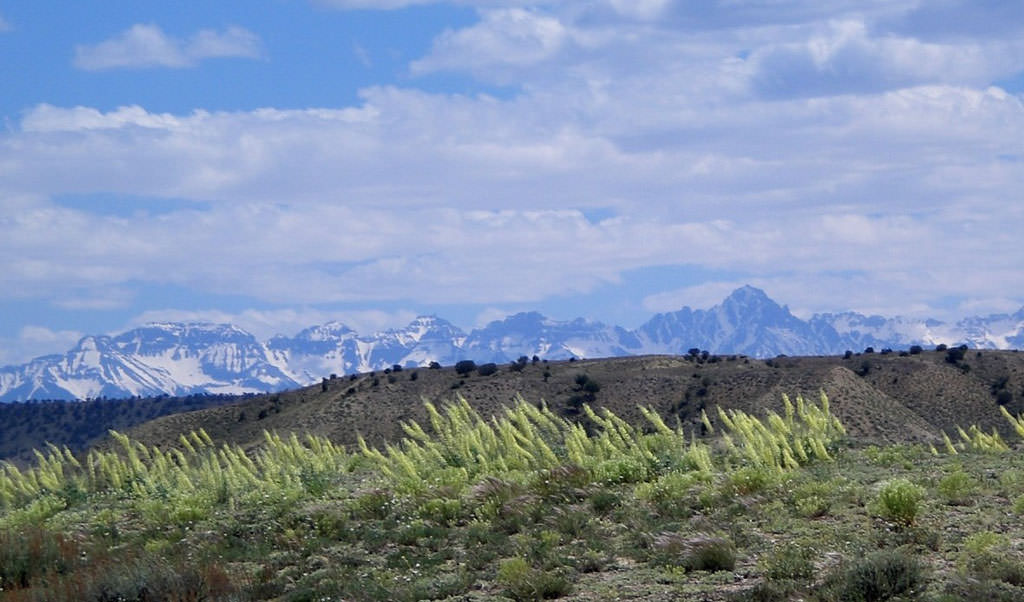
Abundant on adobe flats in the Gunnison and Colorado River valleys between Delta and Grand Junction. In some years the plants are dominant in the landscape while scarce in other years (Weber and Wittmann 2012). Low, sparsely vegetated hills or flats of Mancos Shale dominated by Atriplex confertifolia with Hilaria jamesii. Additional associated plant species include Atriplex corrugata and Sarcobatus vermiculatus (Colorado Natural Heritage Program 2012).
click on image to enlarge
 |
Elevation Range:
4,563 - 6,241 feet (1,391 - 1,902 meters)
Distribution
Colorado Endemic:
No
Range:
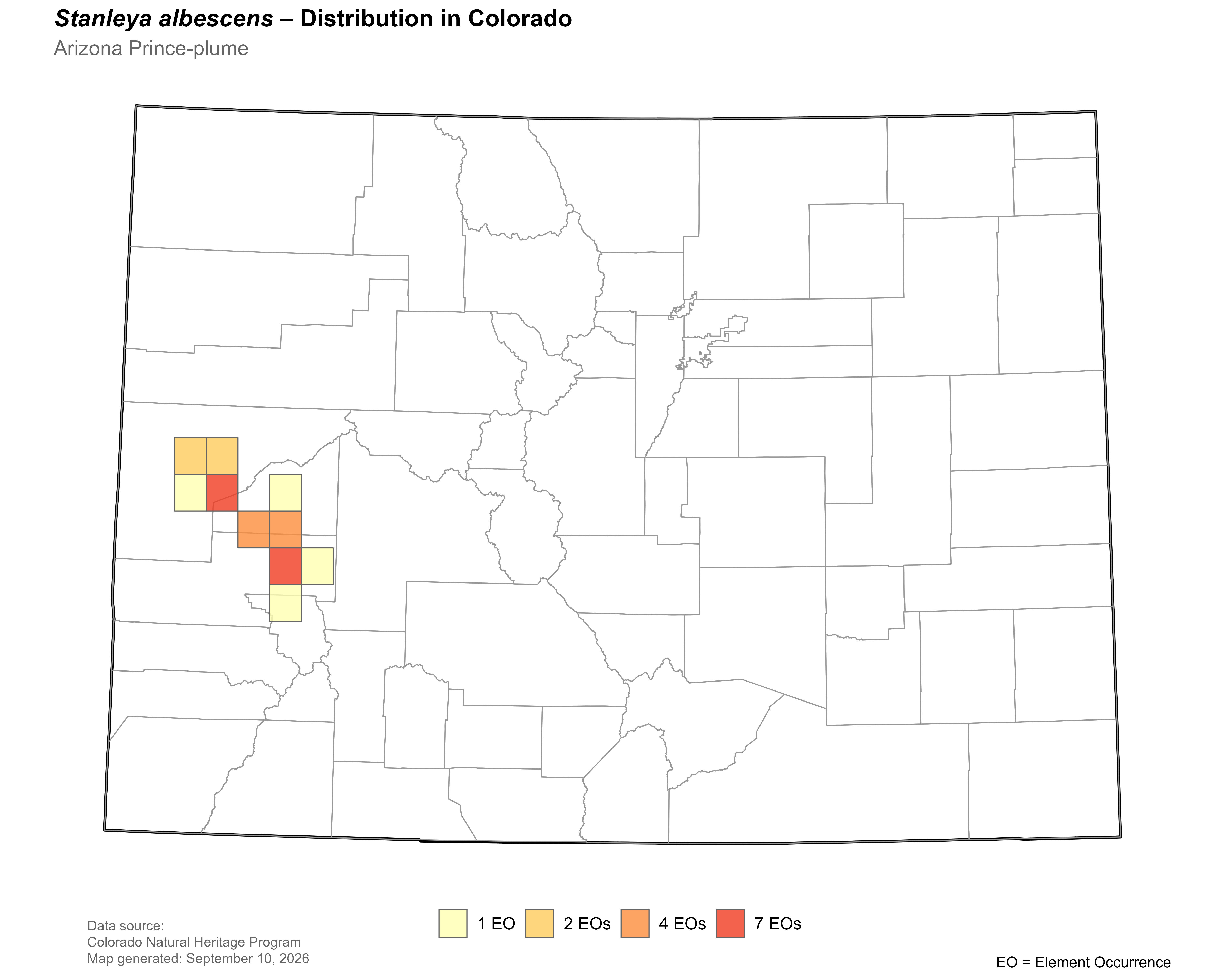
Stanleya albescens is known from Delta, Mesa, and Montrose counties in Colorado, USA. Estimated range extent in Colorado of 6,267 square kilometers was calculated in GeoCAT based on specimen label data from SEINet (2024) and occurrence data provided by the Colorado Natural Heritage Program (2024). This species is also known from Arizona and New Mexico, USA.
Click on map to enlarge |
Threats and Management Issues
Primary threats in Colorado appear to be road maintenance, recreational uses, and potential competition from non-native plant species (Colorado Natural Heritage Program 2012).
References
- Ackerfield, J. 2012. The Flora of Colorado. Colorado State University Herbarium. 433 pp.
- Colorado Natural Heritage Program. 2012. Biodiversity Tracking and Conservation System. Colorado State University, Fort Collins, CO.
- Flora of North America Editorial Committee (FNA). 2010. Flora of North America north of Mexico. Vol. 7. Magnoliophyta: Salicaceae to Brassicaceae. Oxford University Press, New York. xxii + 797 pp.
- Harrington, H.D. 1954. Manual of the plants of Colorado. Sage Press, Chicago. 666 pp.
- Heil, K.D., S.L. O'Kane Jr., L.M. Reeves, and A. Clifford, 2013. Flora of the Four Corners Region, Vascular Plants of the San Juan River Drainage; Arizona, Colorado, New Mexico, and Utah. Missouri Botanical Garden Press, St. Louis, Missouri. 1098 pp.
- Kartesz, J.T. 1996. Species distribution data at state and province level for vascular plant taxa of the United States, Canada, and Greenland (accepted records), from unpublished data files at the North Carolina Botanical Garden, December, 1996.
- Kearney, T.H., R.H. Peebles, and collaborators. 1951. Arizona flora. 2nd edition with Supplement (1960) by J.T. Howell, E. McClintock, and collaborators. Univ. California Press, Berkeley. 1085 pp.
- Lavender, A.E., M.M. Fink, S.E. Linn, D.M. Theobald. 2011. Colorado Ownership, Management, and Protection v9 Database. Colorado Natural Heritage Program and Geospatial Centroid, Colorado State University, Fort Collins, CO. (30 September).
- Martin, W.C., and C.R. Hutchins. 1980-1981. A flora of New Mexico. 1980, Vol. 1; 1981, Vol. 2. J. Cramer, in der A.R. Gantner Verlag, K.G., Vaduz, Liechtenstein. 2591 pp.
- McKee, J. P. 2002. USDA-Forest Service Region 2 Sensitive Species Evaluation Form: Stanleya albescens (Arizona Prince-plume). Online. Available: http://www.fs.fed.us/r2/projects/scp/evalrationale/evaluations/dicots/stanleyaalbescens.pdf (Accessed 2009).
- USDA, NRCS. 2022. The PLANTS Database. National Plant Data Team, Greensboro, NC 27401-4901 USA.
- Weber, W. A. and R. C. Wittmann. 2012. Colorado Flora, Western Slope, A Field Guide to the Vascular Plants, Fourth Edition. Boulder, Colorado. 532 pp.
- Welsh, S.L., N.D. Atwood, S. Goodrich, and L.C. Higgins (eds.) 1993. A Utah flora. 2nd edition. Brigham Young Univ., Provo, Utah. 986 pp.


