


Scientific Name : Sclerocactus cloverae
Author : K.D. Heil & J.M. Porter NatureServe Explorer
Common Name : New Mexico Fishhook Cactus
 Current Research Activities


☰ Click link below for details.
Taxonomy
Cactaceae (cactus family)
This name was proposed for the combination of two varieties of Sclerocactus whipplei, var. heilii and var. reevesii, in Haseltonia No. 2: 20-46, 1994. Flora of North America Editorial Committee (2003) does not recognize subspecies in Sclerocactus cloverae but notes that populations with all reproductive individuals maintaining juvenile morphology have been segregated as S. cloverae ssp. brackii. Both ssp. cloveriae and ssp. brackii are included in Sclerocactus parviflorus ssp. parviflorus by USDA Plants (2019). Sclerocactus cloverae is included in the second edition of the Flora of Colorado (Ackerfield 2022) but was not included in the first edition (Ackerfield 2015).
Ranks and Status
State Rank : S1
State Rank Reason : Sclerocactus cloverae is known from two locations in La Plata County, Colorado, USA. Rangewide threats include oil and gas development, habitat loss, livestock grazing and natural predation. This species is is considered to have low adaptive capacity and is expected to be extremely vulnerable to climate change.
U.S. Endangered Species Act :
Colorado Threatened and Endangered List : none
Other Statuses : SWAP Tier 1
Description and Phenology
General Description:
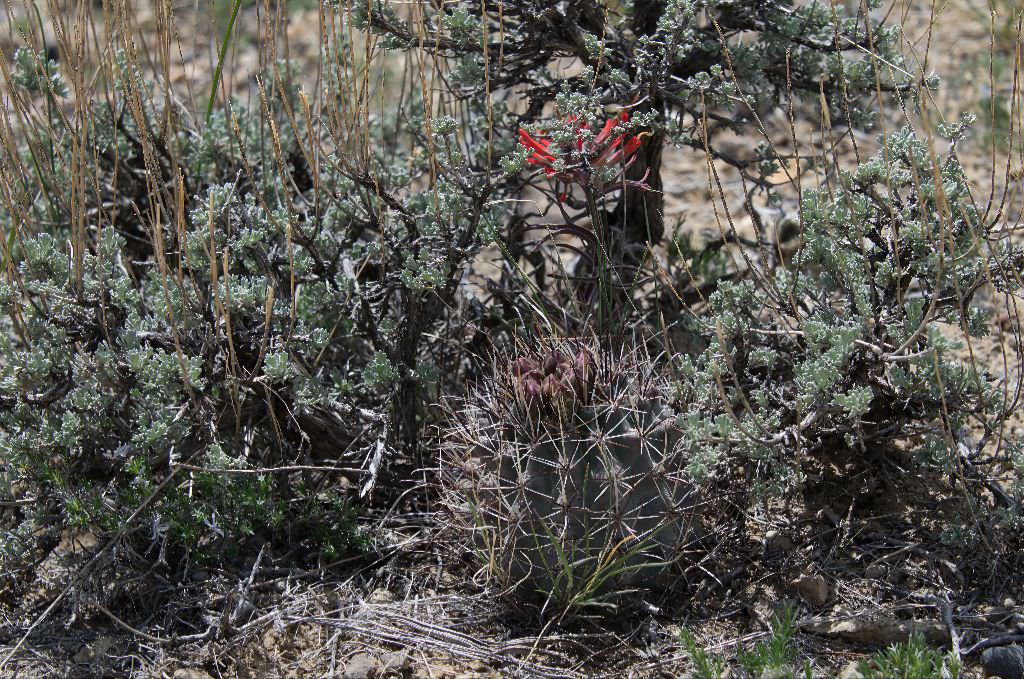
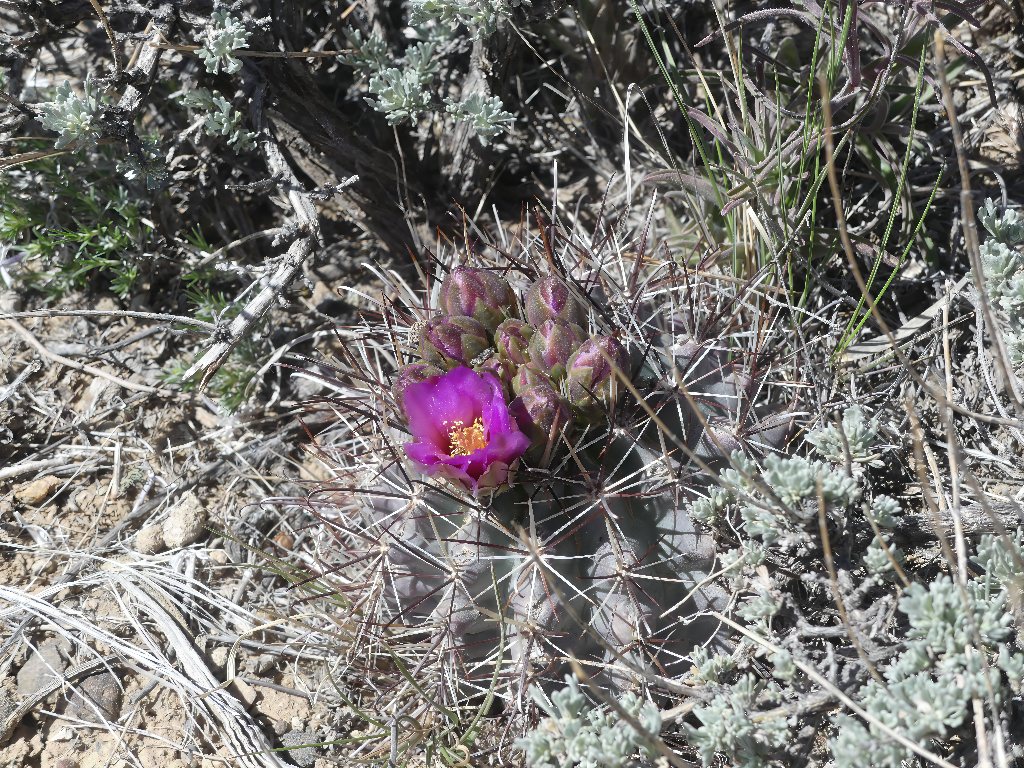
Perennial; plants erect, stems usually unbranched (occasionally 2-3-branched near base), green, ovoid to elongate-cylindric, 3-30 cm long x 1.8-15 cm wide; ribs usually 11-13, well developed, tubercles evident on ribs. Spines obscuring stems; radial spines 4-6 per areole; central spines 6-9 per areole, usually 8 (with one hooked abaxial spine), 1.5-4.6 cm long, straw colored to brown, highlighted with purple or red, terete or somewhat angled, hooked; lateral central spines 5-8 per areole, similar to central abaxial spines but slightly shorter and usually not hooked. Flowers purple sometimes suffused with brown; narrowly funnelform to campanulate, mostly 2.5-3.5 cm long, outer tepals greenish to purple with brownish midstripes, pink, purple, or whitish margins that are membranous and crisped or minutely toothed; inner tepals purple, sometimes suffused with brown; filaments white, tinged with pink to pink-purple; anthers yellow. Fruits irregularly dehiscent or through basal abscission pore, green to tan, sometimes suffused with pink, 7-15 mm long à 5-12 mm wide. Seeds brown or black, 1.2-2.5 mm long à 1.9-3.5 mm wide. (Ackerfield 2022, Heil et al. 2013, FNA Vol. 4, 2003).
Look Alikes:
Sclerocactus cloverae is characterized by its very dense spines and small (2.5-3.5 cm long) purple flowers compared to to S. parviflorus with 3-6 cm long rose to purple flowers.
Phenology:
This taxon flowers from late April to May, and occasionally into June (Ackerfield 2022, FNA Vol. 4, 2003).
Habitat
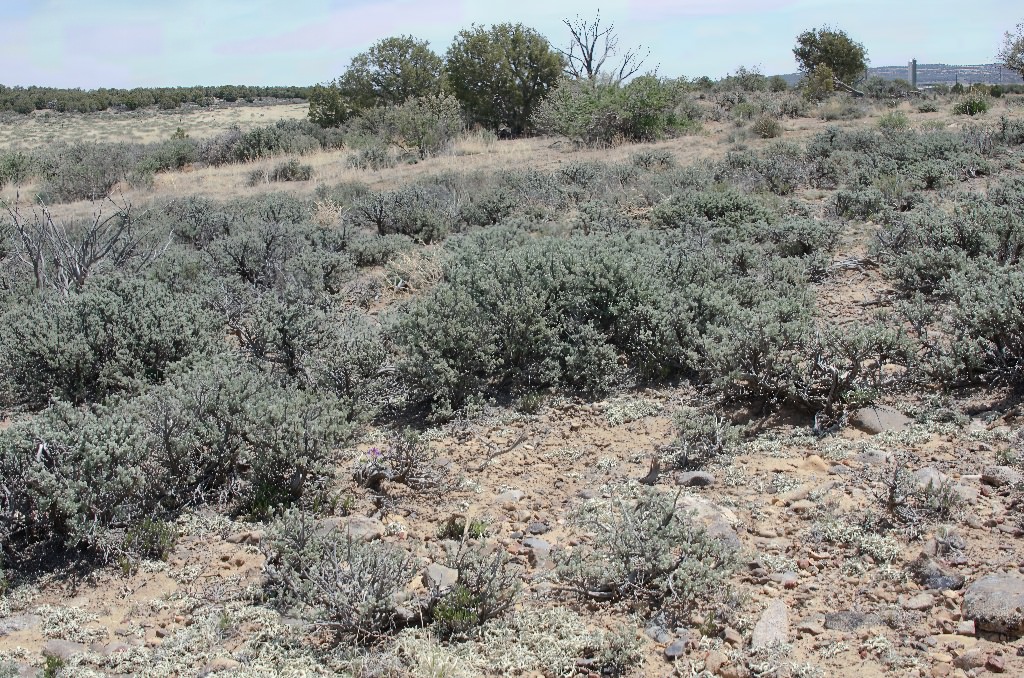
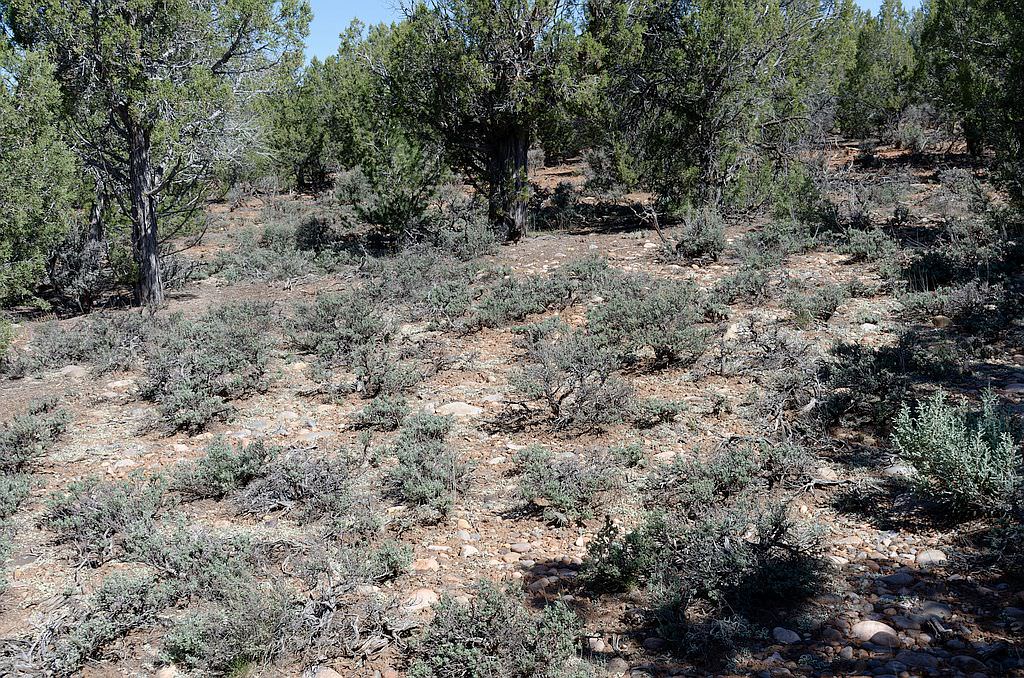
Sandy, gravelly, or clay hills, mesas, and washes, desert grasslands, saltbush, sagebrush, and rabbitbrush flats, pinyon-juniper woodlands (FNA Vol 4, 2003). In Colorado, it is found in sagebrush shrublands (Artemisia tridentata ssp. wyomingensis) within open canopy juniper (Juniperus osteosperma) woodlands. Additional associated species include: Atriplex canescens, Bouteloua gracilis, Castilleja chromosa, Echinocereus fendleri, Lithospermum incisum, Opuntia polyacantha, Pediocactus simpsonii, Phlox hoodii, Sphaeralcea coccinea, Tetraneuris acaulis, Yucca baccata and Anticlea elegans (CNHP 2026).
click on image to enlarge
 |
 |
Elevation Range:
4,500 - 6,000 feet (1,372 - 1,829 meters)
Distribution
Colorado Endemic:
No
Range:
Sclerocactus cloverae is known from La Plata County, Colorado, USA. Estimated range extent in Colorado of 2 square kilometers was calculated in GeoCAT using occurrence data provided by the Colorado Natural Heritage Program (2026). This species can also be found in the Navajo Nation and New Mexico, USA.
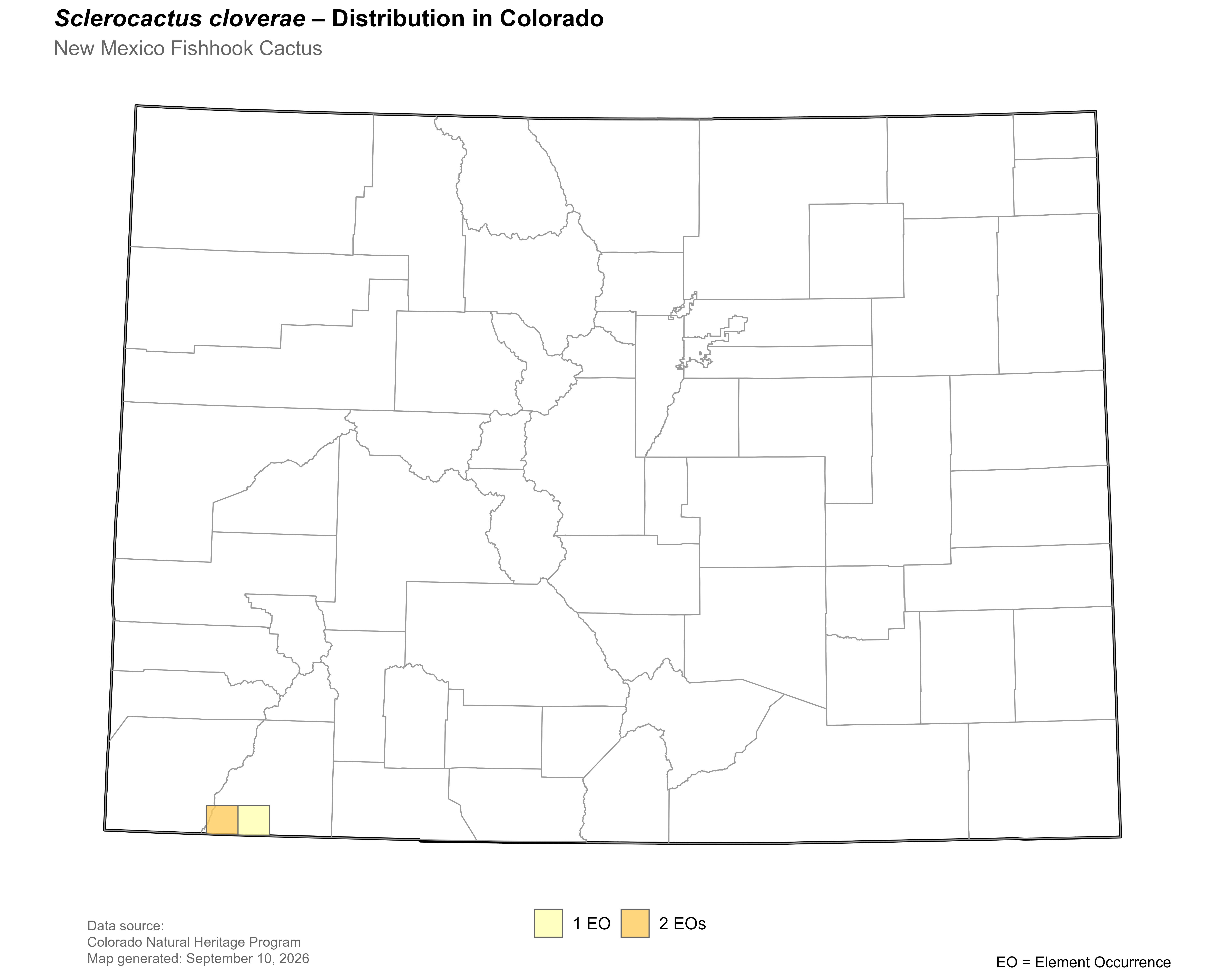
Click on map to enlarge |
Threats and Management Issues
Threats include incompatible livestock grazing which has trampled vegetation and altered soil conditions, and oil and gas development which has altered the habitat. Predation from small mammals (rabbits and rodents) is to be expected. This species is considered to have low adaptive capacity and is expected to be extremely vulnerable to climate change under both RCP 4.5 and 8.5 scenarios, as assessed for the 2025 Colorado State Wildlife Action Plan (CNHP 2025).
References
- Ackerfield, J. 2015. Flora of Colorado. BRIT Press, Botanical Research Institute of Texas, Fort Worth, TX. 818 pp.
- Ackerfield, Jennifer. 2022. Flora of Colorado. Second Edition. Bot. Misc. 60. BRIT Press, Fort Worth Botanic Garden/Botanical Research Institute of Texas, U.S.A. 861 pp.
- Colorado Natural Heritage Program (CNHP). 2025. Climate Change Vulnerability Assessment of Colorado Tier 1 and Tier 2 Plant Species of Greatest Conservation Need (SCGN) for the 2025 Colorado State Wildlife Action Plan. Colorado Natural Heritage Program, Colorado State University, Fort Collins, CO.
- Colorado Natural Heritage Program (CNHP). 2026. Biodiversity Tracking and Conservation System (Biotics 5). Colorado Natural Heritage Program, Colorado State University, Fort Collins.
- Flora of North America Editorial Committee (FNA). 2003b. Flora of North America north of Mexico. Vol. 4, Magnoliophyta: Caryophyllidae, part 1. Oxford University Press, New York. xxiv + 559 pp.
- Heil, K.D, S.L. O'Kane Jr., L.M. Reeves, and A. Clifford. 2013. Flora of the Four Corners Region. Vascular Plants of the San Juan River Drainage: Arizona, Colorado, New Mexico, and Utah. Monographs in systematic botany from the Missouri Botanical Garden, Vol. 124, Missouri Botanical Garden Press, St. Louis, MO. xvi + 1098 pp.
- Heil, K.D., and J.M. Porter. 1994. Sclerocactus (Cactaceae): A revision. Haseltonia 2:20-46.
- U.S. Fish and Wildlife Service (USFWS). 2023. National Listing Workplan. Online. Available: https://www.fws.gov/project/national-listing-workplan