

Scientific Name : Saussurea weberi
Author : Hulten NatureServe Explorer
Common Name : Weber Saussurea
 Current Research Activities
 1997 profile


☰ Click link below for details.
Taxonomy
Asteraceae (sunflower family)
Ranks and Status
State Rank : S2S3
State Rank Reason : Saussurea weberi is known from approximately 20 occurrences within a limited geographic range on alpine gravel and scree slopes in central Colorado, USA. Threats from motorized and non-motorized activities are on-going and affect 60% of the occurrences. Saussurea weberi is also considered to be slightly to moderately vulnerable to the effects of climate change.
U.S. Endangered Species Act : none
Colorado Threatened and Endangered List : none
Other Statuses : SWAP Tier 2
Description and Phenology
General Description:
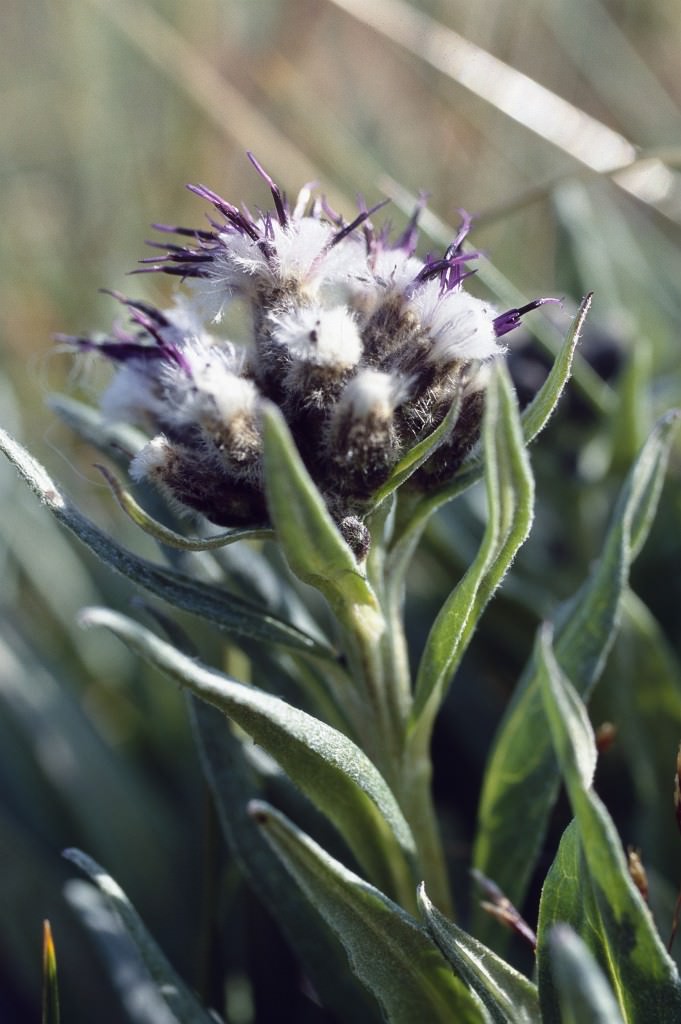
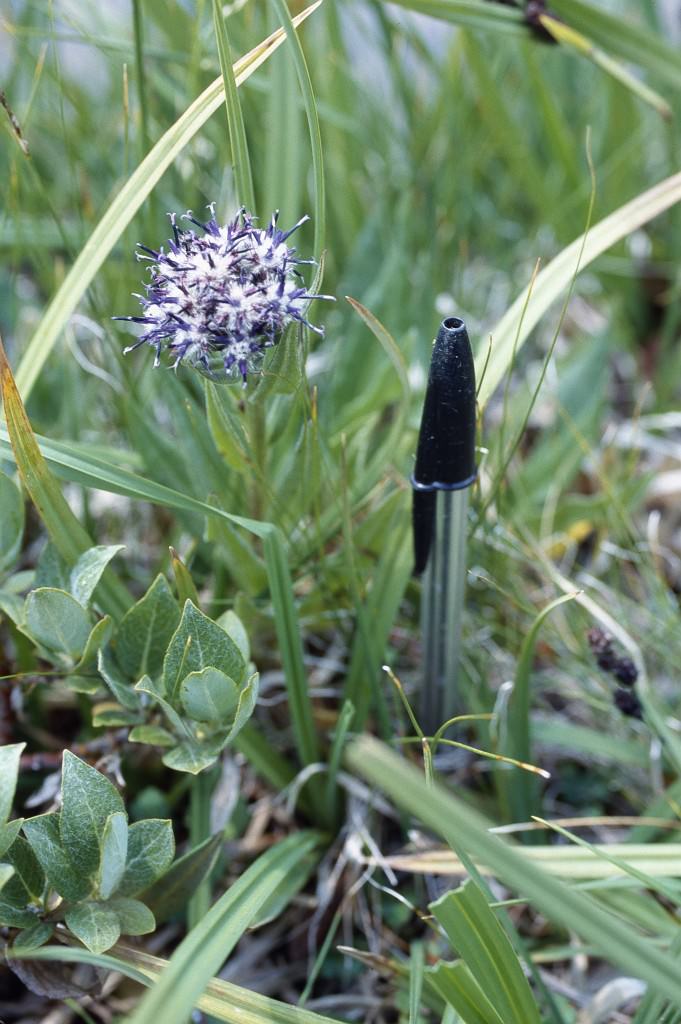
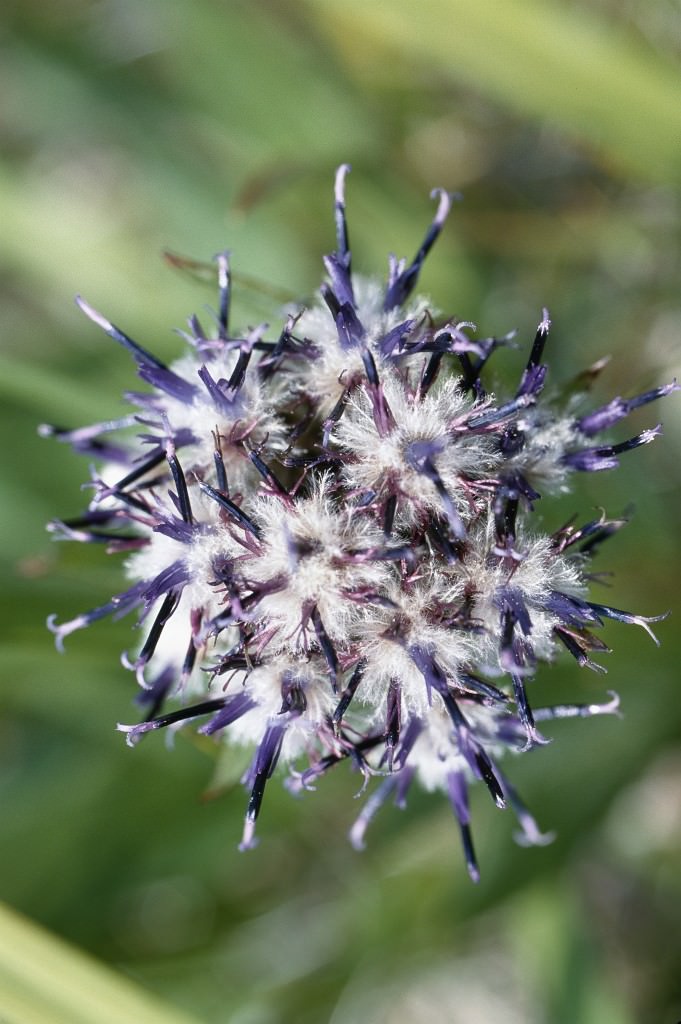
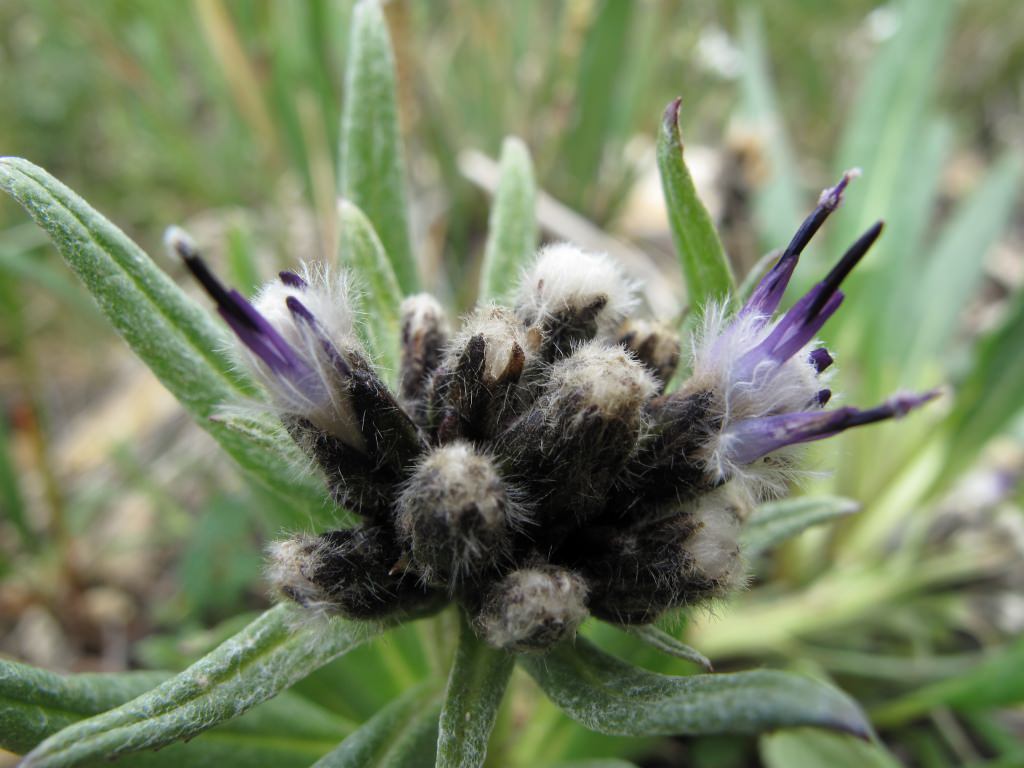
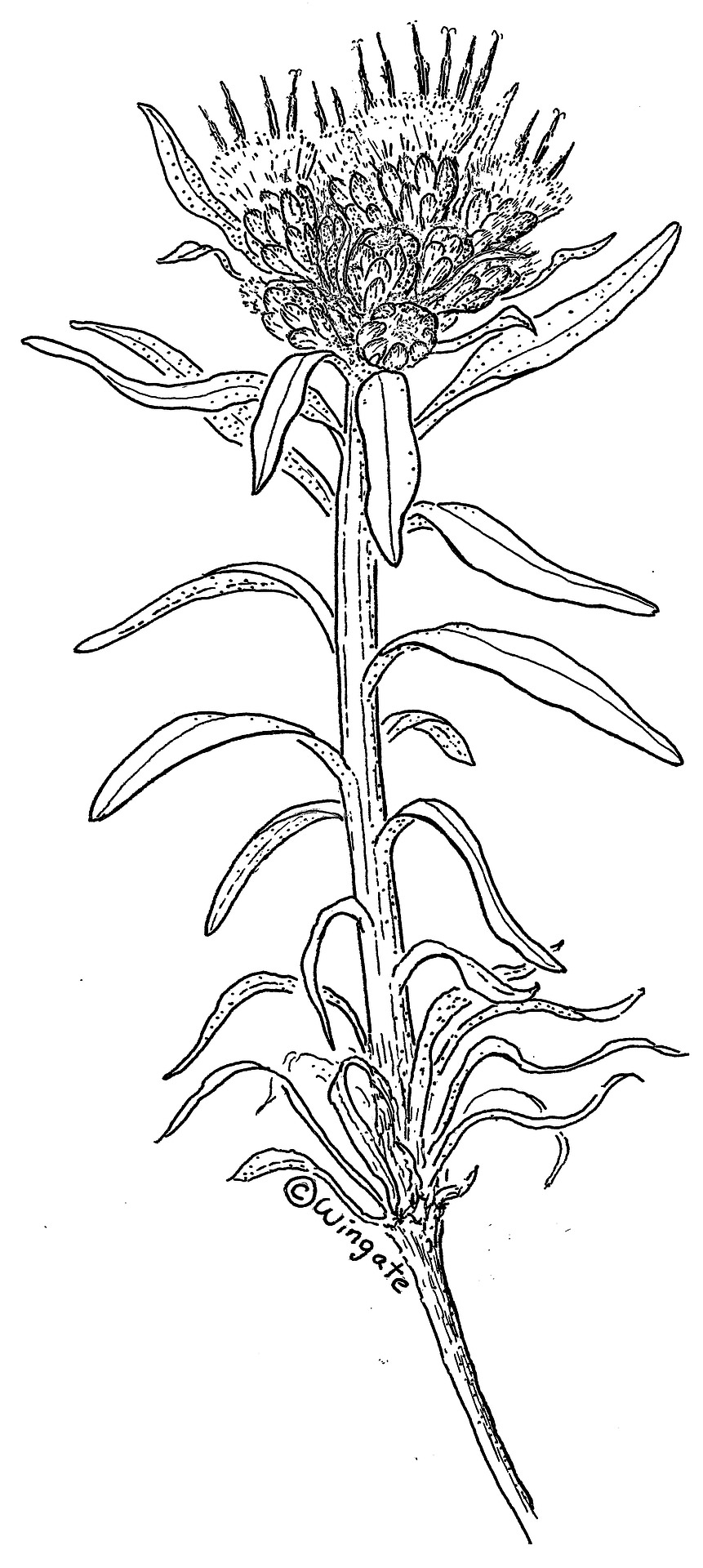
Saussurea weberi is a dwarf perennial herb that is 5-20 cm high, arising from a woody rootstock. The lance-shaped leaf blades are coarsely toothed, up to 8 cm long, and have a broad petiole. The alternate leaves are crowded on the stem, reduced, and lacking petioles towards the top. Herbage is covered with long, tangled hairs when young but becomes glabrous with age. The purple flowering heads are borne in a dense cluster subtended by leaves at the top of the stem. The broad involucral bracts of the heads have rounded tips and are 11-15 mm long. All of the flowers are tubular (disk flowers); ray flowers are absent. The achene has long plumose pappus bristles.
Look Alikes:
None, this species is the only member of this genus to occur in Colorado. It is similar to S. densa of farther north but the two do not co-occur in Colorado.
Phenology:
Flowers late July through August (Colorado Natural Heritage Program occurrence records).
 |
Habitat
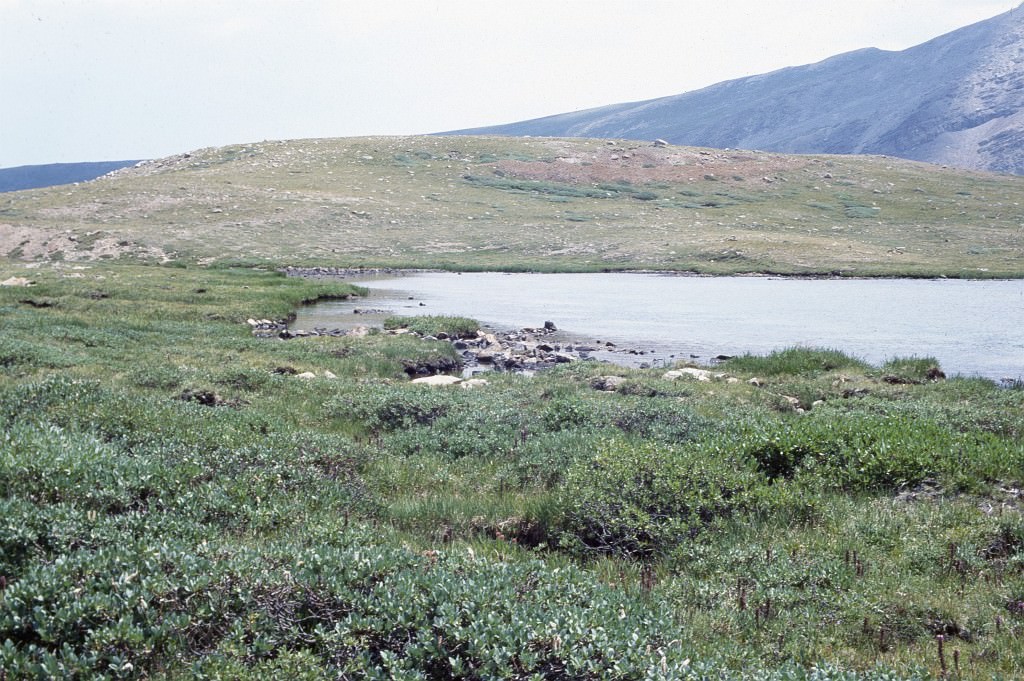
In Colorado, this alpine species is found on wet ledges, in dry alpine turf, gravelly tundra, and scree slopes; exposed sites with poorly developed soils derived from Leadville Limestone and Manitou Dolomite (O'Kane 1988, Spackman et al. 1997). Sites can be perennially wet to quite dry. Associated species include Betula glandulosa, Salix planifolia, Luzula spicata, Danthonia intermedia, Rydbergia grandiflora, Thalictrum alpinum, Potentilla uniflora, Paronychia pulvinata, Draba crassa, Salix brachycarpa, Carex nova, Salix reticulata, Deschampsia cespitosa, Gentianella acuta, Carex rupestris, Trifolium parryi, Zigadenus elegans, Potentilla subjuga, Packera cana, Calamagrostis purpurascens, Cerastium strictum, Erigeron pinnatisectus, Phleum commutatum, Oxytropis viscida, Oligosporus groenlandicus, Bistorta vivipara, Rhodiola integrifolia, Hymenoxis grandiflorum, Trifolium dasyphyllum, Gentian algida, Pedicularis groenlandica, Zigadenus elegans, Caltha leptosepala, Juncus drummondii, Luzula spicata and Gentiana prostrata.
click on image to enlarge
 |
Elevation Range:
10,939 - 13,420 feet (3,334 - 4,090 meters)
Distribution
Colorado Endemic:
No
Range:
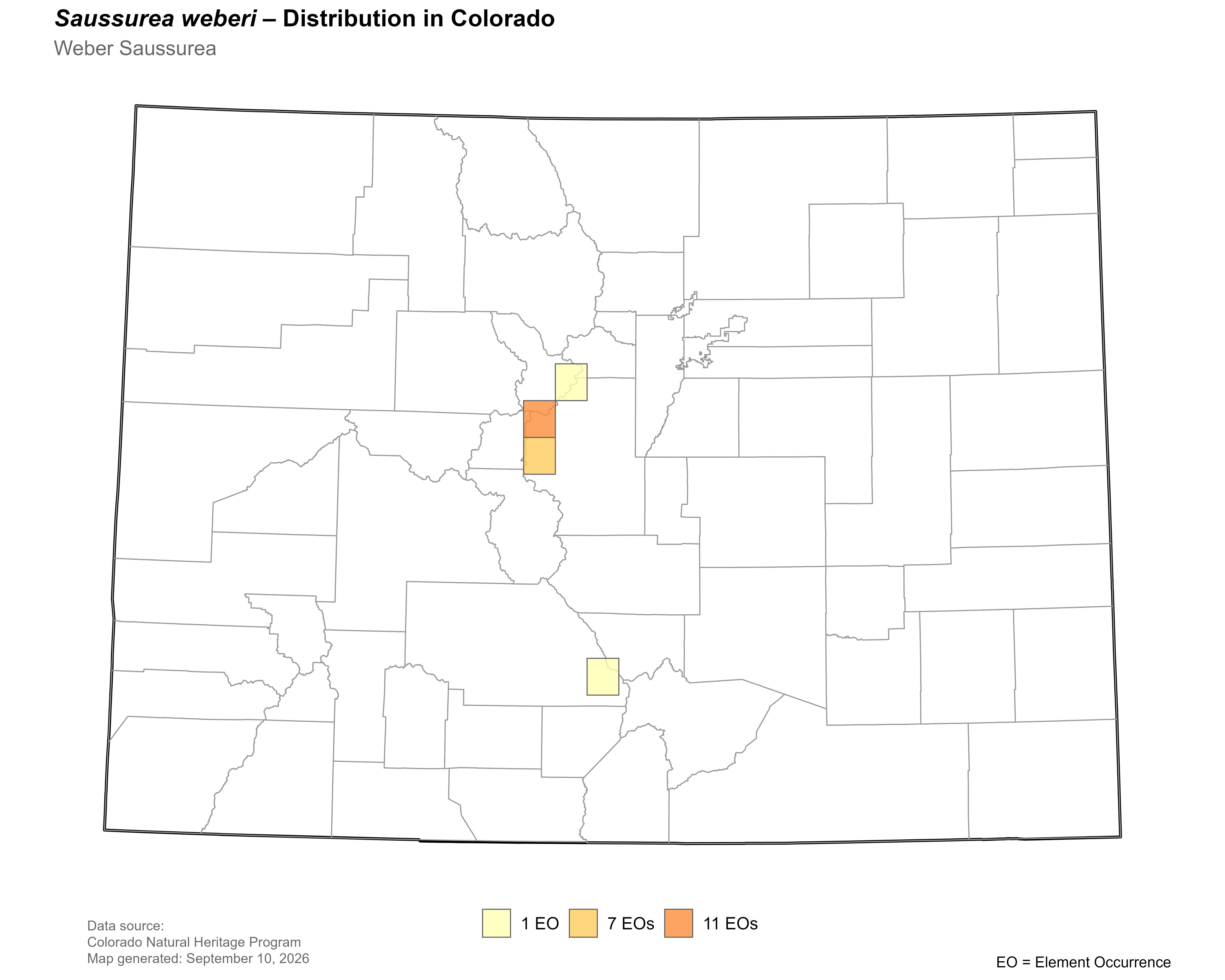
Saussurea weberi is known from Custer, Lake, Park, and Summit counties in Colorado, USA. Estimated range extent in Colorado of 3484 square kilometers was calculated in GeoCAT using occurrence data provided by the Colorado Natural Heritage Program (2023). This species is also known from Montana and Wyoming, USA.
Click on map to enlarge |
Threats and Management Issues
The primary threat at this time is considered to be motorized and non-motorized recreation which affects 60% of the occurrences. Past disturbance from mining activities (including associated road and other mine-related construction) is evident at 50% of the occurrences, and may be a threat in the future. This species is considered to have moderate adaptive capacity and is expected to be slightly to moderately vulnerable to climate change under both RCP 4.5 and 8.5 scenarios, as assessed for the 2025 Colorado State Wildlife Action Plan (CNHP 2025).
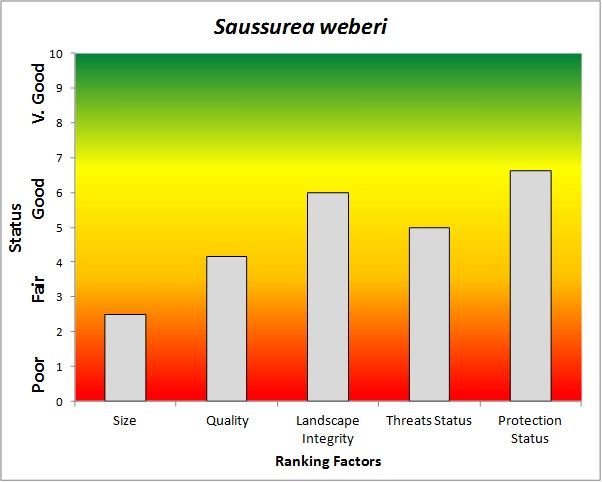
Summary results of an analysis of the status of Saussurea weberi based on several ranking factors. This species was concluded to be "Effectively Conserved. From Rondeau et al. 2011. etc |
References
- Achuff, P. L. and L. S. Roe. 1992. Botanical survey of the Goat Flat proposed Research Natural Area, Deerlodge National Forest. Unpublished report to the Deerlodge National Forest. Montana Natural Heritage Program, Helena, MT. 31 pp.
- Ackerfield, J. 2015. Flora of Colorado. BRIT Press, Botanical Research Institute of Texas, Fort Worth, TX. 818 pp.
- Colorado Native Plant Society. 1989. Rare plants of Colorado. Rocky Mountain Nature Association, Colorado Native Plant Society, Estes Park, Colorado. 73 pp.
- Colorado Natural Heritage Program (CNHP). 2023. Biodiversity Tracking and Conservation System (Biotics 5). Colorado Natural Heritage Program, Colorado State University, Fort Collins.
- Colorado Natural Heritage Program (CNHP). 2025. Climate Change Vulnerability Assessment of Colorado Tier 1 and Tier 2 Plant Species of Greatest Conservation Need (SCGN) for the 2025 Colorado State Wildlife Action Plan. Colorado Natural Heritage Program, Colorado State University, Fort Collins, CO.
- Colorado Natural Heritage Program and the Geospatial Centroid. 2017. The Colorado Ownership and Protection Map (COMaP). Colorado State University, Ft. Collins, CO.
- Dorn, R. D. 2001. Vascular Plants of Wyoming. 3rd edition. Mountain West Publishing. Cheyenne, Wyoming. 412 pp.
- Fertig, W. 2000. Saussurea weberi state species abstract. Wyoming Natural Diversity Database summaries posted for plant species of special concern [pdf files]. Available: http://www.uwyo.edu/wyndd/ University of Wyoming, Laramie.
- Glisson, B. 2004. Saussurea weberi Hultén (Weber's saw-wort): a technical conservation assessment. USDA Forest Service, Rocky Mountain Region. Online. Available: http://www.fs.fed.us/r2/projects/scp/assessments/saussureaweberi.pdf (Accessed 2006).
- Handwerk, J., L. Grunau, and S. Panjabi. 2015. Colorado Wildlife Action Plan: 2015 Rare Plant Addendum. Colorado Natural Heritage Program, Colorado State University, Fort Collins, Colorado, USA.
- Lackschewitz, K. H. 1976. Montana mountain flora: new records. Madrono 23:360-362.
- Montana Natural Heritage Program. Montana Plant Field Guide. Online. Available: http://mtnhp.org/plants/plantguide.asp (Accessed 2006).
- Neely, B., S. Panjabi, E. Lane, P. Lewis, C. Dawson, A. Kratz, B. Kurzel, T. Hogan, J. Handwerk, S. Krishnan, J. Neale, and N. Ripley. 2009. Colorado Rare Plant Conservation Strategy, Developed by the Colorado Rare Plant conservation Initiative. The Nature Conservancy, Boulder, Colorado, 117 pp.
- O'Kane, S. L. 1988. Colorado's Rare Flora. Great Basin Naturalist. 48(4):434-484.
- Rondeau, R., K. Decker, J. Handwerk, J. Siemers, L. Grunau, and C. Pague. 2011. The state of Colorado's biodiversity 2011. Prepared for The Nature Conservancy. Colorado Natural Heritage Program, Colorado State University, Fort Collins, Colorado.
- Spackman, S., B. Jennings, J. Coles, C. Dawson, M. Minton, A. Kratz, and C. Spurrier. 1997. Colorado rare plant field guide. Prepared for Bureau of Land Management, U.S. Forest Service and U.S. Fish and Wildlife Service by Colorado Natural Heritage Program.
- Strickler, D. 1990. Alpine Wildflowers. The Flower Press, Columbia Falls, Montana. 112 pp.
- The Colorado Native Plant Society. 1997. Rare Plants of Colorado, second edition. Falcon Press Publishing Co.,Inc. Helena, Montana. 105pp.
- USDA, NRCS. 2022. The PLANTS Database. National Plant Data Team, Greensboro, NC 27401-4901 USA.
- Weber, W. A. and R. C. Wittmann. 2012. Colorado Flora, Eastern Slope, A Field Guide to the Vascular Plants, Fourth Edition. Boulder, Colorado. 555 pp.
- Weber, W. A. and R. C. Wittmann. 2012. Colorado Flora, Western Slope, A Field Guide to the Vascular Plants, Fourth Edition. Boulder, Colorado. 532 pp.