


Scientific Name : Salix calcicola var. glandulosior
Author : B. Boivin NatureServe Explorer
Common Name : Lime- loving Willow
 Current Research Activities


☰ Click link below for details.
Taxonomy
Salicaceae (willow family)
Ackerfield (2022) and Kittel (2023) list this taxon as Salix calcicola. Plants of the World Online (2024) and the International Plant Names Index (2026) follow Flora of North America (2010) which recognizes the variety. The third edition of the Flora of Colorado will also follow the FNA treatment (Ackerfield 2025). Weber and Wittmann (2012) also indicate variety glandulosior is the taxon present in Colorado.
Ranks and Status
State Rank : S1
State Rank Reason : Salix calcicola var. glandulosior is a Canadian Arctic disjunct known from two locations in Colorado, USA. Changes to the natural hydrology within this species habitat is concern as it is considered to have low adaptive capacity and is expected to be moderately to extremely vulnerable to climate change.
U.S. Endangered Species Act : none
Colorado Threatened and Endangered List : none
Other Statuses : SWAP Tier 1, USFS GMUG
Description and Phenology
General Description:
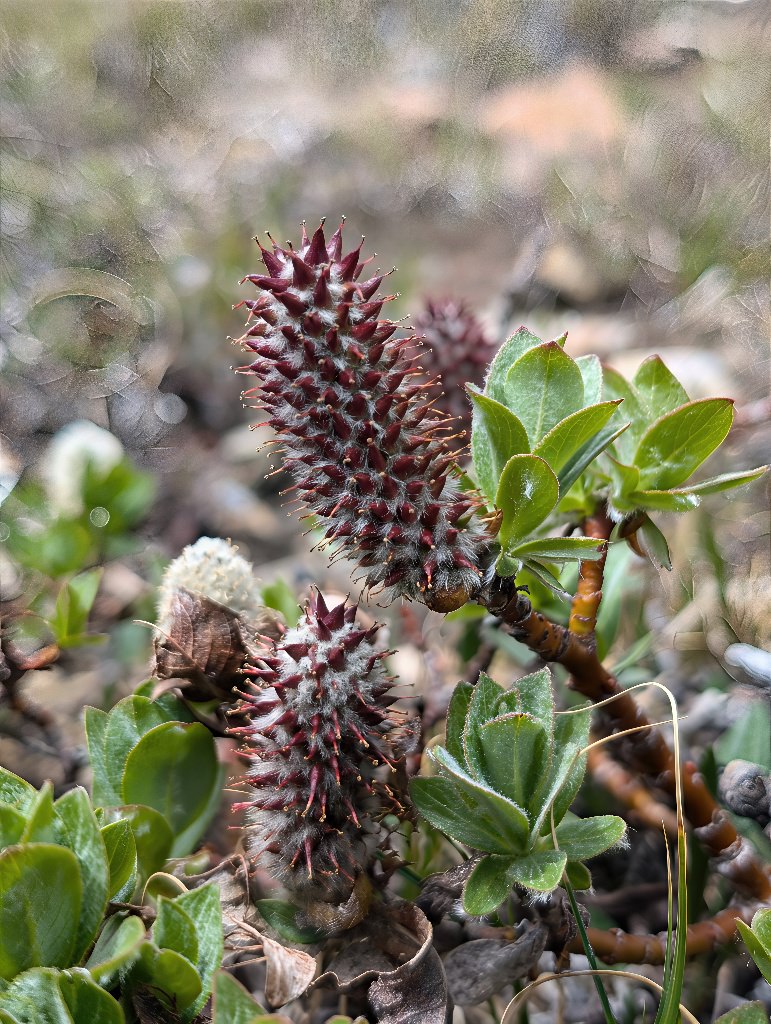
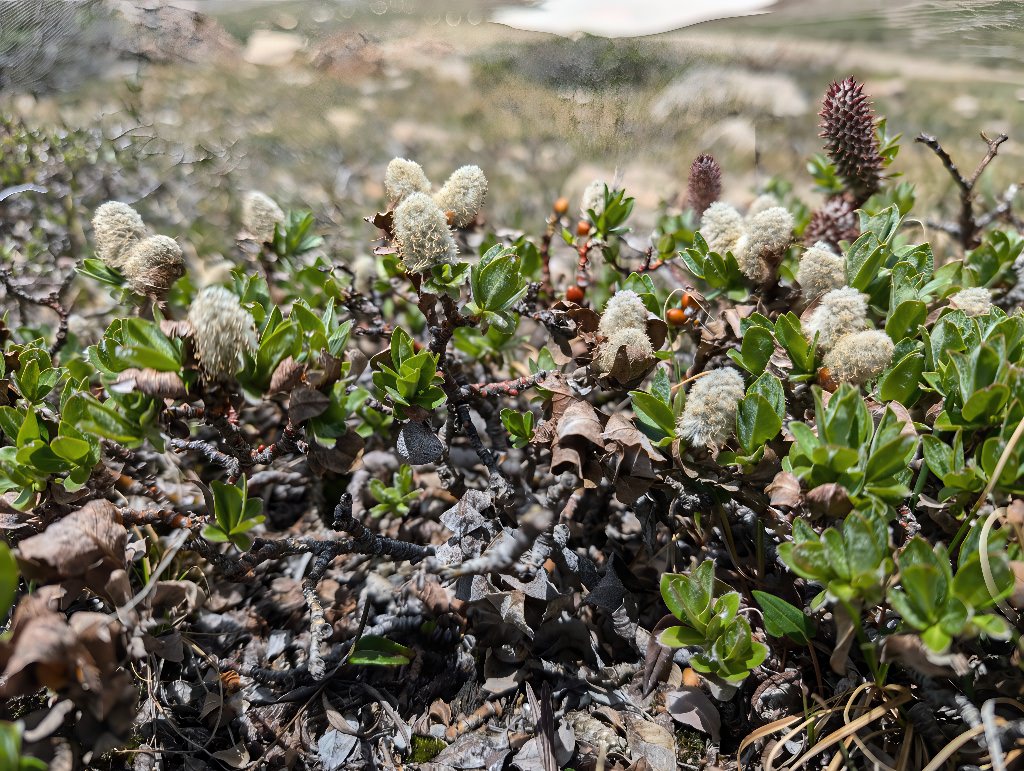
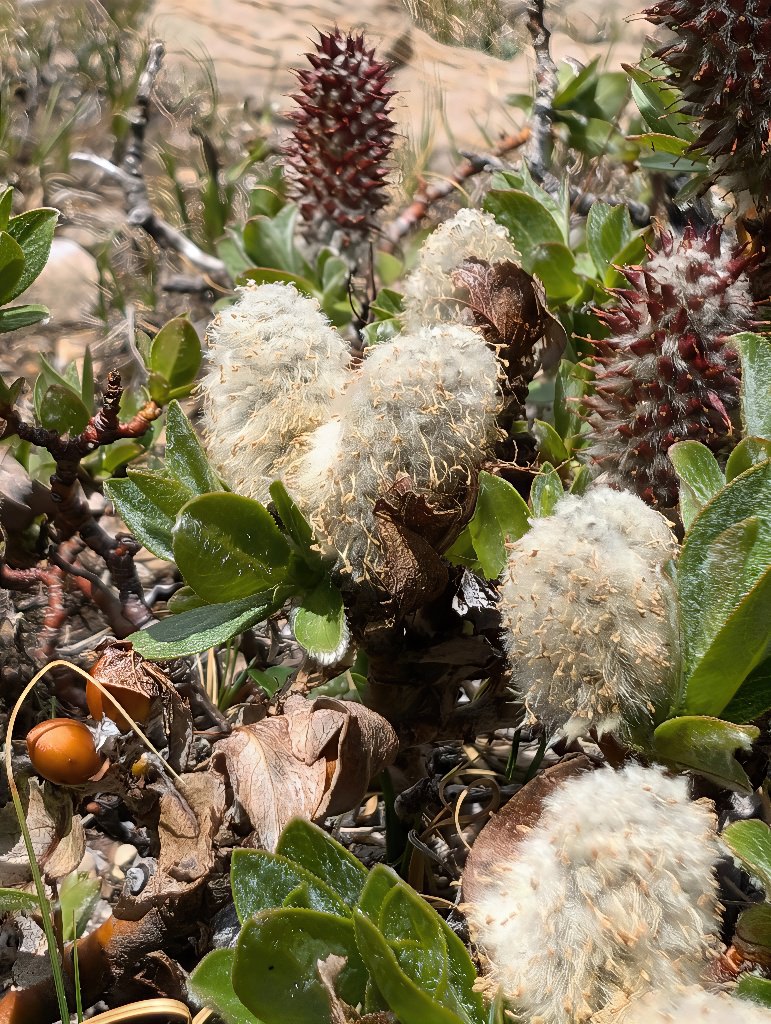
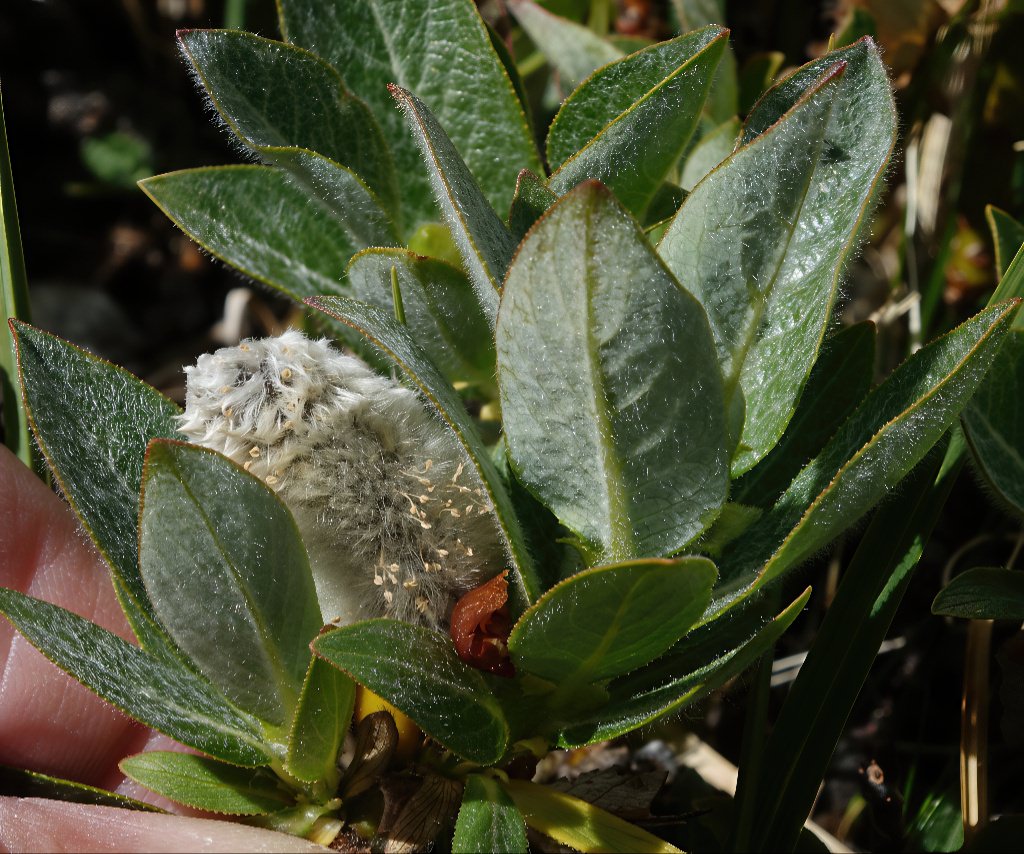
Plants creeping shrubs, 0.05-1.3 M tall, gnarled, sometimes forming clones by layering. Branches yellow-brown, gray-brown, or red-brown, weakly glaucous (dull or slightly glossy), villous to glabrescent; branchlets yellow-brown or red-brown, moderately densely to sparsely villous. Leaves with foliaceous stipules 1-14 mm; petiole short, shallowly grooved, or convex to flat adaxially; largest medial leaf blades narrowly to broadly elliptic or subcircular, 16-61 mm wide à 10-44 mm long, margins green, teeth or glands 5-22 per cm, apex acuminate or acute, adaxial (upper) surface slightly glossy or dull, glaucous underneath. Catkins are stout, long and stiffly erect, flowering before leaves emerge; floral bracts brown or black persistent, with very long straight (wavy) hairs. Capsules 4-8 mm, glabrous (Ackerfield 2022, Kittel 2023, FNA 2010, Weber and Wittmann 2012).
Look Alikes:
The two varieties of Salix calcicola are distinguished in the Flora of North America (Vol. 7, 2010) as follows: in variety glandulosior the largest medial leaf blades have green margins with 5-22 teeth or glands per cm; styles 0.9-1.8 mm; stipes 0.3-0.6 mm. In variety calcicola the largest medial leaf blade margins are often purplish with 6-18 teeth or glands per cm; styles 1.6-3 mm; stipes 0.2-1.2 mm. Salix calcicola var. glandulosior can also be differentiated from other alpine willows such as S. brachycarpa, S. glauca, S. nivalis and S. petrophila by its glaucous capsules (Culver and Lemly 2013). Salix myrtillifolia and S. wolfii have shorter catkins, and hairier leaves (Kittel 2023).
Phenology:
June-August (Ackerfield 2022).
Habitat
Alpine wet meadows on limestone substrate (FNA 2010). In Colorado it is found on loose limestone detritus along lake margins at the base of a cirque. Associated species include Salix brachycarpa, Salix planifolia, Salix reticulata, Carex borealipolaris, Carex microglochin, Carex simpliciuscula, Dasiphora fruticosa and Saussurea weberi (CNHP 2026).
Elevation Range:
11,200 - 12,500 feet (3,414 - 3,810 meters)
Distribution
Colorado Endemic:
No
Range:
Salix calcicola var. glandulosior is known from Gunnison and Park counties in Colorado, USA. Estimated range extent in Colorado of 5 square kilometers was calculated in GeoCAT using occurrence data provided by the Colorado Natural Heritage Program (2026). The full species and the variety are disjunct from the range of the taxa in the Canadian Arctic. In Colorado it is found on calcareous ground in the Mosquito Range just south of the Continental Divide, but to be expected wherever there are extensive alpine outcrops of Leadville limestone (Weber and Wittmann 2012). In the United States, this variety can only be found in Colorado, and in Canada only in Alberta.
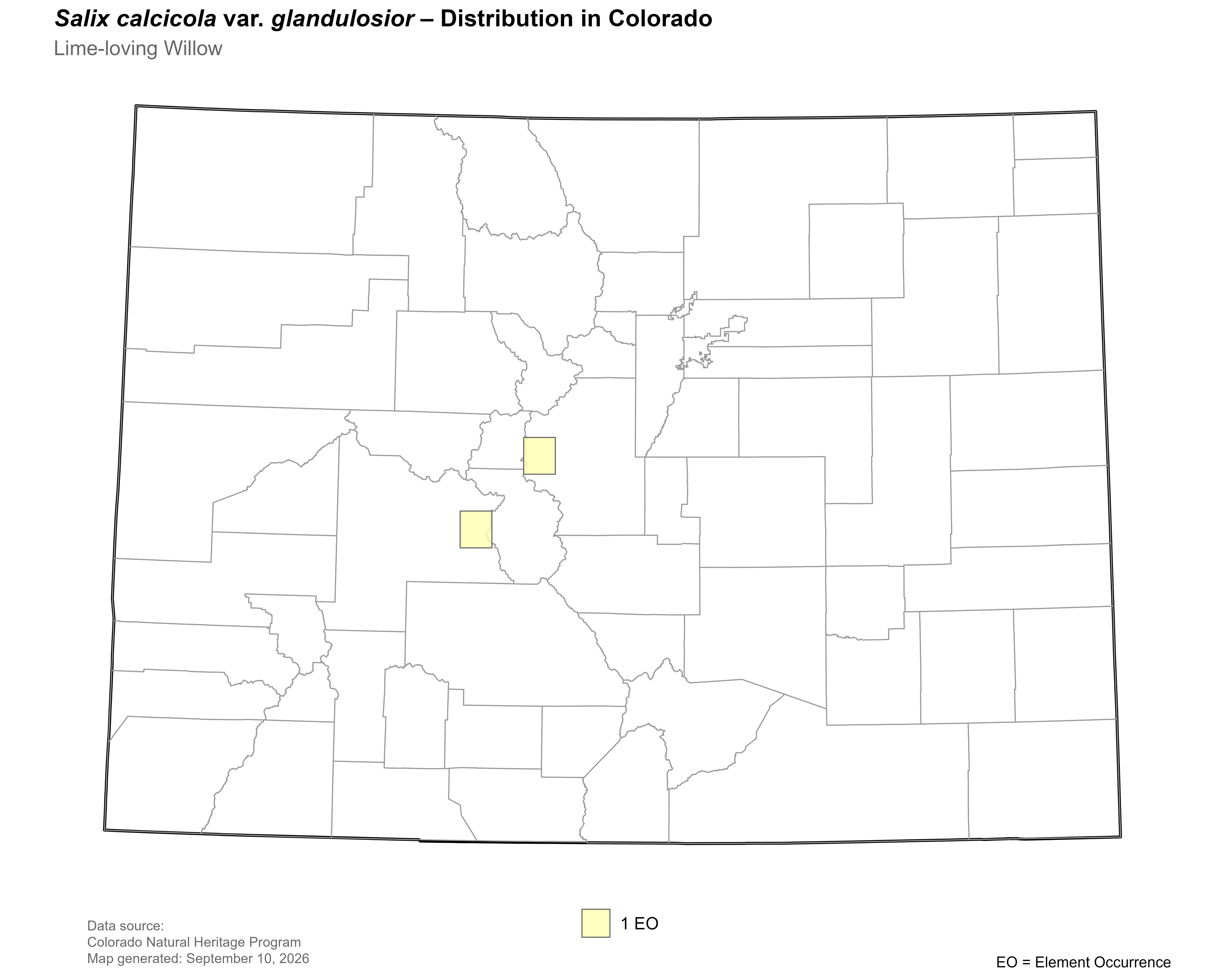
Click on map to enlarge |
Threats and Management Issues
Only known from two occurrences; one of which indicates that maintaining the natural hydrology and closing the local road to recreational access would help protect this occurrence. This species is considered to have low adaptive capacity and is expected to be moderately to extremely vulnerable to climate change under both RCP 4.5 and 8.5 scenarios, as assessed for the 2025 Colorado State Wildlife Action Plan (CNHP 2025).
References
- Ackerfield, Jennifer. 2022. Flora of Colorado. Second Edition. Bot. Misc. 60. BRIT Press, Fort Worth Botanic Garden/Botanical Research Institute of Texas, U.S.A. 861 pp.
- Ackerfield, Jennifer. 2025. Flora_specieslistFROMJENJan20_2025. Excel spreadsheet summarizing proposed changes for Edition 3 of Flora of Colorado, draft.
- Colorado Natural Heritage Program (CNHP). 2025. Climate Change Vulnerability Assessment of Colorado Tier 1 and Tier 2 Plant Species of Greatest Conservation Need (SCGN) for the 2025 Colorado State Wildlife Action Plan. Colorado Natural Heritage Program, Colorado State University, Fort Collins, CO.
- Colorado Natural Heritage Program (CNHP). 2026. Biodiversity Tracking and Conservation System (Biotics 5). Colorado Natural Heritage Program, Colorado State University, Fort Collins.
- Flora of North America Editorial Committee (FNA). 2010. Flora of North America north of Mexico. Vol. 7. Magnoliophyta: Salicaceae to Brassicaceae. Oxford University Press, New York. xxii + 797 pp.
- International Plant Names Index (IPNI). 2026. Online. Available: http://www.ipni.org. (Accessed 2026).
- Kittel, G. 2023. Willows (Salix) of Colorado, Their Ecology and Identification.
- Plants of the World Online (POWO). 2026. Plants of the World Online. Facilitated by the Royal Botanic Gardens, Kew. Online. Available: https://powo.science.kew.org/ (accessed 2026).
- Weber, W. A. and R. C. Wittmann. 2012. Colorado Flora, Eastern Slope, A Field Guide to the Vascular Plants, Fourth Edition. Boulder, Colorado. 555 pp.
Biotics Export Date : 2026-09-16