

Scientific Name : Salix arizonica
Author : Dorn NatureServe Explorer
Common Name : Arizona Willow
 Current Research Activities


☰ Click link below for details.
Taxonomy
Salicaceae (willow family)
Ranks and Status
State Rank : S1
State Rank Reason : Salix arizonica is known from only three occurrences within a very narrow range in southern Colorado (USA). The primary threats to the species result from the impacts of incompatible grazing, disturbance from highway and railroad maintenance, and potential hydrologic alterations within its habitat. Salix arizonica is also considered to be moderately vulnerable to the effects of climate change.
U.S. Endangered Species Act : none
Colorado Threatened and Endangered List : none
Other Statuses : SWAP Tier 2, USFS, USFS RGNF
Description and Phenology
General Description:
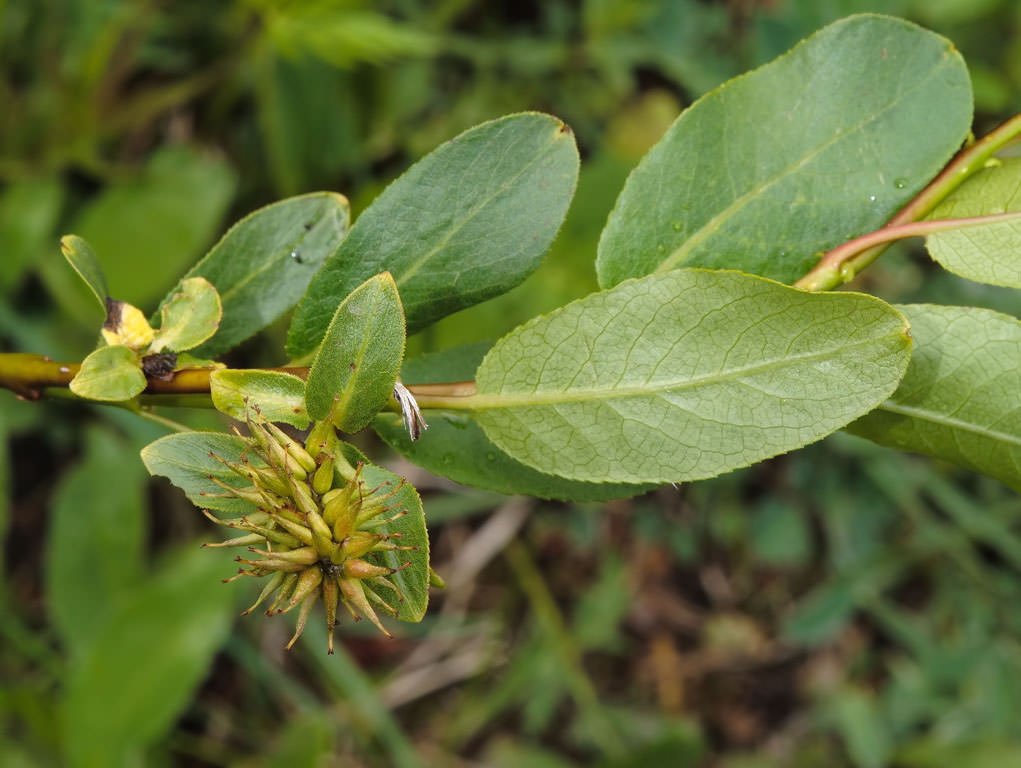
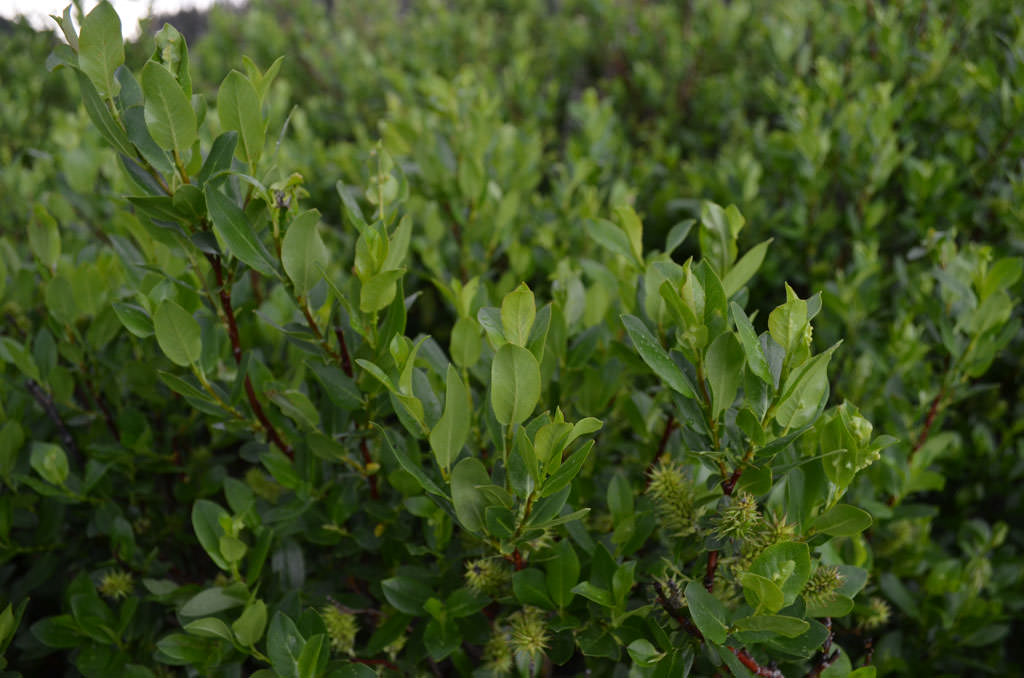
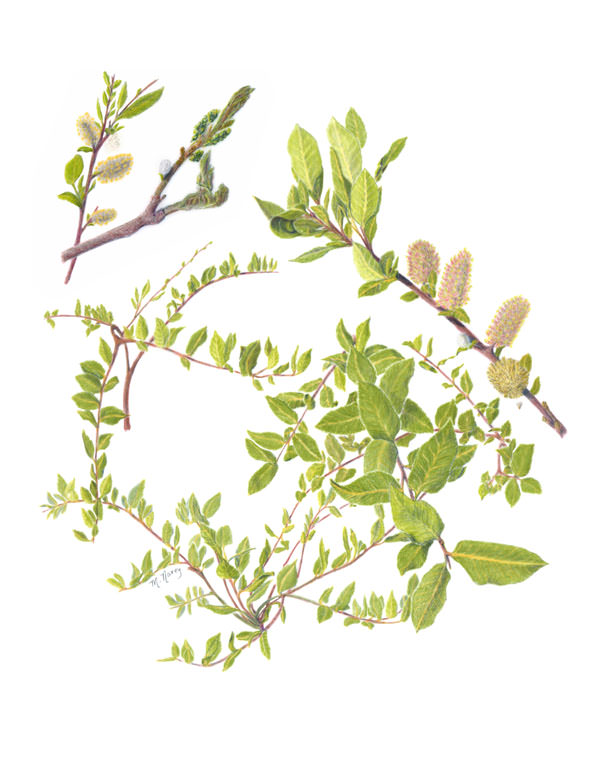
Short shrubs, 0.1-1.5 (2.5) m tall; year-old twigs reddish or sometimes yellowish, glabrous or pubescent; stipules small, soon deciduous; petioles 3-8 mm long; leaf blades glandular-serrulate, acute to obtuse, with a cordate or subcordate (rounded) base, ovate to obovate, mostly 1.5-2.4 times as long as wide, 1-5 cm long and 0.5-2.8 (3.1) cm wide, sparsely pubescent to sometimes glabrous, non-glaucous; catkins precocious to coetaneous, sessile or on leafy peduncles to 1.2 cm long; floral bracts brown or black, persistent, with long, straight or wavy hairs; staminate catkins 1-3 cm long; stamens 2, filaments glabrous; pistillate catkins 1-4 cm long; capsule 3-5 mm long, glabrous, stipes 0.2-1.5 mm long; style 0.5-1.5 mm long, longer than the stigmas (Culver and Lemley 2013).
Look Alikes:
Salix arizonica can hybridize with S. brachycarpa and possibly S. wolfii. Salix arizonica can be distinguished by its short stature and broad, non-glaucous leaves with cordate or subcordate bases (Culver and Lemly 2013).
Phenology:
Flowers May-June.
 |
Habitat
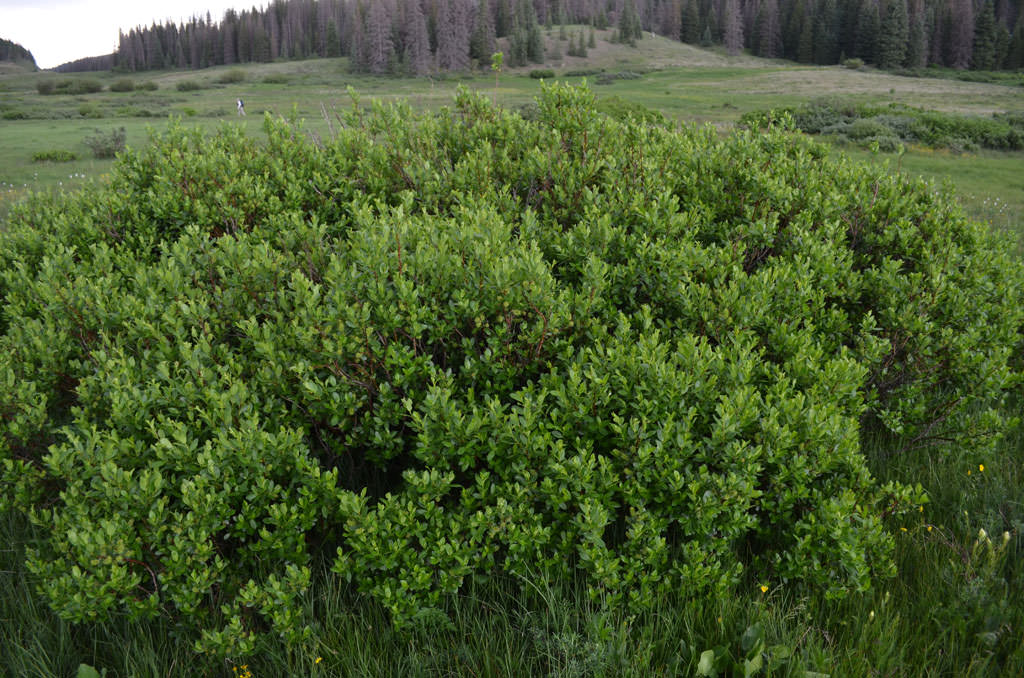
This species is found in moist meadows and along low-gradient streams (Culver and Lemly 2013). Associated species include; Salix wolfii, Pentaphylloides floribunda, Salix monticola, Psychrophila leptosepala, Carex aquatilis, Phleum commutatum, Carex utriculata, Deschampsia cespitosa, Geum macrophyllum, Swertia perennis, Clementsia rhodantha, and Potentilla pulcherrima.
click on image to enlarge
 |
Elevation Range:
10,007 - 10,428 feet (3,050 - 3,178 meters)
Distribution
Colorado Endemic:
No
Range:
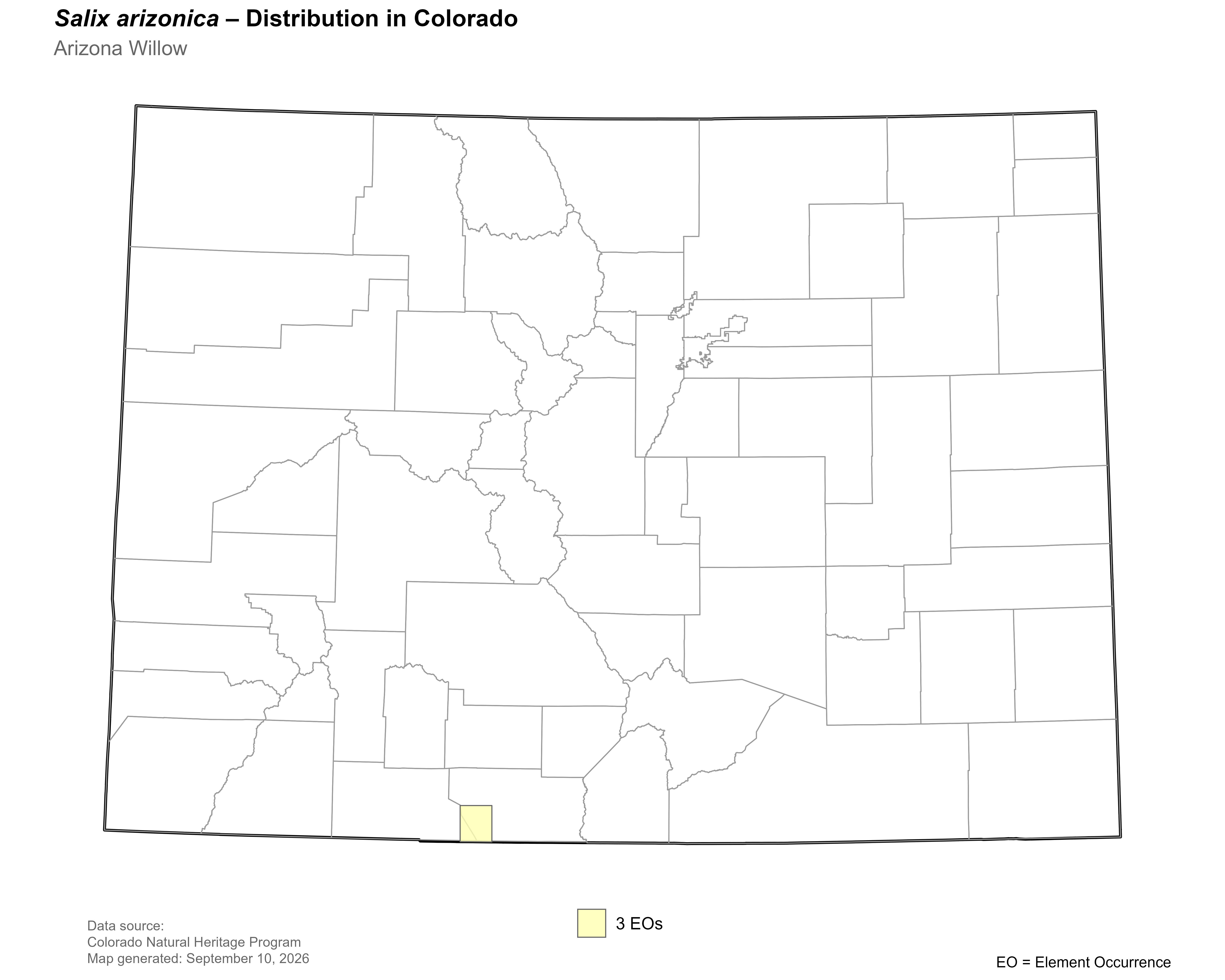
Salix arizonica is known from Conejos County in Colorado, USA. This species can also be found in Arizona, New Mexico, and Utah, USA. Estimated range extent in Colorado of 10 square kilometers was calculated in GeoCAT using occurrence data provided by the Colorado Natural Heritage Program (2023).
Click on map to enlarge |
Threats and Management Issues
The primary threat at this time is considered to be incompatible grazing (Rondeau et al. 2011). Threats to the persistence of Salix arizonica in U.S. Forest Service Region 2 are grazing by domestic and wild ungulates, hydrologic alterations, impacts from timber harvesting, impacts from recreational use, consequences arising from small population sizes, and global climate change. The detrimental effects of grazing and altered hydrology have been documented in occurrences outside Region 2 (Decker 2006). Locally, one of the three occurrences documented 40-50% browsing use by livestock and elk on S. arizonica in a single season and it is also bisected by a highway. A second occurrence is being impacted by the Cumbres railroad, and the third occurrence is undisturbed. This species is considered to have low adaptive capacity and is expected to be moderately vulnerable to climate change under both RCP 4.5 and 8.5 scenarios, as assessed for the 2025 Colorado State Wildlife Action Plan (CNHP 2025).
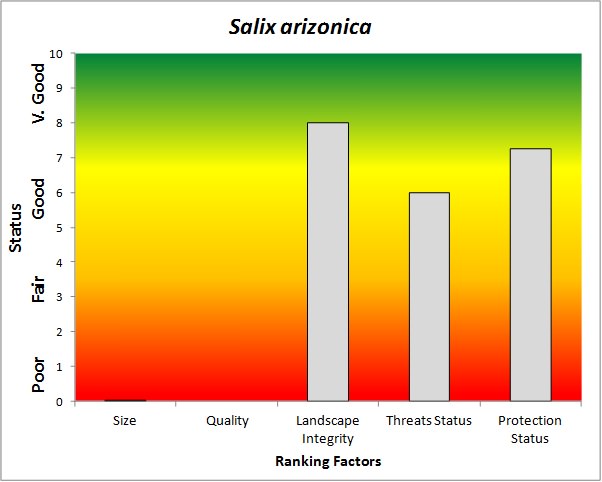
Summary results of an analysis of the status of Salix arizonica based on several ranking factors. This species was concluded to be "Moderately Conserved. From Rondeau et al. 2011. |
References
- Ackerfield, J. 2015. Flora of Colorado. BRIT Press, Botanical Research Institute of Texas, Fort Worth, TX. 818 pp.
- Argus, G. W. 2007. Salix (Salicaceae) distribution maps and a synopsis of their classification in North America, north of Mexico. Harvard Papers in Botany 12(2): 335-368.
- Arizona Game and Fish Department. 2002. Salix arizonica. Unpublished abstract compiled and edited by the Heritage Data Management System, Arizona Game and Fish Department, Phoenix, AZ. 4 pp.
- Colorado Natural Heritage Program (CNHP). 2025. Climate Change Vulnerability Assessment of Colorado Tier 1 and Tier 2 Plant Species of Greatest Conservation Need (SCGN) for the 2025 Colorado State Wildlife Action Plan. Colorado Natural Heritage Program, Colorado State University, Fort Collins.
- Culver, D.R. and J.M. Lemly. 2013. Field Guide to Colorado's Wetland Plants; Identification, Ecology and Conservation. Colorado Natural Heritage Program, Colorado State University, Fort Collins, 694 pp.
- Decker, K. 2006. Salix arizonica Dorn (Arizona willow): A technical conservation assessment. USDA Forest Service, Rocky Mountain Region. Online. Available: http://www.fs.fed.us/r2/projects/scp/assessments/salixarizonica.pdf (Accessed 2009).
- Flora of North America Editorial Committee, ed. (FNA). 1993+. Flora of North America North of Mexico. Oxford Univ. Press, New York, Oxford.
- Handwerk, J., L. Grunau, and S. Panjabi. 2015. Colorado Wildlife Action Plan: 2015 Rare Plant Addendum. Colorado Natural Heritage Program, Colorado State University, Fort Collins, Colorado, USA.
- Holmgren, N.H., P.K. Holmgren, and A. Cronquist. 2005. Intermountain flora. Volume 2, part B. Subclass Dilleniidae. The New York Botanical Garden Press. 488 pages.
- Mygatt, J. 1999. New Mexico Rare Plants: Salix arizonica (Arizona willow). New Mexico Rare Plant Technical Council, Albuquerque, New Mexico. Online. Available: http://nmrareplants.unm.edu (Version 15 March 2002). Accessed 2003, June 17.
- Neely, B., S. Panjabi, E. Lane, P. Lewis, C. Dawson, A. Kratz, B. Kurzel, T. Hogan, J. Handwerk, S. Krishnan, J. Neale, and N. Ripley. 2009. Colorado Rare Plant Conservation Strategy, Developed by the Colorado Rare Plant conservation Initiative. The Nature Conservancy, Boulder, Colorado, 117 pp.
- Rondeau, R., K. Decker, J. Handwerk, J. Siemers, L. Grunau, and C. Pague. 2011. The state of Colorado's biodiversity 2011. Prepared for The Nature Conservancy. Colorado Natural Heritage Program, Colorado State University, Fort Collins, Colorado.
- U.S. Fish and Wildlife Service (USFWS). 1995. Withdrawal of proposed rule to list the plant Salix arizonica (Arizona willow) as endangered with critical habitat. Federal Register 60(82): 20951-20952.
- USDA, NRCS. 2022. The PLANTS Database. National Plant Data Team, Greensboro, NC 27401-4901 USA.
- Weber, W. A. and R. C. Wittmann. 2012. Colorado Flora, Eastern Slope, A Field Guide to the Vascular Plants, Fourth Edition. Boulder, Colorado. 555 pp.
- Weber, W. A. and R. C. Wittmann. 2012. Colorado Flora, Western Slope, A Field Guide to the Vascular Plants, Fourth Edition. Boulder, Colorado. 532 pp.
- Welsh, S.L., N.D. Atwood, S. Goodrich and L.C. Higgins. (Eds.) 2008. A Utah Flora. 4th edition, revised. Brigham Young University, Provo, Utah, U.S.A. 1019 pp.