

Scientific Name : Physaria scrotiformis
Author : O'Kane NatureServe Explorer
Common Name : West Silver Bladderpod
 Current Research Activities


☰ Click link below for details.
Taxonomy
Brassicaceae (mustard family)
This species was first described in 2007 (O'Kane 2007).
Ranks and Status
State Rank : S1
State Rank Reason : Physaria scrotiformis is endemic to southwestern Colorado, USA, where it is known from only four occurrences within a limited range. Potential threats include trampling and erosion from sheep grazing and hiking within occupied habitat. Physaria scrotiformis is also considered to be extremely vulnerable to the effects of climate change.
U.S. Endangered Species Act : none
Colorado Threatened and Endangered List : none
Other Statuses : SWAP SGIN, USFS, USFS RGNF
Description and Phenology
General Description:
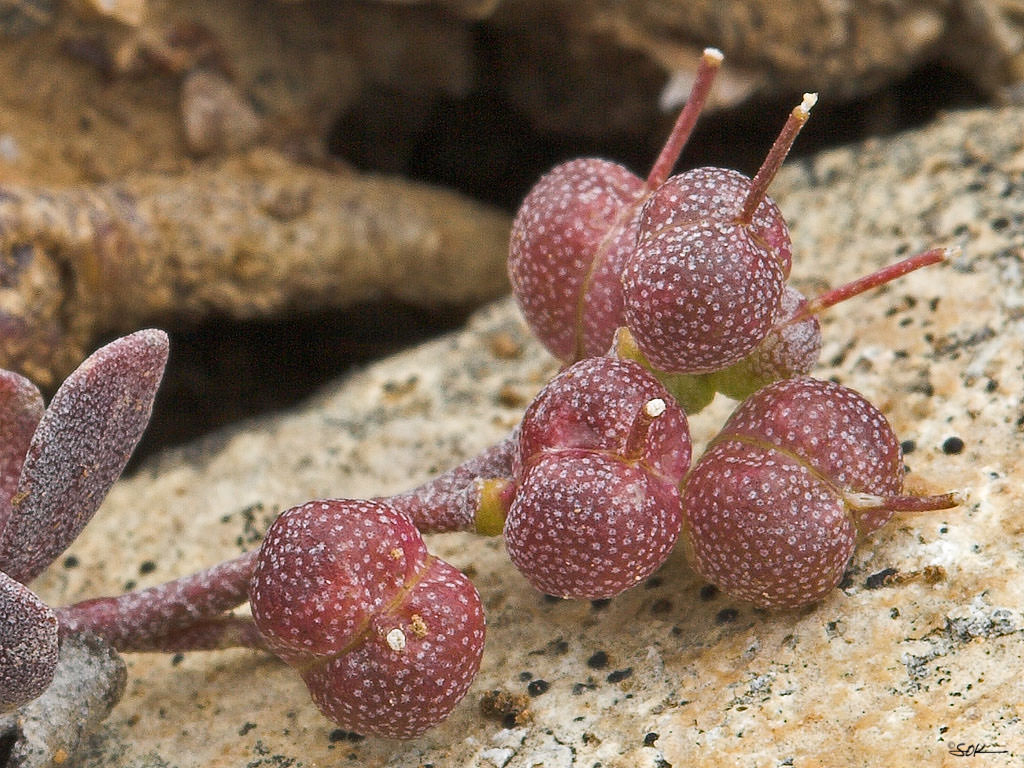
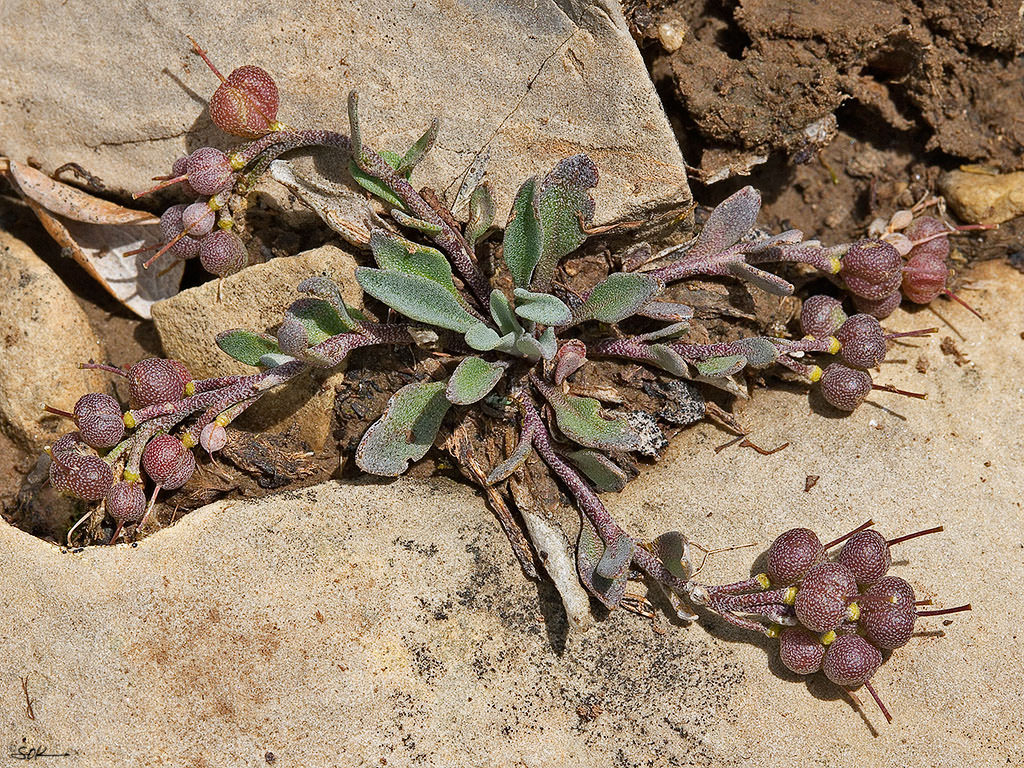
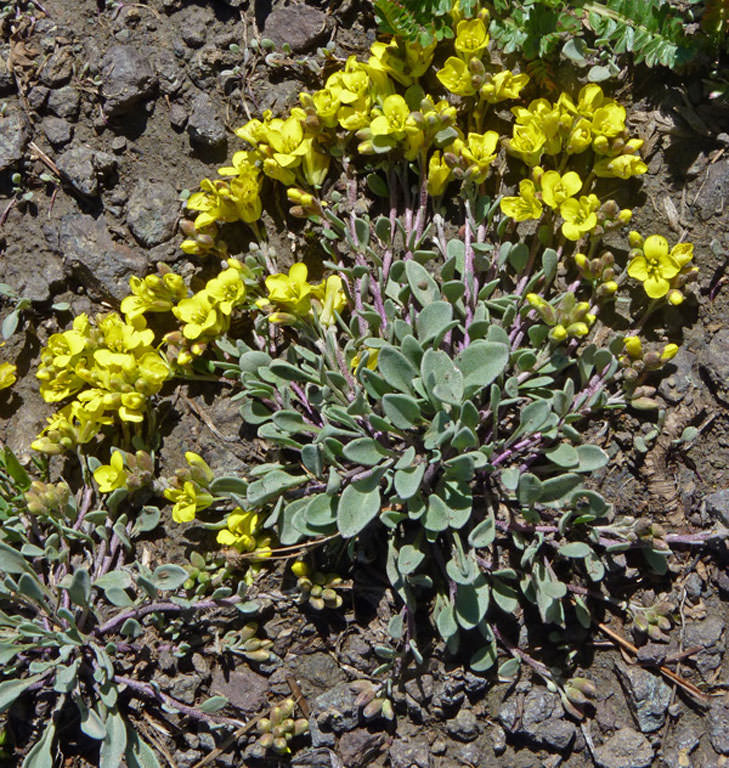
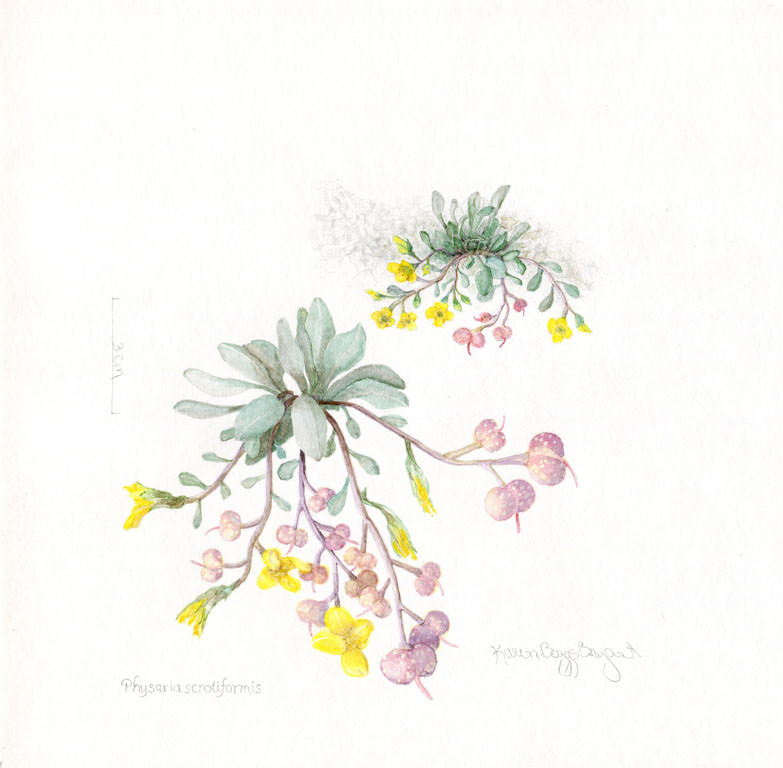
Physaria scrotiformis is a long-lived perennial from a simple or sparsely branched underground caudex. Plants are silvery-gray-green to silvery-purplish, the silver color due to a dense covering of trichomes. Stems are 0.8 to 3 cm long, unbranched, purplish, arising lateral (beneath) the erect or ascending tuft of basal leaves, prostrate to slightly decumbent, from stem tip to stem tip plants up to 10 cm, but typically less than 5.5 cm in diameter. Basal leaves are entire, oblanceolate, elliptic or rhombic, mostly flat, sometimes somewhat folded, attenuate at base and tapering to a slightly winged petiole. Apex rounded to rounded-acute, including the petiole, encrusted with trichomes. Cauline leaves are entire, elliptic to oblanceolate, short-petiolate to essentially entire, 3 to 7 per stem. Infructescence, not elongating appreciably, is a raceme with 3 to 7, more or less crowded fruits, these on straight, ascending pedicels 1.8 to 3.4 mm long. Silicles on stipes 0.2 to 0.5 mm long, ovoid to obpyriform, slightly but obviously didymous (especially in living material), apex rounded, flattened, or even slightly emarginate; base rounded-obtuse; wider than long; 3 to 4.5 mm long and 3.7 to 5 mm wide, the valves inflated and a little wider than the replum; valves glabrous within, the exterior with scattered trichomes; becoming purplish or greenish-purple at maturity; replum entire or medially small-perforate, obovate to rounded-obdeltoid, rounded to obtuse or truncate at the apex (O'Kane 2007).
Look Alikes:
Not likely to be confused with other taxa in this habitat in this part of Colorado.
Phenology:
Fruiting in July (O'Kane 2007, Colorado Natural Heritage Program 2012).
 |
Habitat
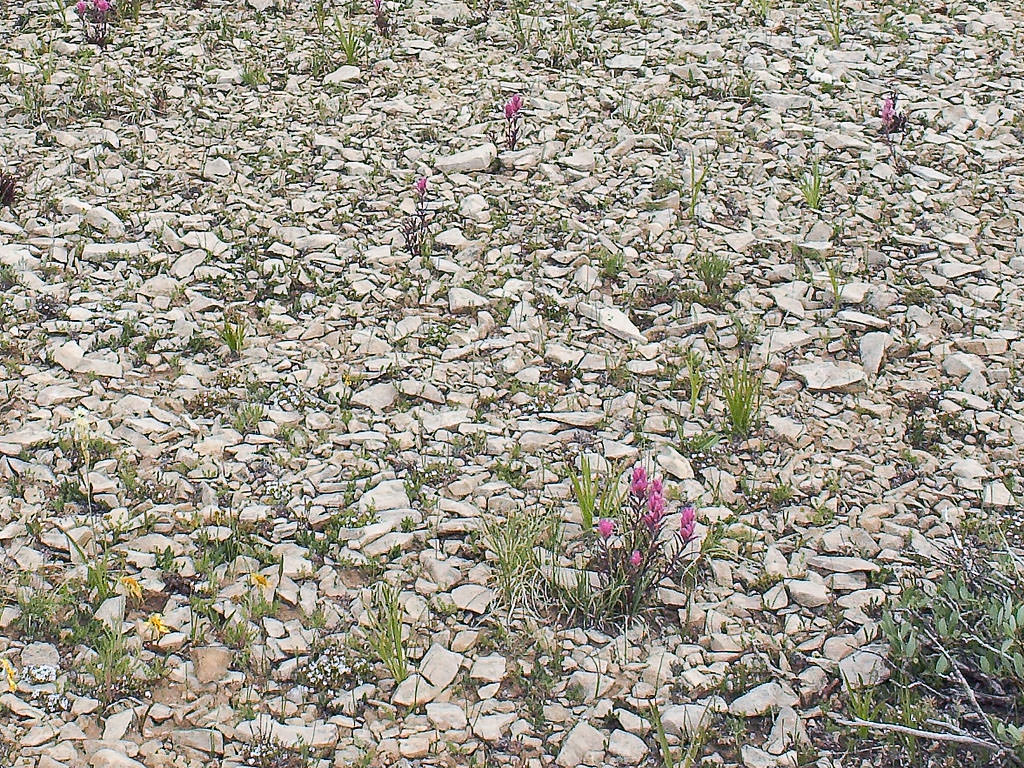
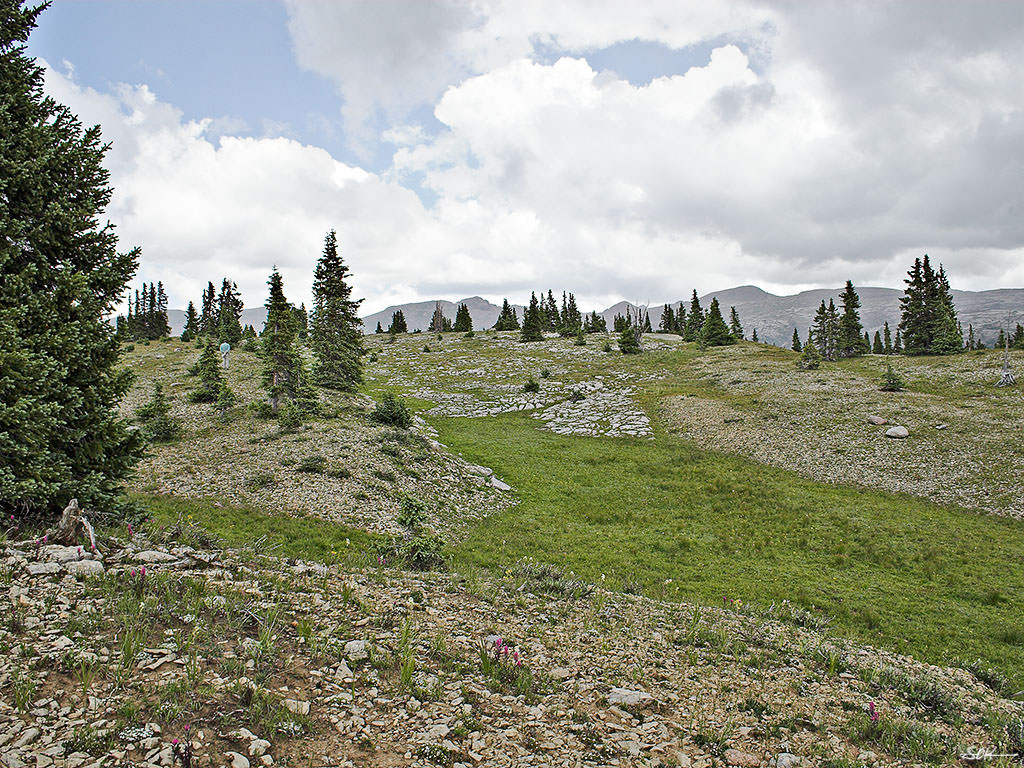
Grows on windswept, nearly barren exposures of Leadville limestone in a matrix of Picea engelmannii islands and tundra. Associates on the nearly barren spots where the species occurs include Minuartia obtusiloba, Zigadenus elegans, Castilleja haydenii, Pseudocymopterus montana, Poa alpina, Hymenoxys grandiflora, Allium geyeri, Townsendia rothrockii and Trisetum spicatum. The plants grow in shallow soil between grey and tan-grey limestone cobbles (O'Kane 2007).
click on image to enlarge
 |
 |
Elevation Range:
11,555 - 12,533 feet (3,522 - 3,820 meters)
Distribution
Colorado Endemic:
Yes
Range:
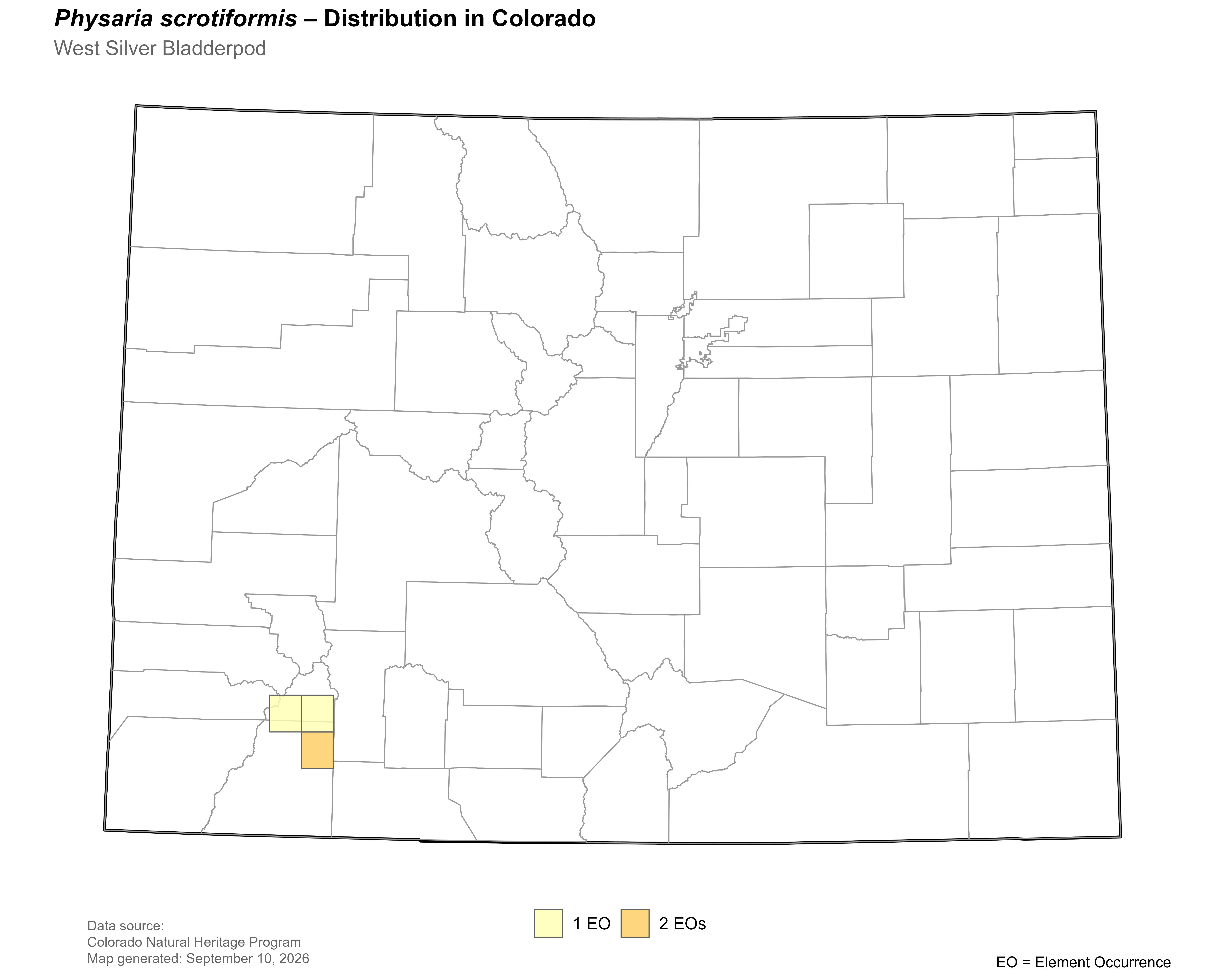
Physaria scrotiformis is endemic to Colorado (USA) where it occurs on in the upper sub-alpine to lower alpine zone of the San Juan Mountains in La Plata and San Juan counties. The estimated range extent in Colorado of 284 square kilometers was calculated in GeoCAT using occurrence data provided by the Colorado Natural Heritage Program (2023).
Click on map to enlarge |
Threats and Management Issues
All of the habitat of Physaria scrotiformis is contained within the Weminuche Wilderness Area (O'Kane 2007). However, with no appropriate contiguous or nearby limestone substrate at higher elevations to allow for population migration, global warming could present a real threat to the species, especially if vegetation types at lower elevations were to invade the inhabited sites (O'Kane 2007). Other threats may include sheep grazing and hiking; some populations are in the vicinity of popular hiking trails on the Continental Divide, and evidence of trampling, erosion and habitat alteration by sheep has been observed (CNHP 2023). This species is considered to be extremely vulnerable to climate change (Handwerk et al. 2015).
References
- Ackerfield, J. 2012. The Flora of Colorado. Colorado State University Herbarium. 433 pp.
- Flora of North America Editorial Committee (FNA). 2010. Flora of North America north of Mexico. Vol. 7. Magnoliophyta: Salicaceae to Brassicaceae. Oxford University Press, New York. xxii + 797 pp.
- Handwerk, J., L. Grunau, and S. Panjabi. 2015. Colorado Wildlife Action Plan: 2015 Rare Plant Addendum. Colorado Natural Heritage Program, Colorado State University, Fort Collins, Colorado, USA.
- Heil, K.D., S.L. O'Kane Jr., L.M. Reeves, and A. Clifford, 2013. Flora of the Four Corners Region, Vascular Plants of the San Juan River Drainage; Arizona, Colorado, New Mexico, and Utah. Missouri Botanical Garden Press, St. Louis, Missouri. 1098 pp.
- Lavender, A.E., M.M. Fink, S.E. Linn, D.M. Theobald. 2011. Colorado Ownership, Management, and Protection v9 Database. Colorado Natural Heritage Program and Geospatial Centroid, Colorado State University, Fort Collins, CO. (30 September).
- Neely, B., S. Panjabi, E. Lane, P. Lewis, C. Dawson, A. Kratz, B. Kurzel, T. Hogan, J. Handwerk, S. Krishnan, J. Neale, and N. Ripley. 2009. Colorado Rare Plant Conservation Strategy, Developed by the Colorado Rare Plant conservation Initiative. The Nature Conservancy, Boulder, Colorado, 117 pp.
- O'Kane, S.L., Jr. 2007. Physaria scrotiformis (Brassicaceae), a new high-elevation species from southwestern Colorado and new combinations in Physaria. Novon 17(3): 376-382.
- Schneider, A. 2013. Wildflowers, Ferns, and Trees of the Four Corners Regions of Colorado, New Mexico, Arizona, and Utah. Accessed on-line at http://www.swcoloradowildflowers.com.
- USDA, NRCS. 2022. The PLANTS Database. National Plant Data Team, Greensboro, NC 27401-4901 USA.
- Weber, W. A. and R. C. Wittmann. 2012. Colorado Flora, Eastern Slope, A Field Guide to the Vascular Plants, Fourth Edition. Boulder, Colorado. 555 pp.
- Weber, W. A. and R. C. Wittmann. 2012. Colorado Flora, Western Slope, A Field Guide to the Vascular Plants, Fourth Edition. Boulder, Colorado. 532 pp.