

Scientific Name : Penstemon retrorsus
Author : Payson ex Pennell NatureServe Explorer
Common Name : Adobe Beardtongue
 Current Research Activities
 1997 profile


☰ Click link below for details.
Taxonomy
Plantaginaceae (plantain family)
Weber and Wittmann (2012) lump this taxon with P. caespitosus Nuttall. Ackerfield (2015, 2022) and the USDA NRCS PLANTS database recognize Penstemon retrorsus, and, along with others, place the genus Penstemon in the Plantaginaceae, the Plantain Family.
Ranks and Status
State Rank : S3
State Rank Reason : Penstemon retrorsus is a Colorado, USA, endemic known from a limited distribution in Delta and Montrose counties. There area at least 2 occurrences with very large population sizes. Threats from ORV use have been reported, other potential threats include incompatible livestock grazing and long-term drought. Competition from invasive plant species, especially in habitat disturbed by grazing or motorized recreation is also a threat. This species is expected to be highly to extremely vulnerable to climate change.
U.S. Endangered Species Act : none
Colorado Threatened and Endangered List : none
Other Statuses : SWAP Tier 2, USFS GMUG
Description and Phenology
General Description:
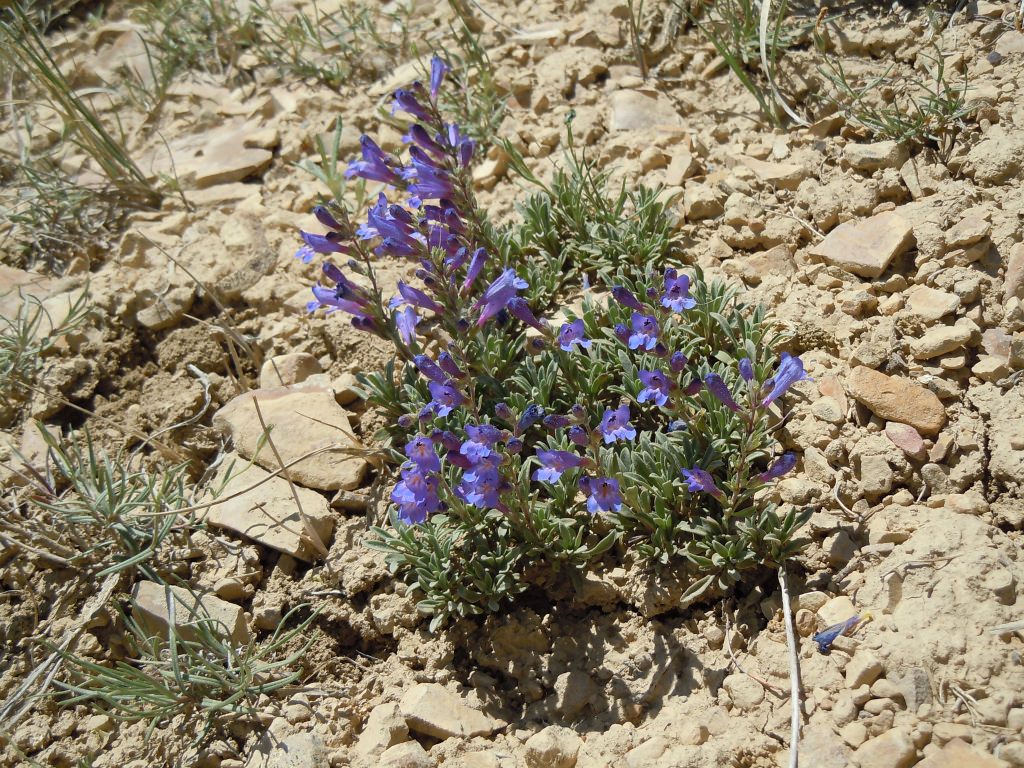
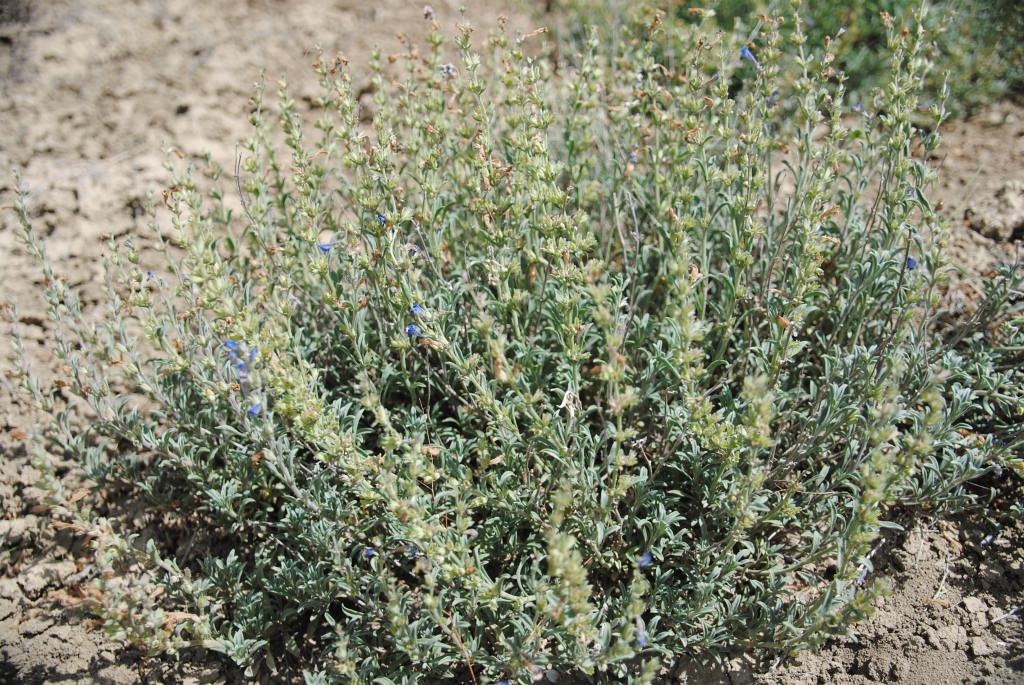
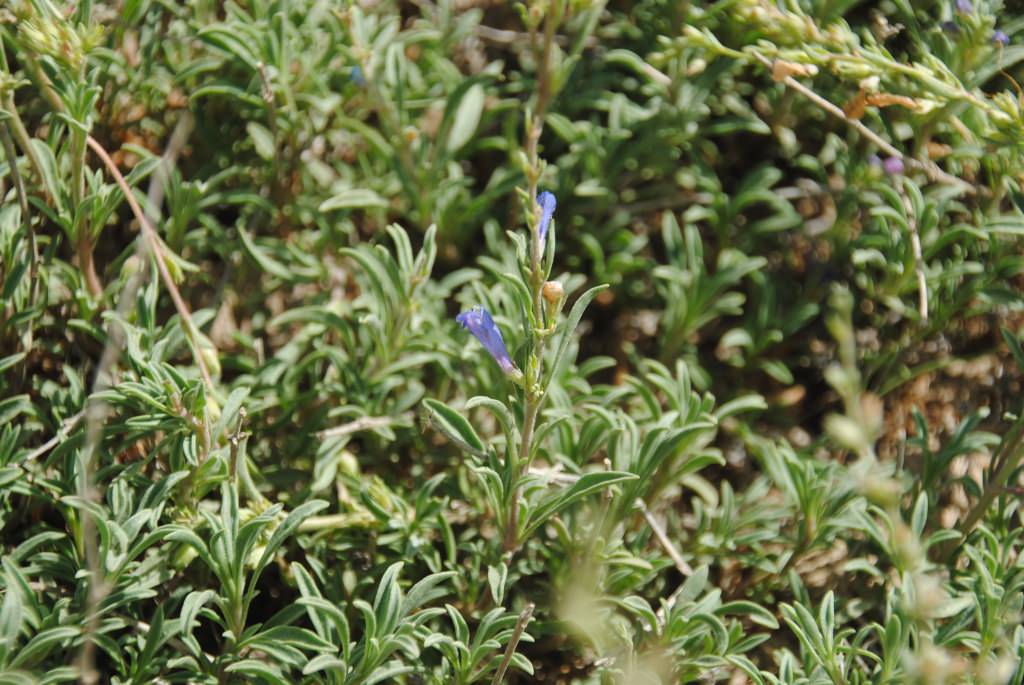
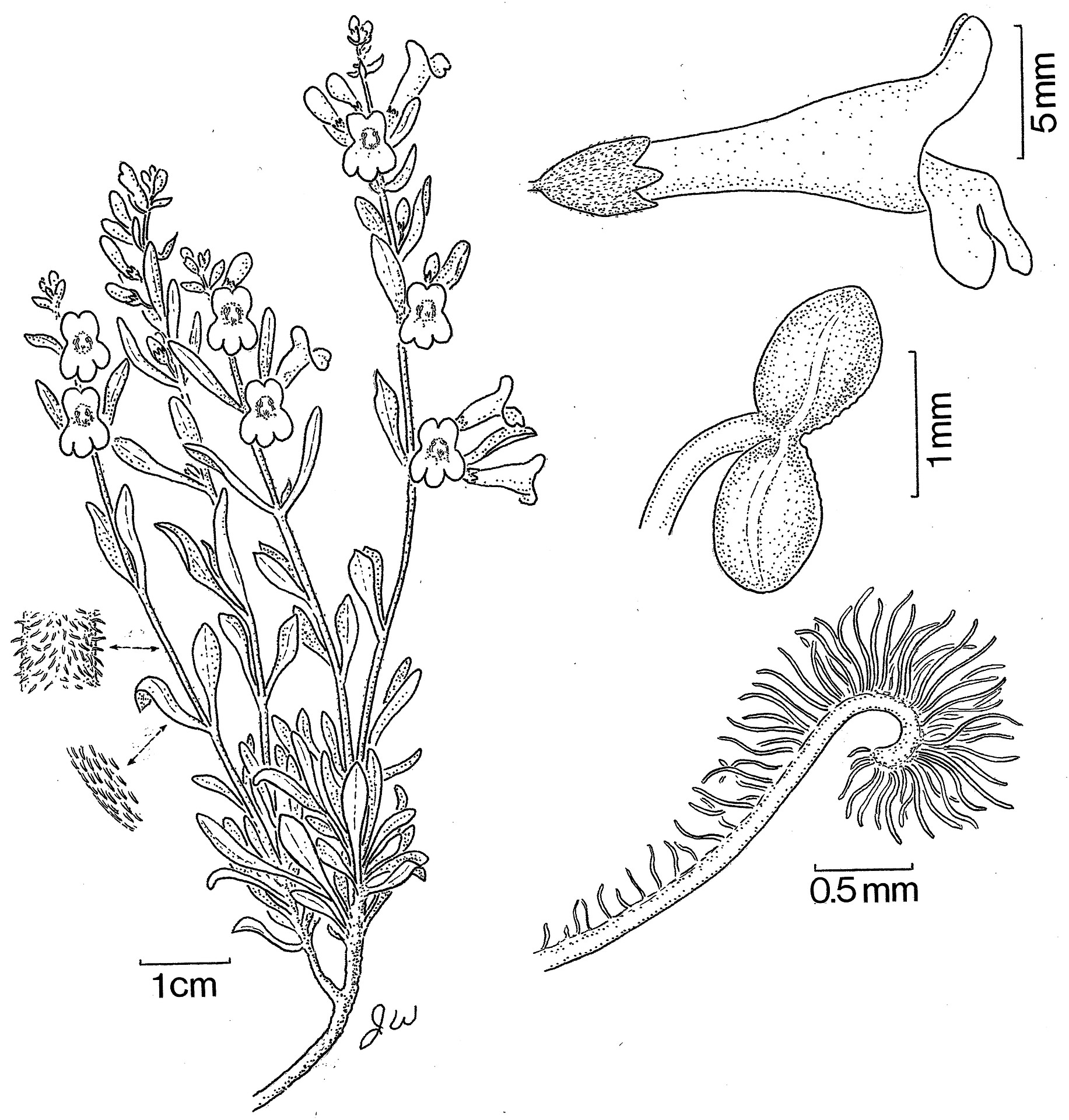
Mat forming, erect perennial with small basal leaves. Stems 1-2 dm tall, cinereous (ashy gray). Leaves entire, cinereous with dense, retrorse pubescence (hairs which point backwards toward the base of the leaves or the stems). Flowering stem erect, greatly exceeding the basal leaves. Calyx cinereous-pubescent, 3-5 mm long. Corolla bluish-purple, throat flattened and 2 ridged within on lower side. Staminode slender, bearded most of its length, anthers glabrous (Colorado Native Plant Society 1989, Spackman et al. 1997, Ackerfield 2015).
Look Alikes:
Distinguished from other species by its mat-forming habit, small basal leaves with dense retrorse pubescence, and specific habitat (Spackman et al. 1997).
Phenology:
Flowers from early May until early June, in fruit by mid June (Spackman et al. 1997).
 |
Habitat
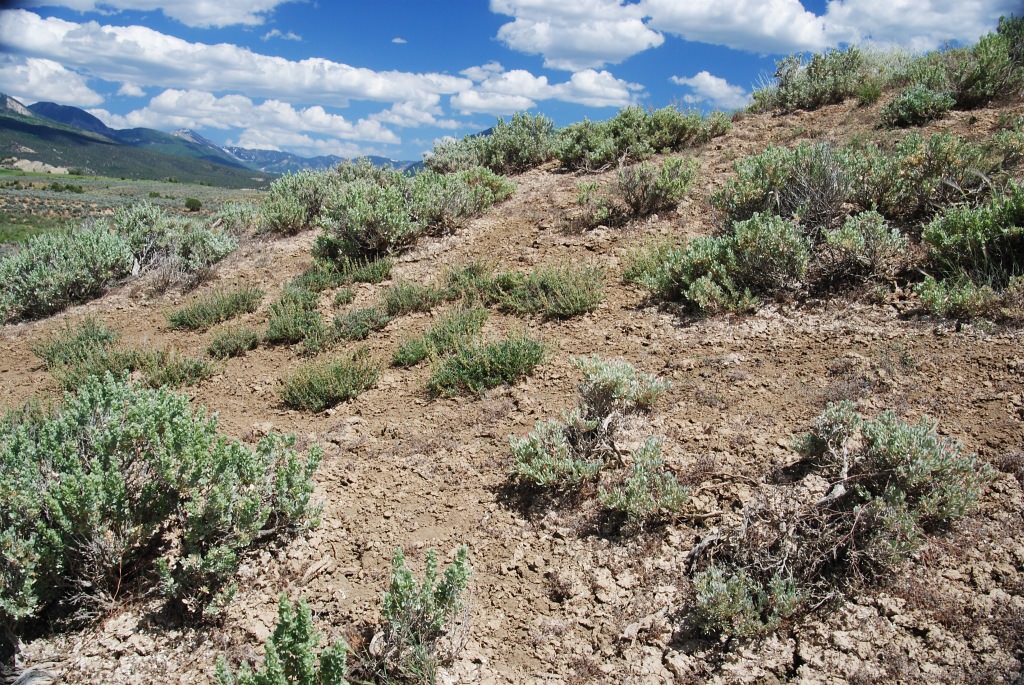
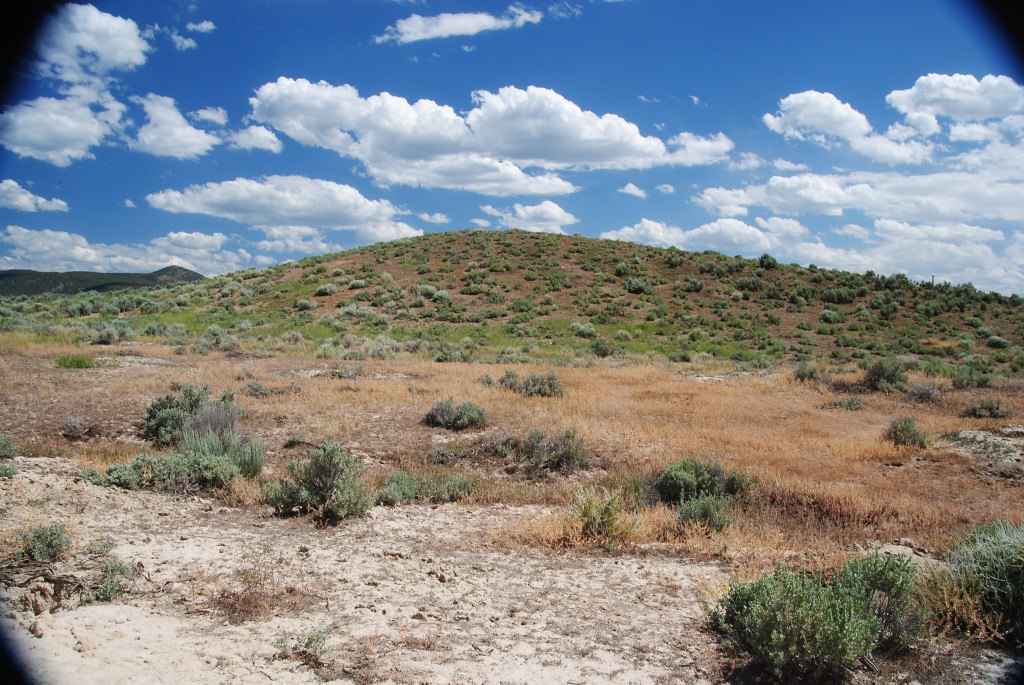
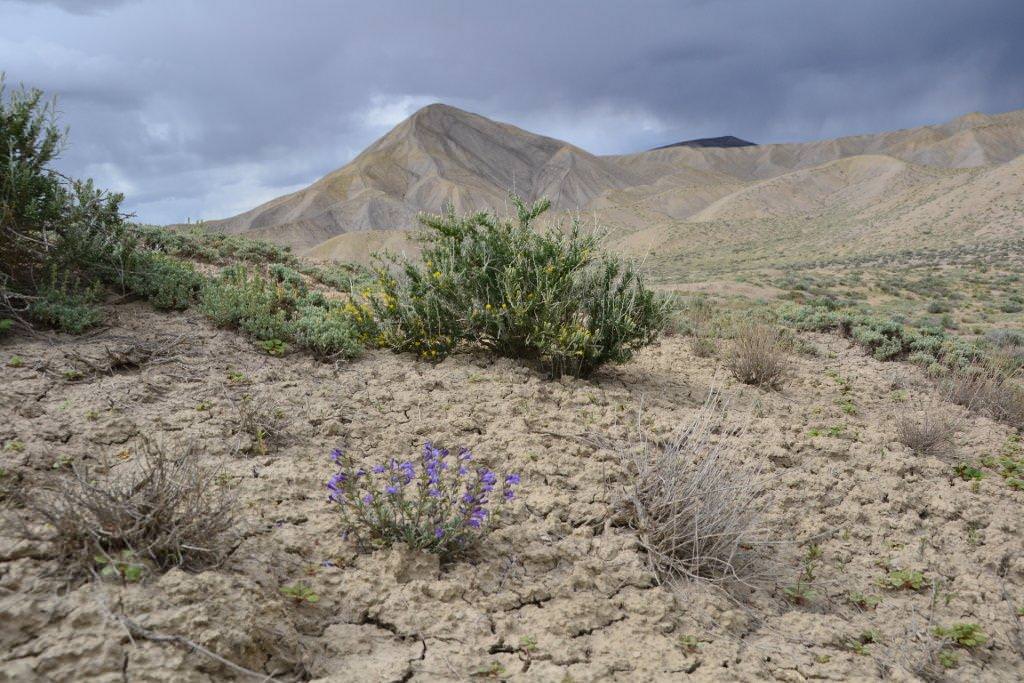
Barren gray adobe hills of Mancos Formation shale where there is a relatively high amount of moisture (in drainage areas or on the north sides of hills). Clayey, alkaline soils; associated with saltbush and/or sagebrush (Spackman et al. 1997). Additional associated taxa include Gutierrezia, Juniperus, Yucca, and Artemisia.
click on image to enlarge
 |
 |
 |
Elevation Range:
5,382 - 9,070 feet (1,640 - 2,765 meters)
Distribution
Colorado Endemic:
Yes
Range:
Penstemon retrorsus is a Colorado, USA, endemic growing in a 15 mile long area in the northern fork of the Gunnison Valley and the Uncompahgre River Valley, in Delta and Montrose counties. Estimated range extent in Colorado of 1038 square kilometers was calculated in GeoCAT using occurrence data provided by the Colorado Natural Heritage Program (2023).
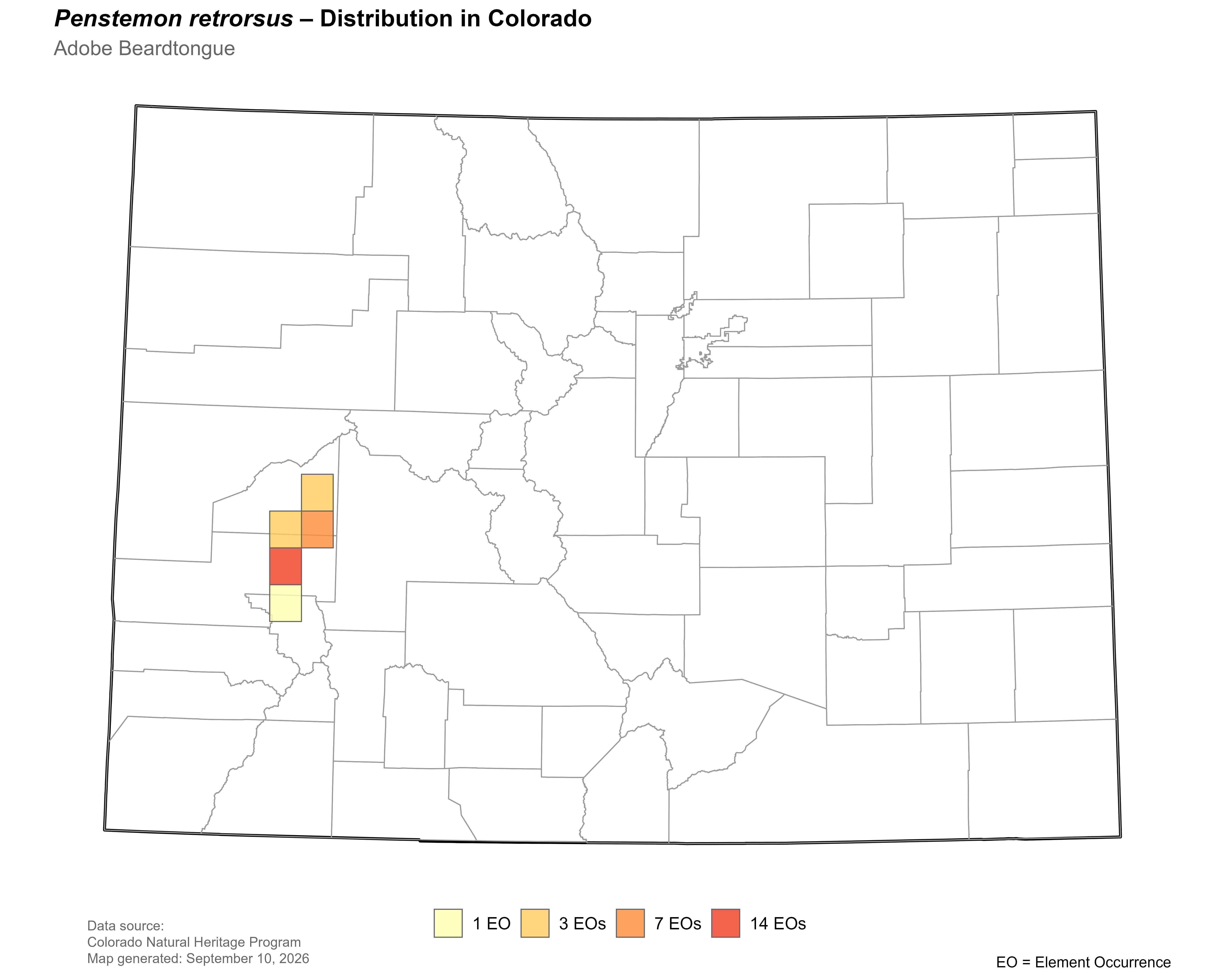
Click on map to enlarge |
Threats and Management Issues
Motorized recreation, including four-wheel drive vehicle, motorcycle and ATV use on the shale hills is the primary threat to P. retrorosus, and has been reported from approximately one-third of the occurrences. Livestock grazing, primarily sheep is also a concern in many of the occurrences, but the plants do seem to be tolerant of intermittent winter sheep grazing. Competition from invasive plant species, especially in habitat disturbed by grazing or motorized recreation is also a threat. The exotic species Bromus tectorum, Halogeton glomeratus, Chorispora tenella, and Ranunculus testiculatus have been observed at several occurrences. This species is considered to have moderate adaptive capacity and is expected to be moderately to extremely vulnerable to climate change under both RCP 4.5 and 8.5 scenarios, as assessed for the 2025 Colorado State Wildlife Action Plan (CNHP 2025).
References
- Ackerfield, J. 2015. Flora of Colorado. BRIT Press, Botanical Research Institute of Texas, Fort Worth, TX. 818 pp.
- Ackerfield, Jennifer. 2022. Flora of Colorado. Second Edition. Bot. Misc. 60. BRIT Press, Fort Worth Botanic Garden/Botanical Research Institute of Texas, U.S.A. 861 pp.
- Colorado Native Plant Society. 1989. Rare plants of Colorado. Rocky Mountain Nature Association, Colorado Native Plant Society, Estes Park, Colorado. 73 pp.
- Colorado Natural Heritage Program (CNHP). 2025. Climate Change Vulnerability Assessment of Colorado Tier 1 and Tier 2 Plant Species of Greatest Conservation Need (SCGN) for the 2025 Colorado State Wildlife Action Plan. Colorado Natural Heritage Program, Colorado State University, Fort Collins, CO.
- Colorado Natural Heritage Program and the Geospatial Centroid. 2017. The Colorado Ownership and Protection Map (COMaP). Colorado State University, Ft. Collins, CO.
- Harmon, W., B. Johnston, and J.S. Peterson. 1981. Status report on Penstemon retrorsus. Unpublished report prepared for the Colorado Natural Areas Program, Denver, CO.
- O'Kane, S. L. 1988. Colorado's Rare Flora. Great Basin Naturalist. 48(4):434-484.
- Spackman, S., B. Jennings, J. Coles, C. Dawson, M. Minton, A. Kratz, and C. Spurrier. 1997. Colorado rare plant field guide. Prepared for Bureau of Land Management, U.S. Forest Service and U.S. Fish and Wildlife Service by Colorado Natural Heritage Program.
- USDA, Natural Resources Conservation Service, PLANTS Database [USDA PLANTS]. http://plants.usda.gov/. Accessed 2017.
- USDA, NRCS. 2022. The PLANTS Database. National Plant Data Team, Greensboro, NC 27401-4901 USA.
- Weber, W. A. and R. C. Wittmann. 2012. Colorado Flora, Western Slope, A Field Guide to the Vascular Plants, Fourth Edition. Boulder, Colorado. 532 pp.