

Scientific Name : Penstemon penlandii
Author : W.A. Weber NatureServe Explorer
Common Name : Kremmling Beardtongue
 Current Research Activities
 1997 profile
☰ Click link below for details.
Taxonomy
Plantaginaceae (plantain family)
Ackerfield (2015, 2022) places this genus in the Plantaginaceae family.
Ranks and Status
State Rank : S1
State Rank Reason : Penstemon penlandii is known from two occurrences within a very narrow range (about 12 square kilometers) in north-central Colorado, USA. Threats to Penstemon penlandii include motorized recreation, powerline maintenance and repair, competition with invasive plant species and damage or disturbance from road maintenance. Prolonged drought and habitat alteration due to climate change within the species range are also significant threats to Penstemon penlandii.
U.S. Endangered Species Act : ESA Endangered
Colorado Threatened and Endangered List : none
Other Statuses : SWAP Tier 1
Description and Phenology
General Description:
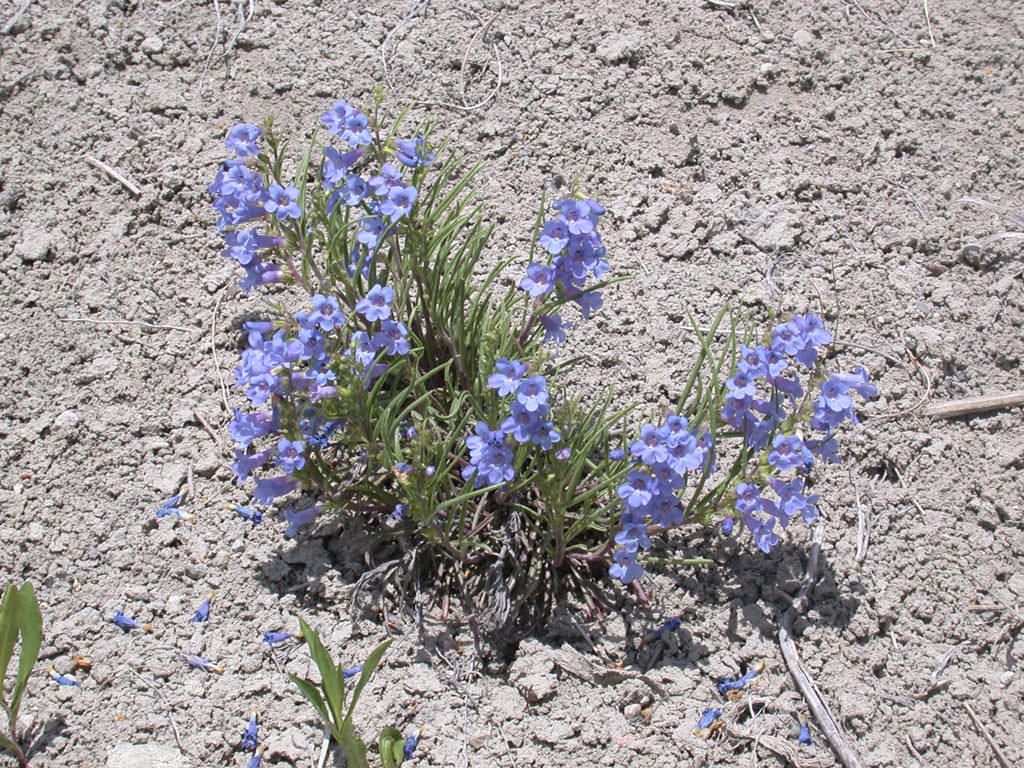
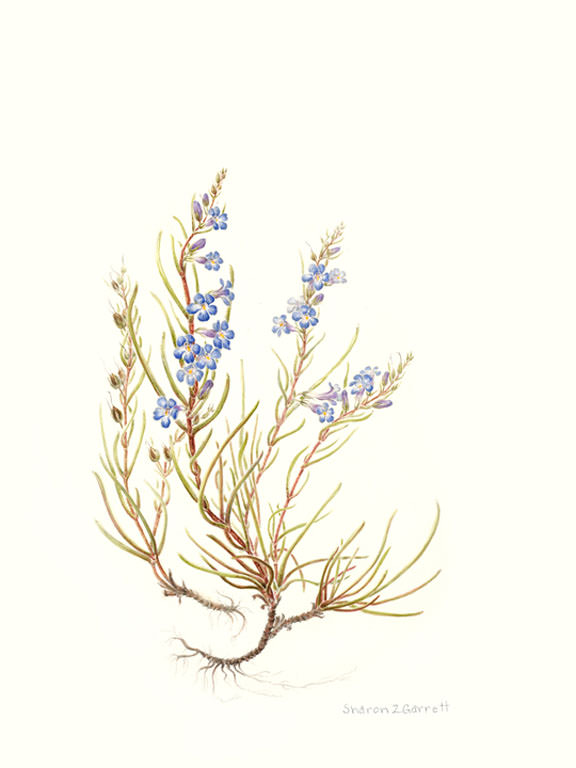
Compact herbaceous perennials up to 25 cm tall and 20 cm wide. Stems are clumped and pubescent. Leaves are linear, 1-2 mm side, involute or folded. Flowers are about 2 cm long, and are bicolored with blue lobes and violet throats. Anthers have short hairs, and the staminode is bearded (Spackman et al. 1997).
Look Alikes:
Not likely to be confused with other Penstemon species in the region. Disjunct from nearest relatives by nearly 150 miles (Spackman et al. 1997).
Phenology:
Flowers June-July; fruit August-September.
 |
Habitat
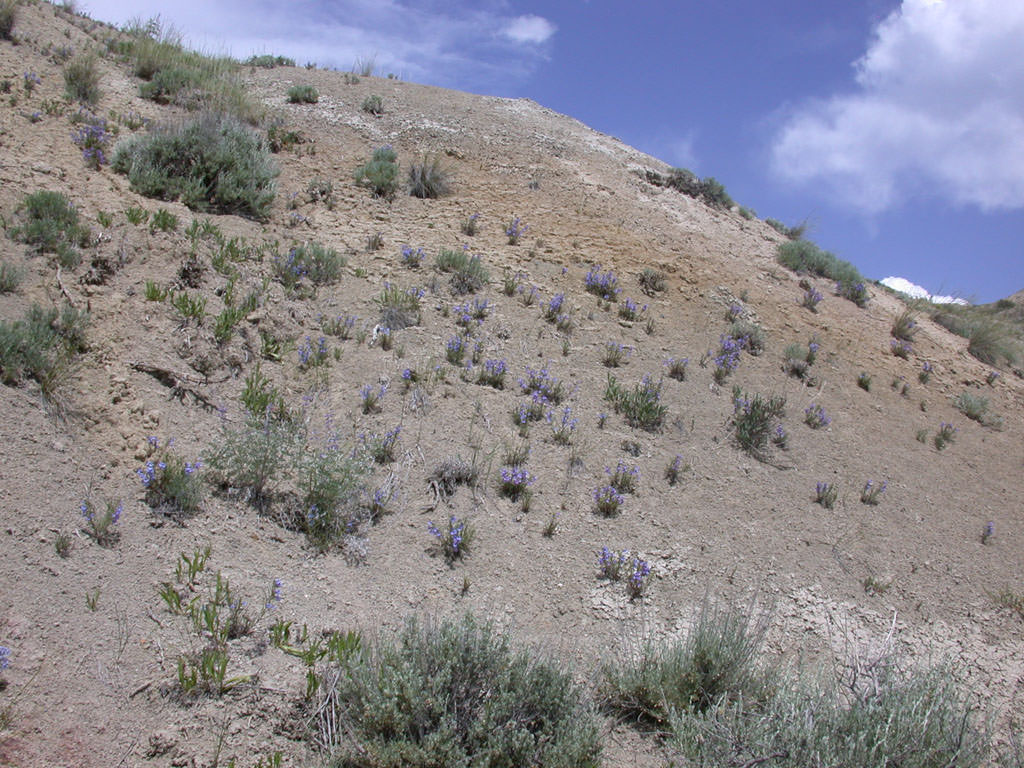
Strongly seleniferous clay-shales of the Troublesome Formation; on steep barrens with sparse plant cover, sagebrush badlands (Spackman et al. 1997). Occurs in the badlands of the Upper Cretaceous Niobrara Shales and on late Tertiary (Miocene Troublesome Formation) siltstone sediments in selenium-rich soils; open grassy vegetation with scattered shrubs of Artemisia tridentata, Chrysothamnus sp., Tetradymia sp., Symphoricarpus sp., and/or Cercocarpus sp. Common perennials include Lupinus sp. and Eriogonum sp. (Anderson 1991). It is often with Lomatium nuttallii, and/or Astragalus osterhoutii but also on steep barrens with sparse plant cover (Neely 1986).
click on image to enlarge
 |
Elevation Range:
7,396 - 8,091 feet (2,254 - 2,466 meters)
Distribution
Colorado Endemic:
Yes
Range:
Penstemon penlandii is a narrow endemic; known from Grand County, Colorado, USA. Estimated range extent in Colorado of 12 square kilometers was calculated in GeoCAT using occurrence data provided by the Colorado Natural Heritage Program (2022).
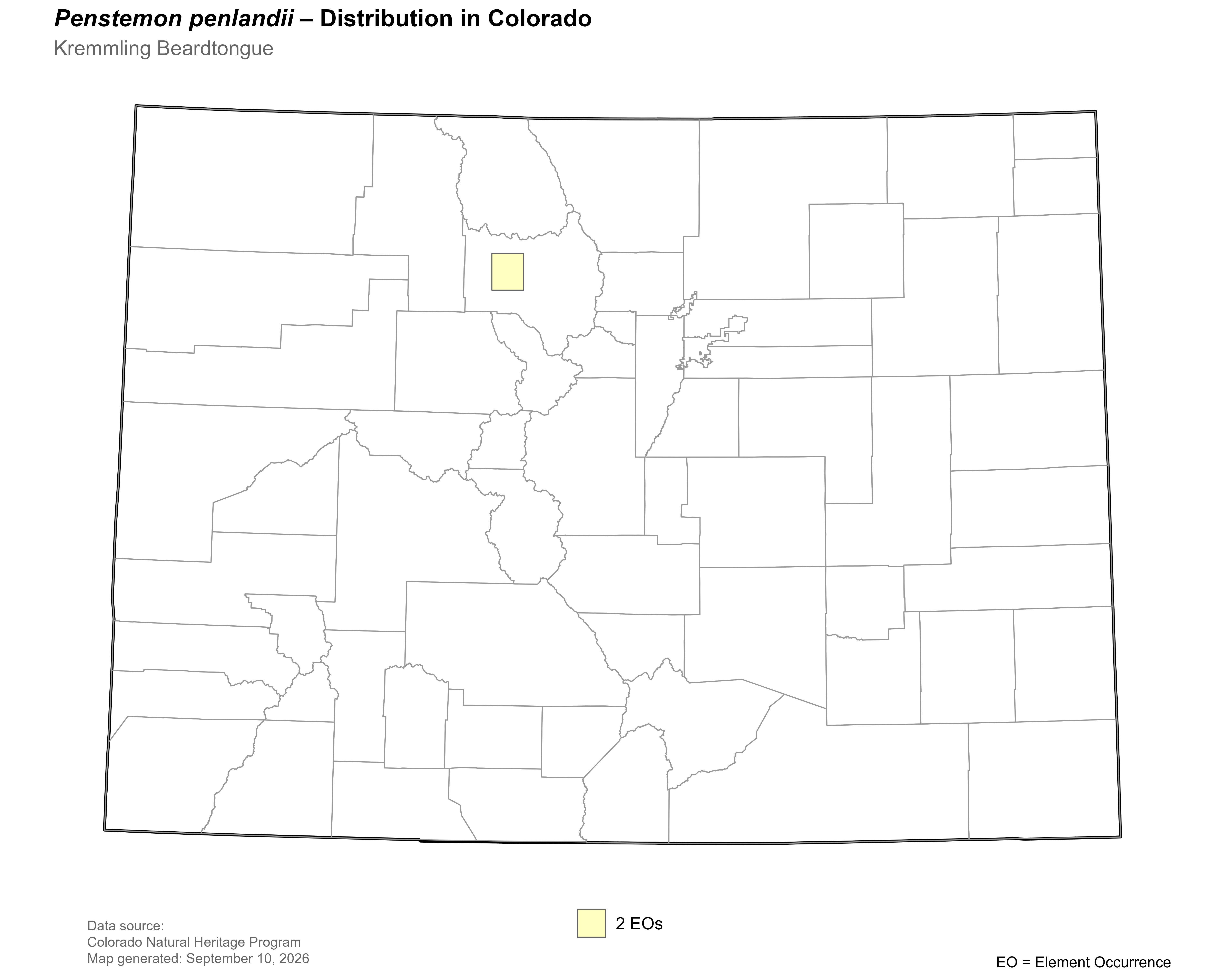
Click on map to enlarge |
Threats and Management Issues
Threats to Penstemon penlandii arise from several factors including motorized recreation, powerline maintenance and repair, climate change, competition with invasive plant species and damage or disturbance from road maintenance. Several dirt roads and two-track roads bisect the species habitat and both on and off-road motorized recreation has been documented within the occurrences (CNHP 2022). The steep topography and nature of the soils make this species' habitat vulnerable to destruction by off-road vehicles. Road widening and weed control are threats to the plants in some areas, and Russian thistle has been documented in portions of one occurrence (CNHP 2022). An electric transmission line runs through the main occurrence and maintenance and repair of the line could directly impact the species. Consecutive years of hotter and drier than average conditions, as observed from 2017-2021, have been visually correlated with decreasing Penstemon penlandii rosette density and had a pronounced effect on driving the decreasing population trends over the same duration (Krening 2021). This species is considered to have low adaptive capacity and is expected to be highly to extremely vulnerable to climate change under both RCP 4.5 and 8.5 scenarios, as assessed for the 2025 Colorado State Wildlife Action Plan (CNHP 2025). Additionally, the Colorado Natural Heritage Program considers all Penstemon species at risk of collectors targeting populations for use in gardens.
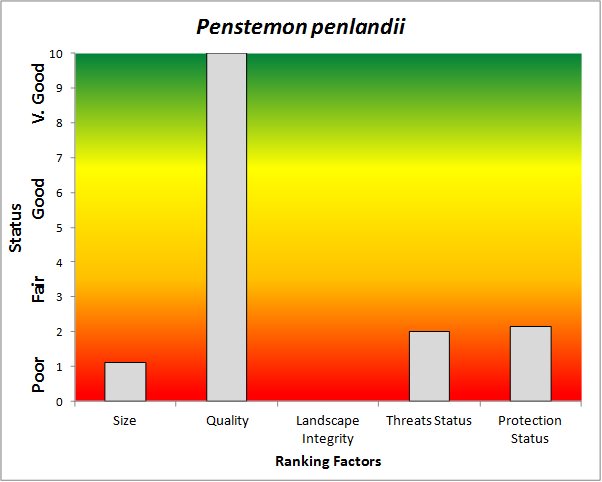
Summary results of an analysis of the status of Penstemon penlandii based on several ranking factors. This species was concluded to be "weakly conserved”. From Rondeau et al. 2011. |
References
- Ackerfield, J. 2012. The Flora of Colorado. Colorado State University Herbarium. 433 pp.
- Ackerfield, J. 2015. Flora of Colorado. BRIT Press, Botanical Research Institute of Texas, Fort Worth, TX. 818 pp.
- Ackerfield, J. 2022. Flora of Colorado. Second Edition. Bot. Misc. 60. BRIT Press, Fort Worth Botanic Garden/Botanical Research Institute of Texas, U.S.A. 861 pp.
- Anderson, J. 1991. Astragalus osterhoutii and Penstemon penlandii recovery plan. Unpublished report prepared for the US Fish and Wildlife Service, Denver, CO.
- Colorado Native Plant Society. 1989. Rare plants of Colorado. Rocky Mountain Nature Association, Colorado Native Plant Society, Estes Park, Colorado. 73 pp.
- Colorado Natural Heritage Program (CNHP). 2022. Biodiversity Tracking and Conservation System (Biotics 5). Colorado Natural Heritage Program, Colorado State University, Fort Collins.
- Colorado Natural Heritage Program (CNHP). 2025. Climate Change Vulnerability Assessment of Colorado Tier 1 and Tier 2 Plant Species of Greatest Conservation Need (SCGN) for the 2025 Colorado State Wildlife Action Plan. Colorado Natural Heritage Program, Colorado State University, Fort Collins.
- Handwerk, J., L. Grunau, and S. Panjabi. 2015. Colorado Wildlife Action Plan: 2015 Rare Plant Addendum. Colorado Natural Heritage Program, Colorado State University, Fort Collins, Colorado, USA.
- Krening, P. 2021. Penland’s beardtongue (Penstemon penlandii) population trend monitoring summary-2021. Prepared for the Colorado State Office - Bureau of Land Management, U.S. Department of the Interior.
- Krening, P. 2021. Penland’s beardtongue (Penstemon penlandii) population trend monitoring summary-2021. Prepared for the Colorado State Office - Bureau of Land Management, U.S. Department of the Interior.
- Krening, P. 2022. Penland’s beardtongue (Penstemon penlandii) Population Trend Monitoring Summary-2022. Prepared for the Colorado State Office - Bureau of Land Management, U.S. Department of the Interior.
- Neale, J.R. and M. DePrenger-Levin. 2008. Report to the Bureau of Land Management on the survey work conducted for Penstemon penlandii W.A. Weber (Penland's penstemon).
- Neely, B., S. Panjabi, E. Lane, P. Lewis, C. Dawson, A. Kratz, B. Kurzel, T. Hogan, J. Handwerk, S. Krishnan, J. Neale, and N. Ripley. 2009. Colorado Rare Plant Conservation Strategy, Developed by the Colorado Rare Plant conservation Initiative. The Nature Conservancy, Boulder, Colorado, 117 pp.
- O'Kane, S. L. 1988. Colorado's Rare Flora. Great Basin Naturalist. 48(4):434-484.
- Rocky Mountain Society of Botanical Artists. 2009. RARE Imperiled Plants of Colorado, a traveling art exhibition. Exhibition catalogue developed by the Denver Botanic Gardens and Steamboat Art Museum.
- Rondeau, R., K. Decker, J. Handwerk, J. Siemers, L. Grunau, and C. Pague. 2011. The state of Colorado's biodiversity 2011. Prepared for The Nature Conservancy. Colorado Natural Heritage Program, Colorado State University, Fort Collins, Colorado.
- Spackman, S., B. Jennings, J. Coles, C. Dawson, M. Minton, A. Kratz, and C. Spurrier. 1997. Colorado rare plant field guide. Prepared for Bureau of Land Management, U.S. Forest Service and U.S. Fish and Wildlife Service by Colorado Natural Heritage Program.
- U.S. Fish and Wildlife Service (USFWS). 1988. Proposal to determine Astragalus osterhoutii and Penstemon penlandii to be endangered species. Federal Register 53(128): 25181-25185.
- USDA, NRCS. 2022. The PLANTS Database. National Plant Data Team, Greensboro, NC 27401-4901 USA.
- Weber, W. A. and R. C. Wittmann. 2012. Colorado Flora, Western Slope, A Field Guide to the Vascular Plants, Fourth Edition. Boulder, Colorado. 532 pp.
- Weber, W.A. 1986. Penstemon penlandii, spec. nov. (SCR) from Colorado. Phytologia 60(6): 459-461.