


Scientific Name : Penstemon luculentus
Author : R.L. Johnson & M.R. Stevens NatureServe Explorer
Common Name : Fremont's Beardtongue
 Current Research Activities
☰ Click link below for details.
Taxonomy
Plantaginaceae (plantain family)
This taxon is listed as Penstemon luculentus in Ackerfield (2022), with P. fremontii var. glabrescens listed as a synonym. This taxon was not differentiated from P. fremontii in Ackerfield (2015). Penstemon fremontii var. glabrescens was first described in 1990 (Dorn and Lichvar 1990). It was recognized as a distinct species by Johnson et al. (2016) who published molecular and morphological evidence for Penstemon luculentus (Plantaginaceae) as a replacement name for P. fremontii var. glabrescens. The varietal name glabrescens was not elevated because it was already occupied by a different species. Weber and Wittmann (2012) feel that this variety is not closely related to P. fremontii and state that it might be better placed, as a species, closer to P. scariosus and P. gibbensii. Although Weber and Wittmann place the genus Penstemon in the Scrophulariaceae (Figwort Family), the Flora of North America (1993+) and Ackerfield (2015, 2022) place the genus in the Plantaginaceae (Plantain Family).
Ranks and Status
State Rank : S2
State Rank Reason : Penstemon luculentus (P. fremontii var. glabrescens) is a narrow endemic known from less than 20 occurrences within an estimated range of 1000 square kilometers (400 square miles) in the Piceance Basin in western Colorado, USA. Potential threats include gas and oil development, oil shale mining, surface disturbance from off-road vehicles and inappropriate livestock grazing. Penstemon luculentus (P. fremontii var. glabrescens) is considered to be moderately vulnerable to the effects of climate change.
U.S. Endangered Species Act : none
Colorado Threatened and Endangered List : none
Other Statuses : BLM, SWAP Tier 1
Description and Phenology
General Description:
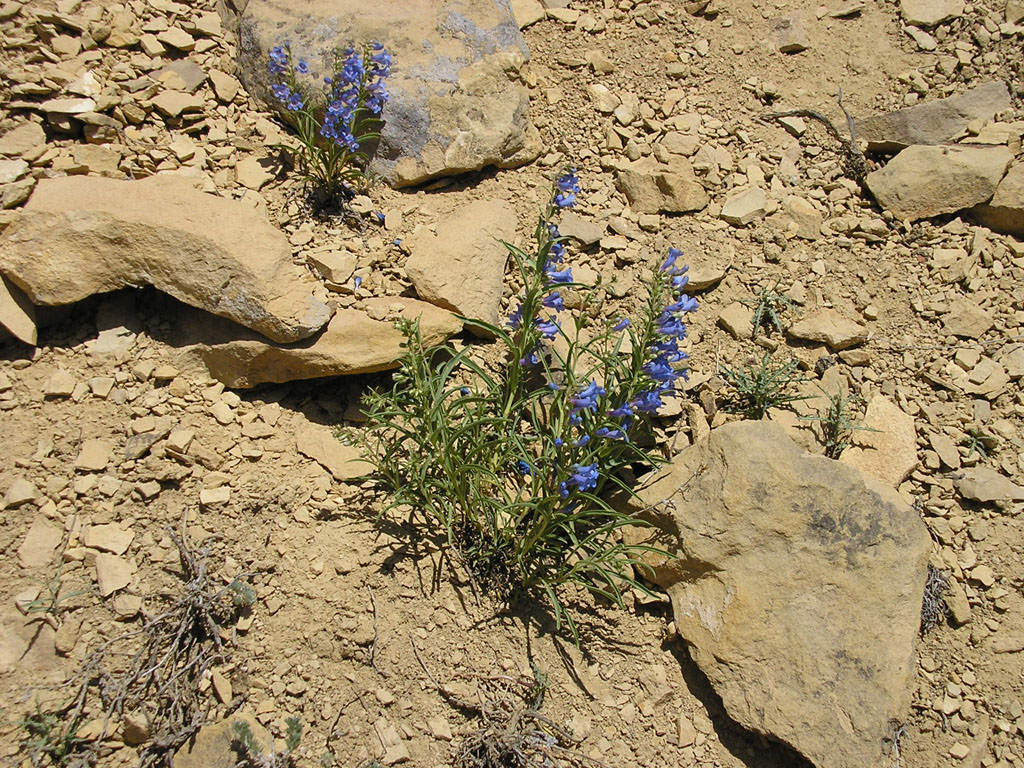
Perennial herb with erect stout densely puberulent stems from 10 to 45 cm in height. Leaves glabrate, oblong-lanceolate to 10 cm long and 2.5 cm wide with winged petioles. Blue to purple (rarely pink or white) flowers have pubescent anther sacs and anthers with short straight or sometimes flexuous hairs.
Look Alikes:
This taxon could be confused with P. fremontii and P. scariosus var. garrettii, however, there are distinctions that can reliably segregate these taxa. Distinguishing characteristics are more apparent when comparing these taxa in situ. Pubescence of the leaves appears to be the most reliable character. Penstemon fremontii var. glabrescens leaves are glabrous or glabrescent, except sometimes the margins and midveins, and the basal and proximal leaves are 2-12 mm wide. Var. fremontii leaves are densely puberulent or, rarely, glabrescent (pers. comm. Craig Freeman 2010). Peggy Lyon (pers. comm. 2012) notes that var. fremontii grows on deeper soils in more mesic sites; and it is taller than var. glabrescens.
Phenology:
Flowers in June (Colorado Natural Heritage Program 2012).
Habitat
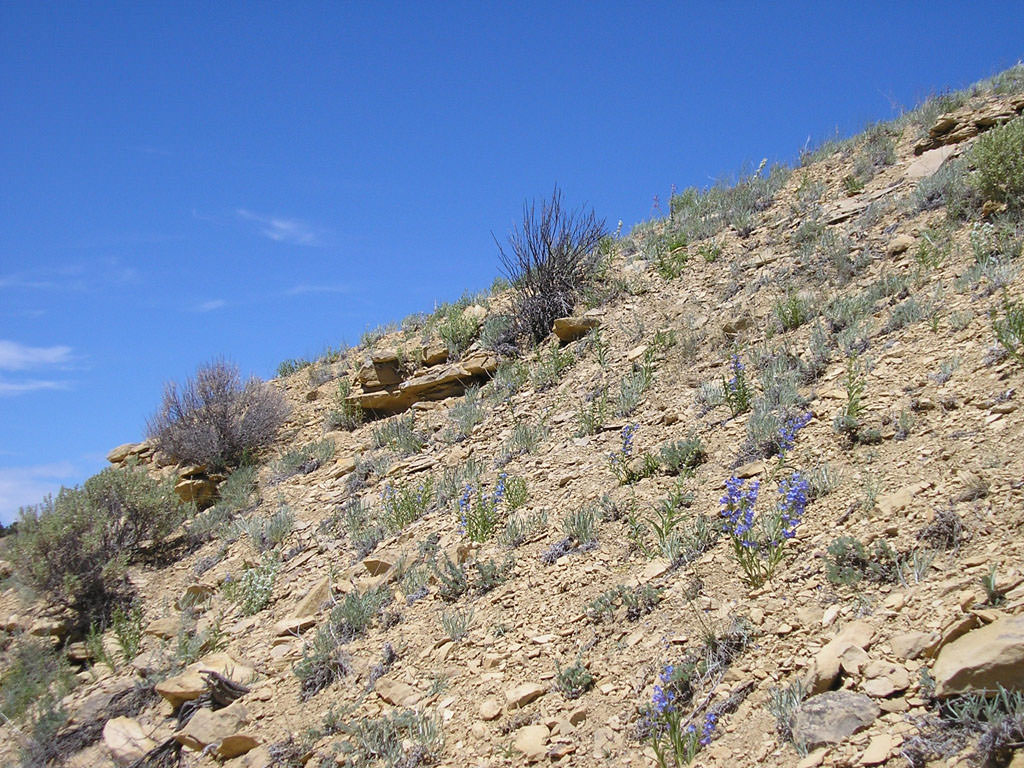
This plant is found on partly barren, arid benches and slopes in sandy clay loams of the Uinta Formation and Green River shale in sagebrush communities with Amelanchier, Chrysothamnus, and Holodiscus (Colorado Natural Heritage Program 2019). It grows almost exclusively on steep slopes composed of Green River shale or sometimes intermixed with sandstone fragments from overlying strata. It is locally common on road cuts, and populations occur abundantly on exposed shale along Piceance Creek and the adjacent tributaries (Johnson et al. 2016). It occurs at 1680 - 2620 meters (5500 - 8600 feet) in elevation (Colorado Natural Heritage Program 2019).
click on image to enlarge
 |
Elevation Range:
5,515 - 8,582 feet (1,681 - 2,616 meters)
Distribution
Colorado Endemic:
Yes
Range:
Penstemon luculentus (synonym P. fremontii var. glabrescens) is a narrow endemic of the Piceance Basin in western Colorado, USA. Since 1991, it has been known only from the Piceance drainage in Rio Blanco County. It was also found at two locations in Garfield County in 1987, but has not since been verified to still still occur there (Dorn and Lichvar 1990, SEINet 2021). Estimated range extent in Colorado of 2563 square kilometers was calculated in GeoCAT using occurrence data provided by the Colorado Natural Heritage Program (2023).
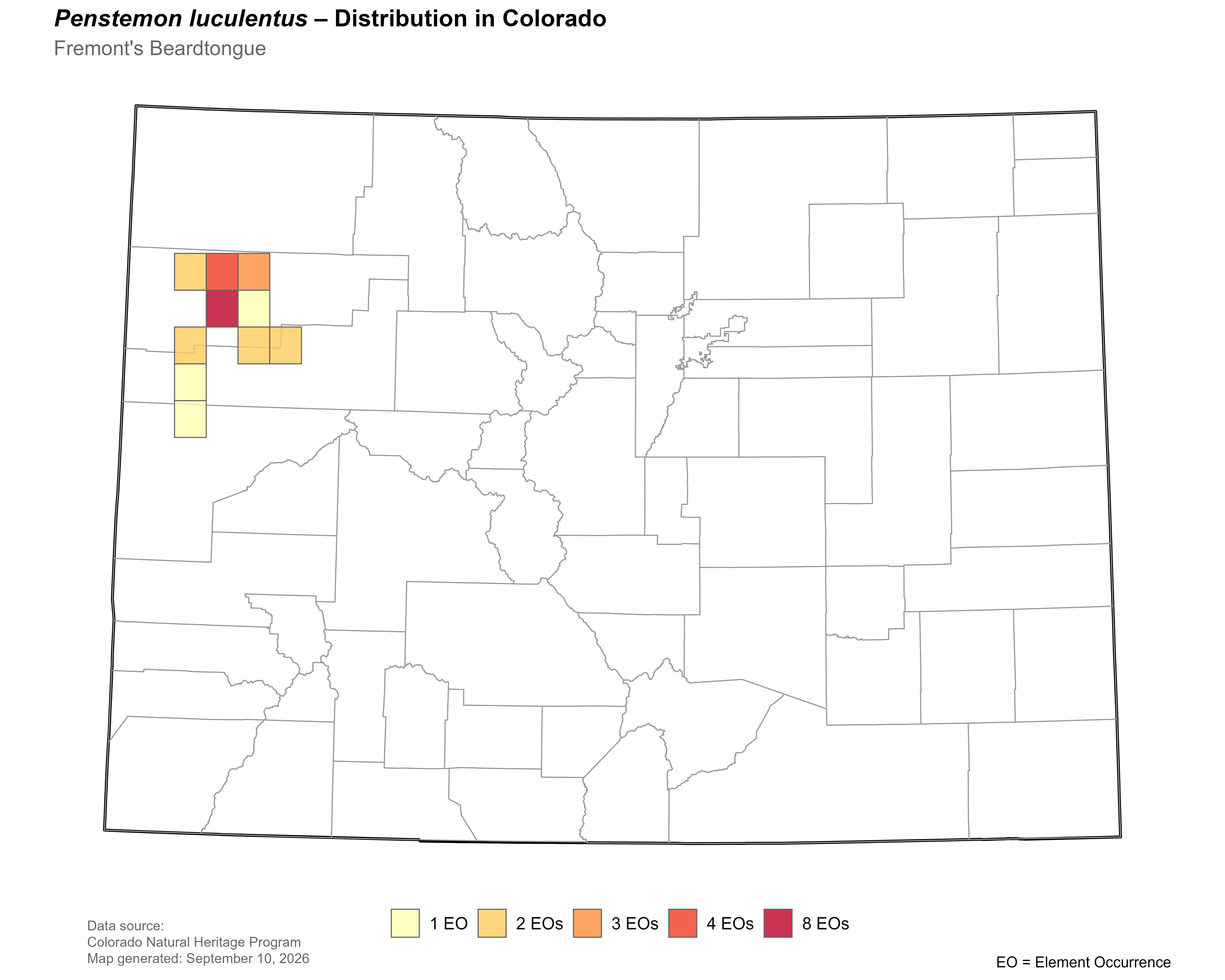
Click on map to enlarge |
Threats and Management Issues
Penstemon luculentus (P. fremontii var. glabrescens) plants occurs within the Piceance Basin, an area of active gas and oil drilling, and significant oil shale deposits, which could be mined in the future (Johnson et al. 2016). Some sites may also be threatened by off road vehicle use and grazing (Colorado Natural Heritage Program 2019). This species is considered to have moderate adaptive capacity and is expected to be moderately vulnerable to climate change under both RCP 4.5 and 8.5 scenarios, as assessed for the 2025 Colorado State Wildlife Action Plan (CNHP 2025).
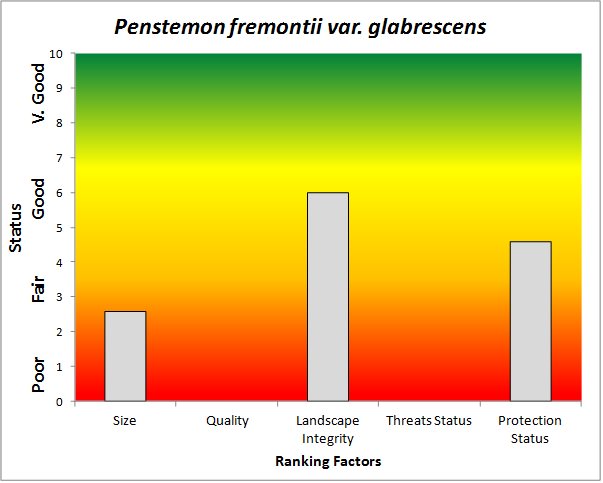
Summary results of an analysis of the status of Penstemon fremontii var. glabrescens based on several ranking factors. This species was concluded to be Weakly Conserved. From Rondeau et al. 2011. |
References
- Ackerfield, J. 2015. Flora of Colorado. BRIT Press, Botanical Research Institute of Texas, Fort Worth, TX. 818 pp.
- Ackerfield, Jennifer. 2022. Flora of Colorado. Second Edition. Bot. Misc. 60. BRIT Press, Fort Worth Botanic Garden/Botanical Research Institute of Texas, U.S.A. 861 pp.
- Colorado Natural Heritage Program (CNHP). 2023. Biodiversity Tracking and Conservation System (Biotics 5). Colorado Natural Heritage Program, Colorado State University, Fort Collins.
- Colorado Natural Heritage Program (CNHP). 2025. Climate Change Vulnerability Assessment of Colorado Tier 1 and Tier 2 Plant Species of Greatest Conservation Need (SCGN) for the 2025 Colorado State Wildlife Action Plan. Colorado Natural Heritage Program, Colorado State University, Fort Collins, CO.
- Dorn, R.D., and R.W. Lichvar. 1990. A new variety of Penstemon fremontii (Scrophulariaceae) from Colorado. Madrono 37(3):195-199.
- Elliott, B. A., S. Spackman Panjabi, B. Kurzel, B. Neely, R. Rondeau, M. Ewing. 2009. Recommended Best Management Practices for Plants of Concern. Practices developed to reduce the impacts of oil and gas development activities to plants of concern. Unpublished report prepared by the Rare Plant Conservation Initiative for the National Fish and Wildlife Foundation.
- Flora of North America Editorial Committee, ed. (FNA). 1993+. Flora of North America North of Mexico. Oxford Univ. Press, New York, Oxford.
- Handwerk, J., L. Grunau, and S. Panjabi. 2015. Colorado Wildlife Action Plan: 2015 Rare Plant Addendum. Colorado Natural Heritage Program, Colorado State University, Fort Collins, Colorado, USA.
- Johnson, R.L., M.R. Stevens, L.A. Johnson, M.D. Robbins, C.D. Anderson, N.J. Ricks, and K.M. Farley. 2016. Molecular and morphological evidence for Penstemon luculentus (Plantaginaceae): a replacement name for Penstemon fremontii var.glabrescens. PhytoKeys 63: 47-62. doi: 10.3897/phytokeys.63.7952
- Kartesz, J.T. 1994. A synonymized checklist of the vascular flora of the United States, Canada, and Greenland. 2nd edition. 2 vols. Timber Press, Portland, OR.
- Lavender, A.E., M.M. Fink, S.E. Linn, D.M. Theobald. 2011. Colorado Ownership, Management, and Protection v9 Database. Colorado Natural Heritage Program and Geospatial Centroid, Colorado State University, Fort Collins, CO. (30 September).
- Neely, B., S. Panjabi, E. Lane, P. Lewis, C. Dawson, A. Kratz, B. Kurzel, T. Hogan, J. Handwerk, S. Krishnan, J. Neale, and N. Ripley. 2009. Colorado Rare Plant Conservation Strategy, Developed by the Colorado Rare Plant conservation Initiative. The Nature Conservancy, Boulder, Colorado, 117 pp.
- USDA, NRCS. 2022. The PLANTS Database. National Plant Data Team, Greensboro, NC 27401-4901 USA.
- Weber, W. A. and R. C. Wittmann. 2012. Colorado Flora, Western Slope, A Field Guide to the Vascular Plants, Fourth Edition. Boulder, Colorado. 532 pp.