

Scientific Name : Packera mancosana
Author : Yeatts, B.Schneid. & Al Schneid. NatureServe Explorer
Common Name : Mancos Shale Packera
 Current Research Activities


☰ Click link below for details.
Taxonomy
Asteraceae (sunflower family)
Discovered by Betty and Al Schneider in 2008 and published in 2011 (Yeatts et al. 2011). Ackerfield (2015, 2022) includes this as a synonym under Packera werneriifolia. Packera mancosana is distinguished from P. werneriifolia by its persistently tomentose, gray-green leaves that are not serrate-dentate; and overall, P. mancosana has fewer stems and flower heads per plant (Yeatts et al. 2011, Weber and Wittmann 2012). This taxon will be included in the third edition of the Flora of Colorado (Ackerfield 2026).
Ranks and Status
State Rank : S1
State Rank Reason : Packera mancosana is shale barren endemic known only from Dolores County in southwest Colorado, USA. Incompatible livestock grazing is a potential threat throughout its limited range and it is considered to be extremely vulnerable to the effects of climate change.
U.S. Endangered Species Act : none
Colorado Threatened and Endangered List : none
Other Statuses : SWAP Tier 1, USFS
Description and Phenology
General Description:
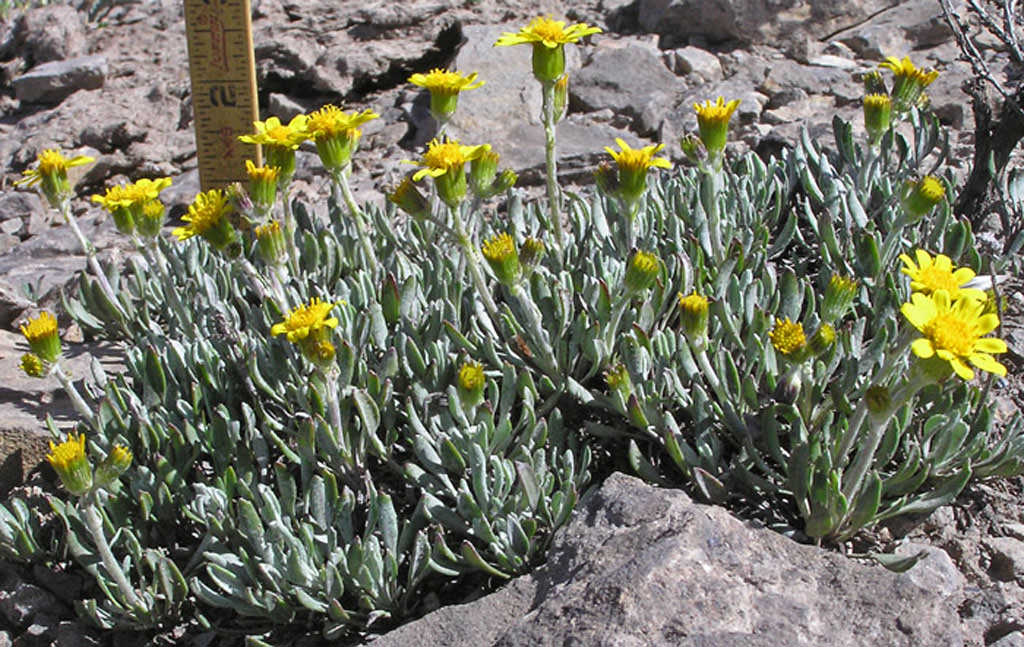
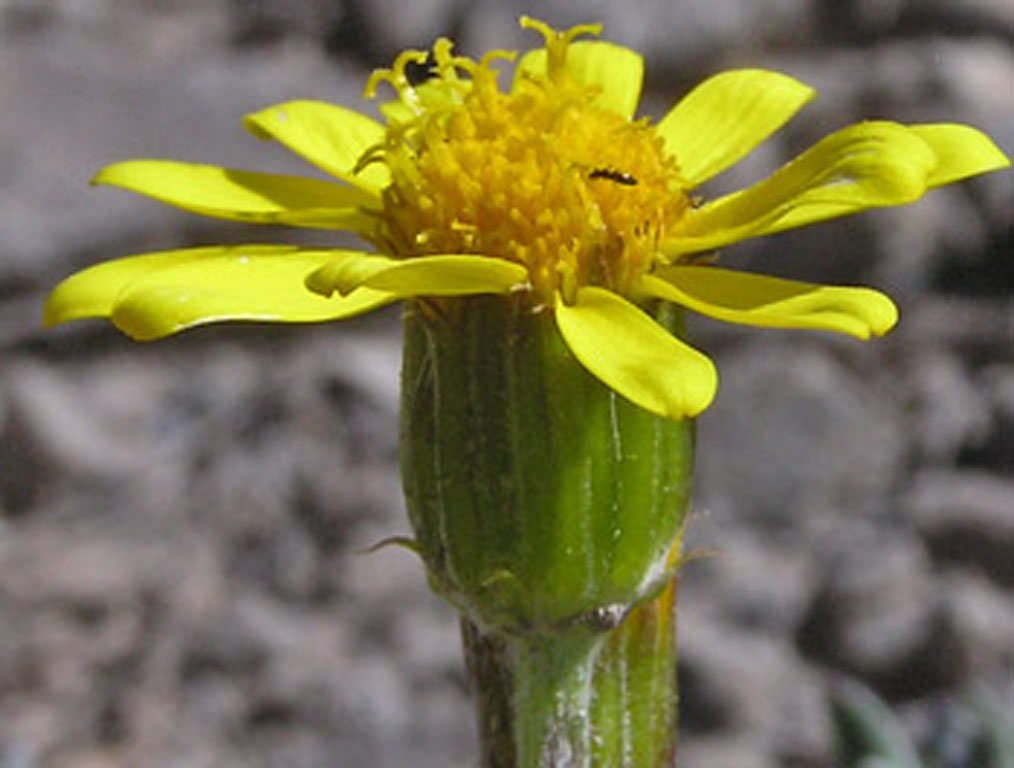
Packera mancosana is a rhizomatous, perennial species with a tightly packed growth form and very short stature. Ray and disc flowers are bright yellow. Leaves are gray-green, and tomentose-cobwebby. Basal leaves are very hairy, sometimes toothed or notched. Plants start out with very small clusters of leaves and over the years grow into dense mats up to 30 cm in diameter and 3 cm high. Flower stems are also quite hairy, 7-10 cm high, have few very short and narrow leaves, and can branch or support but one flower head (Yeatts et al. 2011, Schneider 2013).
Look Alikes:
Packera mancosana is distinguished from P. werneriifolia by it's persistently tomentose, gray-green leaves that are not serrate-dentate; and overall, P. mancosana has fewer stems and flower heads per plant (Yeatts et al. 2011, Weber and Wittmann 2012). Also, Packera werneriifolia is primarily found near and above treeline, occasionally lower (Yeatts et al. 2011).
Phenology:
Depending on the arrival of spring, it begins flowering in mid-May, fruiting into July (Yeatts et al. 2011).
Habitat
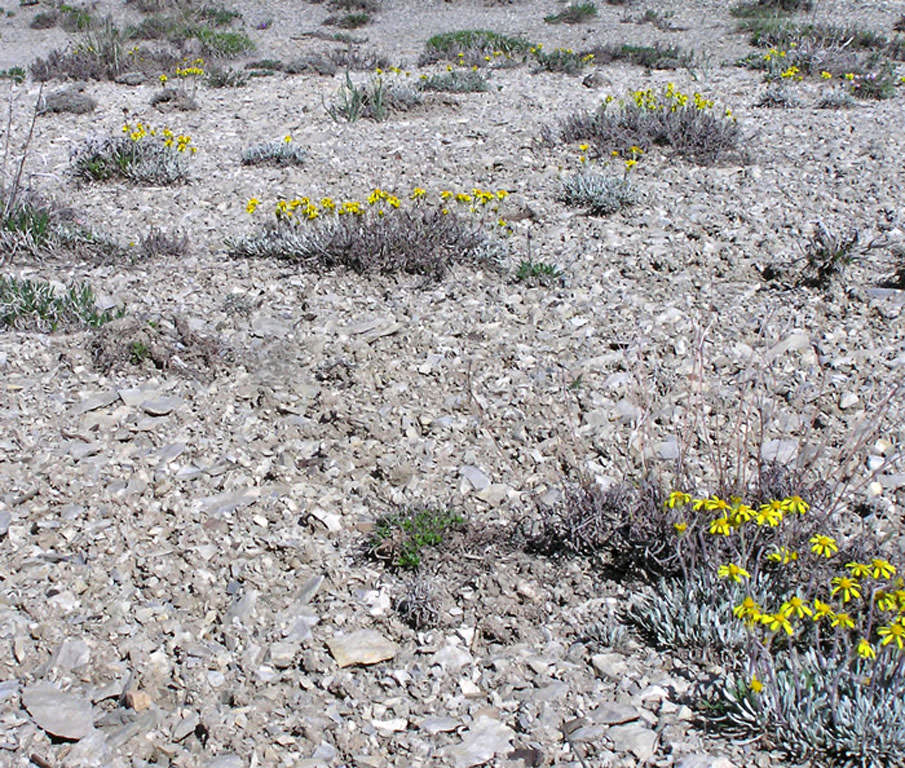
This species is known from outcrops of grayish, argillaceous marine Mancos Shale. The plants are found on very sparsely vegetated flats (slopes ca. 2%) and sides of shallow washes. They grow along cracks in the bare shale and in thin gravelly soil over the shale. Packera mancosana is among the more abundant species in this habitat. Associated species include Helianthella microcephala, Physaria pulvinata, Tetraneuris acaulis, Townsendia leptotes, Eriogonum lonchophyllum, Gutierrezia elegans, Petradoria pumila, Astragalus missouriensis var. amphibolus, Heterotheca villosa, Calochortus nuttallii, Delphinium nuttallianum, Orthocarpus purpureoalbus, Packera oodes, and Solidago simplex; Pinus ponderosa with pinyon-juniper on nearby surrounding slopes (Yeatts et al. 2011).
click on image to enlarge
 |
Elevation Range:
7,581 - 7,732 feet (2,311 - 2,357 meters)
Distribution
Colorado Endemic:
Yes
Range:
Packera mancosana is known only from Dolores County in southwest Colorado, USA (Yeatts et al. 2011; CNHP 2013). The estimated range extent in Colorado of 1.2 square kilometers was calculated in GeoCAT using occurrence data provided by the Colorado Natural Heritage Program (2023).
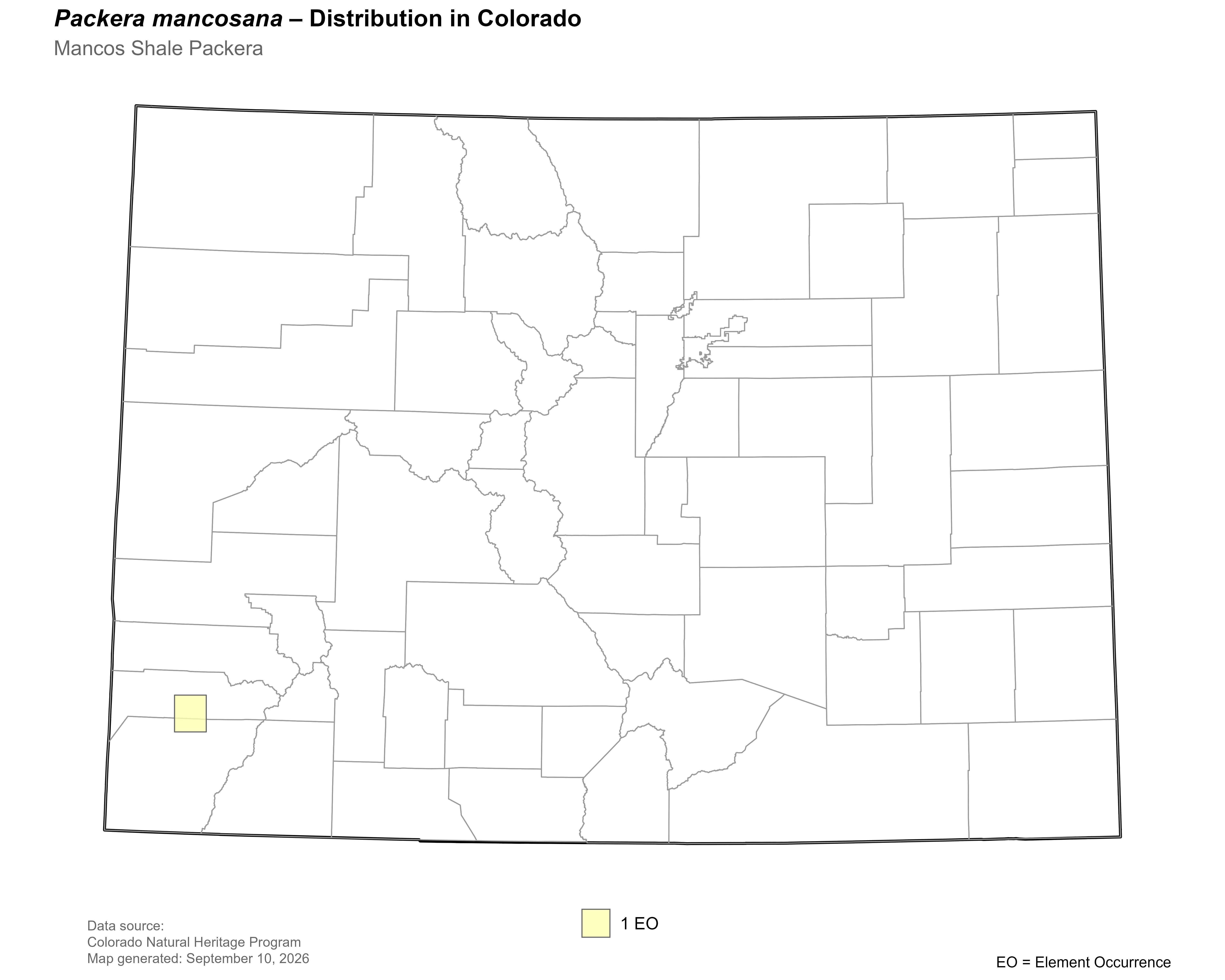
Click on map to enlarge |
Threats and Management Issues
This species is found on State Lands, where the predominant land uses are hunting and grazing (CNHP 2013). Trampling of plants and soil compaction by livestock has been observed within the occupied habitat (CNHP 2023). Severe declines in population size have been observed in years of drought (Handwerk and Malone 2021). Packera mancosana is considered to have low adaptive capacity and is expected to be extremely vulnerable to climate change under both RCP 4.5 and 8.5 scenarios, as assessed for the 2025 Colorado State Wildlife Action Plan (CNHP 2025).
References
- Ackerfield, J. 2015. Flora of Colorado. BRIT Press, Botanical Research Institute of Texas, Fort Worth, TX. 818 pp.
- Ackerfield, Jennifer. 2022. Flora of Colorado. Second Edition. Bot. Misc. 60. BRIT Press, Fort Worth Botanic Garden/Botanical Research Institute of Texas, U.S.A. 861 pp.
- Colorado Natural Heritage Program (CNHP). 2023. Biodiversity Tracking and Conservation System (Biotics 5). Colorado Natural Heritage Program, Colorado State University, Fort Collins.
- Colorado Natural Heritage Program. 2013. Biodiversity Tracking and Conservation System (BIOTICS). Colorado Natural Heritage Program, Colorado State University, Fort Collins.
- Handwerk, J. and D. Malone. 2021. Colorado Natural Heritage Program personal communication regarding Packera mancosana.
- Handwerk, J., L. Grunau, and S. Panjabi. 2015. Colorado Wildlife Action Plan: 2015 Rare Plant Addendum. Colorado Natural Heritage Program, Colorado State University, Fort Collins, Colorado, USA.
- Handwerk, J.E., D.G. Malone, and J.P. Smith. 2022. Monitoring Coloradoā€™s SWAP Tier 1 plant species Physaria pulvinata, 2021. Colorado Natural Heritage Program, Colorado State University, Fort Collins, Colorado.
- Schneider, A. 2013. Wildflowers, Ferns, and Trees of the Four Corners Regions of Colorado, New Mexico, Arizona, and Utah. Accessed on-line at http://www.swcoloradowildflowers.com.
- USDA, NRCS. 2022. The PLANTS Database. National Plant Data Team, Greensboro, NC 27401-4901 USA.
- Yeatts, L., B. Schneider, and A. Schneider. 2011. Packera mancosana (Asteraceae: Senecioneae), a new species and shale barren endemic of southwestern Colorado. Phytoneuron 2011-26: 18.