


Scientific Name : Oreoxis humilis
Author : Raf. NatureServe Explorer
Common Name : Pikes Peak Spring Parsley
 Current Research Activities
 1997 profile
☰ Click link below for details.
Taxonomy
Apiaceae (carrot family)
Ackerfield (2022) lists this species as Oreoxis humilis Raf. and Ackerfield (2015) lists this species as Cymopterus humilis (Raf.) Tidestr. & Kittell. Harrington (1954) notes that this may not be distinct from O. alpina.
Ranks and Status
State Rank : S1
State Rank Reason : Oreoxis humilis is a species of concern because of its restricted geographic range, the small number of documented occurrences, and possible vulnerability to human-related and environmental threats. It is endemic to Colorado (USA) where it is known only from a limited range in the high peaks of El Paso and Teller counties. Oreoxis humilis is considered to be extremely vulnerable to the effects of climate change; road construction and recreational activities within its habitat are other potential threats to this alpine species.
U.S. Endangered Species Act : none
Colorado Threatened and Endangered List : none
Other Statuses : SWAP SGIN, USFS
Description and Phenology
General Description:
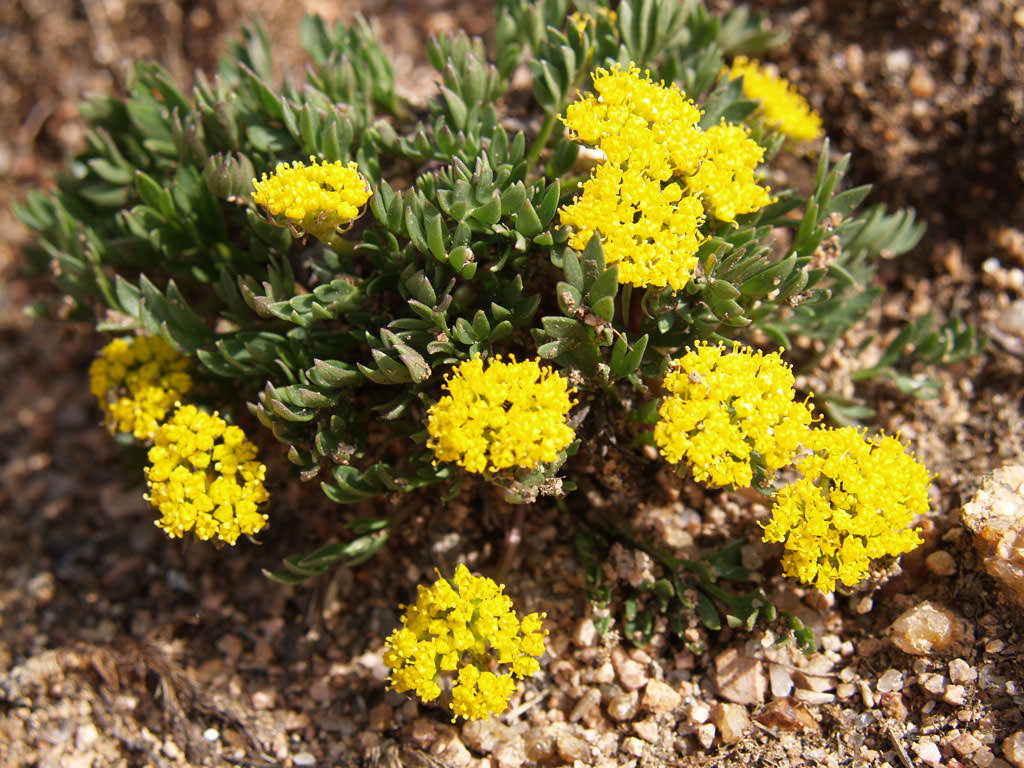
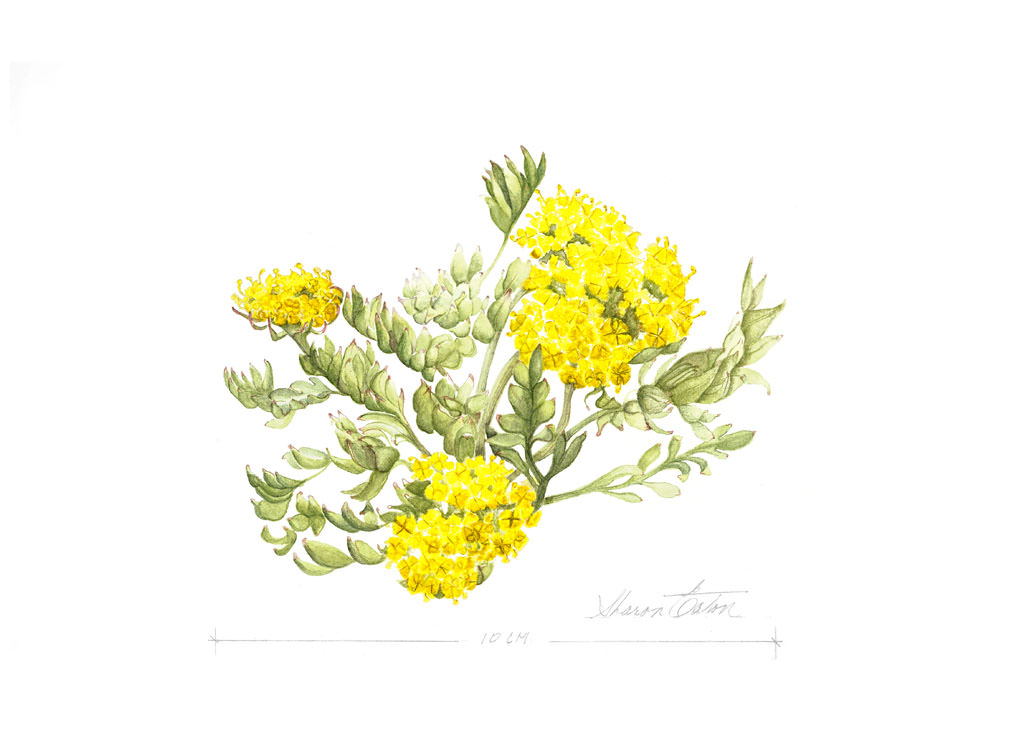
Oreoxis humilis is a perennial herb from 2 to 15 cm (0.78 to 5.9 inches) tall, but most frequently under 5 cm (1.97 inches) tall. Leaves are basal, 0.5 to 4.5 cm (0.20 to 1.77 inches) long and 0.5 to 1.0 cm (0.20 to 0.39 inches) wide. These are once or twice pinnately compound, each segment 1 to 2 mm (0.04 to 0.08 inch) wide and up to 10 mm (0.39 inch) long. Peduncles are up to 1 cm (0.39 inch) long. Umbels have several rays, each 2 to 5 mm (0.08 to 0.20 inch) long. The yellow flowers are subtended by involucel bracts. Plants are minutely hairy in the inflorescence. Fruits are winged, and are 3 to 5 mm (0.12 to 0.20 inch) long and 1.5 to 3 mm (0.06 to 0.12 inch) wide (Beatty et al. 2004, Ackerfield 2015).
Look Alikes:
Oreoxis alpina (Alpine oreoxis) has finely puberulent fruit, while O. humilis fruit are glabrous. Oreoxis bakeri (Baker's alpineparsley) has involucel bracts that are broad, toothed, and sometimes purplish, while the bractlets of O. humilis are linear, entire and green (Spackman et al. 1997).
Phenology:
Flowering occurs from June through August. Fruits appear in July and August (Beatty et al. 2004; Spackman et al. 1997).
 |
Habitat
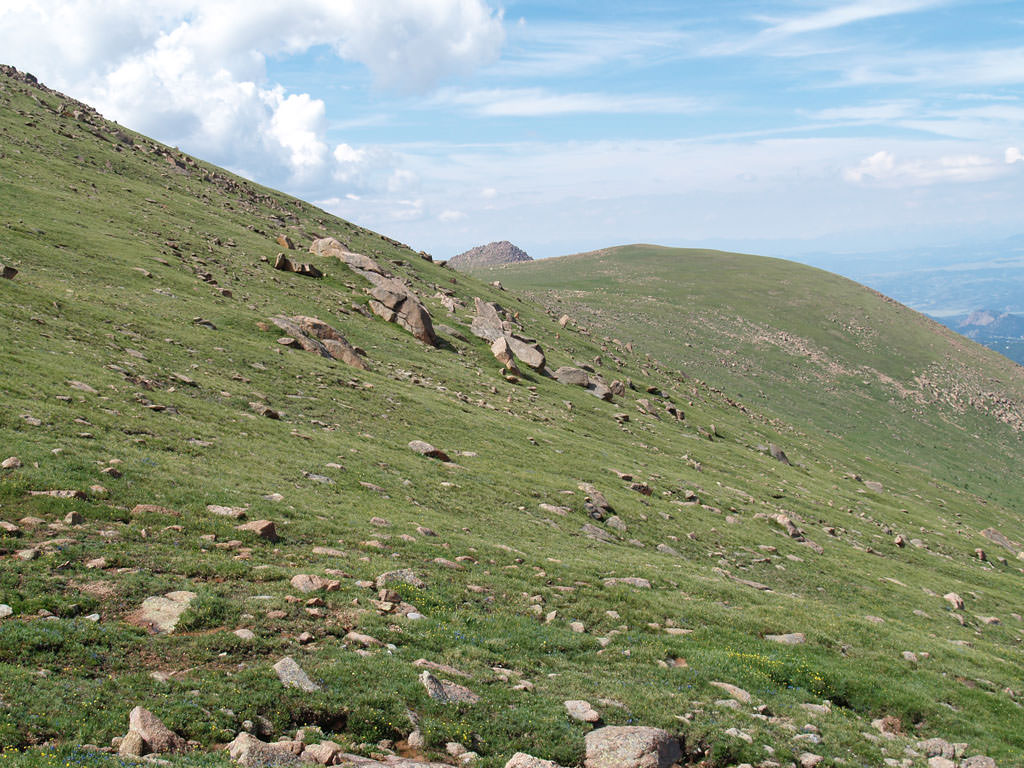
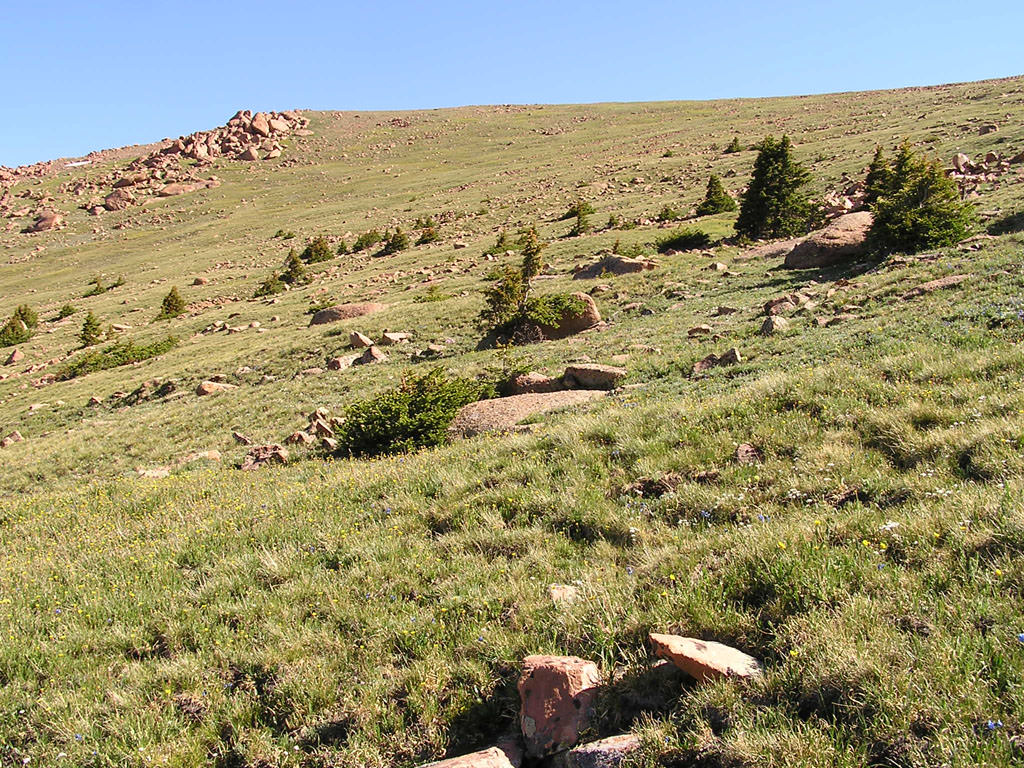
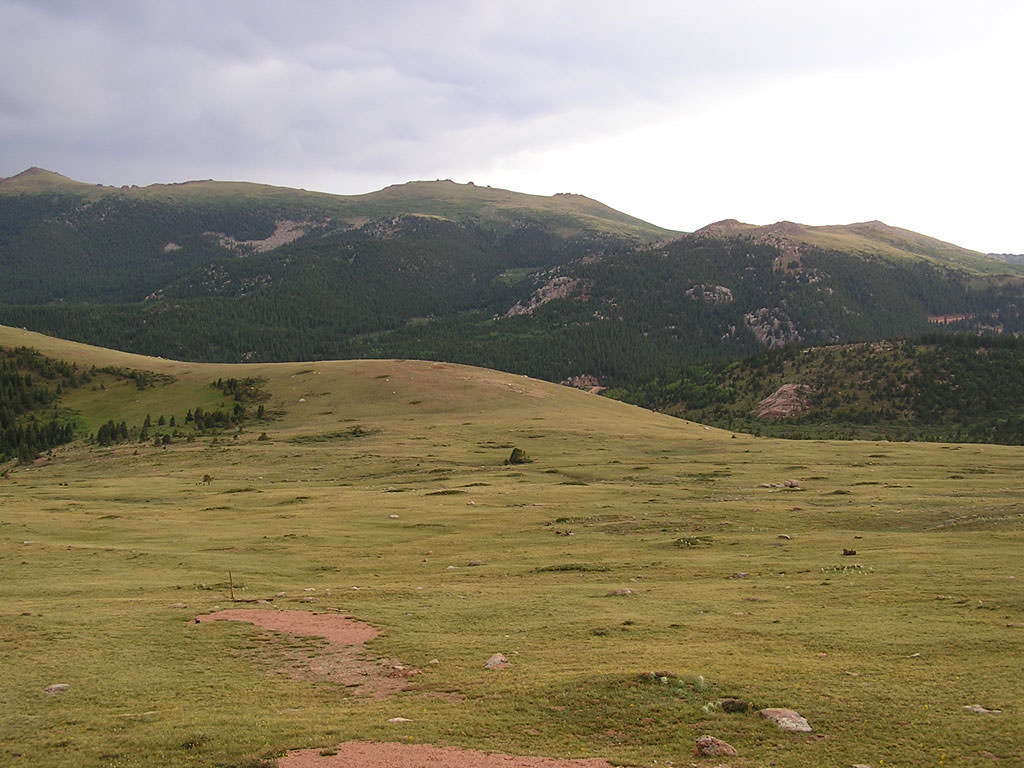
This species occurs on tundra, fell fields, meadows, krumholtz, and open spruce-fir woodlands. It is known only from areas at or above timberline on rocks of Pikes Peak batholith (Pikes Peak granite and Windy Point granite). Plants have been found on slopes of up to 60 degrees, and on all aspects (Beatty, et al., 2004). Associated species include: Kobresia myosuroides (Bellardi bog sedge), Pinus aristata (bristlecone pine), Polemonium viscosum (sticky polemonium), Saxifraga bronchialis (matted saxifrage), Paronychia pulvinata (Rocky Mountain nailwort), Mertensia alpina (alpine bluebells), Telesonix jamesii (James' telesonix), Cirsium scopulorum (mountain thistle), and Erigeron pinnatisectus (featherleaf fleabane).
click on image to enlarge
 |
 |
 |
Elevation Range:
9,648 - 13,970 feet (2,941 - 4,258 meters)
Distribution
Colorado Endemic:
Yes
Range:
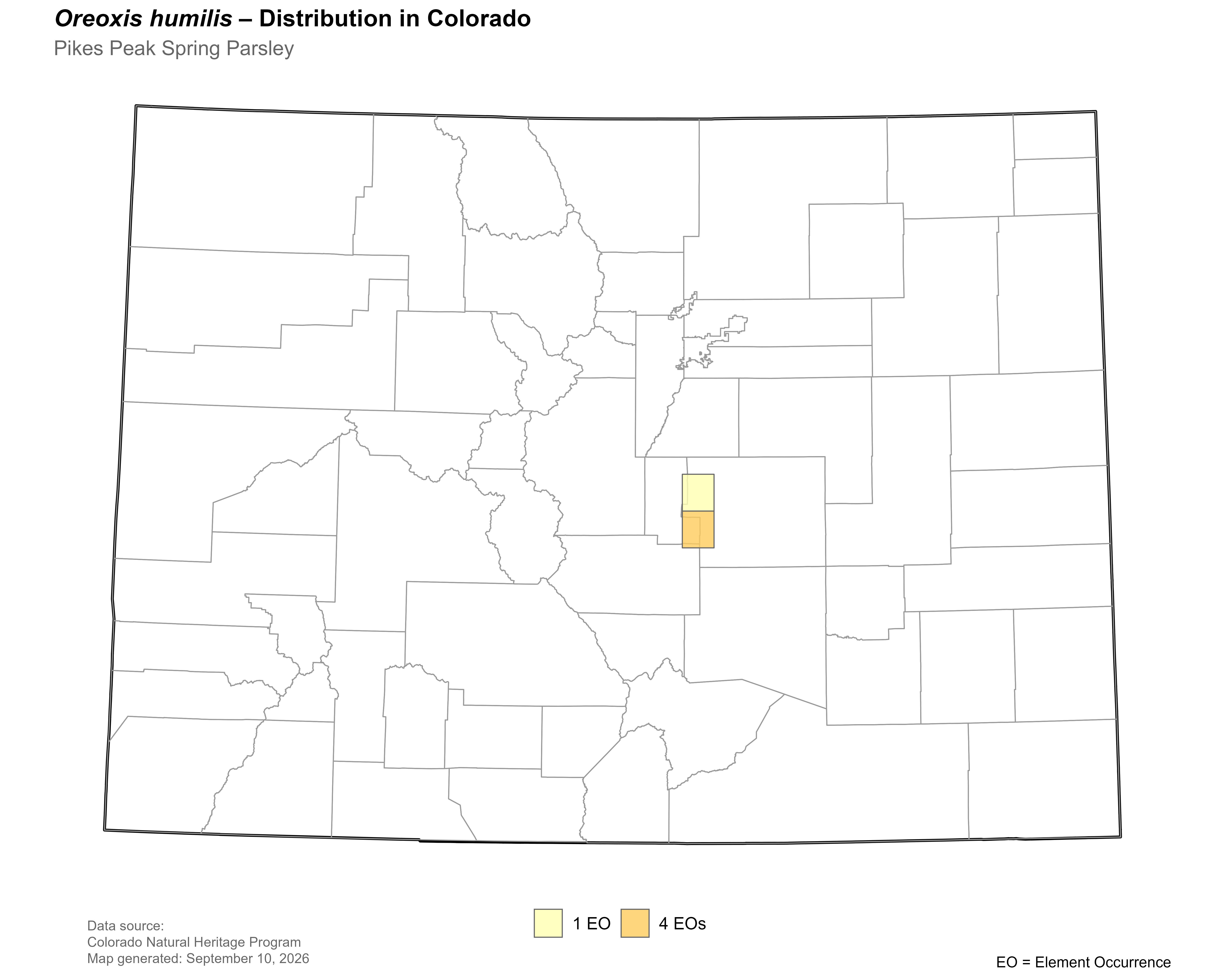
Oreoxis humilis is endemic to Colorado (USA) where it is known only from the Pike's Peak vicinity in El Paso and Teller counties. The estimated range extent in Colorado of 89 square kilometers was calculated in GeoCAT using occurrence data provided by the Colorado Natural Heritage Program (2023).
Click on map to enlarge |
Threats and Management Issues
Road erosion and construction are considered to be the primary threats to the species at this time (Rondeau et al. 2011). Possible human-related threats to O. humilis include road erosion and construction, structure maintenance, and motorized and non-motorized recreational activities (CNHP 2023). Sediment movement along the Pikes Peak Highway had been a concern, but since the paving of the road is nearly completed, the threat is essentially gone (Olson 2012). There is a continuing lesser threat from unregulated recreation, such as user created trails in the alpine on Pikes Peak (Beatty, et al., 2004). One modeling study of the Pikes Peak area suggests that the long term viability of Oreoxis humilis will be at risk given transportation and mitigation plans in the area (Casper et al. 2009). This species is considered to be extremely vulnerable to climate change (Handwerk et al. 2015).
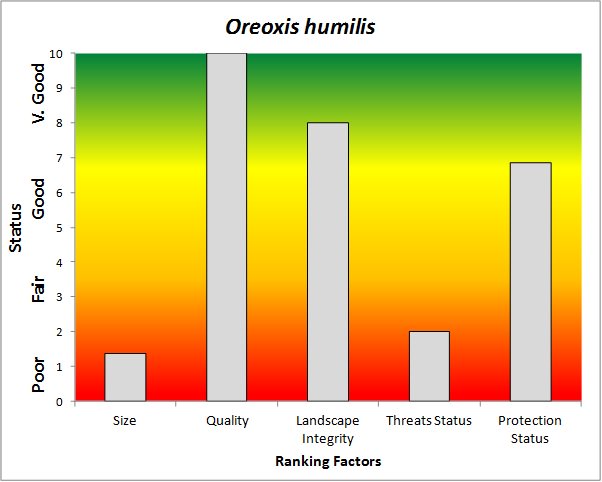
Summary results of an analysis of the status of Oreoxis humilis based on several ranking factors. This species was concluded to be Moderately Conserved. From Rondeau et al. 2011. |
References
- Ackerfield, J. 2015. Flora of Colorado. BRIT Press, Botanical Research Institute of Texas, Fort Worth, TX. 818 pp.
- Ackerfield, J. 2022. Flora of Colorado. Second Edition. Bot. Misc. 60. BRIT Press, Fort Worth Botanic Garden/Botanical Research Institute of Texas, U.S.A. 861 pp.
- Beatty, B.L., W.F. Jennings and R.C. Rawlinson. 2004. Oreoxis humilis Raf. (Rocky Mountain alpineparsley): A Technical Conservation Assessment. [Online]. USDA Forest Service, Rocky Mountain Region. http://www.fs.fed.us/r2/projects/scp/assessments/oreoxishumilis.pdf [2006-01-05]
- Colorado Natural Heritage Program (CNHP). 2023. Biodiversity Tracking and Conservation System (Biotics 5). Colorado Natural Heritage Program, Colorado State University, Fort Collins.
- Design Workshop, Inc. 1999. Pikes Peak Multi-Use Plan. Unpublished report prepared for Colorado Springs Utilities, Colorado Springs, CO and U.S. Forest Service, Pikes Peak Ranger District, Colorado Springs, CO.
- Handwerk, J., L. Grunau, and S. Panjabi. 2015. Colorado Wildlife Action Plan: 2015 Rare Plant Addendum. Colorado Natural Heritage Program, Colorado State University, Fort Collins, Colorado, USA.
- Harrington, H. D. 1954. Manual of the Plants of Colorado. Sage Books, Denver, CO. 666 pp.
- Neely, B., S. Panjabi, E. Lane, P. Lewis, C. Dawson, A. Kratz, B. Kurzel, T. Hogan, J. Handwerk, S. Krishnan, J. Neale, and N. Ripley. 2009. Colorado Rare Plant Conservation Strategy, Developed by the Colorado Rare Plant conservation Initiative. The Nature Conservancy, Boulder, Colorado, 117 pp.
- Olson, S. 2021. Personal communication regarding Oreoxis humilis.
- Rondeau, R., K. Decker, J. Handwerk, J. Siemers, L. Grunau, and C. Pague. 2011. The state of Colorado's biodiversity 2011. Prepared for The Nature Conservancy. Colorado Natural Heritage Program, Colorado State University, Fort Collins, Colorado.
- Spackman, S., B. Jennings, J. Coles, C. Dawson, M. Minton, A. Kratz, and C. Spurrier. 1997. Colorado rare plant field guide. Prepared for Bureau of Land Management, U.S. Forest Service and U.S. Fish and Wildlife Service by Colorado Natural Heritage Program.
- USDA, NRCS. 2022. The PLANTS Database. National Plant Data Team, Greensboro, NC 27401-4901 USA.
- Weber, W. A. and R. C. Wittmann. 2012. Colorado Flora, Eastern Slope, A Field Guide to the Vascular Plants, Fourth Edition. Boulder, Colorado. 555 pp.


