

Scientific Name : Oreocarya rollinsii
Author : (Johnston) Weber NatureServe Explorer
Common Name : Rollins' Cat's- eye
 Current Research Activities
 1997 profile


☰ Click link below for details.
Taxonomy
Boraginaceae (borage family)
=Cryptantha rollinsii
Ranks and Status
State Rank : S2?
State Rank Reason : Oreocarya rollinsii is known from a limited distribution in Rio Blanco County (mainly along the Utah border) in Colorado, USA. Potential threats include inappropriate grazing, oil and gas development, roads, and competition from non-native plant species. This species is also considered moderately to extremely vulnerable to the effects of climate change.
U.S. Endangered Species Act : none
Colorado Threatened and Endangered List : none
Other Statuses : BLM, SWAP Tier 2
Description and Phenology
General Description:
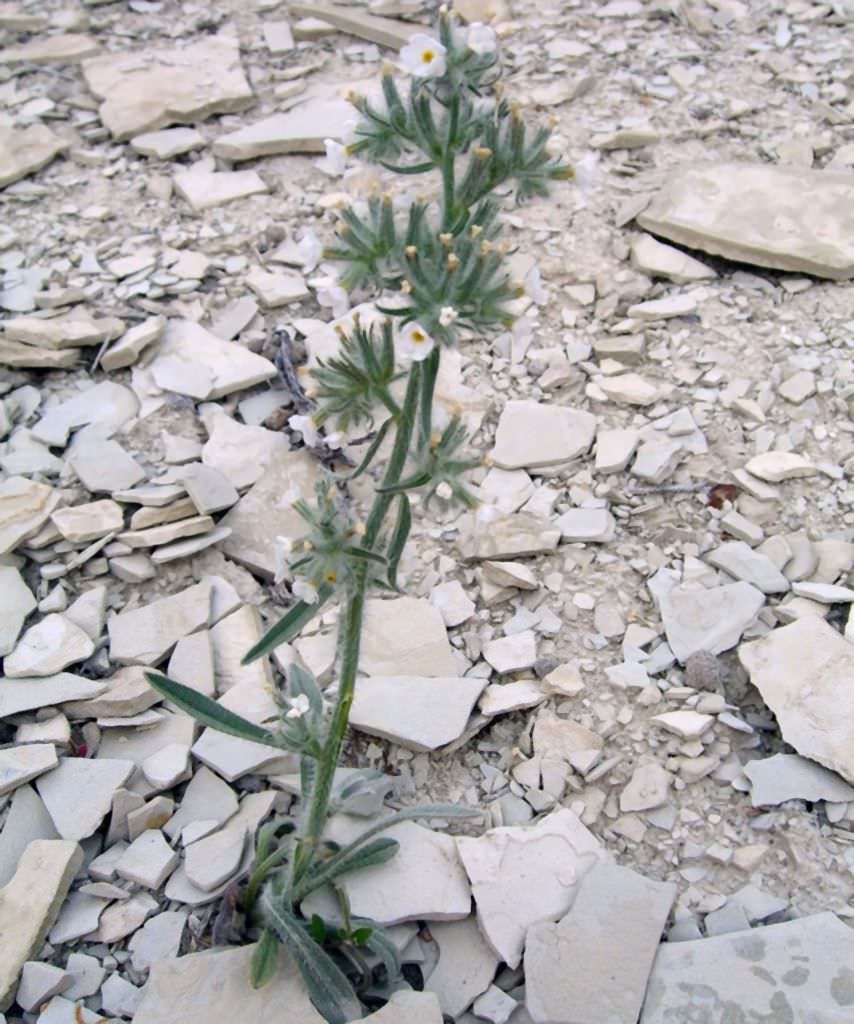
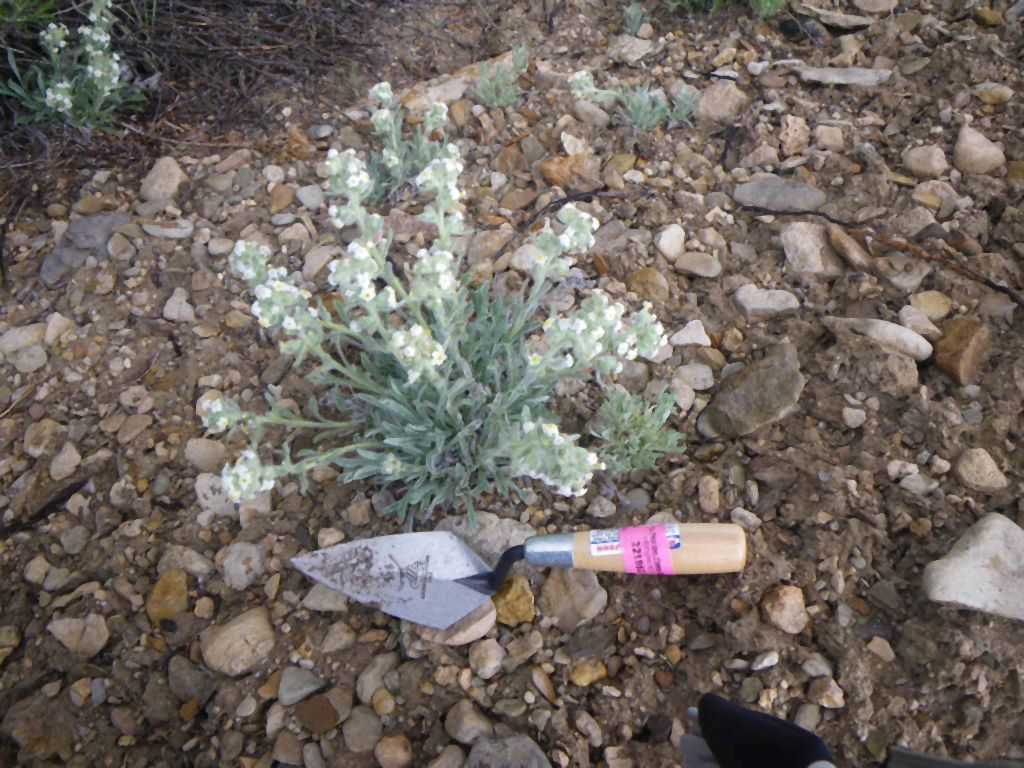
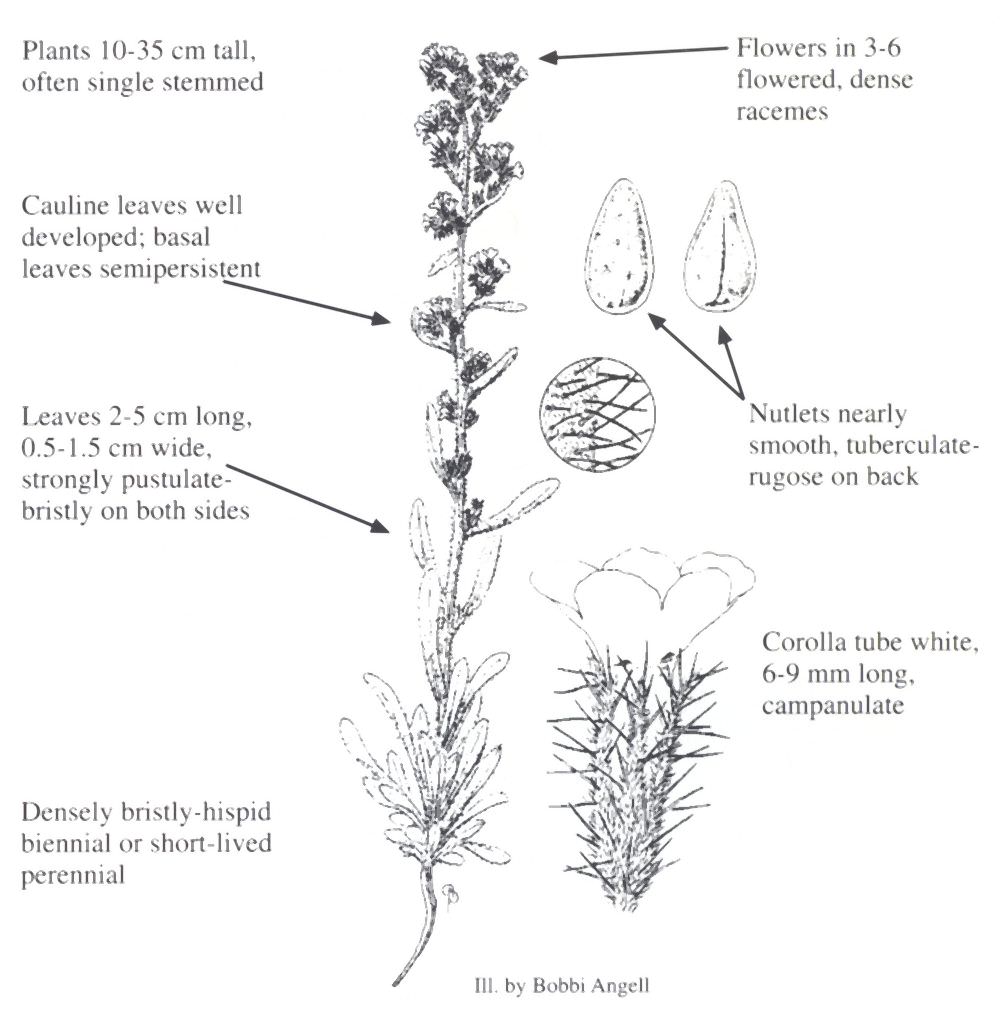
Biennials or short-lived perennials, 1-3.5 dm; leaves oblanceolate, setose and pustulate; calyx 6-8 mm long in flower, 7-10 mm in fruit; corolla white, 6-8 mm wide; nutlets usually 4, narrowly triangular-ovate, 2-4 mm long, slightly roughened or smooth ventrally, the scar closed or nearly so (Ackerfield 2022).
Look Alikes:
No other species resembles C. rollinsii within its habitat (Spackman et al. 1997). It is distinguished by its campanulate corolla, nearly smooth nutlets, noncaespitose habit, and single stem (Higgins 1971).
Phenology:
Plant flowers late May through June (Cronquist et al. 1984, Ackerfield 2022).
 |
Habitat
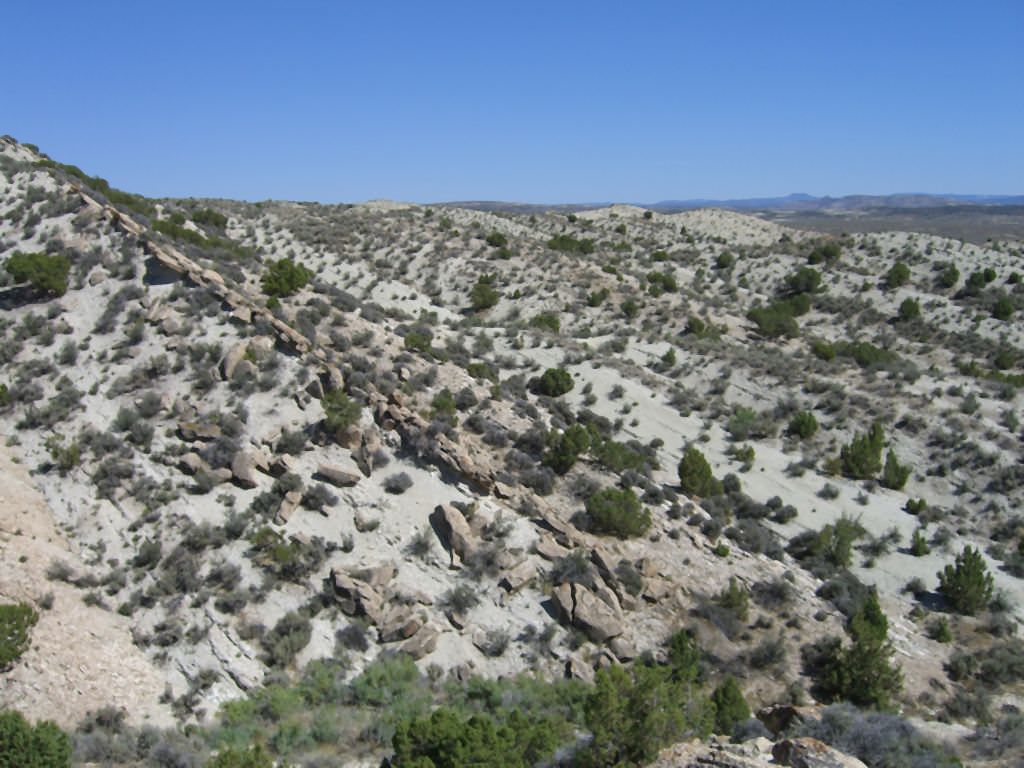
Known from white shale slopes of the Green River Formation; in pinyon-juniper woodlands, sagebrush, and desert shrubland communities (Spackman et al. 1997). Associated plant species: Artemisia nova, Atriplex confertifolia, A. canescens, Forsellesia meionandra, Cercocarpus montanus, C. intricatus, Petradoria pumila, Leptodactylon pungens, Eriogonum lonchophyllum, Pleuraphis jamesii, Leymus salina, Achnatherum hymenoides, Astragalus lutosus, Asclepias cryptoceras, Linum lewisii, Machaeranthera grindelioides, Penstemon sp., Tetradymia spinosa, Stanleya pinnata, Phlox hoodii, Hymenopappus filifolius, Eriogonum jamesii, Ephedra viridis, Gutierrezia sarothrae, Pleuraphis jamesii, Eriogonum ephedroides, Lygodesmia grandiflora, Mentzelia albicaulis, Grindelia squarrosa, Pseudoroegneria spicata, Chamaechaenactis scaposa, Oenothera lavandulifolia, Mirabilis multiflora, Petradoria pubescens, Astragalus spatulatus.
click on image to enlarge
 |
Elevation Range:
5,282 - 6,000 feet (1,610 - 1,829 meters)
Distribution
Colorado Endemic:
No
Range:
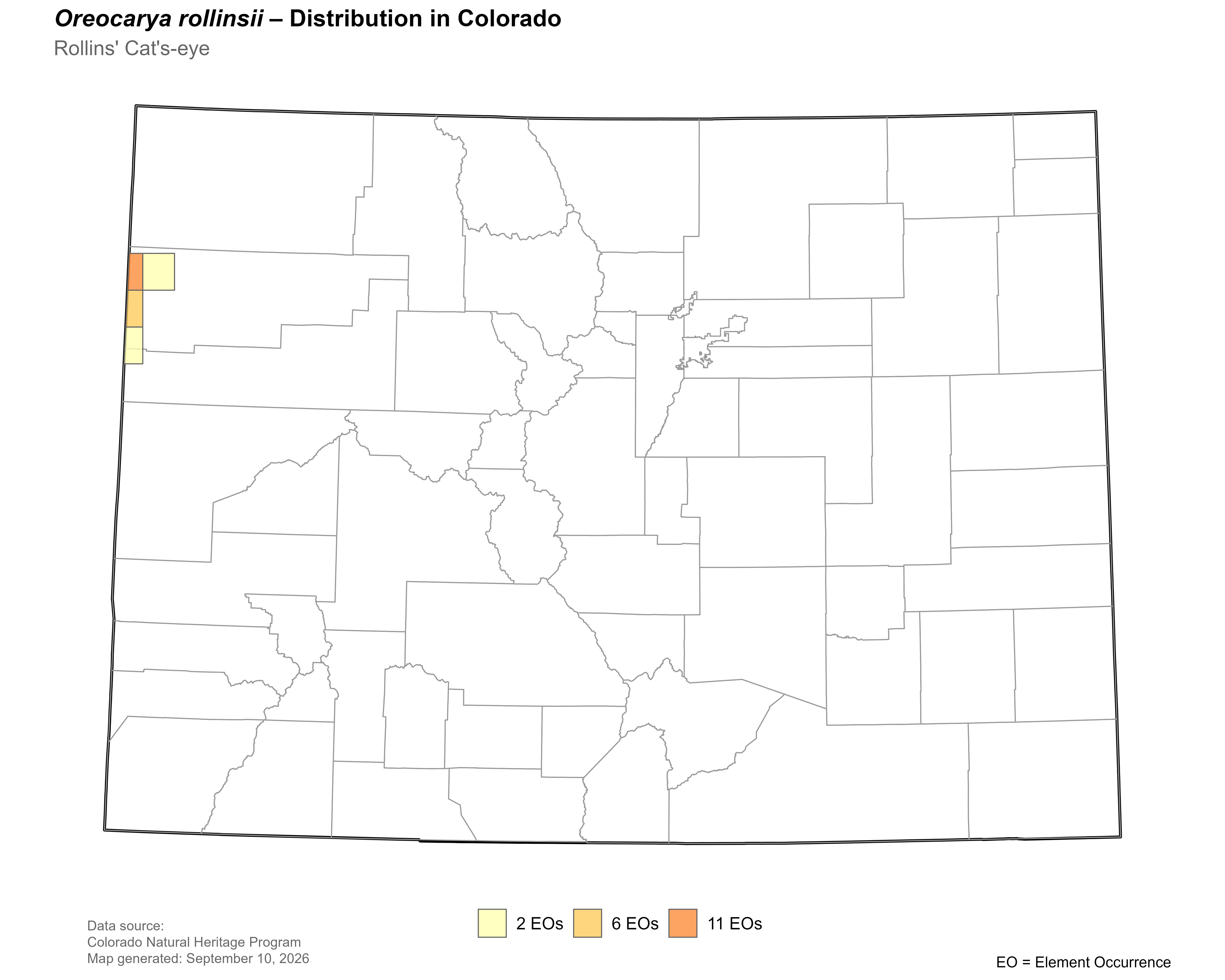
Oreocarya rollinsii is known from Rio Blanco County (mainly along the Utah border) in Colorado, USA. Estimated range extent in Colorado of 429 square kilometers was calculated in GeoCAT using occurrence data provided by the Colorado Natural Heritage Program (2026). This species can also be found in Utah and Wyoming, USA.
Click on map to enlarge |
Threats and Management Issues
Potential threats include inappropriate livestock grazing, oil and gas development and associated infrastructure, and competition from invasive plant species. Livestock grazing impacts including soil erosion and compaction, and subsequent hydrologic alterations, are ubiquitous and vary in intensity from very low to moderate. Oil and gas development is widespread throughout Oreocarya rollinsii's range and has altered and fragmented habitat, with some direct local impacts. Non-native plant species including Bromus tectorum, Chorispora tenella, and Halogeton glomerata, are encroaching on the species habitat in portions of its range in Colorado. Crushing of plants by ATV activity has been documented at one location, and a gravel mining has impacted another. This species is considered to have moderate adaptive capacity and is expected to be moderately to extremely vulnerable to climate change under both RCP 4.5 and 8.5 scenarios, as assessed for the 2025 Colorado State Wildlife Action Plan (CNHP 2025).
References
- Ackerfield, Jennifer. 2022. Flora of Colorado. Second Edition. Bot. Misc. 60. BRIT Press, Fort Worth Botanic Garden/Botanical Research Institute of Texas, U.S.A. 861 pp.
- Colorado Natural Heritage Program (CNHP). 2025. Climate Change Vulnerability Assessment of Colorado Tier 1 and Tier 2 Plant Species of Greatest Conservation Need (SCGN) for the 2025 Colorado State Wildlife Action Plan. Colorado Natural Heritage Program, Colorado State University, Fort Collins, CO.
- Colorado Natural Heritage Program (CNHP). 2026. Biodiversity Tracking and Conservation System (Biotics 5). Colorado Natural Heritage Program, Colorado State University, Fort Collins.
- Cronquist, A., A.H. Holmgren, N.H. Holmgren, J.L. Reveal, and P.K. Holmgren. 1984. Intermountain Flora: Vascular Plants of the Intermountain West, U.S.A. Vol. 4, Subclass Asteridae (except Asteraceae). New York Botanical Garden, Bronx. 573 pp.
- Higgins, L.C. 1971. A revision of Cryptantha subgenus Oreocarya. Brigham Young University Science Bulletin. Volume 13:1-63.
- K. Decker, L. Grunau, J. Handwerk, and J. Siemers, editors. 2015. Climate Change Vulnerability Assessment for Colorado Bureau of Land Management. Colorado Natural Heritage Program, Colorado State University, Fort Collins, Colorado.
- Kartesz, J.T. 1994. A synonymized checklist of the vascular flora of the United States, Canada, and Greenland. 2nd edition. 2 vols. Timber Press, Portland, OR.
- Spackman, S., B. Jennings, J. Coles, C. Dawson, M. Minton, A. Kratz, and C. Spurrier. 1997. Colorado rare plant field guide. Prepared for Bureau of Land Management, U.S. Forest Service and U.S. Fish and Wildlife Service by Colorado Natural Heritage Program.
- USDA, NRCS. 2013. The PLANTS Database. National Plant Data Team, Greensboro, NC 27401-4901 USA.
- Weber, W. A. and R. C. Wittmann. 2012. Colorado Flora, Western Slope, A Field Guide to the Vascular Plants, Fourth Edition. Boulder, Colorado. 532 pp.