

Scientific Name : Oreocarya revealii
Author : W.A. Weber & R.C. Wittmann NatureServe Explorer
Common Name : Gypsum Valley Cat's- eye
 Current Research Activities


☰ Click link below for details.
Taxonomy
Boraginaceae (borage family)
Oreocarya revealii was described as a new species in 2006 by Reveal and Broome under the name Cryptantha gypsophila (Reveal and Broome 2006). Later molecular research by Hasenstab (2009) warranted the resurrection of the genus Oreocarya and Weber and Wittmann (2010) then placed Cryptantha gypsophila in the genus Oreocarya under the name O. revealii in honor of J.L Reveal. The name O. gysophilia had been used by Payton (1915) to describe the taxon now known as O. paradoxa. Recognition of both O. gypsophilia and O. revealii is controversial, both are recognized in Ackerfield (2015) but O. revealii is subsumed under O. paradoxa in Ackerfield?s later publication (2022). Bresowar and McGlaughlin?s (2015) morphological and genetic analyses support treatment of both as separate species. They indicate that plants from the southern Paradox Basin (Dry Creek Basin, Big Gypsum Valley, Little Gypsum Valley, and Disappointment Valley) should be treated as O. revealii, whereas those from Paradox Valley and Sinbad Valley are more genetically aligned with O. paradoxa.
Ranks and Status
State Rank : S2
State Rank Reason : Oreocarya revealii is known from less than 20 occurrences in the southern Paradox Basin where it is restricted to barren gypsum soils. Potential threats include incompatible livestock grazing, browsing and trampling by wild horses, motorized recreation, energy development and the effects of climate change such as long-term drought.
U.S. Endangered Species Act : none
Colorado Threatened and Endangered List : none
Other Statuses : BLM, SWAP Tier 1
Description and Phenology
General Description:
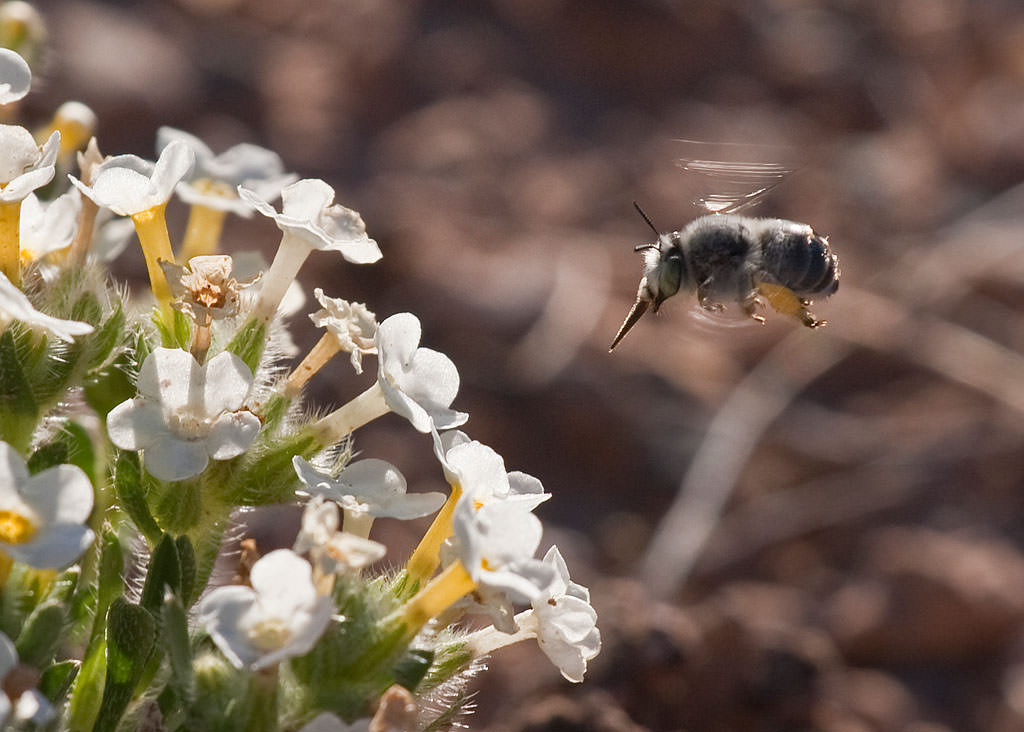
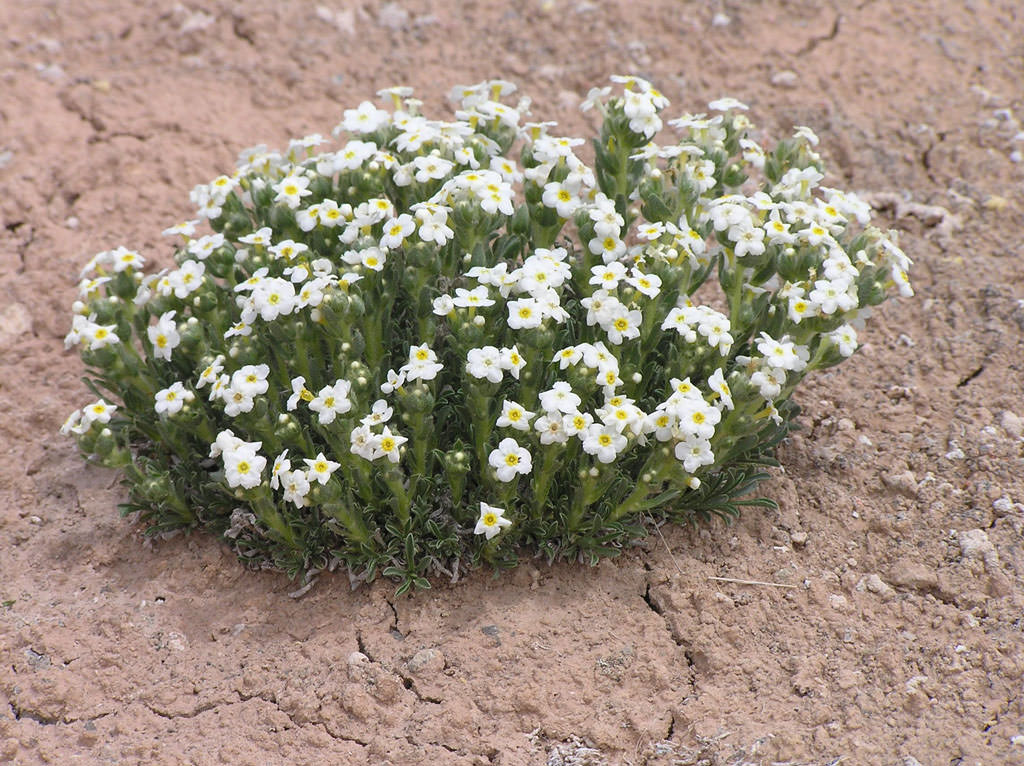
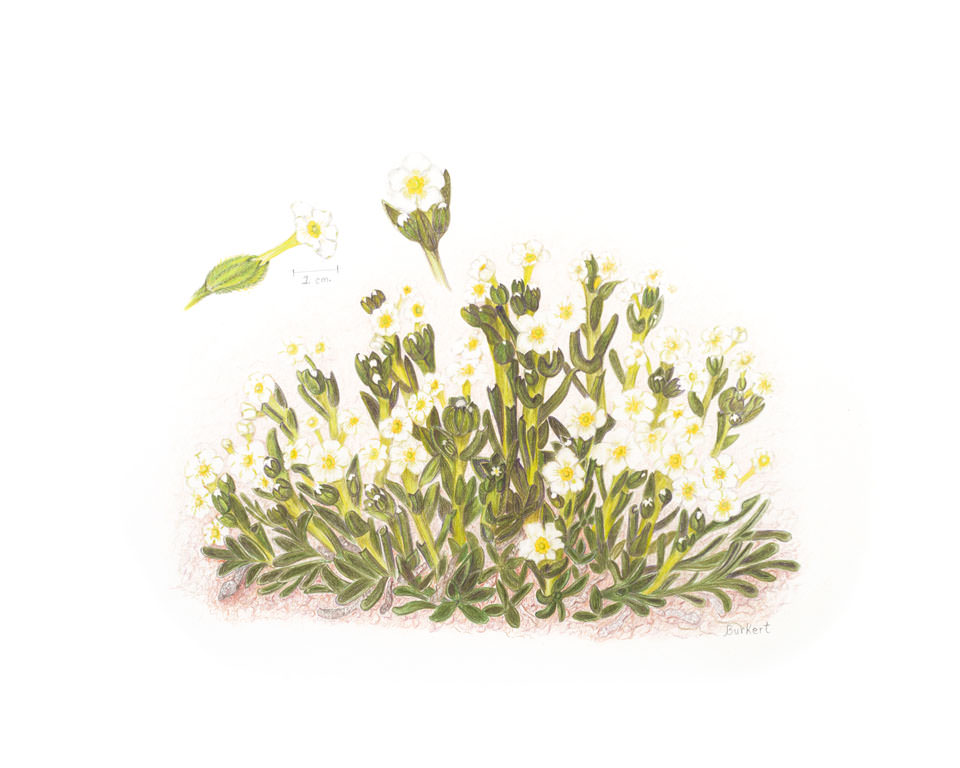
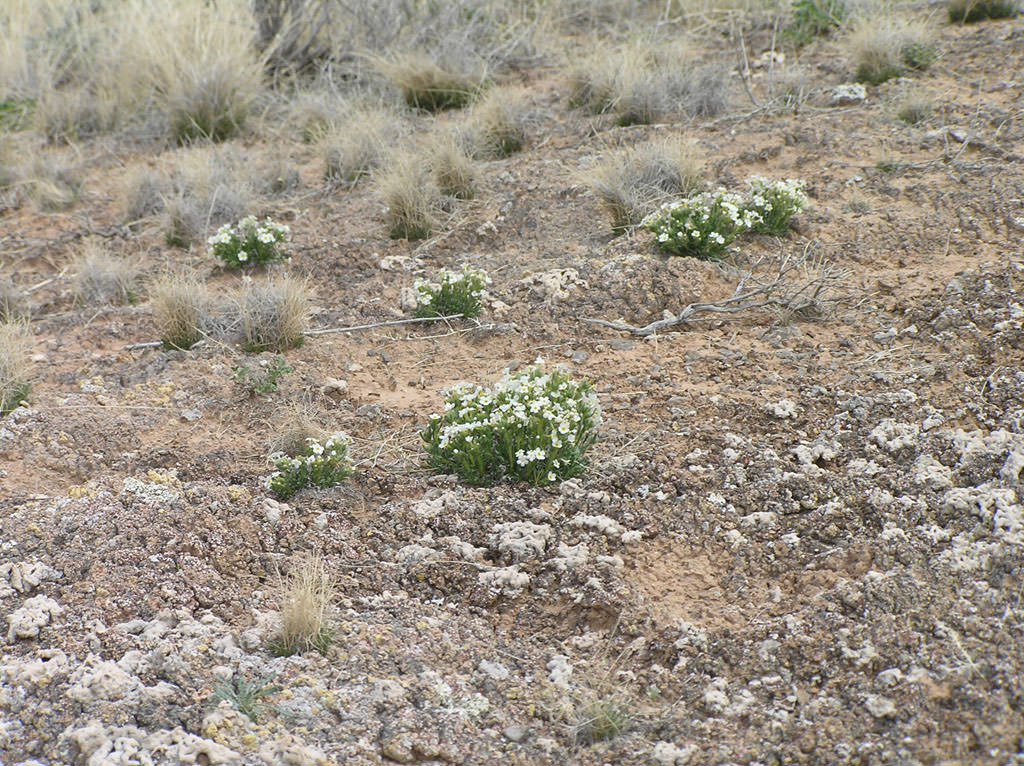
Plants are low, densely tufted herbaceous perennials, 0.3-2.5 dm high, 0.5-4 dm across, with a highly branched, woody caudex system arising from a deeply-seated taproot. Leaves are glabrous on top and have appressed pustulate-based bristles on lower surface. Basal leaves are tufted, narrowly oblanceolate to narrowly spatulate, 1-2.5 (3) cm long, 1.5-3 mm wide. Cauline leaves are scattered, oblanceolate to spatulate, 1-4 cm long, 2-4 (5) mm wide. Stems are erect and softly hairy. The calyx is turbinate, with segments narrowly lanceolate, 4-6 mm long in anthesis, (4) 6-9 mm long in fruit. The corolla is white with yellow fornices, about 10-12 mm long, prominently exserted from the calyx. Usually all 4 nutlets mature, and are rugose-tuberculate on both surfaces. Styles surpass the nutlets by 4-7 mm (Reveal and Broome 2006).
Look Alikes:
Identification based solely on morphology and soil preference is inadequate to delineate O. revealii from O. paradoxa, at least when applying a genetic species concept on the basis of which, individuals from the southern Paradox Basin (Dry Creek Basin, Big Gypsum Valley, Little Gypsum Valley, and Disappointment Valley) should be treated as O. revealii, whereas those from Paradox Valley and Sinbad Valley are more genetically aligned with O. paradoxa. Therefore field identification should rely on geographic location (Bresowar and McGlaughlin 2015).
Phenology:
Plants flower in May and produce fruit in June (Colorado Natural Heritage Program 2012).
 |
Habitat
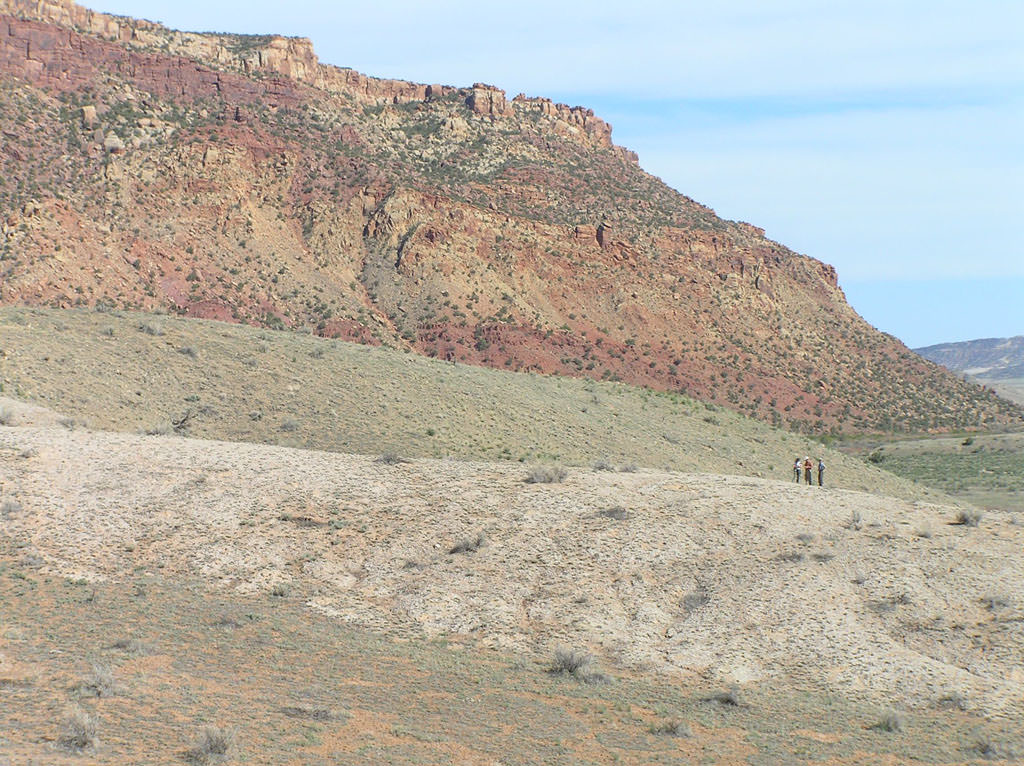
This species is often the dominant vascular plant on the grayish, near-barren gypsum hills of the Paradox Member of the Hermosa Formation in western Colorado (Reveal and Broome 2006). It is also found on other barren shale substrates in the area. In some sites, the dominant plant is a whitish gray cryptobiotic lichen. In a survey of the associated lichens in May 2005 by Larry St.Clair, over 20 lichen species were identified, including two that are globally rare. This species is found on light gray soils, and is absent from the adjacent more reddish-brown soils. Associated vascular plant species include snakeweed (Gutierrezia sarothrae), spearleaf buckwheat (Eriogonum lonchophyllum), winterfat (Krascheninnikovia lanata), fourwing saltbush (Atriplex canescens), galleta (Pleuraphis jamesii), Wyoming big sagebrush (Artemisia tridentata ssp. wyomingensis), slimleaf plains mustard (Schoencrambe linearifolia), fullstem (Chamaechaenactis scaposa), Torreys hymenoxys (Tetraneuris torreyana), gyp dropseed (Sporobolus nealleyi), and western tansy-mustard (Descurainia pinnata).
click on image to enlarge
 |
 |
Elevation Range:
5,393 - 6,849 feet (1,644 - 2,088 meters)
Distribution
Colorado Endemic:
Yes
Range:
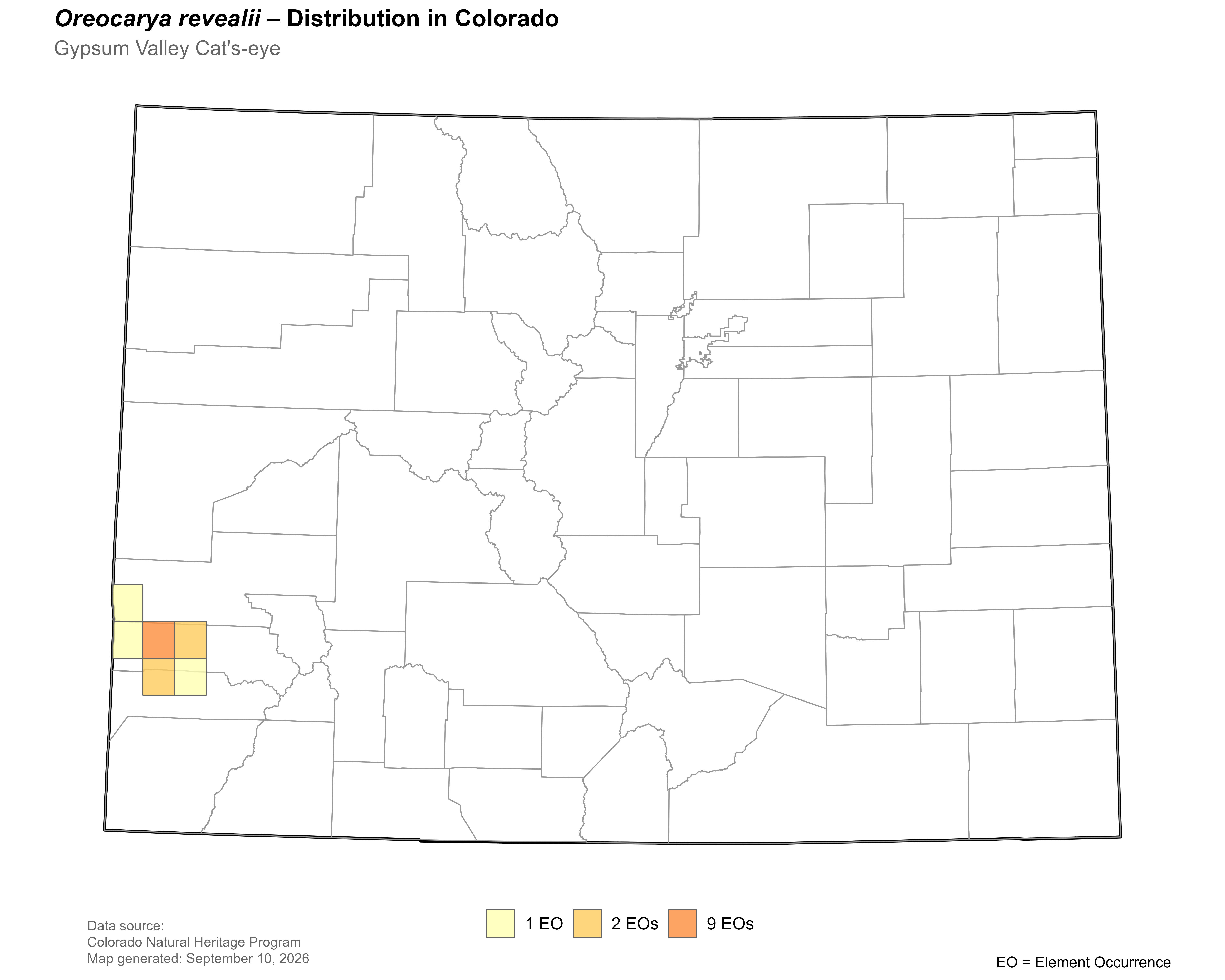
Oreocarya revealii is a Colorado (USA) endemic known from the southern Paradox Basin (Dry Creek Basin, Big Gypsum Valley, Little Gypsum Valley, and Disappointment Valley) in San Miguel and adjoining Montrose and Dolores counties. Estimated range extent in Colorado of 443 square kilometers was calculated in GeoCAT using occurrence data provided by the Colorado Natural Heritage Program (2022).
Click on map to enlarge |
Threats and Management Issues
Livestock grazing is widespread through out the range of Oreocarya revealii and has impacted some occurrences. In addition, several occurrences report impacts from browsing and trampling by wild horses, motorized recreation or are within power line right of ways. Oil and gas development also occurs throughout the area but no direct impacts have been reported. Long-term drought is also a concern throughout its range. This species is considered to have low adaptive capacity and is expected to be moderately to extremely vulnerable to climate change under both RCP 4.5 and 8.5 scenarios, as assessed for the 2025 Colorado State Wildlife Action Plan (CNHP 2025).
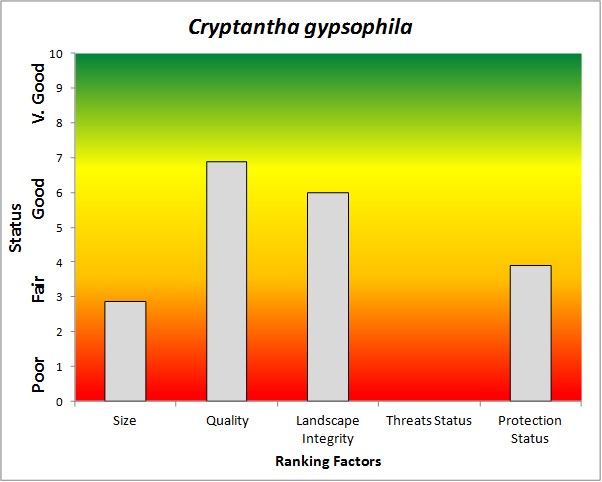
Summary results of an analysis of the status of Cryptantha gypsophila based on several ranking factors. This species was concluded to be Weakly Conserved. From Rondeau et al. 2011. |
References
- Ackerfield, J. 2015. Flora of Colorado. BRIT Press, Botanical Research Institute of Texas, Fort Worth, TX. 818 pp.
- Ackerfield, Jennifer. 2022. Flora of Colorado. Second Edition. Bot. Misc. 60. BRIT Press, Fort Worth Botanic Garden/Botanical Research Institute of Texas, U.S.A. 861 pp.
- Bresowar, G.E. and M.E. McGlaughlin. 2015. Morphological and genetic discrepancies in populations of Oreocarya paradoxa and O. revealii: the impact of edaphic selection on recent diversification in the Colorado Plateau. Am J Bot. 2015 Oct;102(10):1647-58.
- Colorado Natural Heritage Program (CNHP). 2025. Climate Change Vulnerability Assessment of Colorado Tier 1 and Tier 2 Plant Species of Greatest Conservation Need (SCGN) for the 2025 Colorado State Wildlife Action Plan. Colorado Natural Heritage Program, Colorado State University, Fort Collins, CO.
- Colorado Natural Heritage Program. 2012. Biodiversity Tracking and Conservation System. Colorado State University, Fort Collins, CO.
- Elliott, B. A., S. Spackman Panjabi, B. Kurzel, B. Neely, R. Rondeau, M. Ewing. 2009. Recommended Best Management Practices for Plants of Concern. Practices developed to reduce the impacts of oil and gas development activities to plants of concern. Unpublished report prepared by the Rare Plant Conservation Initiative for the National Fish and Wildlife Foundation.
- Handwerk, J., L. Grunau, and S. Panjabi. 2015. Colorado Wildlife Action Plan: 2015 Rare Plant Addendum. Colorado Natural Heritage Program, Colorado State University, Fort Collins, Colorado, USA.
- Krening, P. 2024. Gypsum Valley cryptantha (Oreocarya revealii) Population Trend Monitoring Summary – 2024 Bureau of Land Management, CO State Office. Lakewood, CO.
- Lavender, A.E., M.M. Fink, S.E. Linn, D.M. Theobald. 2011. Colorado Ownership, Management, and Protection v9 Database. Colorado Natural Heritage Program and Geospatial Centroid, Colorado State University, Fort Collins, CO. (30 September).
- Neely, B., S. Panjabi, E. Lane, P. Lewis, C. Dawson, A. Kratz, B. Kurzel, T. Hogan, J. Handwerk, S. Krishnan, J. Neale, and N. Ripley. 2009. Colorado Rare Plant Conservation Strategy, Developed by the Colorado Rare Plant conservation Initiative. The Nature Conservancy, Boulder, Colorado, 117 pp.
- Payson, E.B. 1927. A monograph of the section Oreocarya of Cryptantha. Annuals of the Missouri Botanical Garden 14:211-348.
- Reveal, J.L., and C. R. Broome. 2006. Cryptantha gypsophila (Boraginaceae: Boraginoideae), a new species from western Colorado. Brittonia 58(2): 178-181.
- Schneider, A. 2013. Wildflowers, Ferns, and Trees of the Four Corners Regions of Colorado, New Mexico, Arizona, and Utah. Accessed on-line at http://www.swcoloradowildflowers.com.
- USDA, NRCS. 2022. The PLANTS Database. National Plant Data Team, Greensboro, NC 27401-4901 USA.
- Weber, W. A. and R. C. Wittmann. 2012. Colorado Flora, Western Slope, A Field Guide to the Vascular Plants, Fourth Edition. Boulder, Colorado. 532 pp.
- Weber, W.A., and R.C. Wittmann. 2010. New names and combinations in the flora of Colorado. XIII. J. Bot. Res. Inst. Texas 4(1):213.