

Scientific Name : Oreocarya elata
Author : Eastw. NatureServe Explorer
Common Name : Cliff Dweller's Candlestick Cat's- eye
 Current Research Activities
 1997 profile


☰ Click link below for details.
Taxonomy
Boraginaceae (borage family)
=Cryptantha elata (USDA NRCS 2017).
Ranks and Status
State Rank : S2
State Rank Reason : Oreocarya elata is known from a limited distribution in Delta, Garfield, and Mesa counties, Colorado, USA. The primary threats to this species include habitat fragmentation and degradation resulting from recreational uses, incompatible grazing, and competition from non-native plants, especially Bromus tectorum. Oreocarya elata is also considered to be extremely vulnerable to the effects of climate change.
U.S. Endangered Species Act : none
Colorado Threatened and Endangered List : none
Other Statuses : SWAP Tier 2
Description and Phenology
General Description:
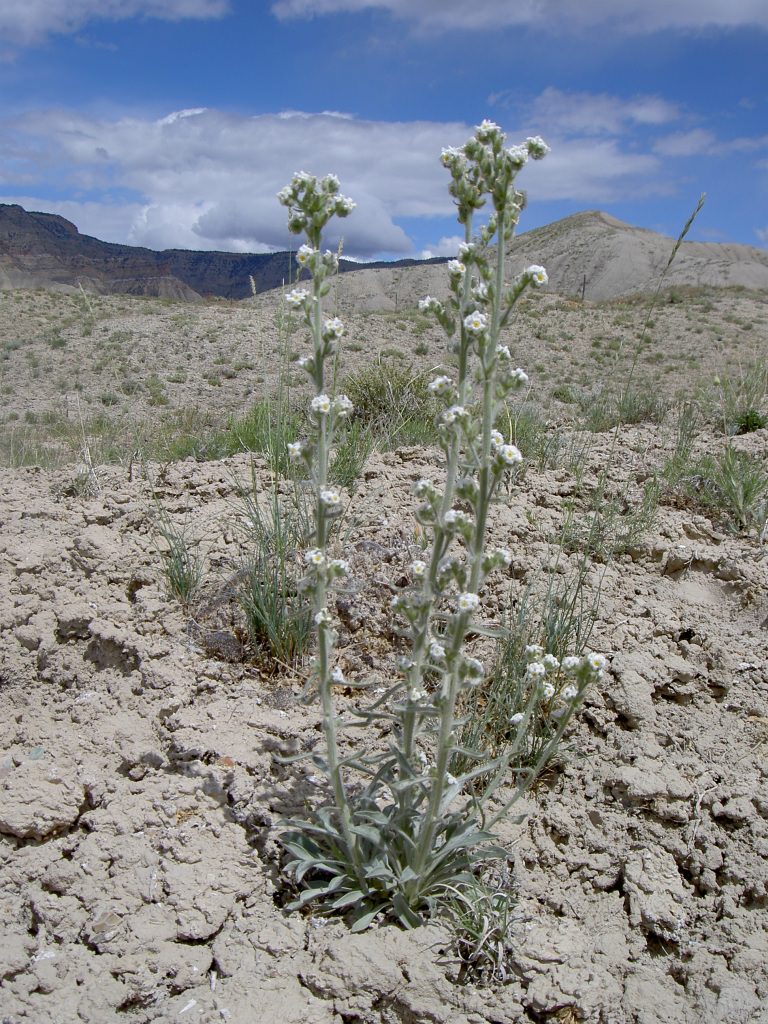
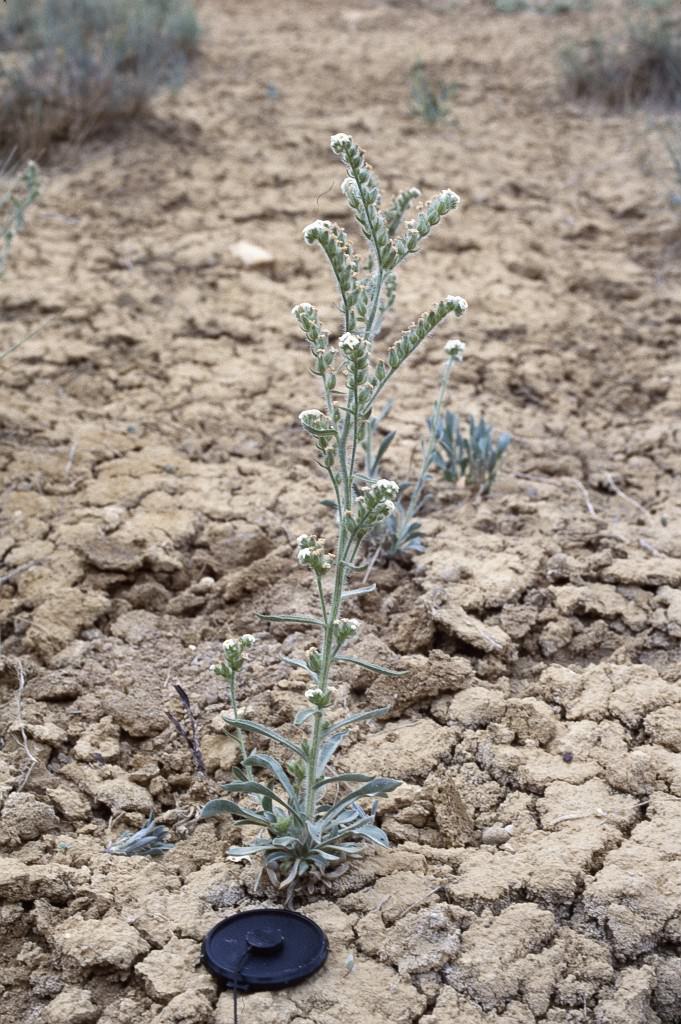
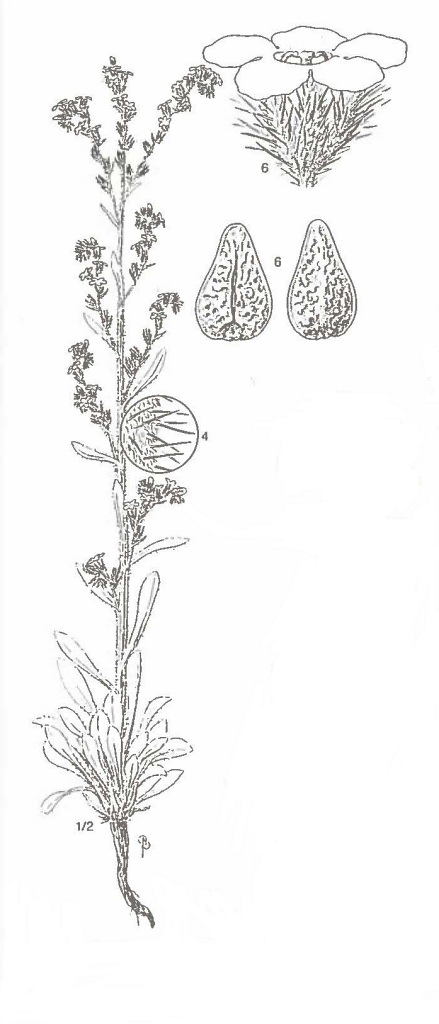
Biennial or short-lived perennial, often single stemmed, 3-5 dm tall, erect. Stem with pungent spreading bristles, mostly 1.5-2.5 mm long. Upper leaf surface with both strigose and pustulate hairs. Broad-topped inflorescence; helicoid cymes elongate and become raceme-like. Corolla white, with evident yellow fornices. Mature calyx exceeding the nutlets by 2-4 mm. Nutlets, usually 4, closely rugose-reticulate or rugulose-tuberculate. Nutlet scar without elevated margin (Spackman et al. 1997, Weber and Wittmann 2012, Ackerfield 2015).
Look Alikes:
Not likely to be confused with other species in same habitat (Spackman et al. 1997).
Phenology:
Flowers May to June (Colorado Natural Heritage Program occurrence records as of 2017).
 |
Habitat
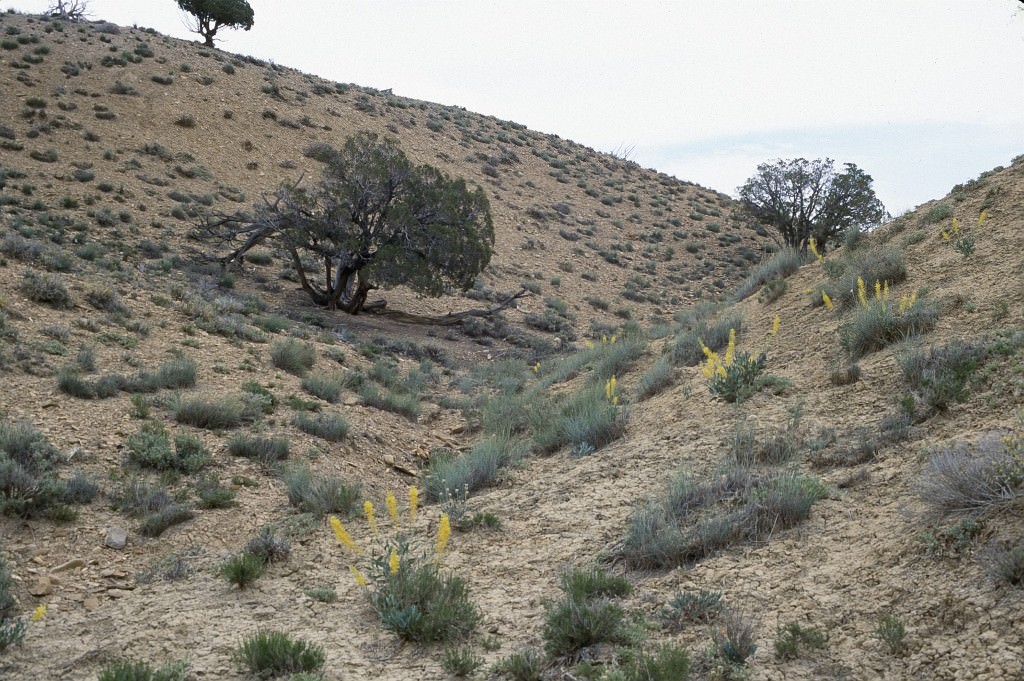
Found on steep slopes and draws, in clay soils from Mancos Shale, with salt desert shrub communities (Spackman et al. 1997, Weber and Wittmann 2012). Associated taxa include Xylorhiza venusta, Hilaria jamesii, Atriplex corrugata, Phacelia sp., Atriplex gardneri, Playschleuhria integrifolia, Astragalus flavus, Cymopterus bulbosus, Chrysothamnus sp., Stanleya pinnata, Chaetopappa ericoides, Gutierrezia sarothrae, and Achnatherum hymenoides.
click on image to enlarge
 |
Elevation Range:
4,472 - 5,271 feet (1,363 - 1,606 meters)
Distribution
Colorado Endemic:
No
Range:
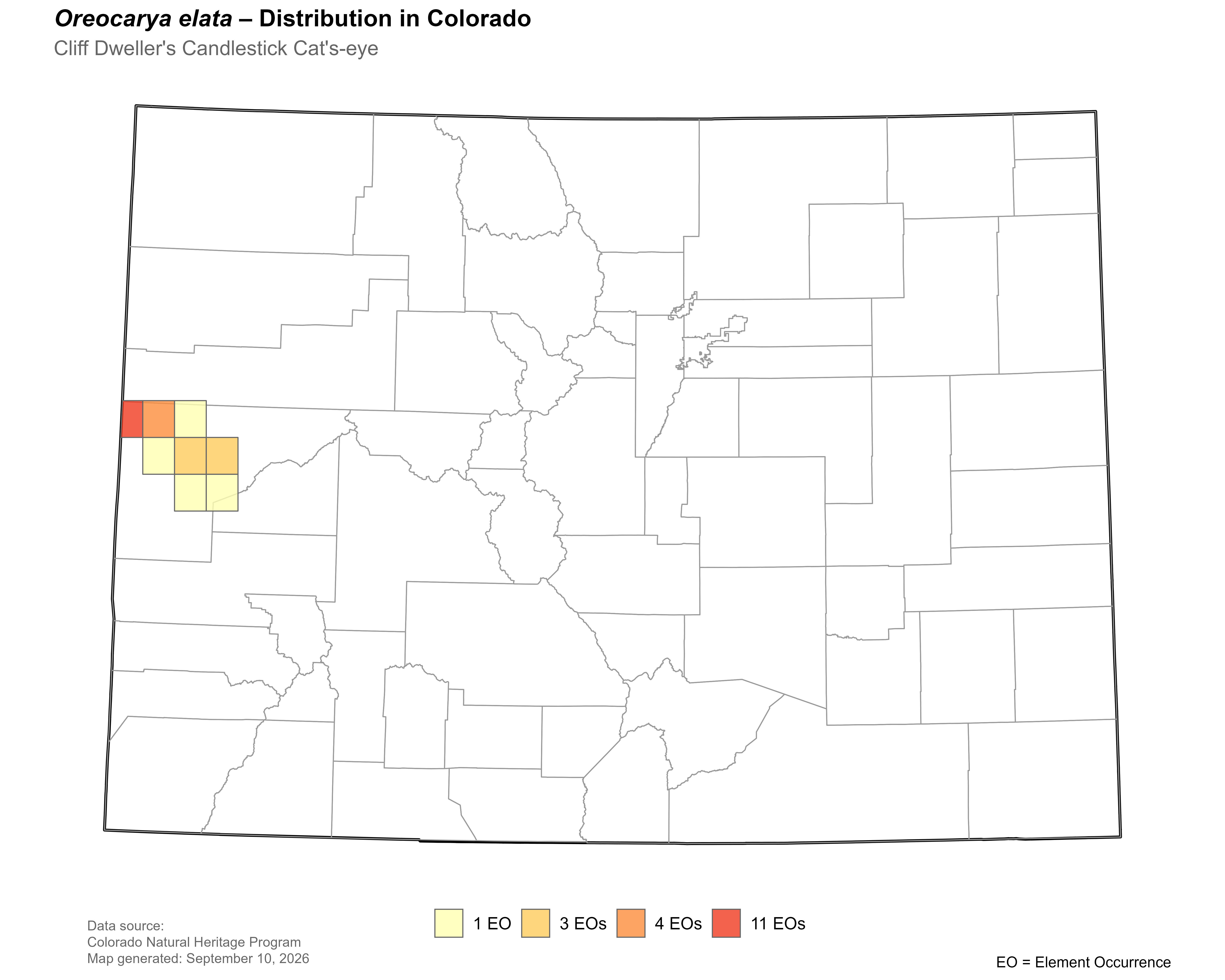
Oreocarya elata is known from Delta, Garfield, and Mesa counties in Colorado, USA. Estimated range extent in Colorado of 1518 square kilometers was calculated in GeoCAT using occurrence data provided by the Colorado Natural Heritage Program (2025). It is also known from Grand County, Utah (USDA NRCS 2017).
Click on map to enlarge |
Threats and Management Issues
The primary concerns documented in the occurrences include habitat fragmentation and degradation resulting from recreational uses, incompatible grazing, and competition from non-native plants, especially Bromus tectorum. Rangewide, long-term drought is a concern. This species is considered to have low adaptive capacity and is expected to be extremely vulnerable to climate change under both RCP 4.5 and 8.5 scenarios, as assessed for the 2025 Colorado State Wildlife Action Plan (CNHP 2025).
References
- Ackerfield, J. 2015. Flora of Colorado. BRIT Press, Botanical Research Institute of Texas, Fort Worth, TX. 818 pp.
- Colorado Natural Heritage Program (CNHP). 2025. Climate Change Vulnerability Assessment of Colorado Tier 1 and Tier 2 Plant Species of Greatest Conservation Need (SCGN) for the 2025 Colorado State Wildlife Action Plan. Colorado Natural Heritage Program, Colorado State University, Fort Collins, CO.
- Colorado Natural Heritage Program and the Geospatial Centroid. 2017. The Colorado Ownership and Protection Map (COMaP). Colorado State University, Ft. Collins, CO.
- Harrington, H. D. 1954. Manual of the Plants of Colorado. Sage Books, Denver, CO. 666 pp.
- Higgins, L.C. 1971. A revision of Cryptantha subgenus Oreocarya. Brigham Young University Science Bulletin. Volume 13:1-63.
- Spackman, S., B. Jennings, J. Coles, C. Dawson, M. Minton, A. Kratz, and C. Spurrier. 1997. Colorado rare plant field guide. Prepared for Bureau of Land Management, U.S. Forest Service and U.S. Fish and Wildlife Service by Colorado Natural Heritage Program.
- USDA, NRCS. 2022. The PLANTS Database. National Plant Data Team, Greensboro, NC 27401-4901 USA.
- Weber, W. A. and R. C. Wittmann. 2012. Colorado Flora, Western Slope, A Field Guide to the Vascular Plants, Fourth Edition. Boulder, Colorado. 532 pp.
- Welsh, S.L., N.D. Atwood, S. Goodrich, and L.C. Higgins (eds.) 1993. A Utah flora. 2nd edition. Brigham Young Univ., Provo, Utah. 986 pp.