


Scientific Name : Oonopsis puebloensis
Author : G.K. Brown & T.M. Evans NatureServe Explorer
Common Name : Pueblo Goldenweed
 Current Research Activities
 1997 profile


☰ Click link below for details.
Taxonomy
Asteraceae (sunflower family)
Described by Nesom (2024) as Oonopsis puebloensis G.K. Brown & T.M. Evans. This species is included in Ackerfield (2015, 2022) but not in Weber and Wittmann (2012).
Ranks and Status
State Rank : S2S3
State Rank Reason : There are 29 documented occurrences of Oonopsis puebloensis, five of which have not been visited in over 20 years. This species is found only on a restricted substrate (shale) in two counties in southeastern Colorado (USA). Threats to the species include limestone mining and residential development. It is also considered vulnerable to the effects of climate change.
U.S. Endangered Species Act : none
Colorado Threatened and Endangered List : none
Other Statuses : SWAP Tier 1
Description and Phenology
General Description:
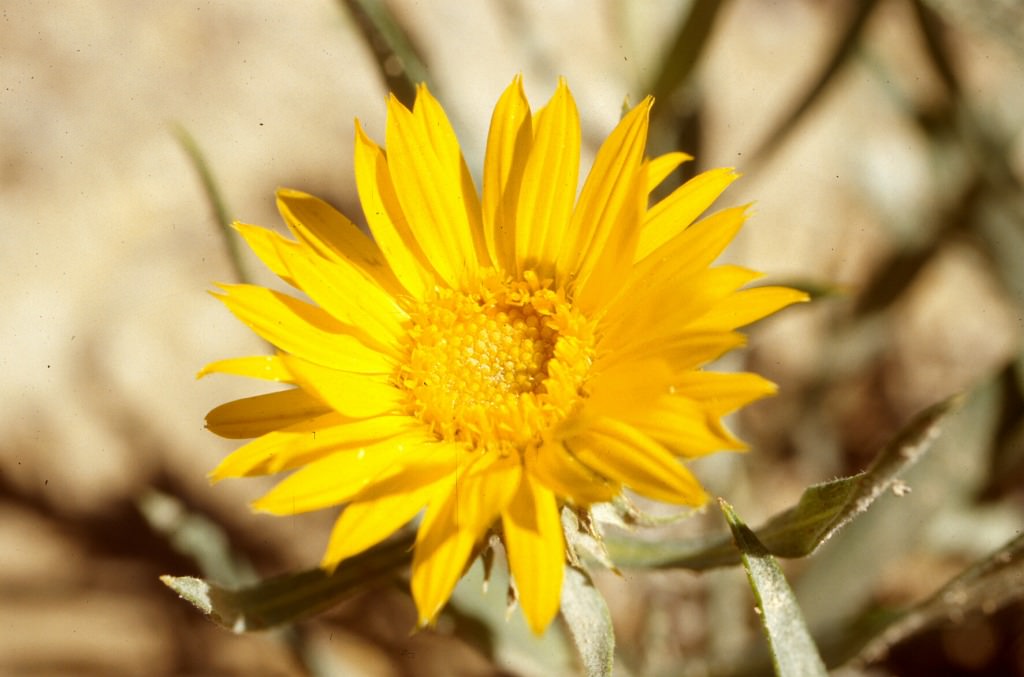
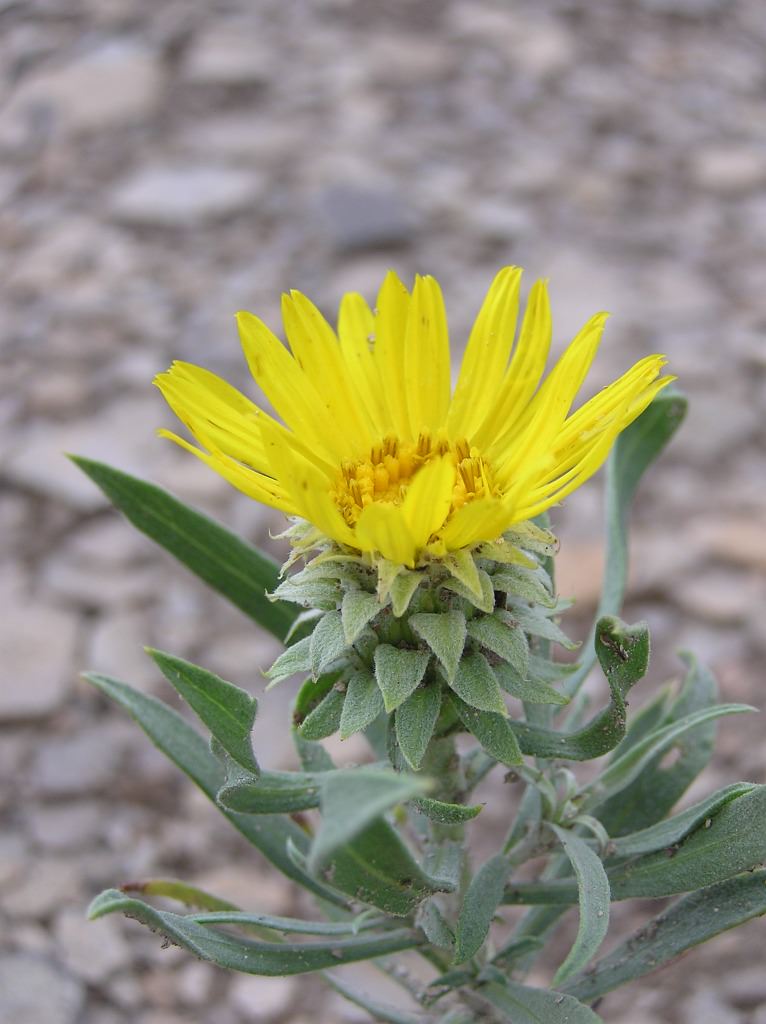
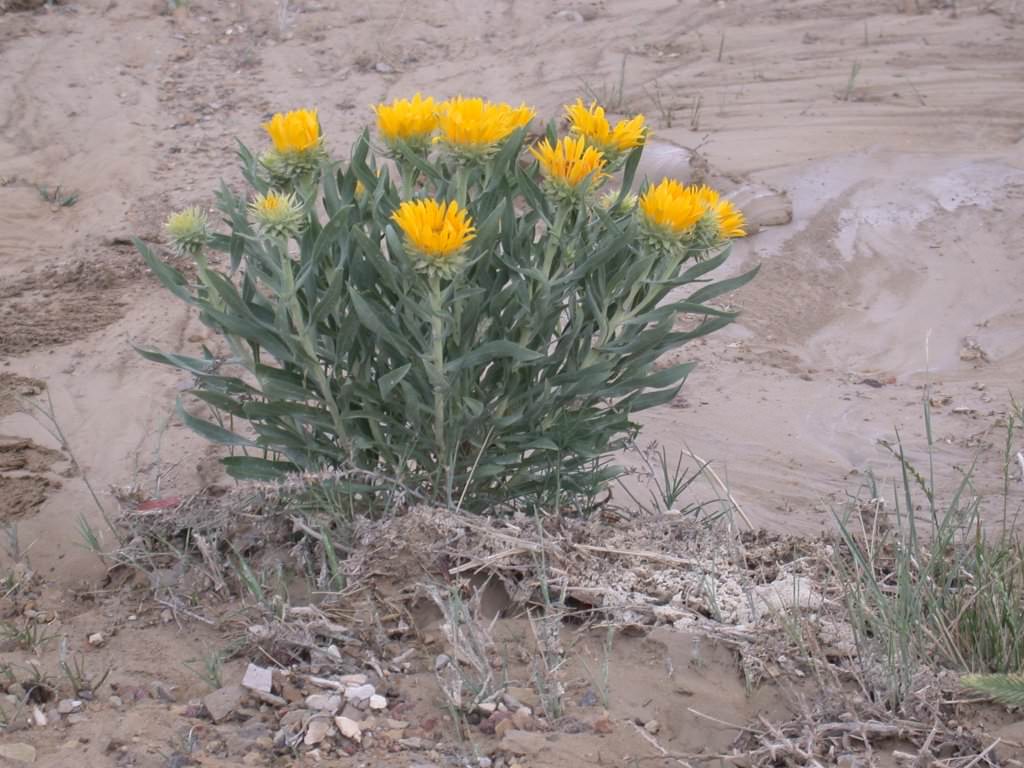
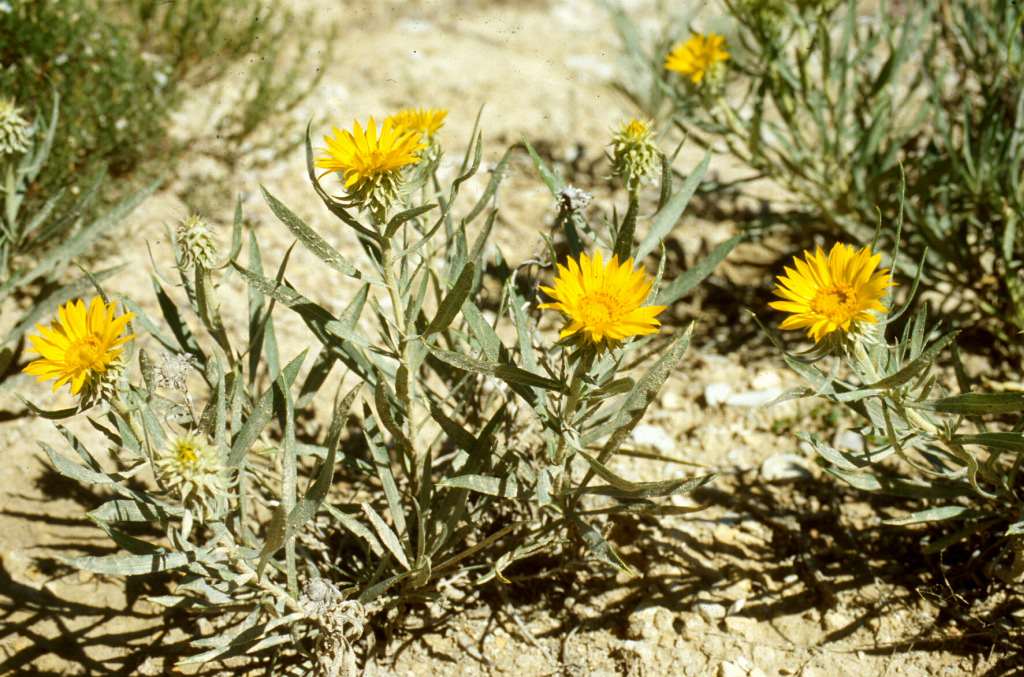
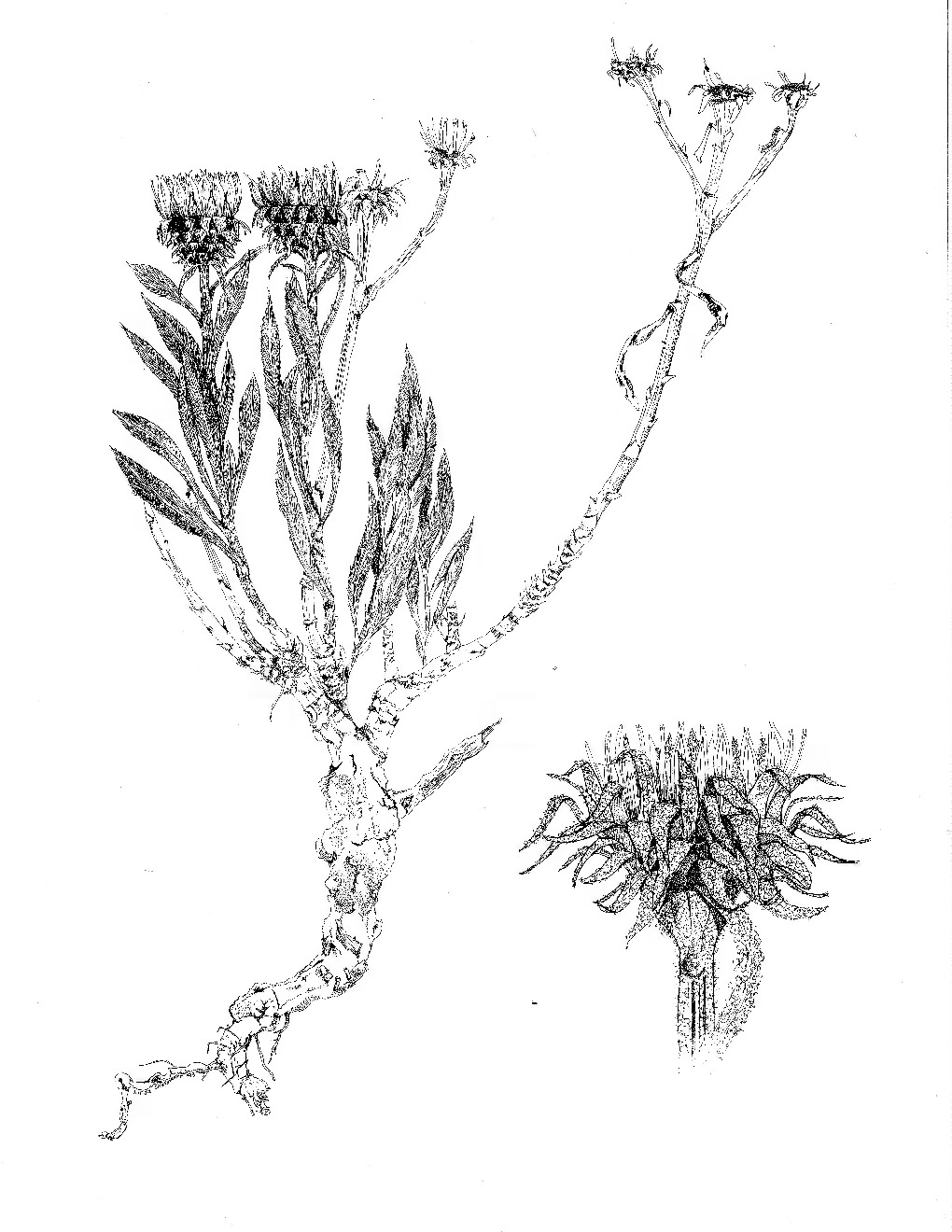
Pueblo goldenweed (Oonopsis puebloensis) is a low-growing (1-6 dm tall) perennial sub-shrub, with leafy stems topped by yellow ray and disk flowers and strongly reflexed phyllaries. The leaves are linear-lanceolate to linear-oblanceolate, and alternate on the stems. Stems and leaves are covered with fine, soft hairs. The woody stalk persists. The usually solitary heads have both disc and ray flowers with the ray flowers numbering 12-30 (Brown 1993, Spackman et al. 1997, Ackerfield 2015).
Look Alikes:
Oönopsis puebloensis could be confused with O. foliosa which also grows in similar habitats, but has smooth or barely hairy leaves. The plants are taller, with 2-6 flowerheads per stem, and the phyllaries are not reflexed. Oönopsis foliosa also has a wider range (Brown 1993, Spackman et al. 1997).
Phenology:
Flowers June-August (Ackerfield 2015).
 |
Habitat
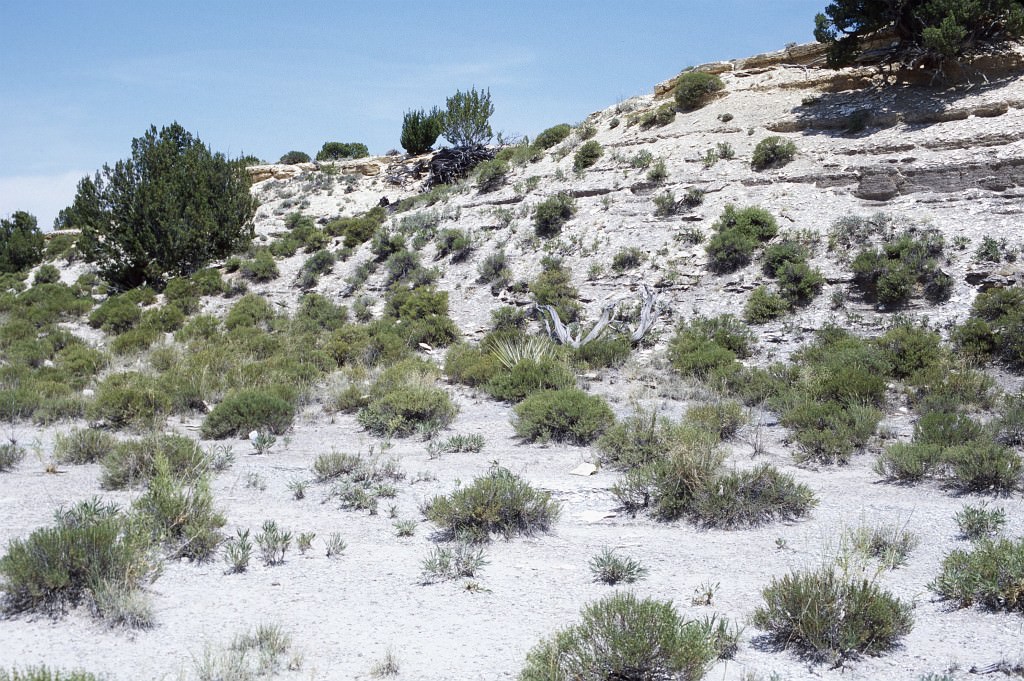
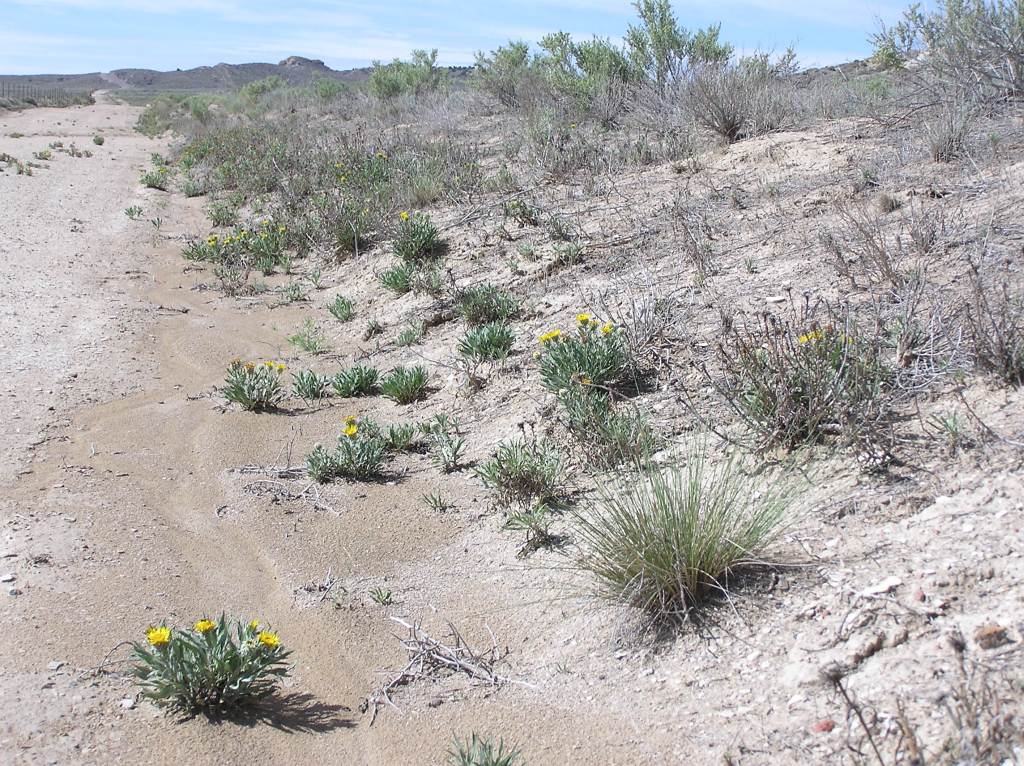
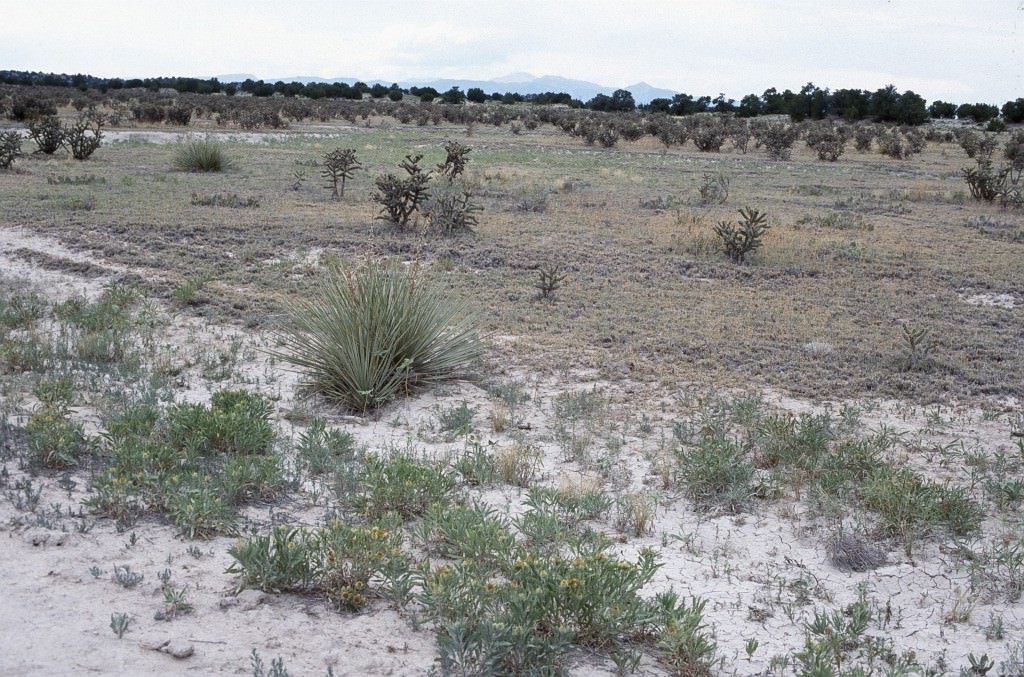
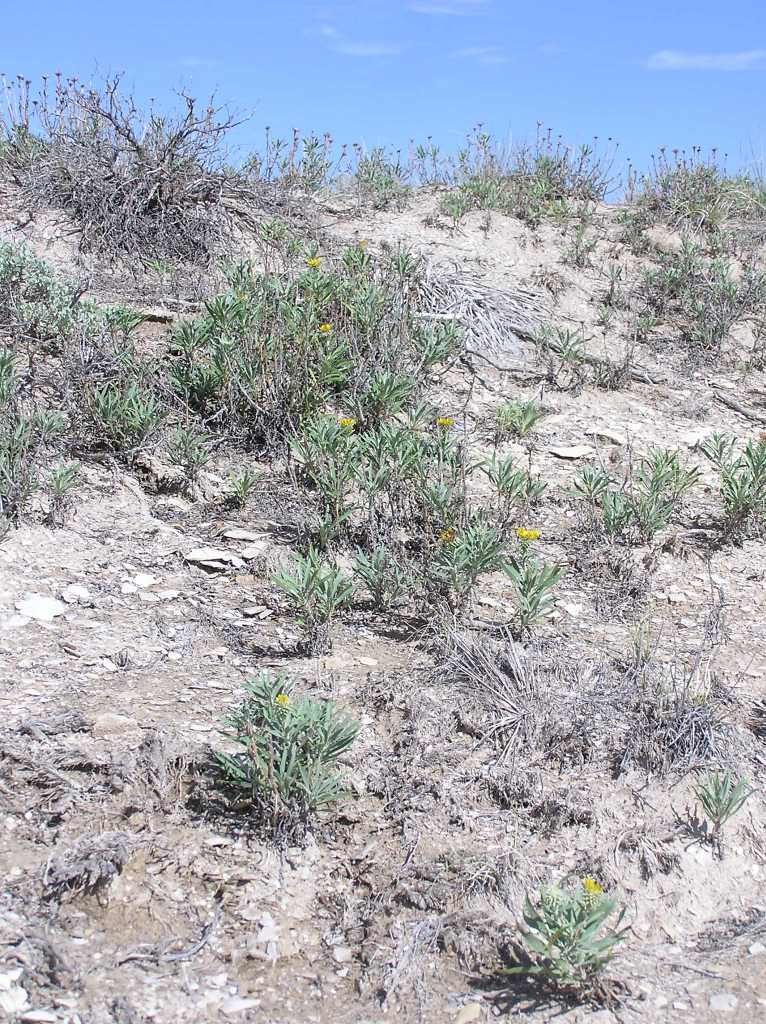
This species is found on barren shale outcrops of the Smoky Hill member of the Niobrara Formation in sparse shrublands or pinyon-juniper woodlands. Associated taxa include: Frankenia jamesii, Oryzopsis hymenoides, Artemisia bigelovii, Penstemon versicolor, as well as several other rare plants such as Mirabilis rotundifolia (Oxybaphus rotundifolius), Oenothera harringtonii, and Parthenium (Bolophyta) tetraneuris.
click on image to enlarge
 |
 |
 |
 |
Elevation Range:
4,856 - 6,121 feet (1,480 - 1,866 meters)
Distribution
Colorado Endemic:
Yes
Range:
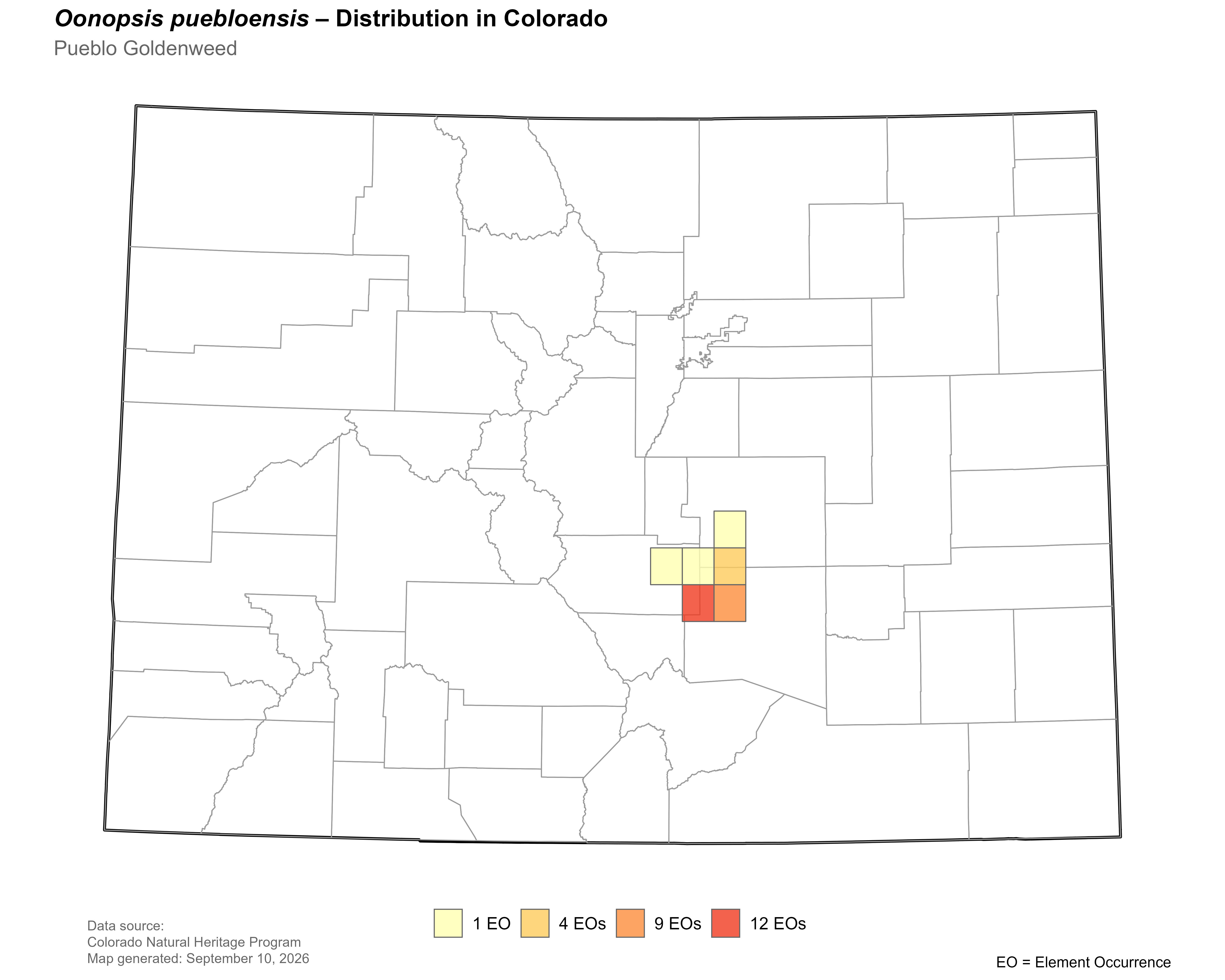
Oonopsis puebloensis is an edaphic endemic found on the Smoky Hill member of the Niobrara Shale Formation. It is known from El Paso, Fremont and Pueblo counties, Colorado (USA). Estimated range extent in Colorado of 1250 square kilometers was calculated in GeoCAT using occurrence data provided by the Colorado Natural Heritage Program (2023).
Click on map to enlarge |
Threats and Management Issues
The major threats to Oonopsis puebloensis are from excavation by a local cement plant and development of the species' habitat for housing. These threats have been documented for the other rare endemic plant species inhabiting the same shale habitat. The shale substrates occur mostly on private land, much of it owned by a local cement plant and used for mining subsurficial limestone. In addition, residential development associated with the cities of Pueblo, Pueblo West, Penrose, Portland, Florence, and Canon City are expanding into the area. The Niobrara shale is exposed on the surface in a fairly restricted area west of Pueblo, and it is on these exposed surfaces that other endemic plant species occur. The cement plant is located in the area because of the ease of mining limestone from these exposed surfaces. Without protection planning, habitat for the rare plant species, including Oonopsis puebloensis, could become so restricted and fragmented that viable populations cannot be sustained. This species is considered to have high adaptive capacity and is expected to be slightly vulnerable to climate change under both RCP 4.5 and 8.5 scenarios, as assessed for the 2025 Colorado State Wildlife Action Plan (CNHP 2025).
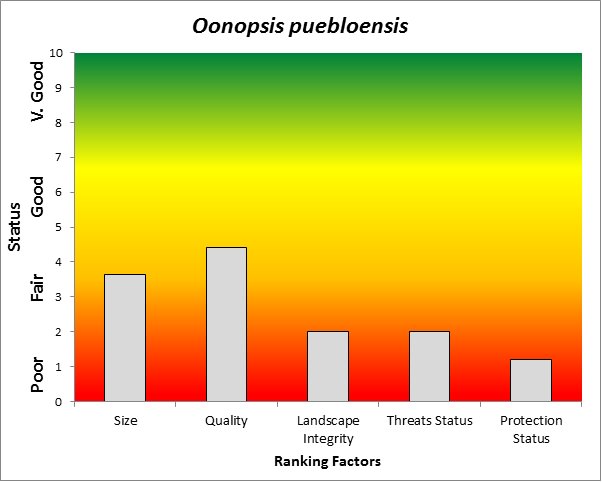
Summary results of an analysis of the status of Oonopsis puebloensis based on several ranking factors. This species was concluded to be "Weakly Conserved. From Rondeau et al. 2011. |
References
- Ackerfield, J. 2015. Flora of Colorado. BRIT Press, Botanical Research Institute of Texas, Fort Worth, TX. 818 pp.
- Ackerfield, Jennifer. 2022. Flora of Colorado. Second Edition. Bot. Misc. 60. BRIT Press, Fort Worth Botanic Garden/Botanical Research Institute of Texas, U.S.A. 861 pp.
- Brown, G. K. 1993. Systematics of Oönopsis (Asteraceae). [Abstract.] Amer. J. Bot. 80(6, suppl.): 133-134.
- Colorado Natural Heritage Program (CNHP). 2025. Climate Change Vulnerability Assessment of Colorado Tier 1 and Tier 2 Plant Species of Greatest Conservation Need (SCGN) for the 2025 Colorado State Wildlife Action Plan. Colorado Natural Heritage Program, Colorado State University, Fort Collins, CO.
- Colorado Natural Heritage Program and the Geospatial Centroid. 2017. The Colorado Ownership and Protection Map (COMaP). Colorado State University, Ft. Collins, CO.
- Handwerk, J., L. Grunau, and S. Panjabi. 2015. Colorado Wildlife Action Plan: 2015 Rare Plant Addendum. Colorado Natural Heritage Program, Colorado State University, Fort Collins, Colorado, USA.
- Neely, B., S. Panjabi, E. Lane, P. Lewis, C. Dawson, A. Kratz, B. Kurzel, T. Hogan, J. Handwerk, S. Krishnan, J. Neale, and N. Ripley. 2009. Colorado Rare Plant Conservation Strategy, Developed by the Colorado Rare Plant conservation Initiative. The Nature Conservancy, Boulder, Colorado, 117 pp.
- Nesom, G.L. Nomenclatural summary of Oonopsis (Asteraceae: Astereae). Phytoneuron 2024-66: 1-11. Published 19 September 2024. ISSN 2153 733X.
- Rocky Mountain Society of Botanical Artists. 2009. RARE Imperiled Plants of Colorado, a traveling art exhibition. Exhibition catalogue developed by the Denver Botanic Gardens and Steamboat Art Museum.
- Rondeau, R., K. Decker, J. Handwerk, J. Siemers, L. Grunau, and C. Pague. 2011. The state of Colorado's biodiversity 2011. Prepared for The Nature Conservancy. Colorado Natural Heritage Program, Colorado State University, Fort Collins, Colorado.
- Spackman, S., B. Jennings, J. Coles, C. Dawson, M. Minton, A. Kratz, and C. Spurrier. 1997. Colorado rare plant field guide. Prepared for Bureau of Land Management, U.S. Forest Service and U.S. Fish and Wildlife Service by Colorado Natural Heritage Program.
- Weber, W. A. and R. C. Wittmann. 2012. Colorado Flora, Eastern Slope, A Field Guide to the Vascular Plants, Fourth Edition. Boulder, Colorado. 555 pp.


