


Scientific Name : Oenothera harringtonii
Author : W.L. Wagner NatureServe Explorer
Common Name : Arkansas Valley Evening Primrose
 Current Research Activities
 1997 profile


☰ Click link below for details.
Taxonomy
Onagraceae (evening primrose family)
Oenothera harringtonii is a member of the O. caespitosa complex within the section Pachylophus. The O. caespitosa complex comprises five species: O. caespitosa, O. psammophila, O. harringtonii, O. cavernae, and O. brandegeei (Wagner et al. 1985).
Ranks and Status
State Rank : S2S3
State Rank Reason : Oenothera harringtonii is thought to be endemic to Colorado, USA; it is known from Bent, El Paso, Fremont, Huerfano, Las Animas, Otero, and Pueblo counties. There are over 80 documented occurrences, with only 19 known to be of good viability. Many occurrences are threatened by weed invasion, roadside maintenance activities, or residential and commercial development. This species is considered to have moderate adaptive capacity and is expected to be moderately to extremely vulnerable to climate change.
U.S. Endangered Species Act : none
Colorado Threatened and Endangered List : none
Other Statuses : SWAP Tier 2
Description and Phenology
General Description:
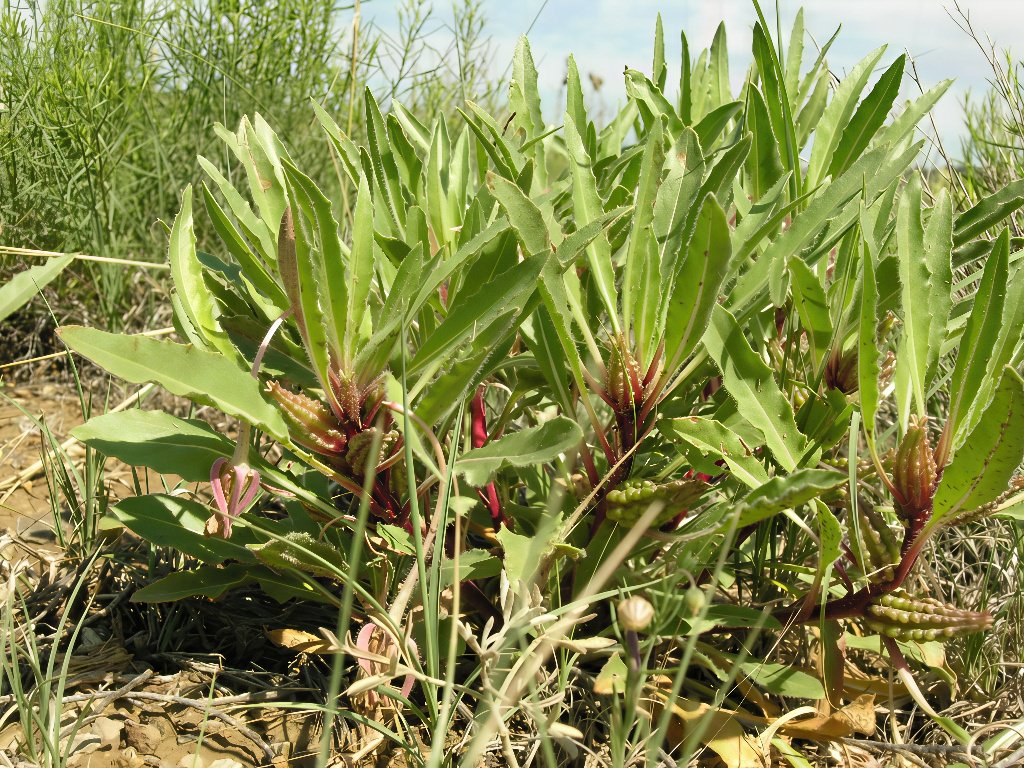
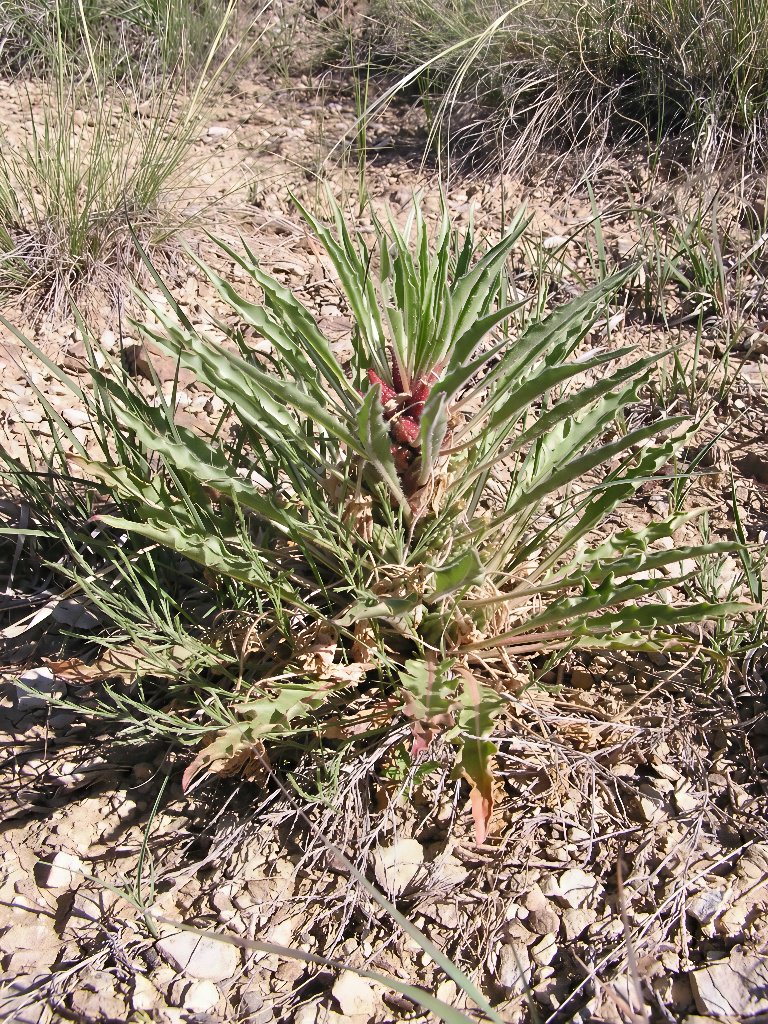
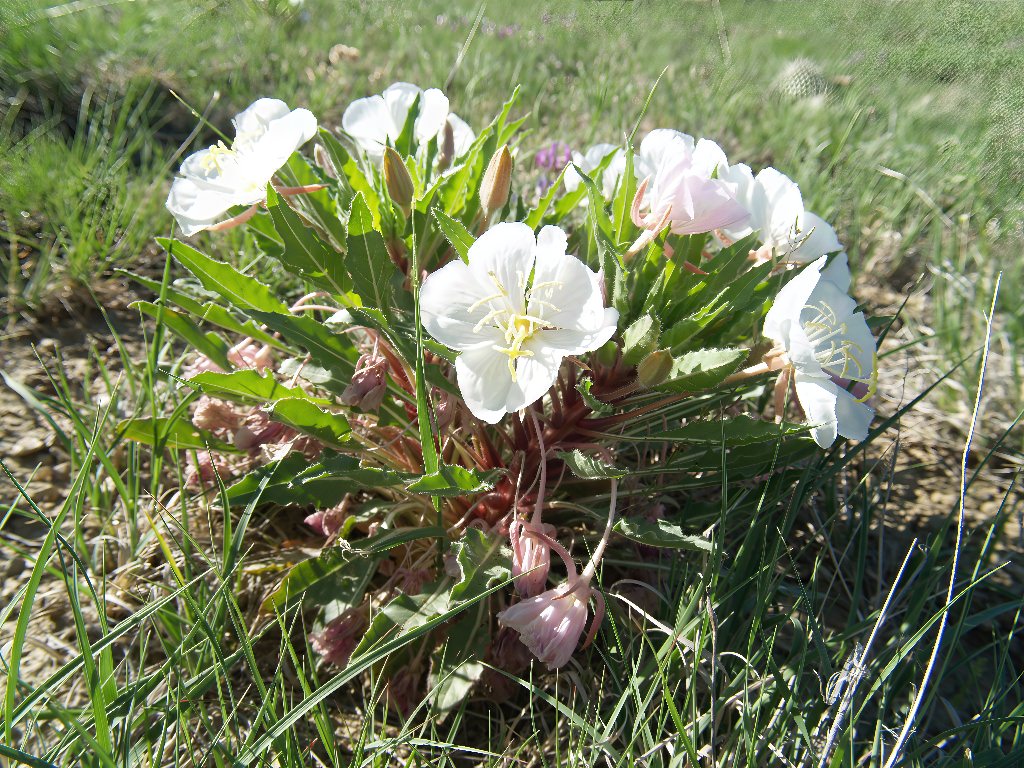
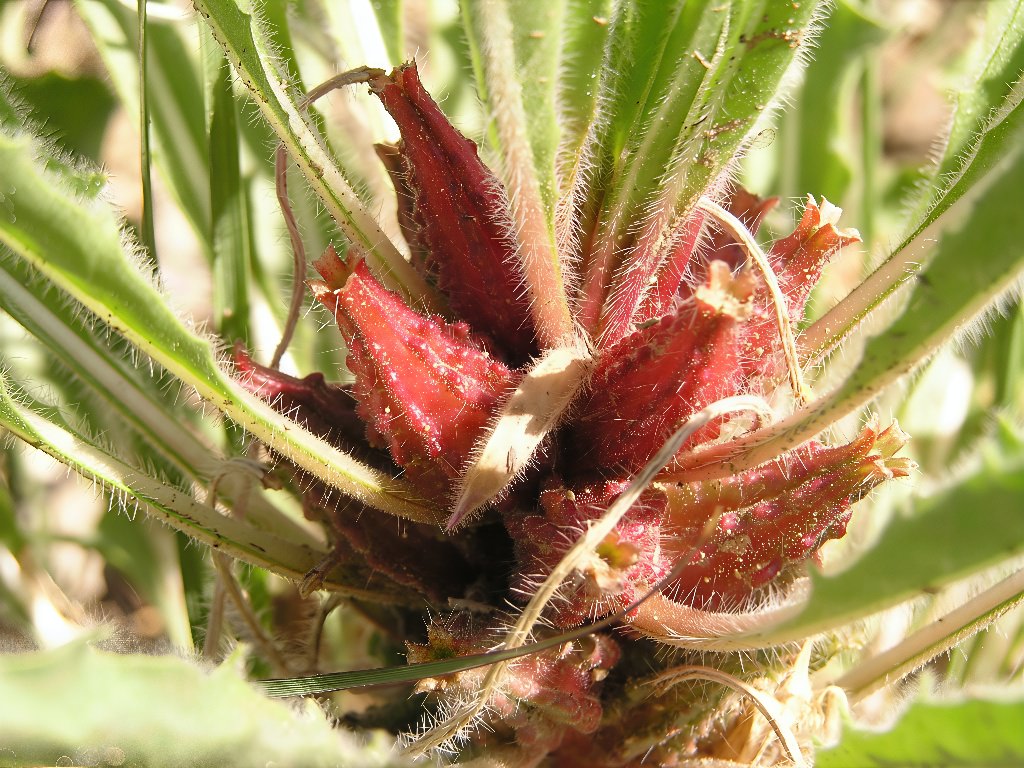
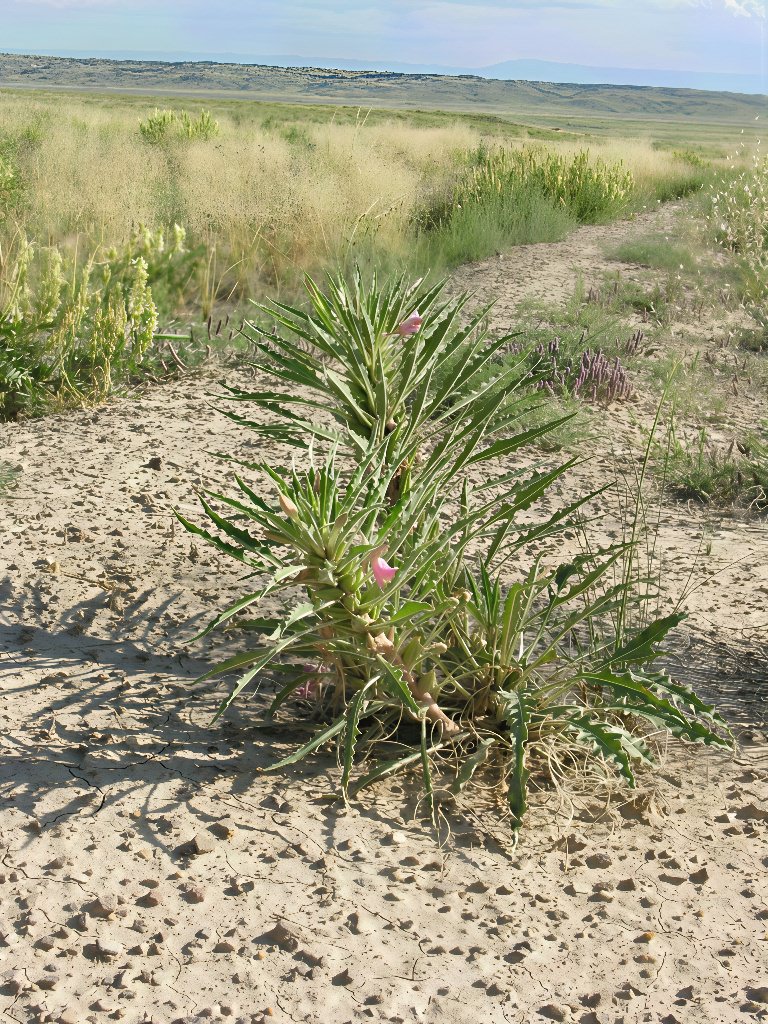
Herbaceous annual, or rarely surviving a second year; caulescent, from a stout taproot; strigulose, hirtelllous or glandular puberulent. Stems ascending to erect, stout, unbranched or with lateral stems from basal rosette, densely leafy, 15-40 cm tall. Leaves to 30 cm long, narrowly oblanceolate, margins irregularly and coarsely dentate, apex acute. Flowers solitary in upper axils, usually 5-10 per stem opening per day near sunset, with heavy sweet scent; petals white, fading pink, 20-25 mm; stigma 4 lobed, exserted beyond anthers at anthesis. Fruit a capsule, 20-35 mm long, lanceoloid, tapering to a sterile beak, winged with prominent tubercle ridges between wings (Ackerfield 2022, FNA Vol 10, 2021).
Look Alikes:
Similar to O. caespitosa ssp. macroglottis whose range overlaps that of O. harringtonii in Fremont county. Because of their greatly different habitats they are rarely found growing together. One exception is along the Arkansas River between Parkdale and Canon City, where O. caespitosa ssp. macroglottis atypically occurs in a non montane habitat along the river. Intermediates have not been observed. The perennial O. caespitosa ssp. macroglottis has all basal leaves, notched corolla lobes, lower numbers of capsules per stem, and lower seed production. O. caespitosa ssp. macroglottis has a sweet fragrance as opposed to the strong "gardenia-like" fragrance of O. harringtonii (Ladyman 2005, Wagner et al. 1995).
Phenology:
Flowering mid May through June (Ackerfield 2022, CNHP 2026). Though O. harringtonii is typically annual, some individuals, especially from the southern part of the range, appear to overwinter and flower for at least a second season (Wagner et al. 1985).
Habitat
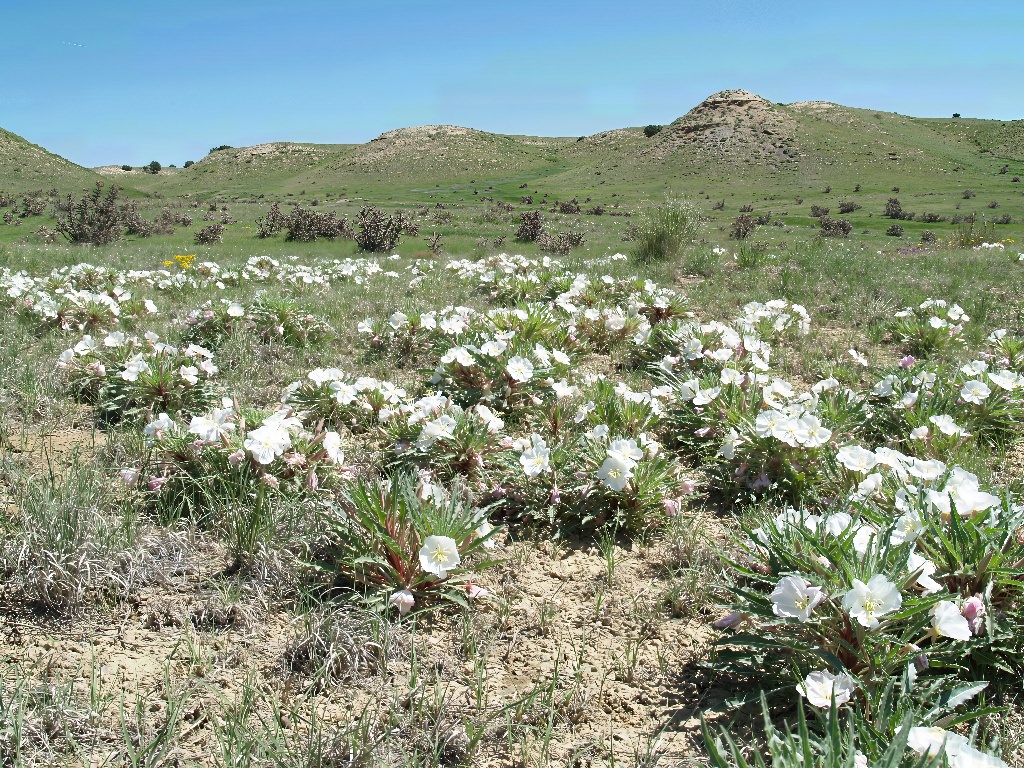
Oenothera harringtonii habitat is typically flat or gentle slopes in open shortgrass prairie or saltbush communities or open juniper woodlands (CNHP 2026, Wagner et al. 1985). Plants are often found on compacted, silty clay soil, but may also grow on rocky, sandy, and silty loam soils. Substrates are often derived from shale and limestone formations, including the Niobrara formation, Carlile shale, Greenhorn limestone, Graneros shale, and Pierre shale formations (Ladyman 2005, Tweto 1979). Associated species include Juniperus monosperma, Artemisia bigelovii, Atriplex canescens, Frankenia jamesii, Gutierrezia sarothrae, Bouteloua gracilis, Ericoma hymenoides, Hilaria jamesii, Hesperostipa comata, H. neomexicana, Artemisia frigida, Krascheninnikovia lanata, Lesquerella calcicola, Linum lewisii, Opuntia polycantha, Oonopsis puebloensis, Oxybaphus rotundifolius, Oonopsis foliosa var. monocephala, and Parthenium tetraneuris (CNHP 2026).
click on image to enlarge
 |
 |
Elevation Range:
4,137 - 6,453 feet (1,261 - 1,967 meters)
Distribution
Colorado Endemic:
Yes
Range:
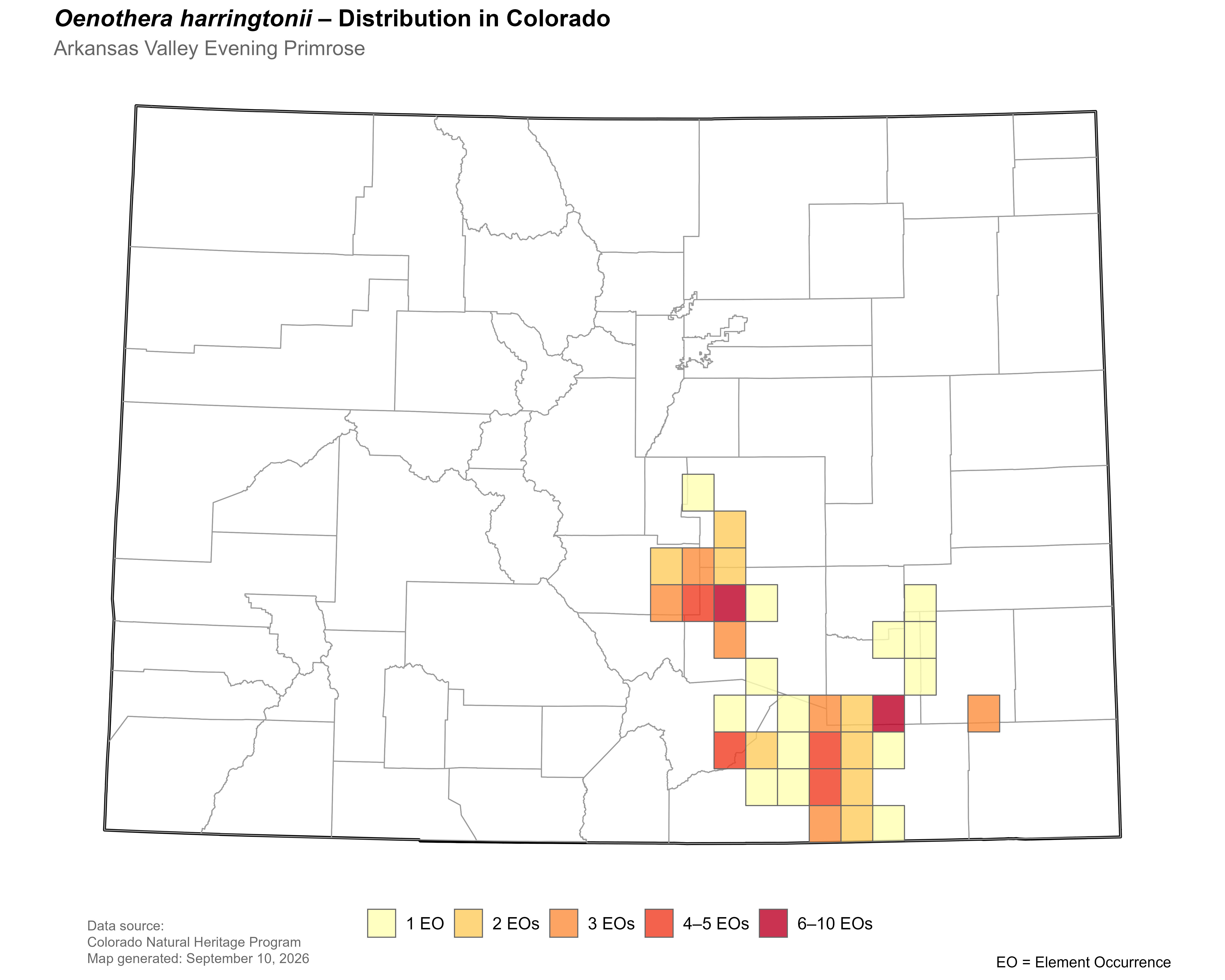
Oenothera harringtonii is a Colorado endemic known from Bent, El Paso, Fremont, Huerfano, Las Animas, Otero, and Pueblo counties. Estimated range extent in Colorado of 23,125 square kilometers was calculated in GeoCAT using occurrence data provided by the Colorado Natural Heritage Program (2026). The species is to be sought in adjacent New Mexico, USA (Wagner et al. 1985).
Click on map to enlarge |
Threats and Management Issues
Residential development is considered to be the primary threat to the species at this time. Habitat loss due to urbanization, road development projects, and resource extraction activities, especially quarrying and surface mining, is a substantial threat to Oenothera harringtonii. Since several known occurrences are near highways, roadside maintenance activities, such as herbicide use, may impact several of those occurrences. Recreational use of habitat is a threat to at least one occurrence at a Colorado state park. Invasion of habitat by non-native plant species is a potential threat throughout the range of this non-competitive species. Two classes of weeds pose substantial problems. Noxious weeds, such as field bindweed (Convolvulus arvensis) and jointed goatgrass (Aegilops cylindrica), and escaped non-native species used for agriculture and restoration, such as sweetclover (Melilotus spp.) and Mexican-fireweed (Kochia scoparia), have both been recorded at current occurrences. Livestock grazing, especially during flowering and fruiting periods, is likely to reduce the reproductive output of this species. This is a significant threat because O. harringtonii relies on seed production rather than vegetative reproduction to maintain its populations. Long-term sustainability of O. harringtonii populations is also jeopardized by declines in pollinator populations. The small size of many populations confers susceptibility to local extirpation from genetic, demographic, and environmental stochasticities (Ladyman 2005). This species is considered to have moderate adaptive capacity and is expected to be moderately to extremely vulnerable to climate change under both RCP 4.5 and 8.5 scenarios, as assessed for the 2025 Colorado State Wildlife Action Plan (CNHP 2025).
References
- Ackerfield, Jennifer. 2022. Flora of Colorado. Second Edition. Bot. Misc. 60. BRIT Press, Fort Worth Botanic Garden/Botanical Research Institute of Texas, U.S.A. 861 pp.
- Colorado Natural Heritage Program (CNHP). 2025. Climate Change Vulnerability Assessment of Colorado Tier 1 and Tier 2 Plant Species of Greatest Conservation Need (SCGN) for the 2025 Colorado State Wildlife Action Plan. Colorado Natural Heritage Program, Colorado State University, Fort Collins, CO.
- Colorado Natural Heritage Program (CNHP). 2026. Biodiversity Tracking and Conservation System (Biotics 5). Colorado Natural Heritage Program, Colorado State University, Fort Collins.
- Flora of North America Editorial Committee (FNA). 2021. Flora of North America north of Mexico. Vol. 10. Magnoliophyta: Proteaceae to Elaeagnaceae. Oxford Univ. Press, New York. xxiv + 456 pp.
- Ladyman, J.A.R. (2005, February 1). Oenothera harringtonii Wagner, Stockhouse & Klein (Colorado Springs evening-primrose): a technical conservation assessment. [Online]. USDA Forest Service, Rocky Mountain Region. Available: http://www.fs.fed.us/r2/projects/scp/assessments/oenotheraharringtonii.pdf [March 2006].
- Tweto, O. 1979. Geologic Map of Colorado, 1:500,000. United States Geological Survey, Department of Interior, and Geologic Survey of Colorado, Denver, CO.
- Wagner, W.L., R.E. Stockhouse and W.M. Klein. 1985. The systematics and evolution of the Oenothera caespitosa species complex (Onagraceae). Monographs in Systematic Botany, Missouri Botanical Garden 12:1-103.