

Scientific Name : Neoparrya lithophila
Author : Mathias NatureServe Explorer
Common Name : Rock- loving Neoparrya
 Current Research Activities
 1997 profile


☰ Click link below for details.
Taxonomy
Apiaceae (carrot family)
=Aletes lithophilus. Weber and Wittmann (2012) list as Aletes lithophilus (Mathias) W.A. Weber; Ackerfield (2015, 2022) lists as Neoparrya lithophila Mathias.
Ranks and Status
State Rank : S3
State Rank Reason : Neoparrya lithophila is known from 30-40 occurrences in south central Colorado. Approximately one third of the occurrences are of good to excellent viability and over half are considered historical. Motorized recreation and grazing pose threats to the species at individual locations,but many occurrences are naturally protected by the inaccessible habitat in which they occur. Climate change is also a concern.
U.S. Endangered Species Act : none
Colorado Threatened and Endangered List : none
Other Statuses : BLM, SWAP Tier 2, USFS
Description and Phenology
General Description:
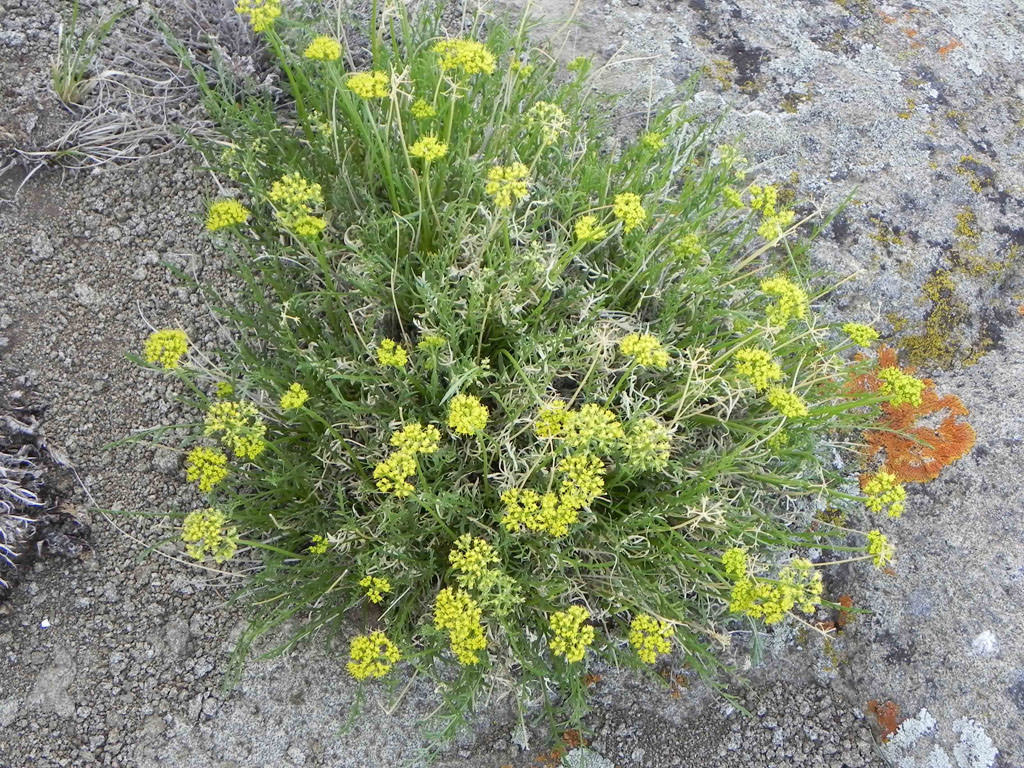
An herbaceous perennial that produces new leaves and leafless inflorescences each year. The plants grow in clumps, are taprooted, and 8 to 29 cm tall. Large clumps of vegetation more than two feet in diameter can form, but it is sometimes unclear whether these clumps are a single individual or represent multiple individuals that have coalesced. Plants have thick, glossy, leathery leaves that are once pinnate, with linear, remote pinnae that are 5 to 32 millimeters long and 1.5 to 4 millimeters broad (Anderson 2004). Fruit are oblong, 3-5 mm long, not winged. Some umbel rays are reflexed (Spackman et al. 1997).
Look Alikes:
Aletes acaulis lateral leaf lobes are broad and incised with flaring tips. Aletes acaulis and A. anisatus do not have reflexed umbel rays which give the inflorescence of A. lithophilus a ball-shaped appearance. Aletes anisatus has a strong anise odor (Spackman et al. 1997).
Phenology:
This species flowers from May through early July; fruiting late June to September (Spackman et al. 1997, Colorado Natural Heritage Program 2015).
Habitat
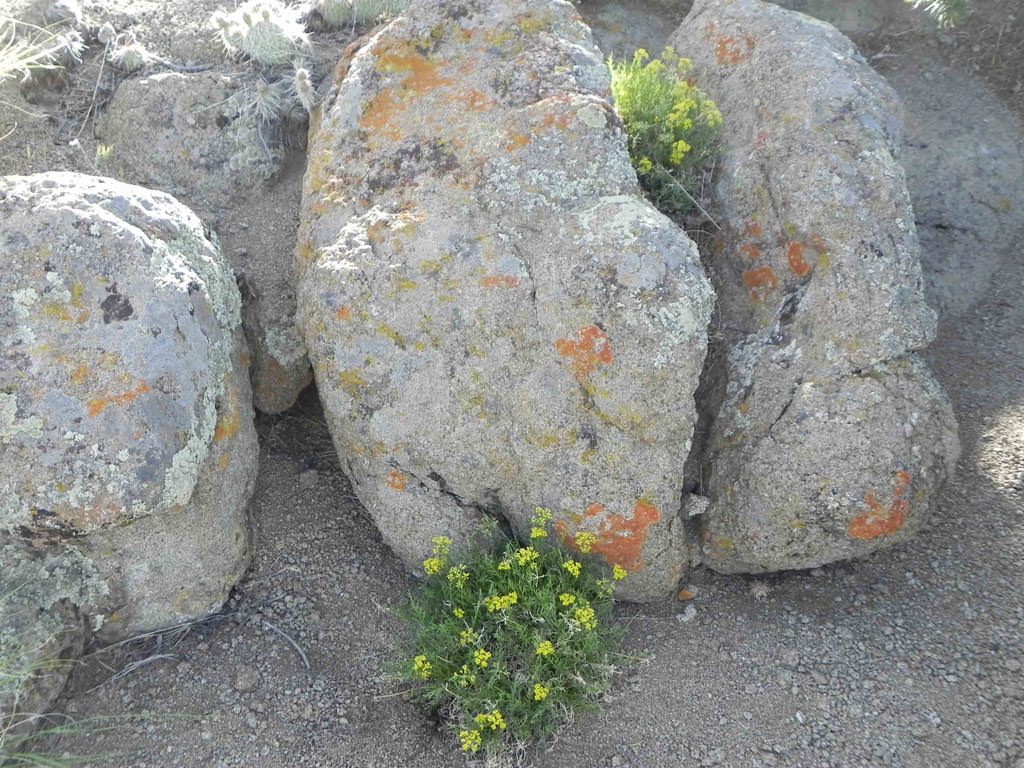
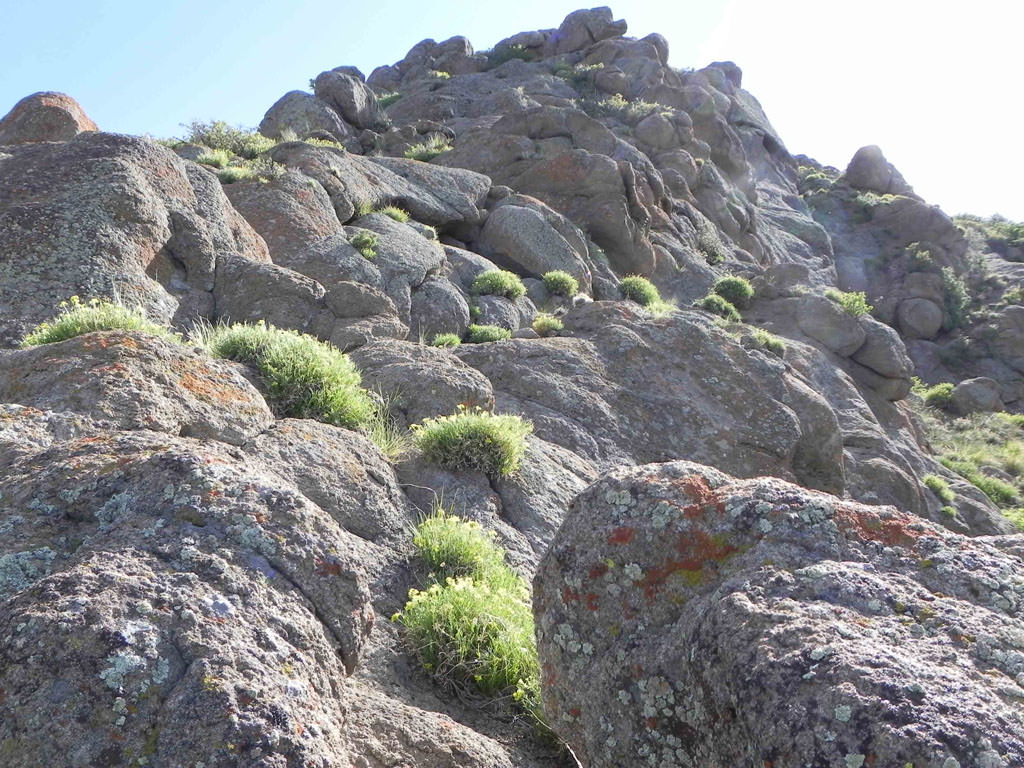
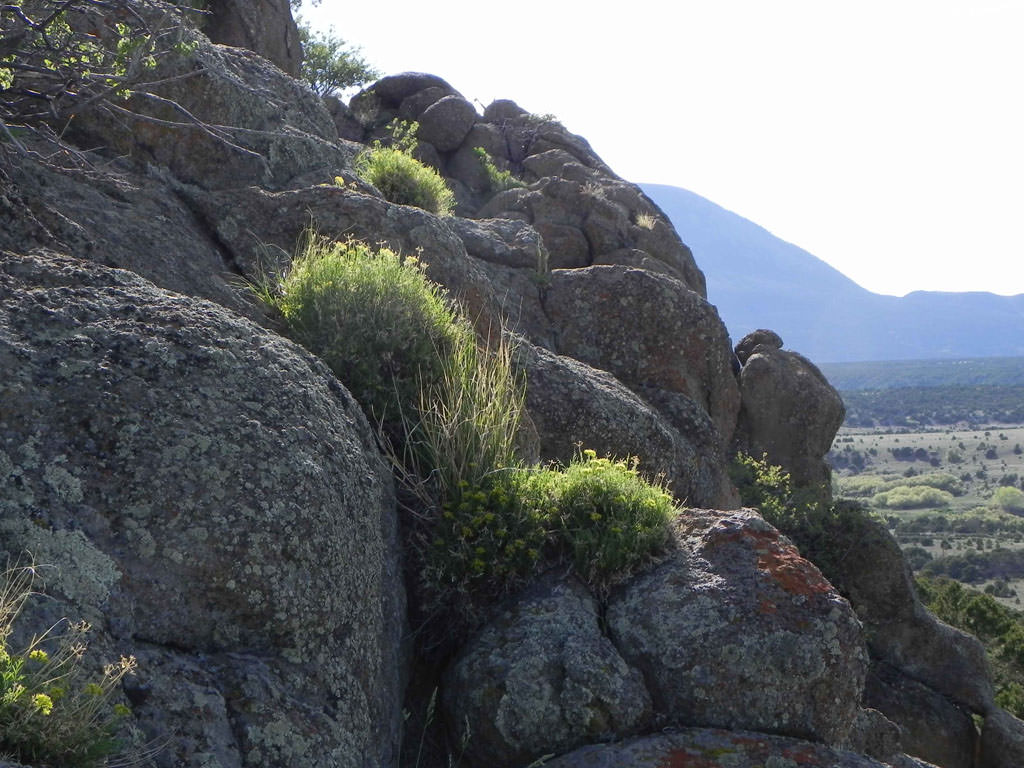
Grows on volcanic substrates, in cracks or shelves usually with minimal talus. It is seen in moderate to steep rock outcrops, or outcrops of volcanic soils. It also occurs on sedimentary rock derived from extrusive volcanics (Dry Union Formation at Salida). The surrounding habitat is typically grasslands or pinon-juniper woodlands. Associated taxa often include: Festuca, Artemisia, Muhlenbergia, Hymenoxys, and Ribes (Neely 1986; O'Kane, 1986). Although this species is found on all aspects, reports in element occurrence records suggest that it favors north slopes (Anderson 2004). This species occurs east and (mostly) west of the Sangre de Cristo Mountain Range. Average rainfall is about 7 to 16 inches (180-410 mm) annually.
click on image to enlarge
 |
 |
Elevation Range:
7,186 - 10,267 feet (2,190 - 3,130 meters)
Distribution
Colorado Endemic:
No
Range:
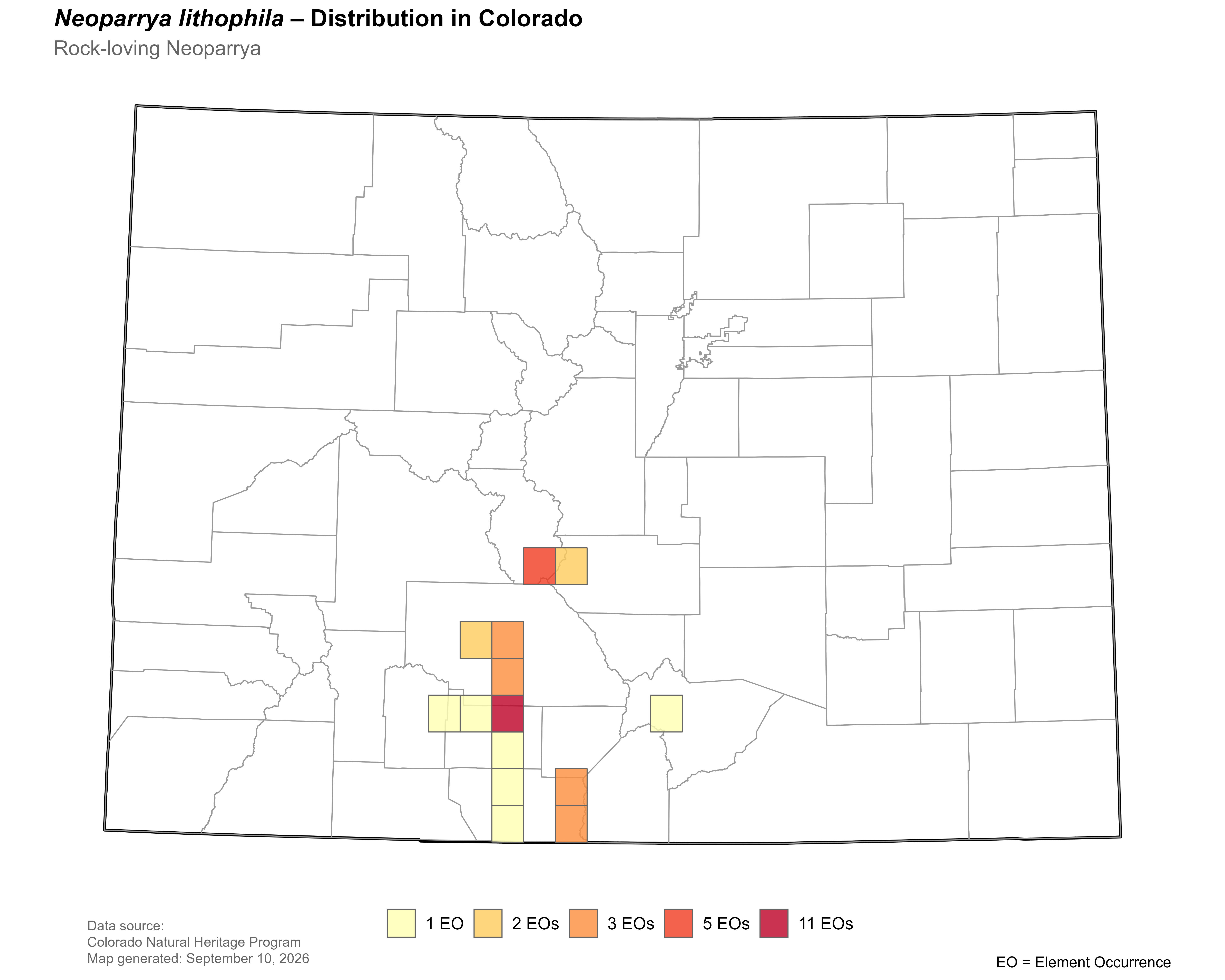
Neoparrya lithophila occurs mostly in south central Colorado, USA, where it is restricted to seven counties: Chaffee, Conejos, Fremont, Huerfano, Mineral, Rio Grande, and Saguache. Estimated range extent in Colorado of 12,073 square kilometers was calculated in GeoCAT using occurrence data provided by the Colorado Natural Heritage Program (2022). This taxon has also been seen in New Mexico, USA.
Click on map to enlarge |
Threats and Management Issues
As of 2022, 90% of the occurrences are found in habitat with minimal to low levels of landscape disturbance (CNHP 2021). However, at the local level recreational activities and livestock grazing are potential threats to the populations. Many of the sites are on land subject to moderate to heavy grazing but the populations themselves are often inaccessible (i.e., steep rock outcrops). In some cases, this has resulted in a flourish of exotics (e.g., Bromus tectorum, Plantago patagonica), which may compete for N. lithophila habitat. Long term drought is occurring throughout the range of this species. This species is considered to have low adaptive capacity and is expected to be extremely vulnerable to climate change under both RCP 4.5 and 8.5 scenarios, as assessed for the 2025 Colorado State Wildlife Action Plan (CNHP 2025).
References
- Ackerfield, J. 2015. Flora of Colorado. BRIT Press, Botanical Research Institute of Texas, Fort Worth, TX. 818 pp.
- Ackerfield, J. 2022. Flora of Colorado. Second Edition. Bot. Misc. 60. BRIT Press, Fort Worth Botanic Garden/Botanical Research Institute of Texas, U.S.A. 861 pp.
- Anderson, D.G. (2004, November 8). Neoparrya lithophila Mathias (Bill's neoparrya): a technical conservation assessment. [Online]. USDA Forest Service, Rocky Mountain Region. Available: http://www.fs.fed.us/r2/projects/scp/assessments/neoparryalithophila.pdf [April 18, 2007].
- Baker, W.L. 1981. Farisita Dike Site Summary. Unpublished Report to the Colorado Natural Areas Program (CNAP) and The Nature Conservancy.
- Carpenter, Alan. 1993. Monitoring Neoparrya lithophila at Farisita Dike for the Nature Conservancy.
- Colorado Native Plant Society. 1989. Rare plants of Colorado. Rocky Mountain Nature Association, Colorado Native Plant Society, Estes Park, Colorado. 73 pp.
- Colorado Natural Heritage Program (CNHP). 2025. Climate Change Vulnerability Assessment of Colorado Tier 1 and Tier 2 Plant Species of Greatest Conservation Need (SCGN) for the 2025 Colorado State Wildlife Action Plan. Colorado Natural Heritage Program, Colorado State University, Fort Collins.
- Hartman, R.L., B. Reif, B.E. Nelson, and B. Jacobs. 2006. New vascular plant records for New Mexico. Sida 22(2): 1225-1233.
- Kartesz, J.T. 1994. A synonymized checklist of the vascular flora of the United States, Canada, and Greenland. 2nd edition. 2 vols. Timber Press, Portland, OR.
- Mathias, M.E. 1929. Studies in the Umbelliferae, II. Annals of the Missouri Botanical Garden 16: 393-398.
- Neely, B.E. 1986. Farisita Dike Preserve Design. Unpublished Prepared for The Nature Conservancy.
- O'Kane, S.L. Jr. 1986. Floristic reconnaissance of the San Luis Valley. Unpublished report, Colorado Natural Areas Program, Denver, Colorado. 18pp + appendices.
- O'Kane, S.L., D.H. Wilken, and R.L. Hartman. 1988. Noteworthy Collections. Madrono 35(1):72-74.
- Peterson, J.S., B.C. Johnston, W. Harmon. 1983. Status Report of Neoparrya lithophila Mathias. USFWS and CNAP.
- Rondeau, R., K. Decker, J. Handwerk, J. Siemers, L. Grunau, and C. Pague. 2011. The state of Colorado's biodiversity 2011. Prepared for The Nature Conservancy. Colorado Natural Heritage Program, Colorado State University, Fort Collins, Colorado.
- Spackman, S., B. Jennings, J. Coles, C. Dawson, M. Minton, A. Kratz, and C. Spurrier. 1997. Colorado Rare Plant Field Guide. Prepared for the Bureau of Land Management, the U.S. Forest Service and the U.S. Fish and Wildlife Service by the Colorado Natural Heritage Program.
- Theobald, W. L., C. S. Tseng, and M. E. Mathias. 1964. A revision of Aletes and Neoparrya (Umbelliferae). Brittonia 16:296-315.
- Weber, W. A. 1984. New names and combinations, principally in the Rocky Mountain flora--IV. Phytologia 55: 1-11.
- Weber, W. A. and R. C. Wittmann. 2012. Colorado Flora, Eastern Slope, A Field Guide to the Vascular Plants, Fourth Edition. Boulder, Colorado. 555 pp.