

Scientific Name : Mirabilis rotundifolia
Author : (Greene) Standl. NatureServe Explorer
Common Name : Round- leaf Four- o'clock
 Current Research Activities
 1997 profile


☰ Click link below for details.
Taxonomy
Nyctaginaceae (four-o'clock family)
Weber and Wittmann (2012) consider this as Oxybaphus rotundifolius and Ackerfield (2015, 2022) as Mirabilis rotundifolia.
Ranks and Status
State Rank : S2
State Rank Reason : Mirabilis rotundifolia is endemic to southern Colorado (USA) where it is restricted to a narrowly distributed geological substrate. Although there are 40 documented occurrences only half are of good viability, the remainder are of fair to poor viability or are known only from historical observations. There are several threats to this species, including residential development, military training exercises, recreation, competition from non-native plants species, road and utility corridor maintenance, livestock grazing, and industrial activities including mining and cement plants. It is also considered to be moderately to extremely vulnerable to the effects of climate change.
U.S. Endangered Species Act : none
Colorado Threatened and Endangered List : none
Other Statuses : SWAP Tier 1
Description and Phenology
General Description:
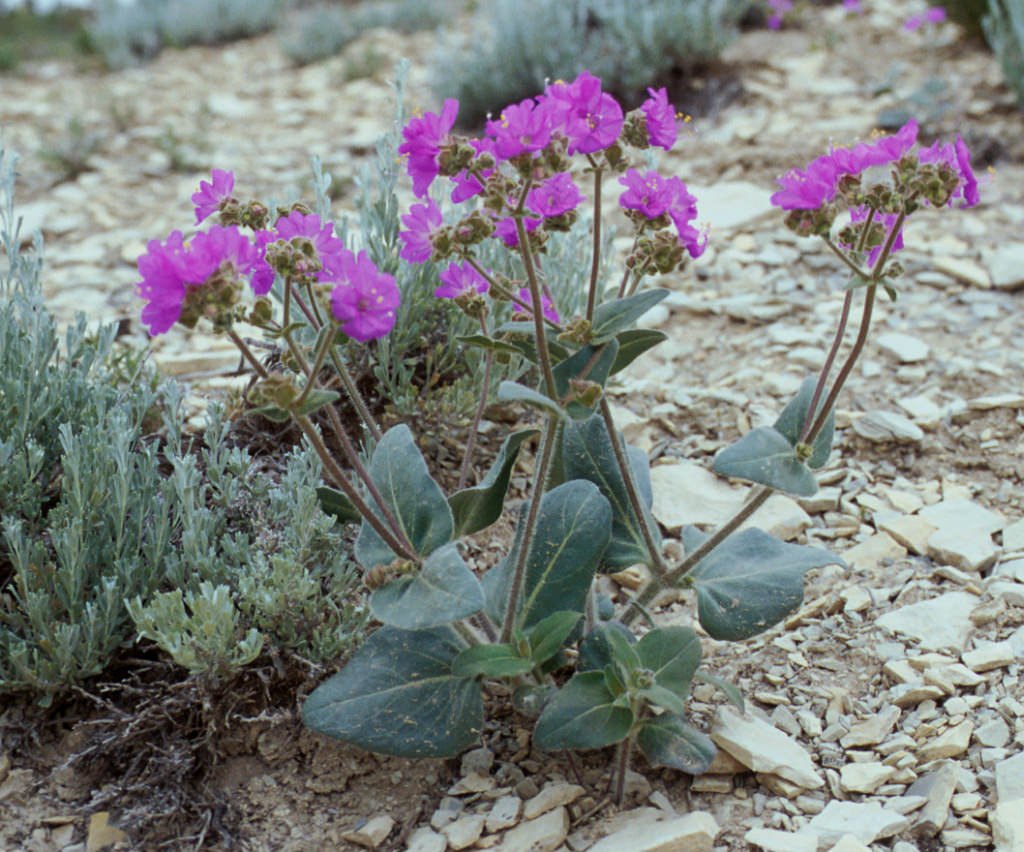
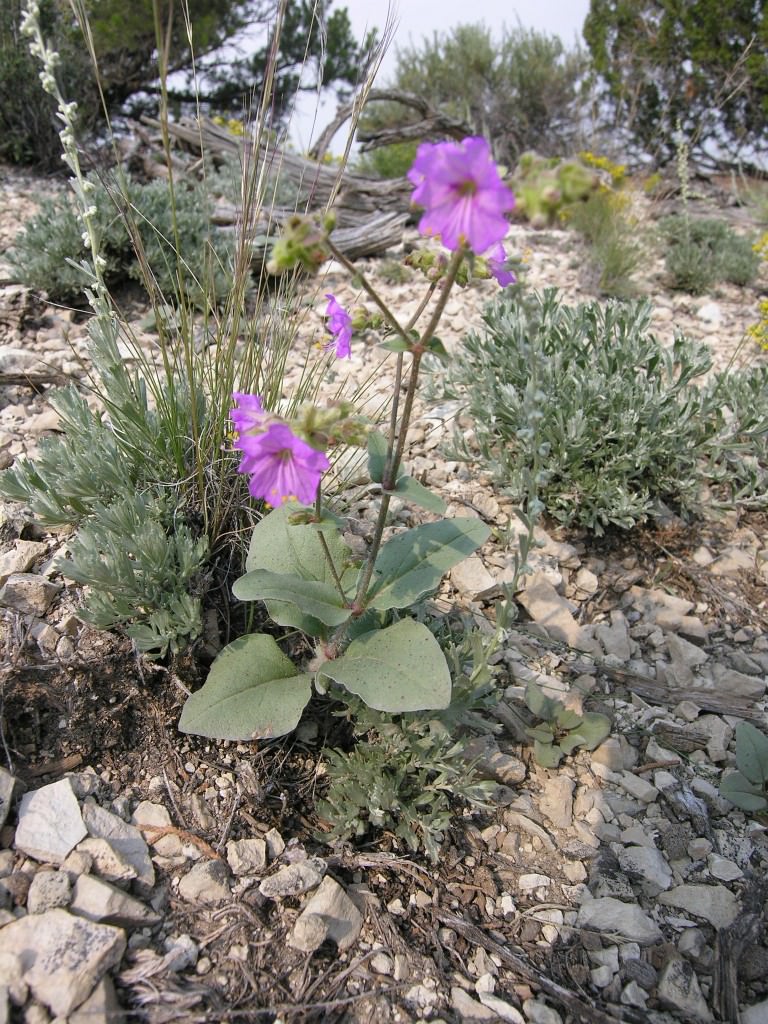
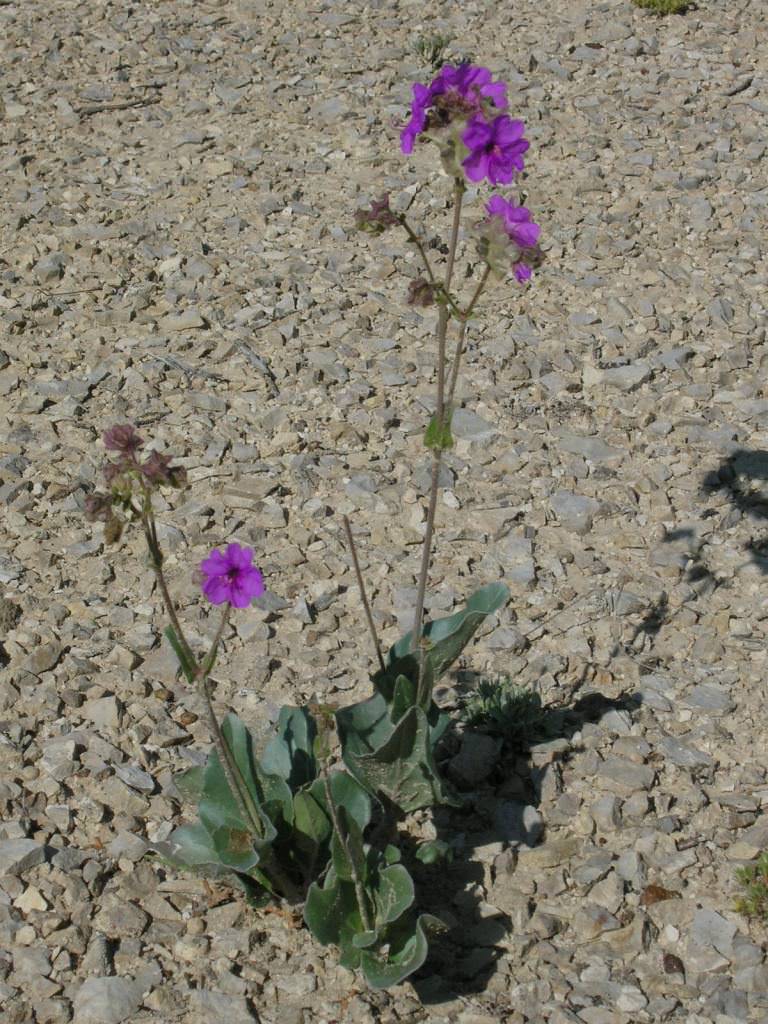
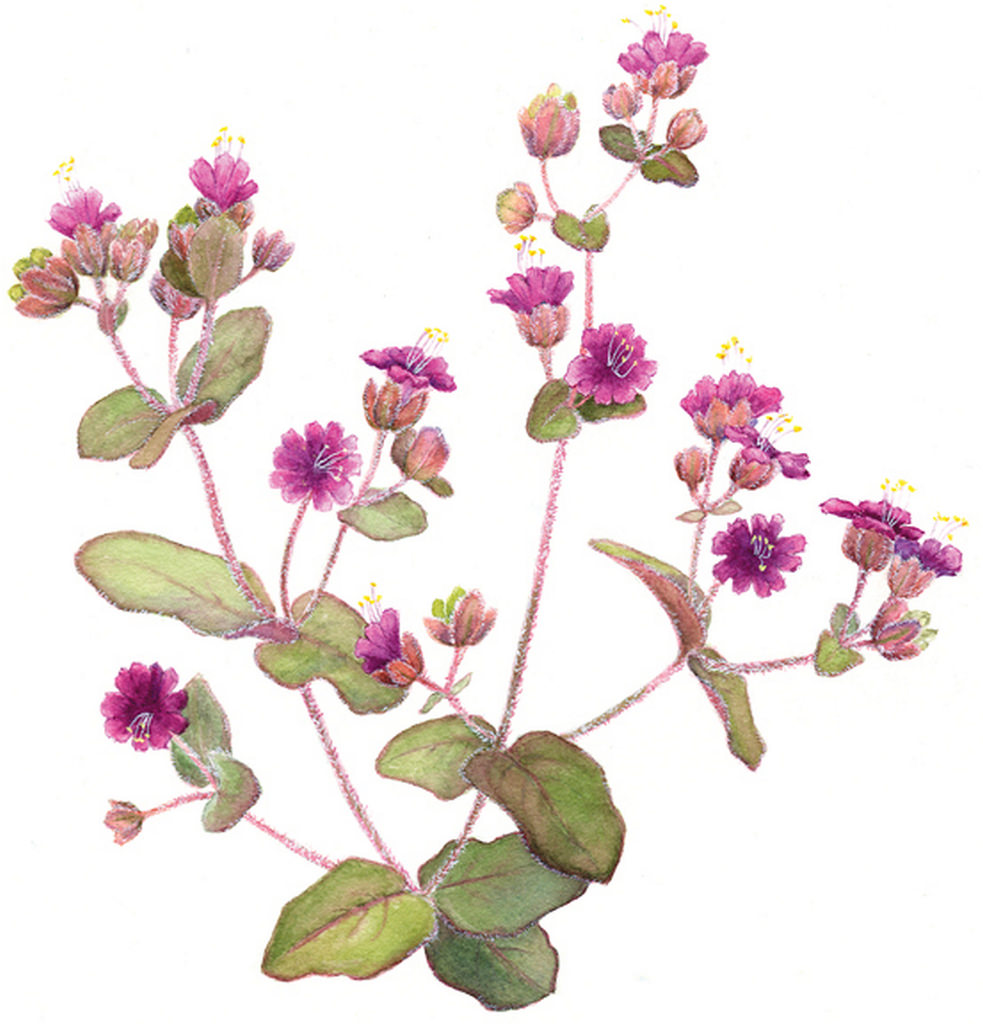
Round-leaf four oâclock (Mirabilis rotundifolius) is 2-3 dm tall, erect to spreading, taprooted perennial with bright trumpet-shaped magenta flowers. The flowers occur in groups of three, and normally close by mid-morning. The almost round, basal leaves which give the plant its name are densely hairy, and are usually withering close to the flowering time. Flowering stems, which are also densely covered with short hairs, arise from axils where pairs of the ovate leaves join the stem. The bright pink flowers have 5 strongly exerted stamens with five notched petals and are about 1 cm in diameter. The fruit are obovoid, 4-5 mm long, and hairy (Spackman et al. 1997, Ackerfield 2015).
Look Alikes:
Mirabilis multiflora is much larger than M. rotundifolius, and has glabrous and glaucous leaves (Spackman et al. 1997). Mirabilis hirsuta has smaller flowers and more linear leaves.
Phenology:
Flowers open pre-dawn and close usually by mid-morning in June, but with some flowering through mid-August (Spackman et al. 1997, Ackerfield, 2015).
 |
Habitat
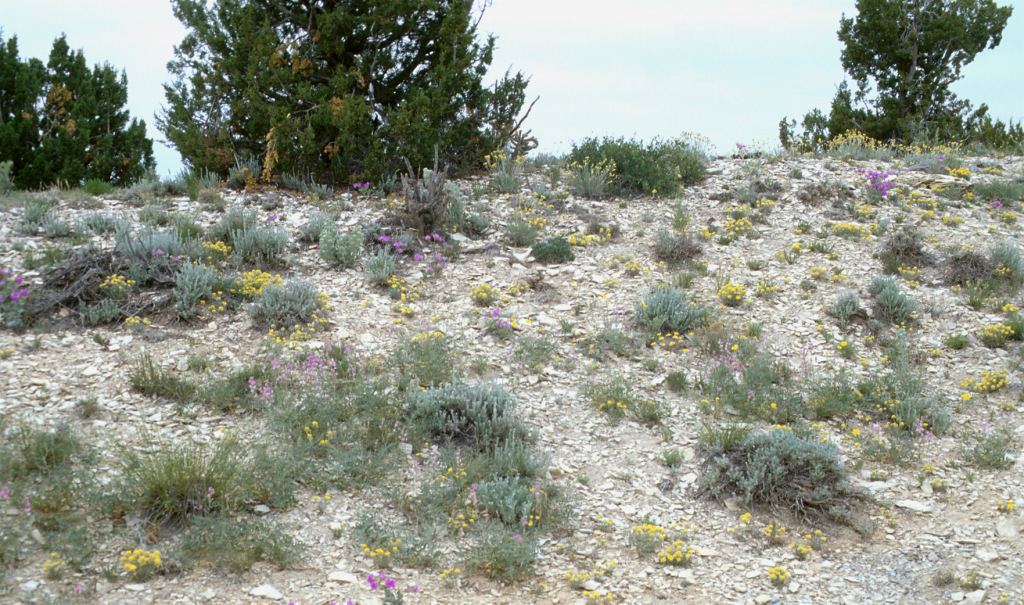
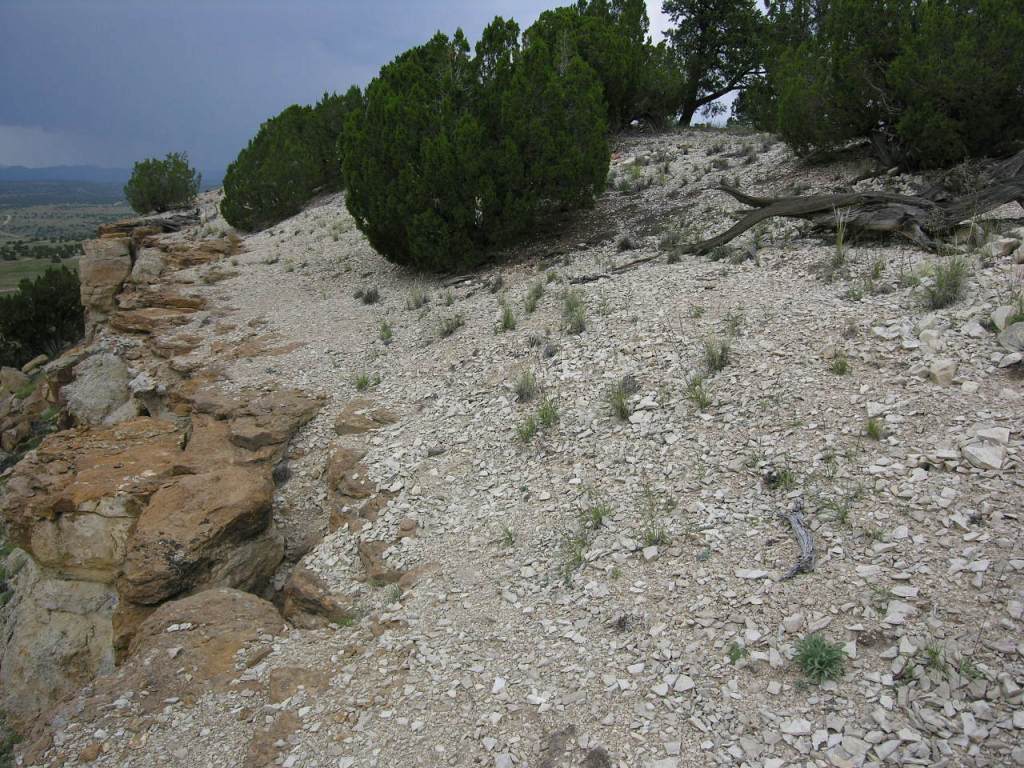
This species is generally restricted to outcrops of the lower shale unit of the Smoky Hill member of the Cretaceous Niobrara Formation. The plant community is sparse shrubland or woodland with a barren aspect. Frequent associates are James' frankenia (Frankenia jamesii) and oneseed juniper (Juniperus monosperma). Other associated species may include: Bolophyta (Parthenium) tetraneuris, Oryzopsis hymenoides, Atriplex confertifolia, Eriogonum fendlerianum, Cryptantha jamesii, Zinnia grandiflora, Melampodium leucanthum, Lesquerella ovalifolia, Gutierrezia sarothrae, Hoffmanseggia drepanocarpa and Lesquerella montana.
click on image to enlarge
 |
 |
Elevation Range:
4,848 - 6,367 feet (1,478 - 1,941 meters)
Distribution
Colorado Endemic:
Yes
Range:
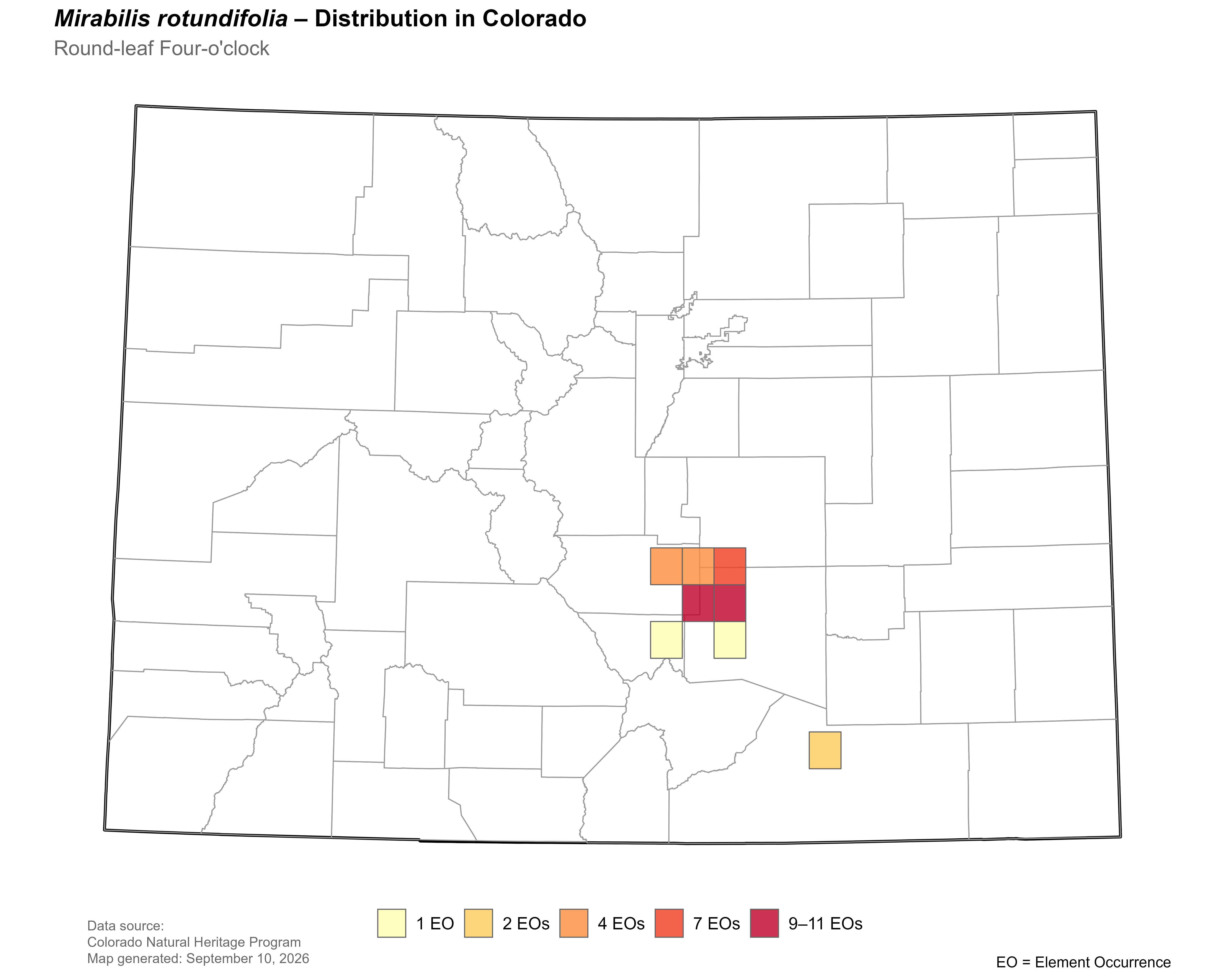
Mirabilis rotundifolia is endemic to Colorado (USA) where it is known only from Custer, El Paso, Fremont, Las Animas, and Pueblo counties. Estimated range extent in Colorado of 4301 square kilometers was calculated in GeoCAT using occurrence data provided by the Colorado Natural Heritage Program (2023).
Click on map to enlarge |
Threats and Management Issues
There are several threats to this species, including residential development, military training exercises,recreation, competition from non-native plants species, road and utility corridor maintenance, livestock grazing, and industrial activities including mining and cement plants. Campground construction heavily impacted one occurrence. Other occurrences were lost to the construction and filling of Pueblo Reservoir, and the construction of Pueblo West housing development, and three sites are bisected by state highways. Nearly 30% of the occurrences have documented tank tracks and other evidence of former heavy military disturbance both in and nearby the occupied habitat. It appears that the plants were not necessarily responding positively to vehicle traffic but rather they prefer flat, rocky, open sites where it is easier to drive vehicles. The invasive non-native Russian thistle (Salsola sp.) has been observed at 28% of the occurrences. Predation by Hawk Moth Caterpillars (hornworms) may be a problem (pers. comm. Kelso 1996). This species is considered to have moderate adaptive capacity and is expected to be moderately to extremely vulnerable to climate change under both RCP 4.5 and 8.5 scenarios, as assessed for the 2025 Colorado State Wildlife Action Plan (CNHP 2025).
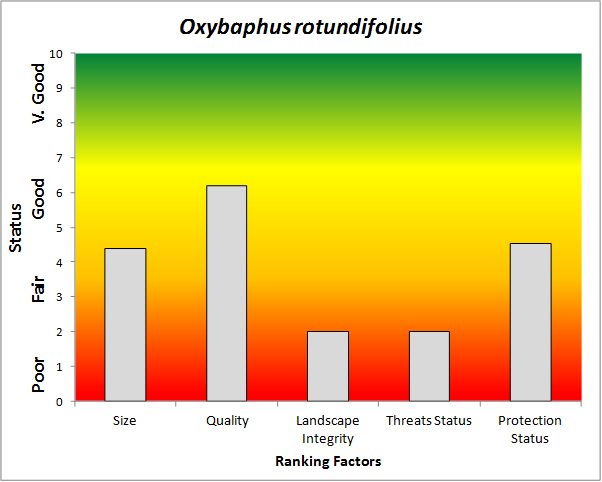
Summary results of an analysis of the status of Oxybaphus rotundifolius based on several ranking factors. This species was concluded to be "Weakly Conserved. From Rondeau et al. 2011. |
References
- Ackerfield, J. 2015. Flora of Colorado. BRIT Press, Botanical Research Institute of Texas, Fort Worth, TX. 818 pp.
- Ackerfield, Jennifer. 2022. Flora of Colorado. Second Edition. Bot. Misc. 60. BRIT Press, Fort Worth Botanic Garden/Botanical Research Institute of Texas, U.S.A. 861 pp.
- Colorado Native Plant Society. 1989. Rare plants of Colorado. Rocky Mountain Nature Association, Colorado Native Plant Society, Estes Park, Colorado. 73 pp.
- Colorado Natural Heritage Program (CNHP). 2025. Climate Change Vulnerability Assessment of Colorado Tier 1 and Tier 2 Plant Species of Greatest Conservation Need (SCGN) for the 2025 Colorado State Wildlife Action Plan. Colorado Natural Heritage Program, Colorado State University, Fort Collins, CO.
- Colorado Natural Heritage Program and the Geospatial Centroid. 2017. The Colorado Ownership and Protection Map (COMaP). Colorado State University, Ft. Collins, CO.
- Flora of North America Editorial Committee, ed. (FNA). 1993+. Flora of North America North of Mexico. Oxford Univ. Press, New York, Oxford.
- Handwerk, J., L. Grunau, and S. Panjabi. 2015. Colorado Wildlife Action Plan: 2015 Rare Plant Addendum. Colorado Natural Heritage Program, Colorado State University, Fort Collins, Colorado, USA.
- Kelso, S., K. Heckmann, J. Lawton, and G. Maentz. 1995. The Ecology and Distribution of Oxybaphus rotundifolius and Penstemon versicolor: geobotany and endemism in the Arkansas Valley, Colorado. Report to the Colorado Natural Areas Program and Colorado Native Plant Society. 30 pp. + appendices.
- Naumann, T.S. 1990. Status report for Oxybaphus rotundifolius. Unpublished report prepared for the Colorado Natural Areas Program, Denver, CO.
- Neely, B., S. Panjabi, E. Lane, P. Lewis, C. Dawson, A. Kratz, B. Kurzel, T. Hogan, J. Handwerk, S. Krishnan, J. Neale, and N. Ripley. 2009. Colorado Rare Plant Conservation Strategy, Developed by the Colorado Rare Plant conservation Initiative. The Nature Conservancy, Boulder, Colorado, 117 pp.
- O'Kane, S.L. 1988. Colorado's rare flora. Great Basin Naturalist 48(4): 434-484.
- Rocky Mountain Society of Botanical Artists. 2009. RARE Imperiled Plants of Colorado, a traveling art exhibition. Exhibition catalogue developed by the Denver Botanic Gardens and Steamboat Art Museum.
- Rondeau, R., K. Decker, J. Handwerk, J. Siemers, L. Grunau, and C. Pague. 2011. The state of Colorado's biodiversity 2011. Prepared for The Nature Conservancy. Colorado Natural Heritage Program, Colorado State University, Fort Collins, Colorado.
- Spackman, S., B. Jennings, J. Coles, C. Dawson, M. Minton, A. Kratz, and C. Spurrier. 1997. Colorado rare plant field guide. Prepared for Bureau of Land Management, U.S. Forest Service and U.S. Fish and Wildlife Service by Colorado Natural Heritage Program.
- Standley, P.C. 1909. The Allioniaceae of the United States with notes on Mexican species. Contributions from the US National Herbarium 12:303-389.
- USDA, NRCS. 2022. The PLANTS Database. National Plant Data Team, Greensboro, NC 27401-4901 USA.
- Weber, W. A. and R. C. Wittmann. 2012. Colorado Flora, Eastern Slope, A Field Guide to the Vascular Plants, Fourth Edition. Boulder, Colorado. 555 pp.