

Scientific Name : Mentzelia paradoxensis
Author : J. J. Schenk & L. Hufford NatureServe Explorer
Common Name : Paradox Blazingstar
 Current Research Activities
☰ Click link below for details.
Taxonomy
Loasaceae (blazingstar family)
Ranks and Status
State Rank : S2
State Rank Reason : Mentzelia paradoxensis is known from nine occurrences in Paradox and Gypsum Valleys of western Colorado, USA. Specific management and protection issues are not well documented, but the species is considered to be vulnerable to the effects of climate change.
U.S. Endangered Species Act : none
Colorado Threatened and Endangered List : none
Other Statuses : BLM, SWAP SGIN
Description and Phenology
General Description:
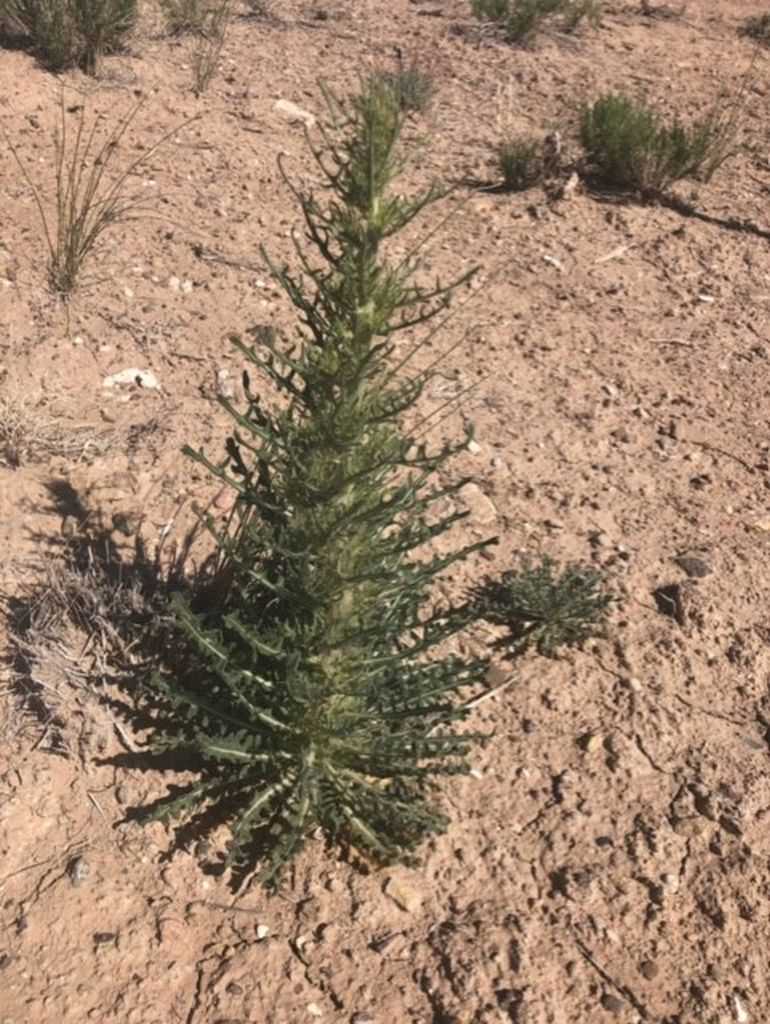
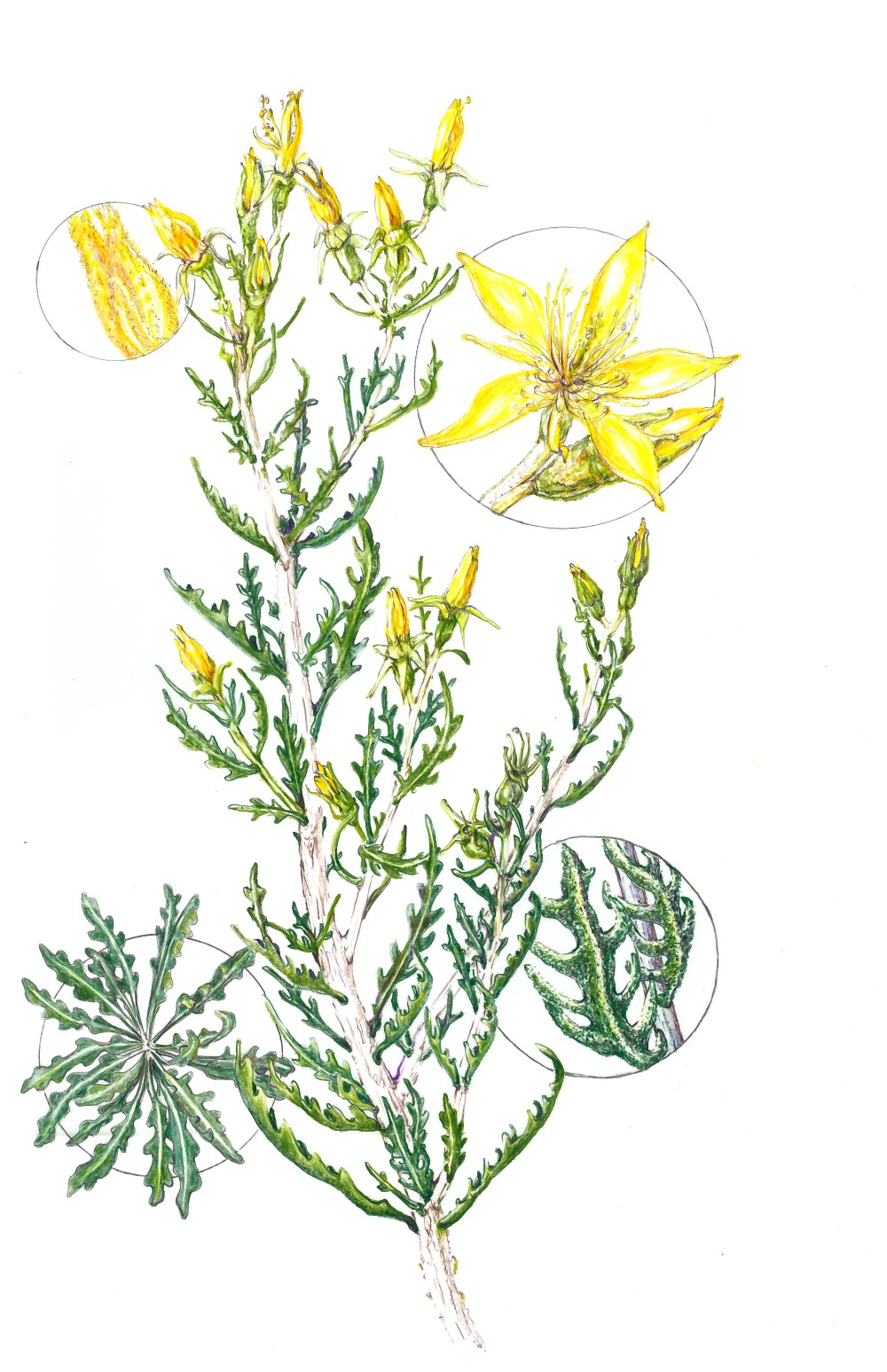
Plants biennial, usually cylindric, rarely candelabra-form. Stems solitary, erect, straight; branches distal or along entire stem, -± equal, perpendicular to stem, especially proximal and mid-stem, or slightly antrorse, especially distal, straight; hairy. Leaves: blade 38.1â95 Ã 6â17(â26) mm, widest intersinus distance 1.6â4.7 mm; proximal oblanceolate, lanceolate, or elliptic, margins dentate to serrate or pinnate, teeth or lobes 10â22, slightly antrorse or perpendicular to leaf axis, 2â6.8 mm; distal elliptic to lanceolate, base not clasping, margins dentate to serrate or pinnate, teeth or lobes 8â16, slightly antrorse or perpendicular to leaf axis, 2.4â8.5 mm; abaxial surface with simple grappling-hook, complex grappling-hook, and needlelike trichomes, adaxial surface with needlelike and occasionally simple grappling-hook trichomes. Bracts: margins entire. Flowers: petals golden yellow, 8.3â14.5(â17.2) Ã 1.7â5.3 mm, apex acute to rounded, hairy abaxially; stamens golden yellow, 5 outermost petaloid, filaments narrowly spatulate, slightly clawed, 4.9â12.5 Ã 1.2â3.8 mm, with or without anthers, second whorl with anthers; anthers occasionally twisted or straight after dehiscence, epidermis papillate or not; styles 5.4â10.4 mm. Capsules cup-shaped, 5â9 Ã 3.7â6.5 mm, base rounded, not longitudinally ridged. Seeds: coat anticlinal cell walls straight to slightly wavy, papillae 6â11 per cell. (Flora of North America Editorial Committee, eds. 1993+).
Look Alikes:
Distinguished from other Mentzelia in the area by its columnar growth form, and petals that are hairy on the back, at least below the middle (Ackerfield 2015). Mentzelia cronquistii has a bushy growth form and longer capsules (6-16 mm in length; M. paradoxensis capsules are 5-9 mm).
Phenology:
June-September (Ackerfield 2015, Flora of North America Editorial Committee, eds. 1993+).
 |
Habitat
Found on dry, sandy or gypsum slopes (Ackerfield 2015). Found on Mancos Shale, Paradox Formation, sandstone, clay, barren hills, canyon walls, sagebrush flats, and seasonal drainages associated with pinyon-juniper, Artemisia tridentata, Atriplex, Eriogonum, Chrysothamnus, Fraxinus, and Salix (Colorado Natural Heritage Program 2022).
Elevation Range:
4,960 - 6,623 feet (1,512 - 2,019 meters)
Distribution
Colorado Endemic:
Yes
Range:
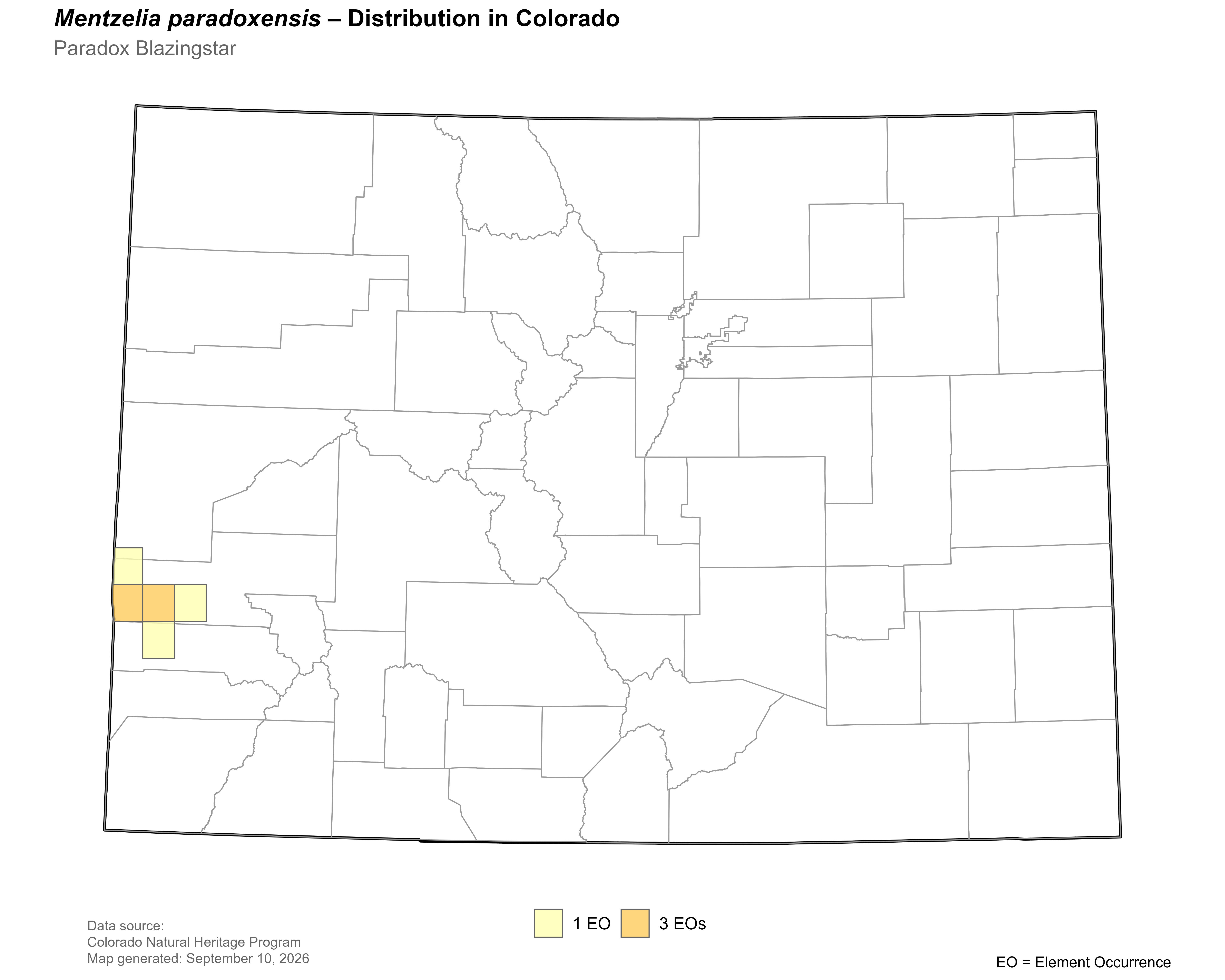
Mentzelia paradoxensis is known from Paradox and Gypsum Valleys in Montrose and San Miguel counties, Colorado, USA (Schenk and Hufford 2010). Estimated range extent in Colorado of 671 square kilometers was calculated in GeoCAT using occurrence data provided by the Colorado Natural Heritage Program (2023).
Click on map to enlarge |
Threats and Management Issues
Threats are mostly unknown. One observer mentions disturbances from a highway, and weeds, and that the predominant land use in the habitat is grazing. This species is considered to be highly vulnerable to climate change (Handwerk et al. 2015).
References
- Ackerfield, J. 2015. Flora of Colorado. BRIT Press, Botanical Research Institute of Texas, Fort Worth, TX. 818 pp.
- Colorado Natural Heritage Program (CNHP). 2022. Biodiversity Tracking and Conservation System (Biotics 5). Colorado Natural Heritage Program, Colorado State University, Fort Collins.
- Colorado Natural Heritage Program (CNHP). 2023. Biodiversity Tracking and Conservation System (Biotics 5). Colorado Natural Heritage Program, Colorado State University, Fort Collins.
- Flora of North America Editorial Committee, ed. (FNA). 1993+. Flora of North America North of Mexico. Oxford Univ. Press, New York, Oxford.
- Handwerk, J., L. Grunau, and S. Panjabi. 2015. Colorado Wildlife Action Plan: 2015 Rare Plant Addendum. Colorado Natural Heritage Program, Colorado State University, Fort Collins, Colorado, USA.
- Schenk, J. J., and L. Hufford. 2010. Taxonomic novelties from western North America in Mentzelia section Bartonia (Loasaceae). Madroño 57(4): 246-260.