


Scientific Name : Lepidium huberi
Author : Welsh & Goodrich NatureServe Explorer
Common Name : Huber's Pepperweed
 Current Research Activities


☰ Click link below for details.
Taxonomy
Brassicaceae (mustard family)
First described in 1995 (Welsh and Goodrich 1995).
Ranks and Status
State Rank : S2
State Rank Reason : Lepidium huberi is known from 19 occurrences in 3 western Colorado counties (USA). Specific management and protection issues are not known for this species. This species is considered to be highly vulnerable to climate change.
U.S. Endangered Species Act : none
Colorado Threatened and Endangered List : none
Other Statuses : SWAP SGIN
Description and Phenology
General Description:
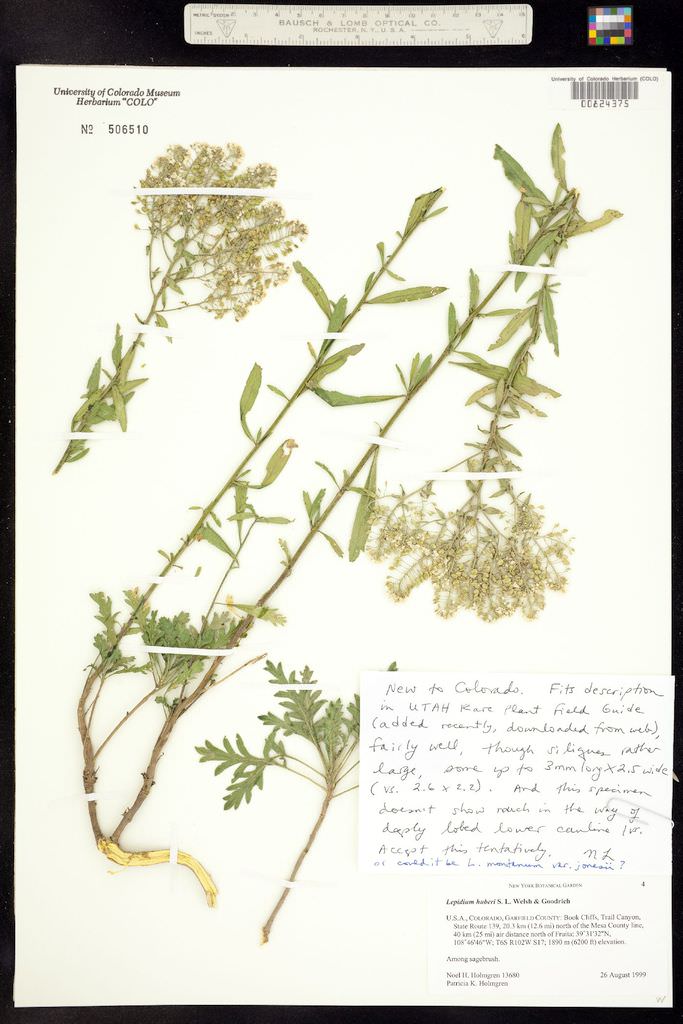
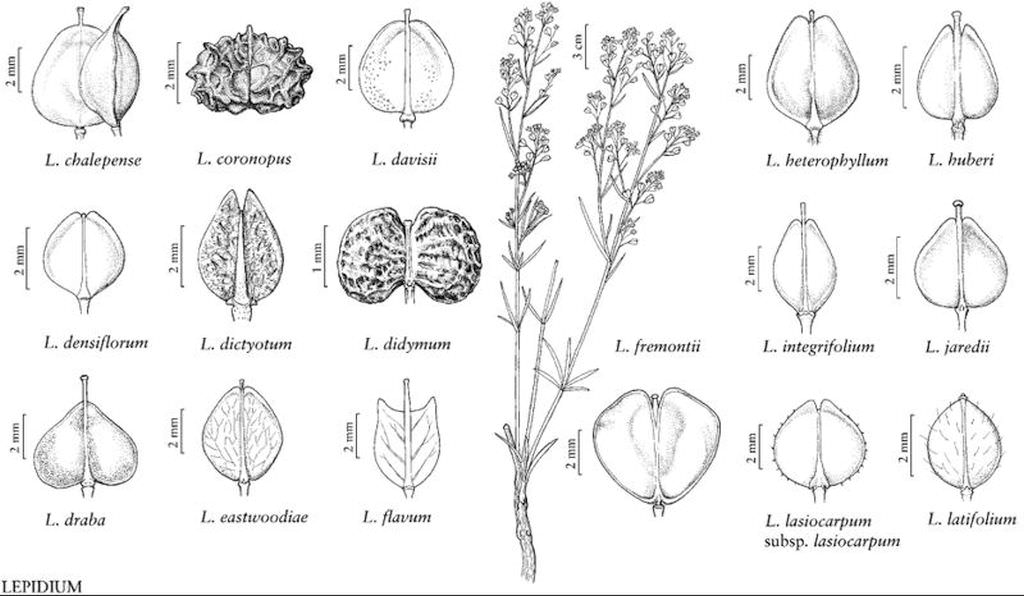
Perennials or subshrubs; (caudex to 2 cm diam., woody base aboveground); puberulent. Stems several from base, erect to ascending, branched distally, (1.8-)3-6(-7) dm. Basal leaves not rosulate; petiole 1-3 cm; blade ovate to lanceolate, pinnatifid, 1-4.5 cm à 8-25 mm, margins (of lobes) entire. Cauline leaves shortly petiolate or sessile; blade lanceolate to oblanceolate, 1.8-3.5 cm à 3-10 mm (smaller distally), base cuneate, not auriculate, margins entire or coarsely serrate. Racemes (subcorymbose panicles), individual racemes slightly elongated; rachis puberulent, trichomes straight. Fruiting pedicels divaricate to horizontal, straight or slightly curved, (not winged), 4-7 à 0.2 mm, puberulent throughout. Flowers: sepals suborbicular to broadly ovate, 1.2-2 à 1.2-1.5 mm; petals white, suborbicular to obovate, 2-3.2 à 1.5-2 mm, claw 0.5-1 mm; stamens 6; filaments 1.4-1.7 mm, (glabrous); anthers 0.4-0.5 mm. Fruits often broadly obovate, 2-3.3 à 1.8-2.5 mm, apically winged, apical notch 0.1-0.2 mm deep; valves thin, smooth, not veined, glabrous; style 0.2-0.8 mm, exserted beyond apical notch. Seeds ovate, 1.4-1.6 à 0.8-1 mm.(Flora of North America Editorial Committee, eds. 1993+).
Look Alikes:
Distinguished from other Colorado Lepidium species by it's subshrub or perrenial growth form; pinnatifid basal leaves; stem leaves without an auriculate, clasping or sagittate base; and minutely hairy flower pedicels.
Phenology:
June-Aug (Ackerfield 2015).
 | |
Habitat
Sandy or gravely soil on rocky slopes in sagebrush shrublands and pinyon-juniper woodlands (Ackerfield 2015). Associated species also include rabbitbrush and snowberry (Colorado Natural Heritage Program 2022).
Elevation Range:
4,785 - 8,466 feet (1,458 - 2,580 meters)
Distribution
Colorado Endemic:
No
Range:
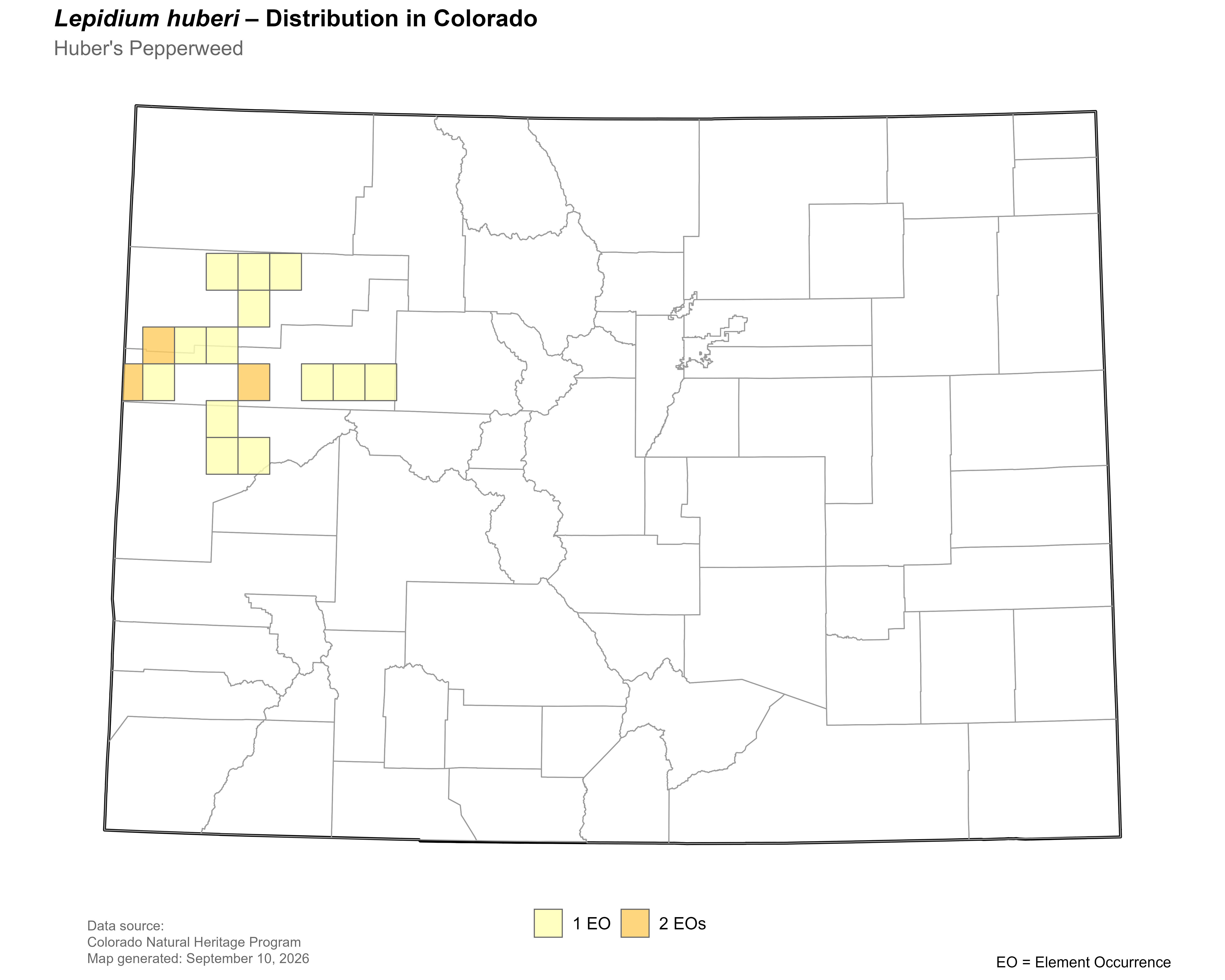
Lepidium huberi is known from Garfield, Mesa and Rio Blanco counties in Colorado, USA. Estimated range extent in Colorado of 8360 square kilometers was calculated in GeoCAT using occurrence data provided by the Colorado Natural Heritage Program (2023). This species is also known from Uintah County, Utah.
Click on map to enlarge |
Threats and Management Issues
Specific management and protection issues are not known for this species. This species is considered to be highly vulnerable to climate change (Handwerk et al. 2015).
References
- Ackerfield, J. 2015. Flora of Colorado. BRIT Press, Botanical Research Institute of Texas, Fort Worth, TX. 818 pp.
- Colorado Natural Heritage Program (CNHP). 2022. Biodiversity Tracking and Conservation System (Biotics 5). Colorado Natural Heritage Program, Colorado State University, Fort Collins.
- Colorado Natural Heritage Program (CNHP). 2023. Biodiversity Tracking and Conservation System (Biotics 5). Colorado Natural Heritage Program, Colorado State University, Fort Collins.
- Flora of North America Editorial Committee, ed. (FNA). 1993+. Flora of North America North of Mexico. Oxford Univ. Press, New York, Oxford.
- Handwerk, J., L. Grunau, and S. Panjabi. 2015. Colorado Wildlife Action Plan: 2015 Rare Plant Addendum. Colorado Natural Heritage Program, Colorado State University, Fort Collins, Colorado, USA.
- USDA, NRCS. 2022. The PLANTS Database. National Plant Data Team, Greensboro, NC 27401-4901 USA.
- Welsh, S.L., and S. Goodrich. 1995. Plant novelties in Lepidium (Cruciferae) and Artemisia (Compositae) from the Uinta Basin, Utah. Great Basin Naturalist 55(4):359-362.


