

Scientific Name : Lepidium crenatum
Author : (Greene) Rydb. NatureServe Explorer
Common Name : Alkaline Pepperwort
 Current Research Activities
☰ Click link below for details.
Taxonomy
Brassicaceae (mustard family)
Ranks and Status
State Rank : S3
State Rank Reason : Lepidium crenatum is known from 30 or more occurrences in western Colorado, USA. Threats to this species include disturbance from road maintenance activities, motorized and non-motorized recreation, and competition from non-native invasive plant species such as cheatgrass (Bromus tectorum) and smooth brome (Bromus inermis). This species is considered to be vulnerable to the effects of climate change.
U.S. Endangered Species Act : none
Colorado Threatened and Endangered List : none
Other Statuses : none
Description and Phenology
General Description:
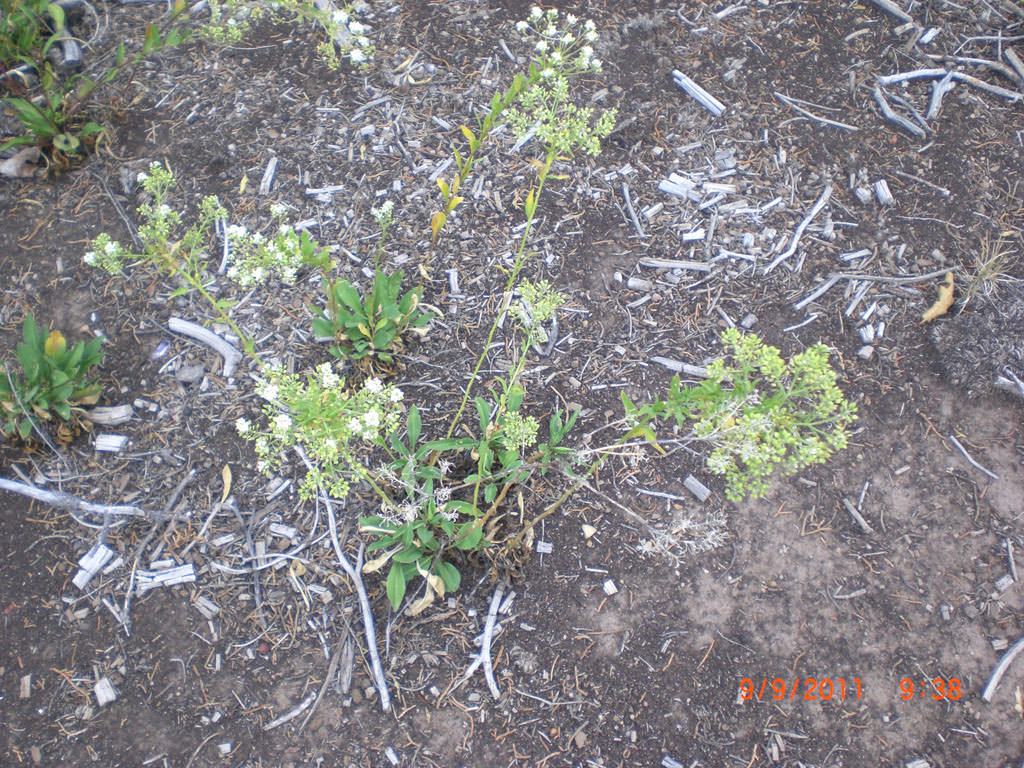
Perennials or subshrubs; 2-11 dm tall; puberulent; flowers white. Stems are simple from base, erect, and branched distally. Basal leaves form a small rosette of oblanceolate to spatulate leaves with crenate to serrate-crenate margins. Cauline leaves are shortly petiolate or sessile; and the leaf blades are oblong to oblanceolate, with margins entire. Flowers are in racemes which elongate slightly in fruit. Fruit are broadly ovate, apically winged, and glabrous; style is 0.2-0.6 mm, and is exserted beyond the apical notch (Flora of North America 1993+). The plants are succulent, branching at the base, with many densely leafy stems (Weber and Wittmann 2012).
Look Alikes:
Lepidium crenatum is distinguished from other species of Lepidium as follows: the lower leaves are entire or few-toothed at or near the apex, and are broadly spatulate. Cauline leaves are oblanceolate or broader, and entire. The plants are succulent, and branching at the base, with many densely leafy stems (Weber and Wittmann 2012). Additionally, mature fruits contain apical notch 0.1-0.2 mm deep (Flora of North America 2010).
Phenology:
Flowering June-August (Flora of North America 1993+, Colorado Natural Heritage Program 2012).
Habitat
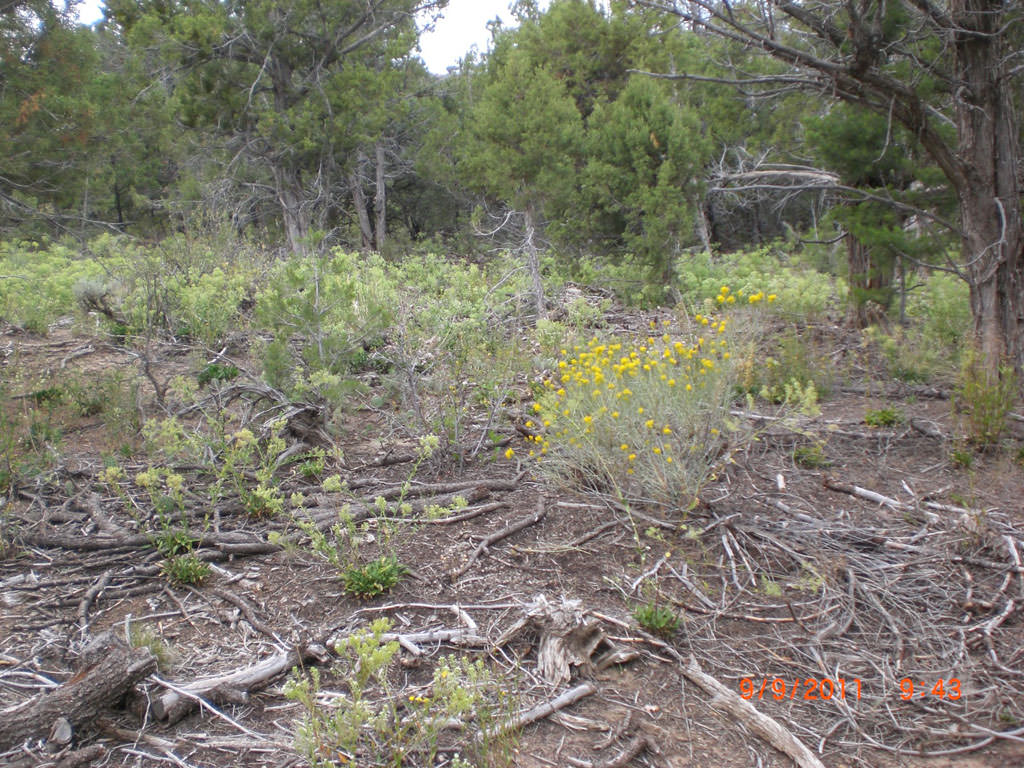
Openings in pinyon-juniper (Pinus edulis-Juniperus osteosperma) woodlands. Associated plant species include Oligospermous dracunculus, Symphoricarpos oreophilus, Artemisia ludoviciana, Quercus gambelii, Fendlera falcata, Amelanchier utahensis, Gutierrezia sarothrae. May be associated with Mancos shale (Colorado Natural Heritage Program 2012). Also found on arroyo banks and greasewood flats (Weber and Wittmann 2012).
click on image to enlarge
 |
Elevation Range:
4,689 - 8,332 feet (1,429 - 2,540 meters)
Distribution
Colorado Endemic:
No
Range:
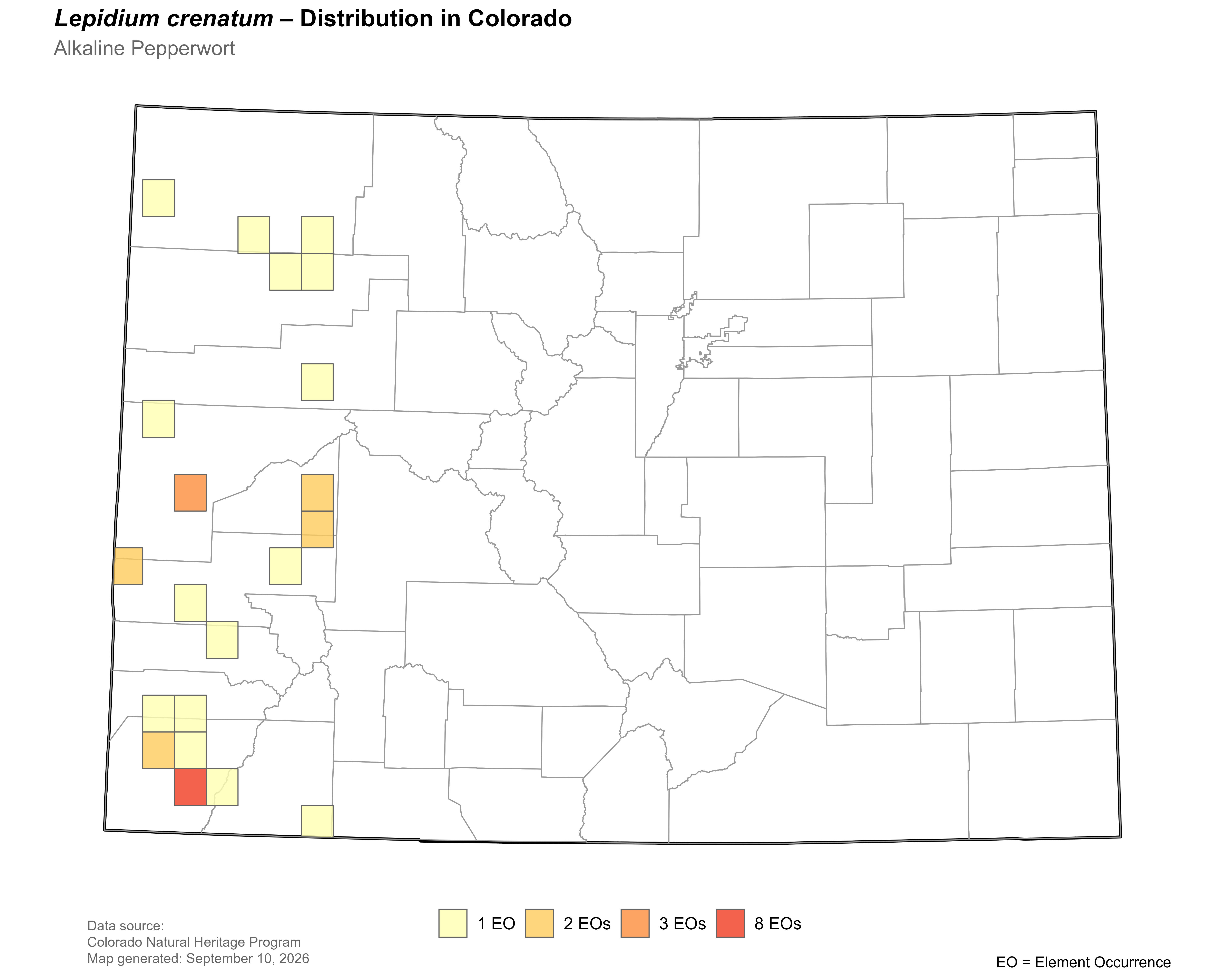
Lepidium crenatum is known from Delta, Dolores, Garfield, Mesa, Moffat, Montezuma, Montrose and Rio Blanco counties in Colorado, USA. It is also known from eastern Utah and northwestern New Mexico. Estimated range extent in Colorado of 39,223 square kilometers was calculated in GeoCAT using occurrence data provided by the Colorado Natural Heritage Program (2022).
Click on map to enlarge |
Threats and Management Issues
Lepidium crenatum may be subject to disturbance from road maintenance activities, motorized and non-motorized recreation, and competition from non-native invasive species such as cheatgrass (Bromus tectorum) and smooth brome (Bromus inermis). This species is considered to be extremely vulnerable to climate change (Handwerk et al. 2015).
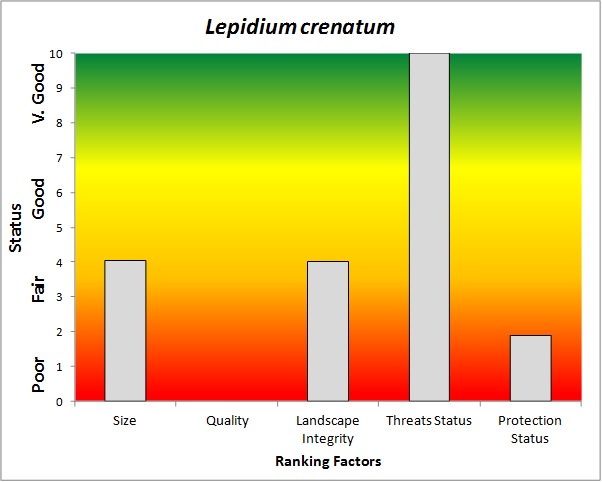
Summary results of an analysis of the status of Lepidium crenatum based on several ranking factors. This species was concluded to be Weakly Conserved. From Rondeau et al. 2011. |
References
- Ackerfield, J. 2015. Flora of Colorado. BRIT Press, Botanical Research Institute of Texas, Fort Worth, TX. 818 pp.
- Colorado Natural Heritage Program. 2012. Biodiversity Tracking and Conservation System. Colorado State University, Fort Collins, CO.
- Flora of North America Editorial Committee (FNA). 2010. Flora of North America north of Mexico. Vol. 7. Magnoliophyta: Salicaceae to Brassicaceae. Oxford University Press, New York. xxii + 797 pp.
- Goodrich, S., and E. Neese. 1986. Uinta Basin flora. U.S. Forest Service, Intermountain Region, Ogden, Utah. 320 pp.
- Handwerk, J., L. Grunau, and S. Panjabi. 2015. Colorado Wildlife Action Plan: 2015 Rare Plant Addendum. Colorado Natural Heritage Program, Colorado State University, Fort Collins, Colorado, USA.
- Harrington, H.D. 1954. Manual of the plants of Colorado. Sage Press, Chicago. 666 pp.
- Heil, K.D., S.L. O'Kane Jr., L.M. Reeves, and A. Clifford, 2013. Flora of the Four Corners Region, Vascular Plants of the San Juan River Drainage; Arizona, Colorado, New Mexico, and Utah. Missouri Botanical Garden Press, St. Louis, Missouri. 1098 pp.
- Lavender, A.E., M.M. Fink, S.E. Linn, D.M. Theobald. 2011. Colorado Ownership, Management, and Protection v9 Database. Colorado Natural Heritage Program and Geospatial Centroid, Colorado State University, Fort Collins, CO. (30 September).
- Neely, B., S. Panjabi, E. Lane, P. Lewis, C. Dawson, A. Kratz, B. Kurzel, T. Hogan, J. Handwerk, S. Krishnan, J. Neale, and N. Ripley. 2009. Colorado Rare Plant Conservation Strategy, Developed by the Colorado Rare Plant conservation Initiative. The Nature Conservancy, Boulder, Colorado, 117 pp.
- Rollins, R.C. 1993. The Cruciferae of Continental North America:Systematics of the Mustard Family from the Arctic to Panama. Stanford University Press. Stanford, CA.
- USDA, NRCS. 2022. The PLANTS Database. National Plant Data Team, Greensboro, NC 27401-4901 USA.
- Weber, W. A. and R. C. Wittmann. 2012. Colorado Flora, Western Slope, A Field Guide to the Vascular Plants, Fourth Edition. Boulder, Colorado. 532 pp.