

Scientific Name : Ipomopsis ramosa
Author : Al Schneid. & Bregar NatureServe Explorer
Common Name : Coral Ipomopsis
 Current Research Activities


☰ Click link below for details.
Taxonomy
Polemoniaceae (phlox family)
Ipomopsis ramosa was discovered in 2006 by Al and Betty Schneider and described as a new species by Al Schneider and John Breger in 2011 (Schneider and Bregar 2011). The species is endemic to Colorado. It is recognized in Weber and Wittmann (2012) and Ackerfield (2012, 2022). The Flora of North America does not currently include a treatment of Ipomosis (Polemoniaceae).
Ranks and Status
State Rank : S1
State Rank Reason : Ipomopsis ramosa is endemic to southwestern Colorado, USA, where it is found only on the Permian Cutler Formation in a restricted area near the Dolores River in Montezuma County. Threats and management issues have not been documented for this species, but it is considered to be highly vulnerable to climate change.
U.S. Endangered Species Act : none
Colorado Threatened and Endangered List : none
Other Statuses : SWAP SGIN
Description and Phenology
General Description:
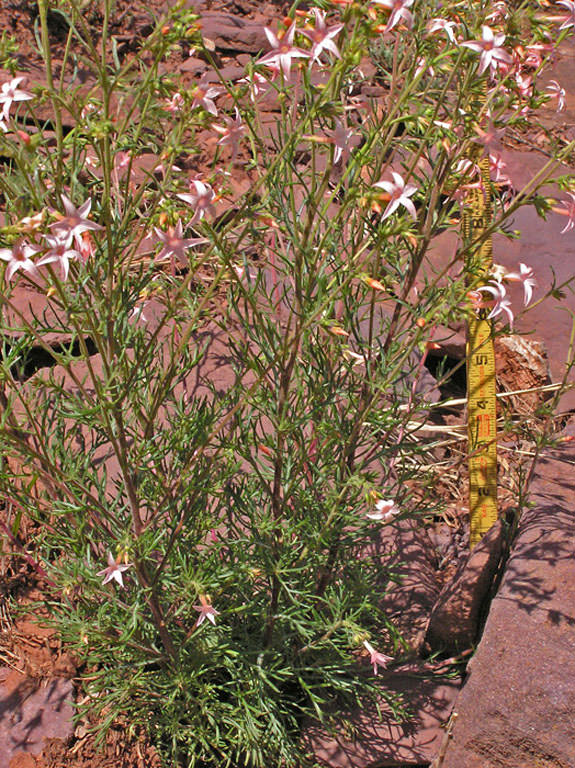
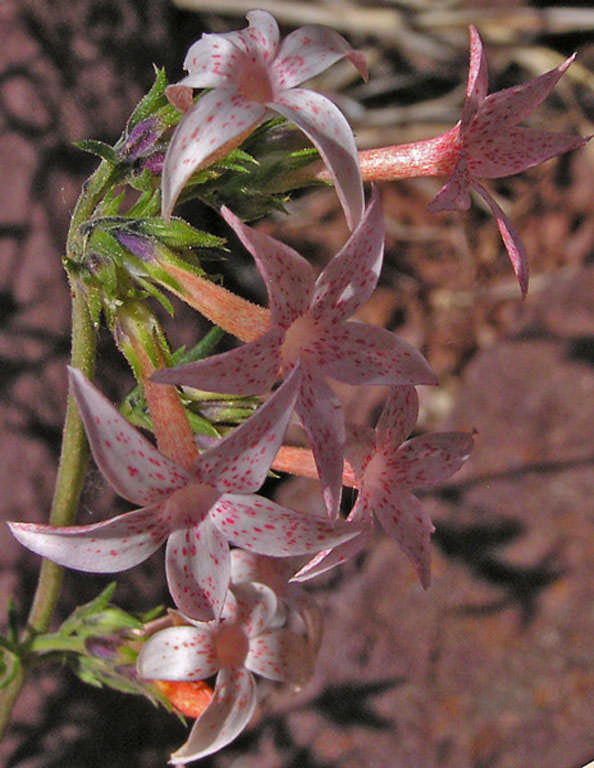
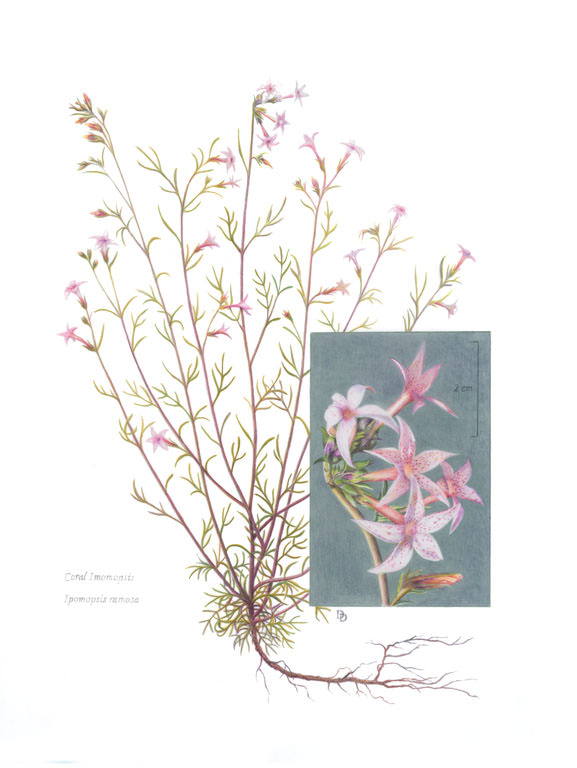
Ipomopsis ramosa is biennial to perennial, and 25-45 cm tall. The plants branch frequently from a woody base and along the main stem producing a bushy growth pattern. The flowers are white with short streaks and dots of coral pink. Stamens are deeply included within the corolla tube. Corolla tubes are quite short, 14-17 mm long. The style is only 2-4 millimeters. Plants are densely covered in glandular hairs and sparse silky hairs. The glandular hairs impart a very strong and pleasant spicy aroma. Leaves are light green and deeply divided. Basal rosettes are withered at flowering (Schneider and Bregar 2011, Ackerfield 2012, Weber and Wittmann 2012, Schneider 2013).
Look Alikes:
Schneider and Bregar (2011) list four species that are superficially similar to Ipomopis ramosa. Only one of these, I. aggregata, is known from Colorado and is found in the vicinity of I. ramosa. Ipomopsis agretata is much larger than I. ramosa and markedly different in its corolla color (usually scarlet) (Scheider and Bregar 2011). Additionally, I. ramosa is unique in that the branching of this species is prominent and found by Scheider and Bregar (2011) to be a distinguishing visual characteristic and reason for choosing for the specific epithet of ?ramosa,? meaning ?many-branched?. Additional species that are considered superficially similar include I. arizonica, I. tenuituba, and I. sancti-spiritus.
Phenology:
Flowers late June through early August.
 |
Habitat
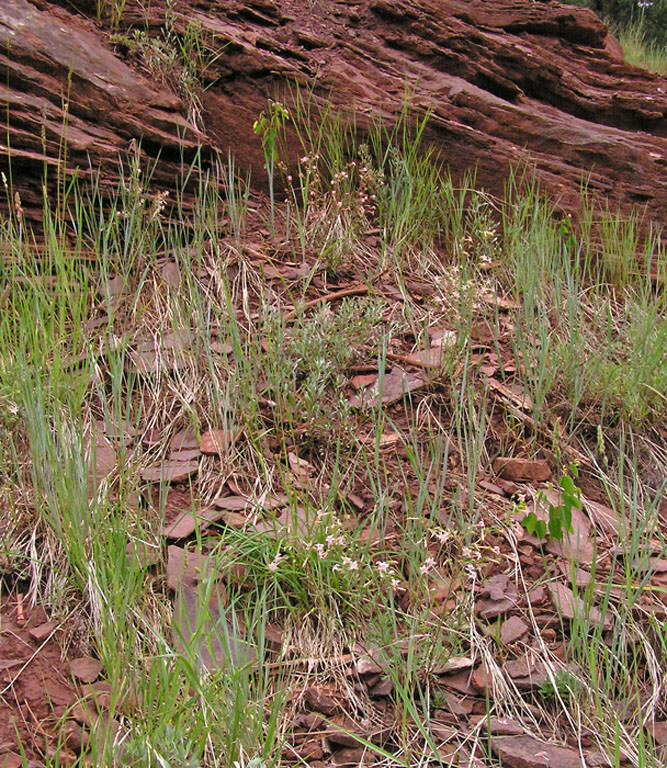
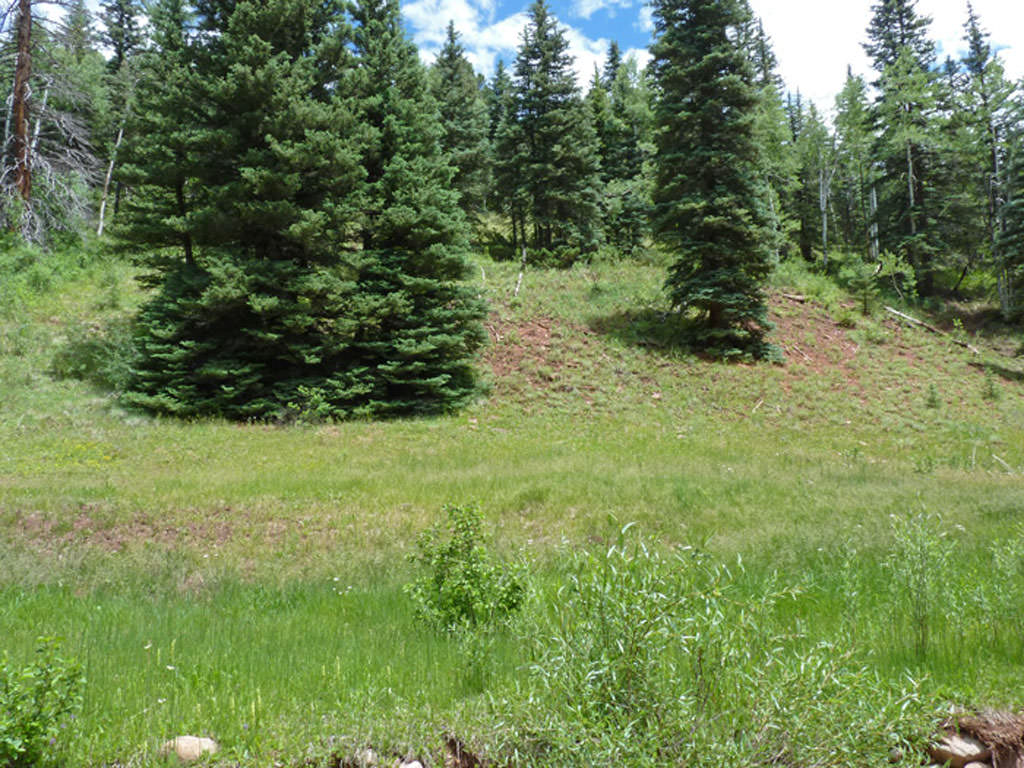
This species is found on red sandstones, siltstones, and shales of the Permian Cutler Formation. The plants grow on steep slopes in sunny meadows and open forests in moist but well-drained habitat with Picea pungens, Pseudotsuga menziesii, and Populus tremuloides (Schneider and Bregar 2011).
click on image to enlarge
 |
 |
Elevation Range:
7,997 - 10,053 feet (2,437 - 3,064 meters)
Distribution
Colorado Endemic:
Yes
Range:
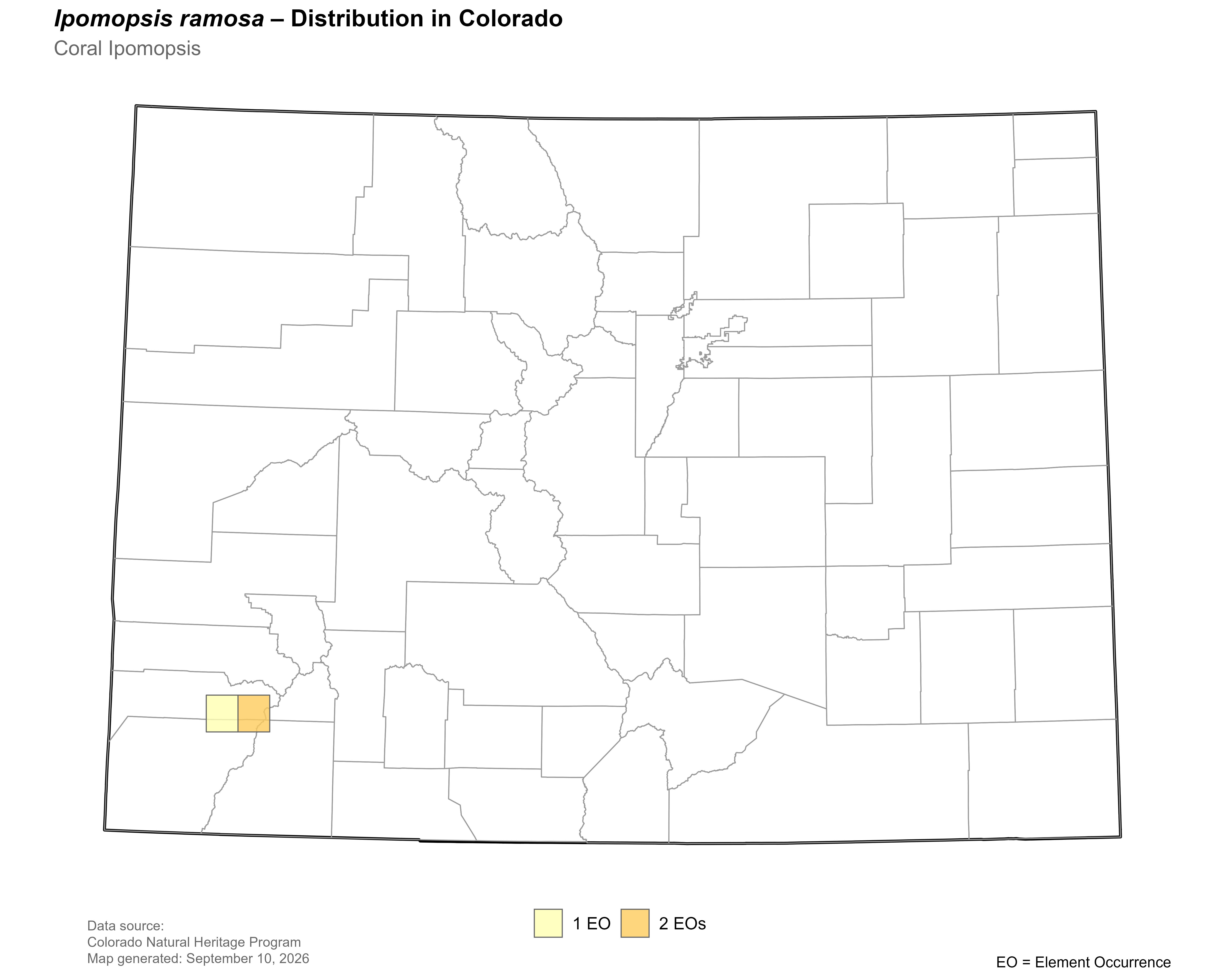
Ipomopsis ramosa is known only from the Permian Cutler Formation in the vicinity of the Dolores River Canyon in Montezuma County, Colorado, USA. The estimated range extent in Colorado of 40 square kilometers was calculated in GeoCAT using occurrence data provided by the Colorado Natural Heritage Program (2023).
Click on map to enlarge |
Threats and Management Issues
Threats and management issues have not been documented for this species. This species is considered to be highly vulnerable to climate change (Handwerk et al. 2015).
References
- Ackerfield, J. 2015. Flora of Colorado. BRIT Press, Botanical Research Institute of Texas, Fort Worth, TX. 818 pp.
- Colorado Natural Heritage Program (CNHP). 2023. Biodiversity Tracking and Conservation System (Biotics 5). Colorado Natural Heritage Program, Colorado State University, Fort Collins.
- Handwerk, J., L. Grunau, and S. Panjabi. 2015. Colorado Wildlife Action Plan: 2015 Rare Plant Addendum. Colorado Natural Heritage Program, Colorado State University, Fort Collins, Colorado, USA.
- Schneider, A., and J. Bregar. 2011. Ipomopsis ramosa (Polemoniaceae), a new species from southwestern Colorado. Phytoneuron 45: 1-11.
- USDA, NRCS. 2022. The PLANTS Database. National Plant Data Team, Greensboro, NC 27401-4901 USA.
- Weber, W. A. and R. C. Wittmann. 2012. Colorado Flora, Western Slope, A Field Guide to the Vascular Plants, Fourth Edition. Boulder, Colorado. 532 pp.