

Scientific Name : Iliamna crandallii
Author : (Rydb.) Wiggins NatureServe Explorer
Common Name : Crandall's Wild- hollyhock
 Current Research Activities
☰ Click link below for details.
Taxonomy
Malvaceae (mallow family)
This taxon is listed as Iliamna crandallii (Rydb.) Wiggins in Ackerfield (2022); Ackerfield (2015) considered all Iliamna as I. rivularis (Douglas) Greene. Recognized in Weber and Wittmann (2012), CU Herbarium, FNA, and BONAP/Kartesz (2015) as a distinct species. T. A. Bodo Slotta annotated specimens in 2004.
Ranks and Status
State Rank : S2
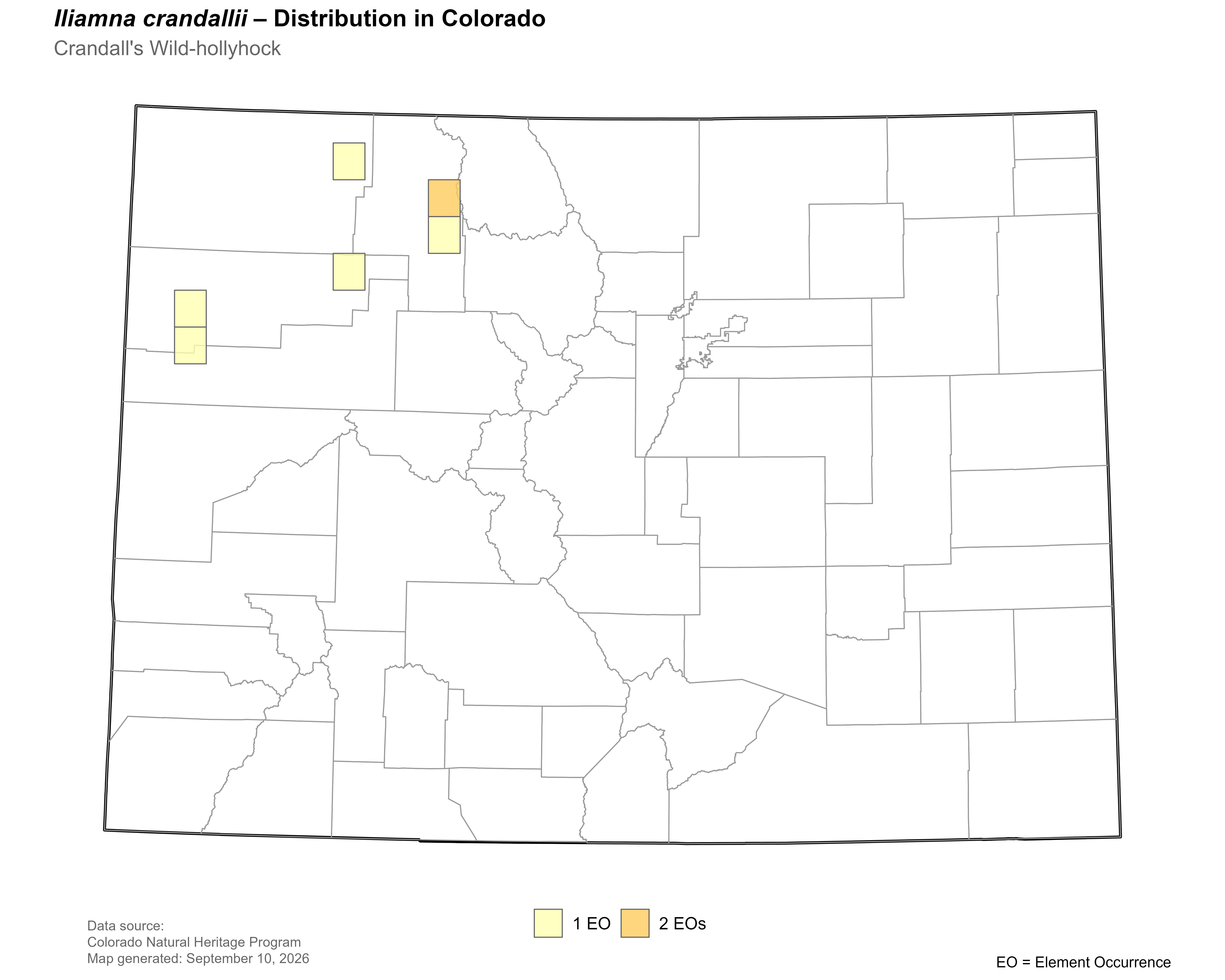
State Rank Reason : Iliamna crandallii is a Colorado, USA, endemic known from seven occurrences in Routt, Garfield, Moffat, and Rio Blanco counties. Five of the occurrences are considered historical. Potential threats include road maintenance and construction, competition from invasive species and impacts from climate change.
U.S. Endangered Species Act : none
Colorado Threatened and Endangered List : none
Other Statuses : SWAP Tier 1
Description and Phenology
General Description:
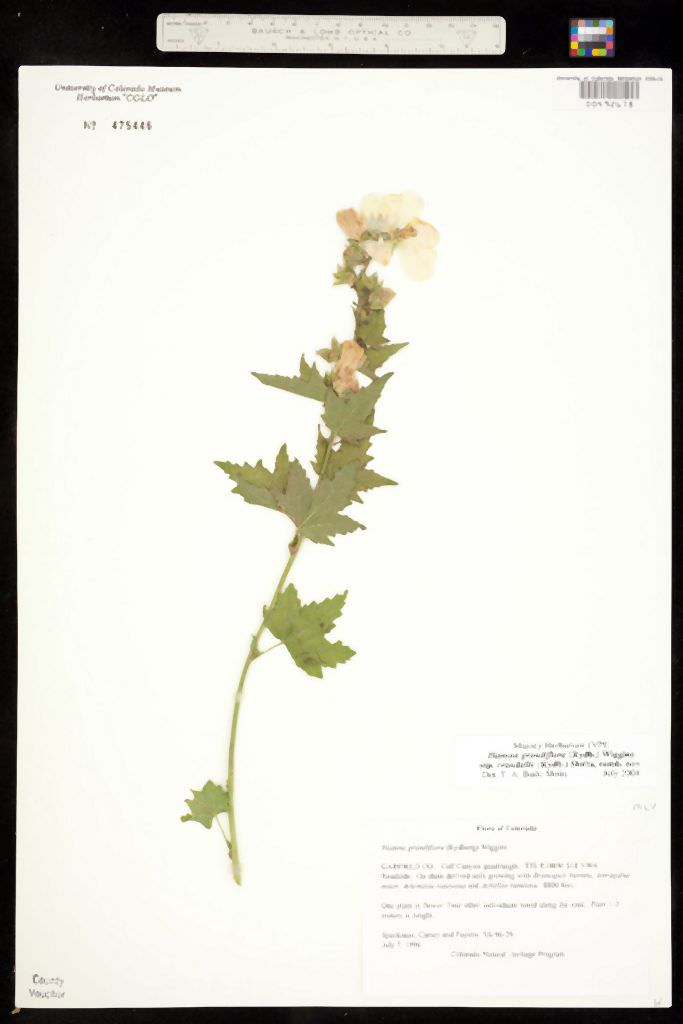
Plants 5-7 dm; leaves palmately 5-7 lobed, 5-10 cm wide, coarsely toothed; calyx lobes 9-12 mm long; petals pinkish-white or pink, 20-25 mm long (Ackerfield 2022).
Look Alikes:
Iliamna angulata (= grandiflora) has epicalyx lobes that are lanceolate-ovate, 8-12 mm long, and 3/4 as long as the calyx, while I crandalii has epicalyx lobes that are linear to linear-subulate, 3-10 mm long and 1/3-2/3 as long as the calyx. Iliamna rivularis has calyx lobes 2.5-5.5 mm long and puberulent seeds while I crandallii has calyx lobes 9-12 mm long and glabrous seeds (Ackerfield 2022).
Phenology:
Flowering and fruiting June-August (Ackerfield 2022).
Habitat
Along streams, creeks, and forest borders (Ackerfield 2022). This species has also been documented on sagebrush slopes, in meadows, and on rocky roadsides. Associated taxa that have been reported include: Bromus inermis, Astragalus miser, Artemisia tridentata ssp. vaseyana, Achillea, Taraxacum, Vicia, Symphoricarpos. Eriogonum, Lupinus, Artemisia, Amelanchier (CNHP 2023).
Elevation Range:
7,400 - 9,000 feet (2,256 - 2,743 meters)
Distribution
Colorado Endemic:
Yes
Range:
Iliamna crandallii is known from Routt, Garfield, Moffat and Rio Blanco counties in Colorado, USA. Estimated range extent in Colorado of 8,512 square kilometers was calculated in GeoCAT using occurrence data provided by the Colorado Natural Heritage Program (2024).
Click on map to enlarge |
Threats and Management Issues
Roadside occurrences could be vulnerable to road construction and maintenance activities, and competition from invasive species. Drought conditions and variation in wildfire frequency as a result of climate change are also a concern. This species is considered to have moderate adaptive capacity and is expected to be moderately vulnerable to climate change under both RCP 4.5 and 8.5 scenarios, as assessed for the 2025 Colorado State Wildlife Action Plan (CNHP 2025).
References
- Ackerfield, J. 2015. Flora of Colorado. BRIT Press, Botanical Research Institute of Texas, Fort Worth, TX. 818 pp.
- Ackerfield, Jennifer. 2022. Flora of Colorado. Second Edition. Bot. Misc. 60. BRIT Press, Fort Worth Botanic Garden/Botanical Research Institute of Texas, U.S.A. 861 pp.
- Colorado Natural Heritage Program (CNHP). 2023. Biodiversity Tracking and Conservation System (Biotics 5). Colorado Natural Heritage Program, Colorado State University, Fort Collins.
- Colorado Natural Heritage Program (CNHP). 2025. Climate Change Vulnerability Assessment of Colorado Tier 1 and Tier 2 Plant Species of Greatest Conservation Need (SCGN) for the 2025 Colorado State Wildlife Action Plan. Colorado Natural Heritage Program, Colorado State University, Fort Collins, CO.
- Harrington, H. D. 1954. Manual of the Plants of Colorado. Sage Books, Denver, CO. 666 pp.
- Weber, W. A. and R. C. Wittmann. 2012. Colorado Flora, Eastern Slope, A Field Guide to the Vascular Plants, Fourth Edition. Boulder, Colorado. 555 pp.
- Weber, W. A. and R. C. Wittmann. 2012. Colorado Flora, Western Slope, A Field Guide to the Vascular Plants, Fourth Edition. Boulder, Colorado. 532 pp.