

Scientific Name : Eriogonum viridulum
Author : Reveal NatureServe Explorer
Common Name : Clay Hill Buckwheat
 Current Research Activities


☰ Click link below for details.
Taxonomy
Polygonaceae (buckwheat family)
First described by James Reveal in 1966 (Flora of North America 1993+). Weber and Wittmann (2012) list as a synonym under Eriogonum brevicaule. Flora of North America (1993+) include E. viridulum as an accepted taxon, and list E. brevicaule var. viridulum as a synonym. Welsh et al. (1993) list E. brevicaule var. viridulum as the accepted name. Ackerfield (2015, 2022) does not include this taxon. Flora of North America (1993+) considers this to be known only from Duchesne and Uintah counties, Utah. This taxon was relocated in adjacent Moffat County, Colorado in 2022.
Ranks and Status
State Rank : S1
State Rank Reason : Eriogonum viridulum is known from one location in Moffat County, Colorado, USA. Although it is found in a landscape with moderate levels of disturbance there is no evidence of recent disturbance within the occurrence. The effects of climate change on this species are unknown.
U.S. Endangered Species Act : none
Colorado Threatened and Endangered List : none
Other Statuses : BLM, SWAP SGIN
Description and Phenology
General Description:
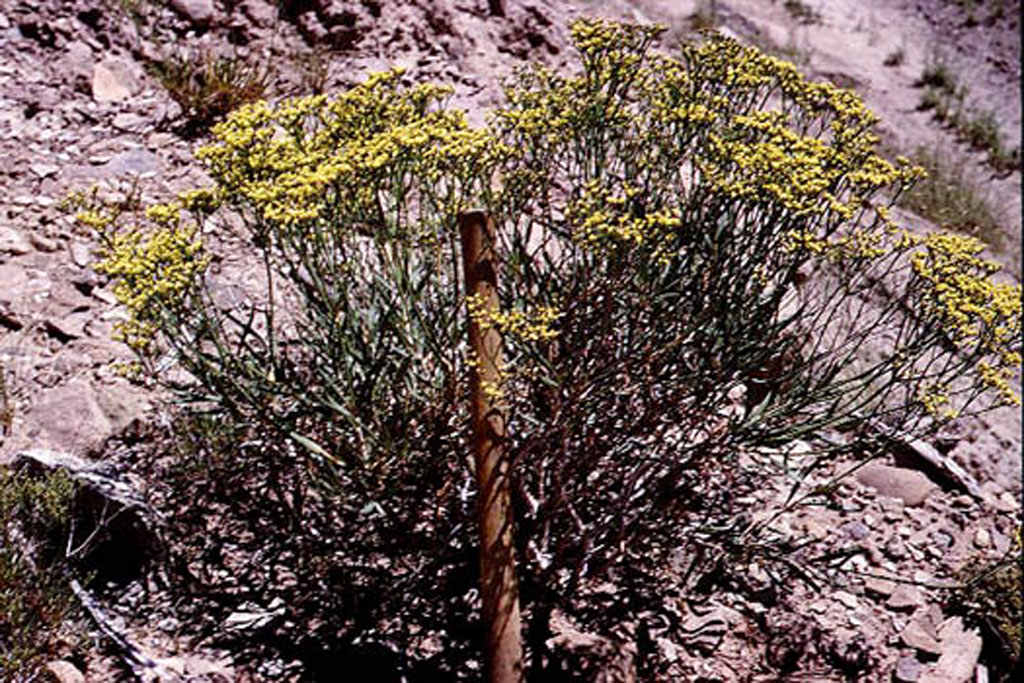
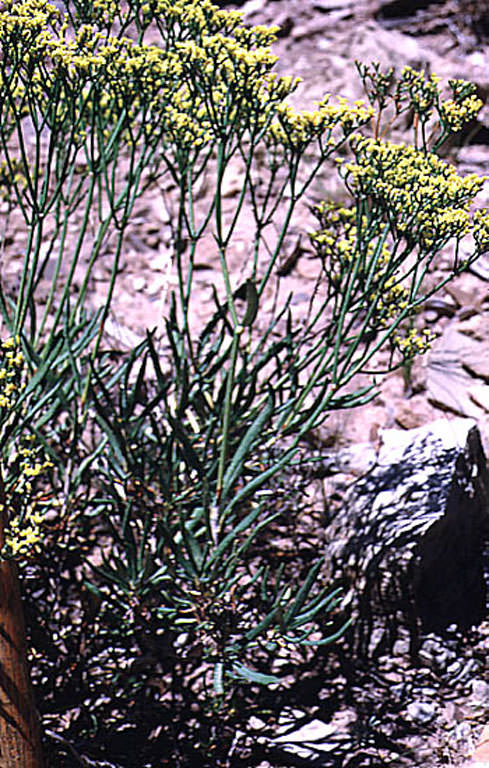
Herbs, spreading, not scapose, 1-3.5 Ã 1-4 dm, glabrous, bright green. Stems spreading, without persistent leaf bases; caudex stems absent; aerial flowering stems erect, slender, solid, not hollow, 0.5-1.2 dm, glabrous, tomentose among leaves. Leaves sheathing 1-6 cm, 1 per node; petiole 0.1-0.2 cm, tomentose or glabrous; blade linear or rarely narrowly elliptic, 1-4 Ã 0.1-0.5 cm, densely white-tomentose abaxially, glabrous and green adaxially, margins usually tightly revolute. Inflorescences cymose, 3-15 Ã 2-10 cm; branches dichotomous, glabrous; bracts 3, scalelike, narrowly triangular, 1-3 mm. Peduncles absent or erect, slender, 0.05-0.2 cm. Involucres 1 per node, turbinate, 2-3 Ã 1.5-2 mm, glabrous; teeth 5, erect, 0.5-0.8 mm. Flowers 1.5-2 mm; perianth yellow, glabrous; tepals connate proximal 4- 3, slightly dimorphic, those of outer whorl ovate, 1-1.2 wide, those of inner whorl oblong, 0.7-0.8 mm wide; stamens exserted, 1.5-2 mm; filaments pilose proximally. Achenes brown, 1.5-2 mm, glabrous (Flora of North America 1993+).
Look Alikes:
Eriogonum viridulum has a distinctive upright inflorescence composed of numerous, bright green and glabrous branches bearing essentially sessile involucres. These features and the linear to narrowly elliptic leaf blades that are typically tightly revolute combine to distinguish the species from the related E. brevicaule var. brevicaule (Flora of North America 1993+).
Phenology:
Flowers July through October (Flora of North America 1993+).
Habitat
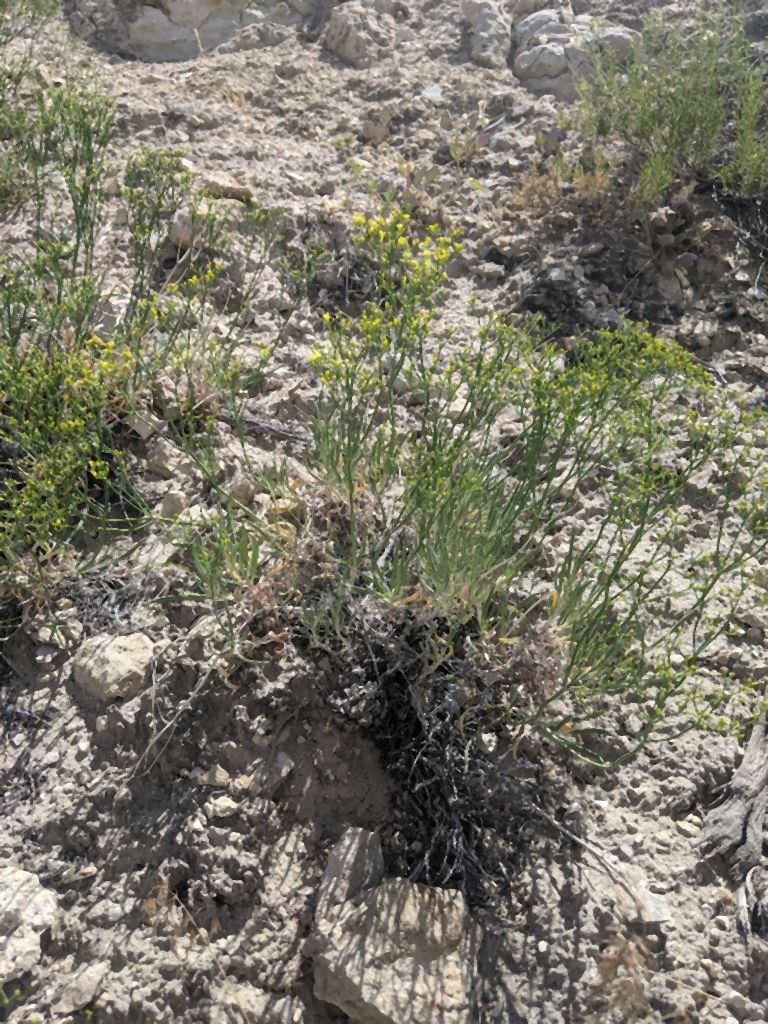
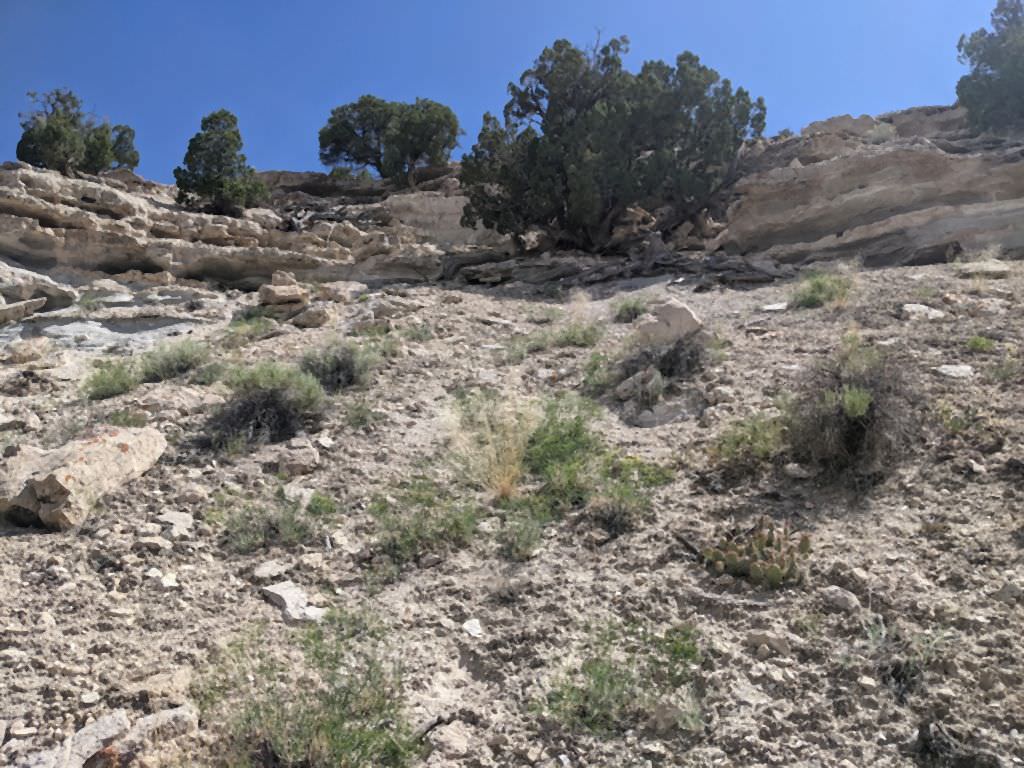
Habitat information specific to the Colorado location is not known. The Flora of North America (1993+) reports that this species is found on sandy or silty flats or clay slopes and hills, in saltbush or sagebrush communities, or in pinyon-juniper woodlands.
click on image to enlarge
 |
Elevation Range:
5,628 - 5,865 feet (1,716 - 1,788 meters)
Distribution
Colorado Endemic:
No
Range:
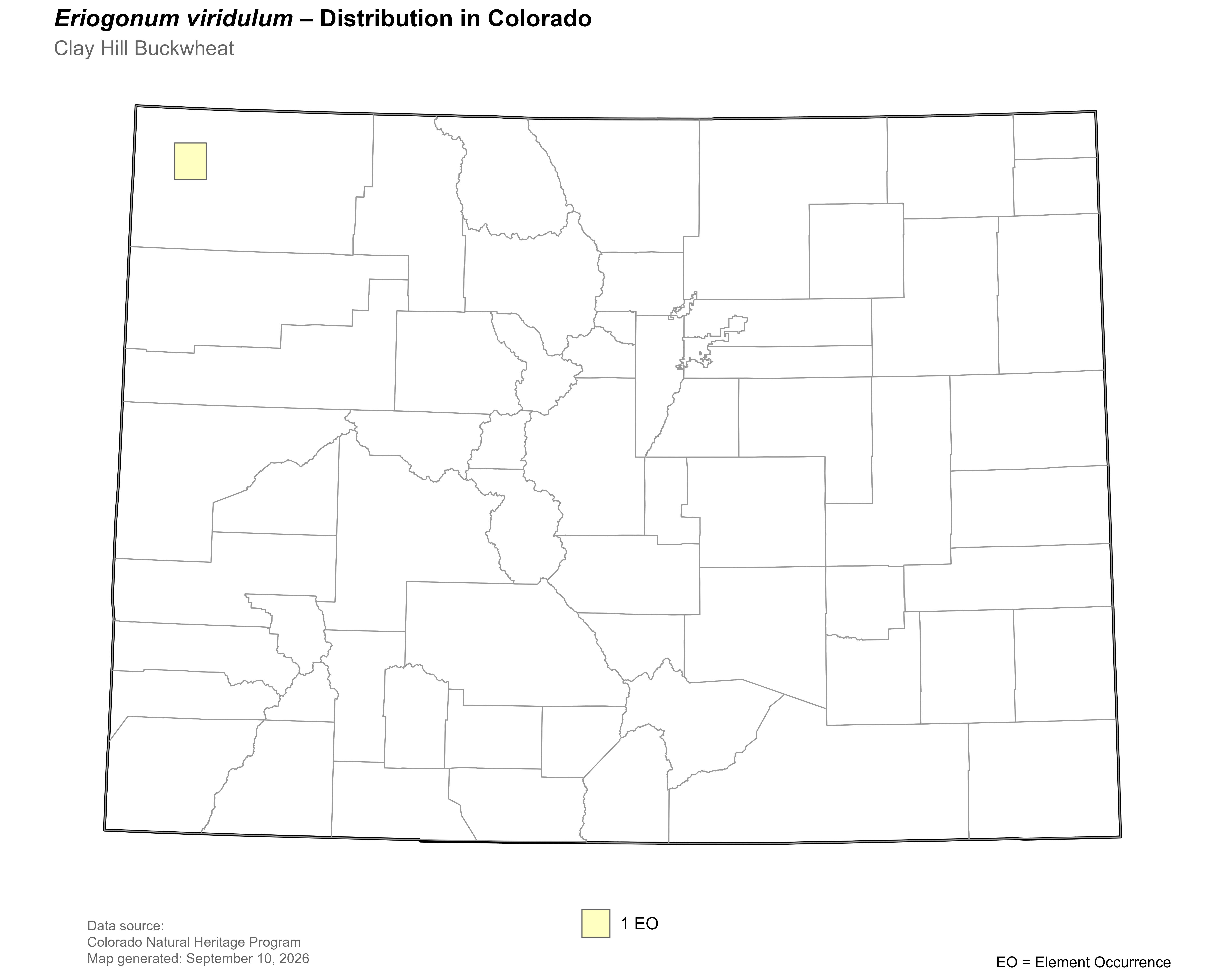
Eriogonum viridulum is known from one location in Moffat County, Colorado, USA. This species can also be found in Utah. T
Click on map to enlarge |
Threats and Management Issues
The lone Colorado occurrence is found in habitat with moderate levels of landscape disturbance, however, there is no evidence of recent disturbance within the occurrence (CNHP 2021, 2023). The occurrence is adjacent to but above a highway on a slope where road maintenance or widening is not a concern. There is scattered Salsola at the site (CNHP 2023). The effects of climate change on this species have not been studied.
References
- Ackerfield, J. 2015. Flora of Colorado. BRIT Press, Botanical Research Institute of Texas, Fort Worth, TX. 818 pp.
- Ackerfield, Jennifer. 2022. Flora of Colorado. Second Edition. Bot. Misc. 60. BRIT Press, Fort Worth Botanic Garden/Botanical Research Institute of Texas, U.S.A. 861 pp.
- Flora of North America Editorial Committee (FNA). 2005. Flora of North America north of Mexico. Vol. 5. Magnoliophyta: Caryophyllidae: Caryophyllales, Polygonales, and Plumbaginales. Oxford Univ. Press, New York. vii + 656 pp.
- Flora of North America Editorial Committee, ed. (FNA). 1993+. Flora of North America North of Mexico. Oxford Univ. Press, New York, Oxford.
- Lavender, A.E., M.M. Fink, S.E. Linn, D.M. Theobald. 2011. Colorado Ownership, Management, and Protection v9 Database. Colorado Natural Heritage Program and Geospatial Centroid, Colorado State University, Fort Collins, CO. (30 September).
- USDA, NRCS. 2022. The PLANTS Database. National Plant Data Team, Greensboro, NC 27401-4901 USA.
- Weber, W. A. and R. C. Wittmann. 2012. Colorado Flora, Western Slope, A Field Guide to the Vascular Plants, Fourth Edition. Boulder, Colorado. 532 pp.
- Welsh, S.L., N.D. Atwood, S. Goodrich, and L.C. Higgins (eds.) 1993. A Utah flora. 2nd edition. Brigham Young Univ., Provo, Utah. 986 pp.
- Wiley-Eberle, K.L. 1980. Threatened and Endangered Plant Species: Habitat Classifications, Descriptions, and Associated Plant Species. Unpublished Report Prepared for the Colorado Natural Areas Program, Denver CO.