

Scientific Name : Eriogonum pelinophilum
Author : Reveal NatureServe Explorer
Common Name : Clay- loving Wild Buckwheat
 Current Research Activities
 1997 profile


☰ Click link below for details.
Taxonomy
Polygonaceae (buckwheat family)
Ranks and Status
State Rank : S1S2
State Rank Reason : Eriogonum pelinophilum is known from less than 500 sq km within two counties in western Colorado, USA. It is threatened by a variety of anthropogenic disturbances including housing and urban development, power lines, canals and roads, and off highway vehicle use. Prolonged drought and habitat alteration due to climate change within the species range also threaten Eriogonum pelinophilum.
U.S. Endangered Species Act : ESA Endangered
Colorado Threatened and Endangered List : none
Other Statuses : SWAP Tier 1
Description and Phenology
General Description:
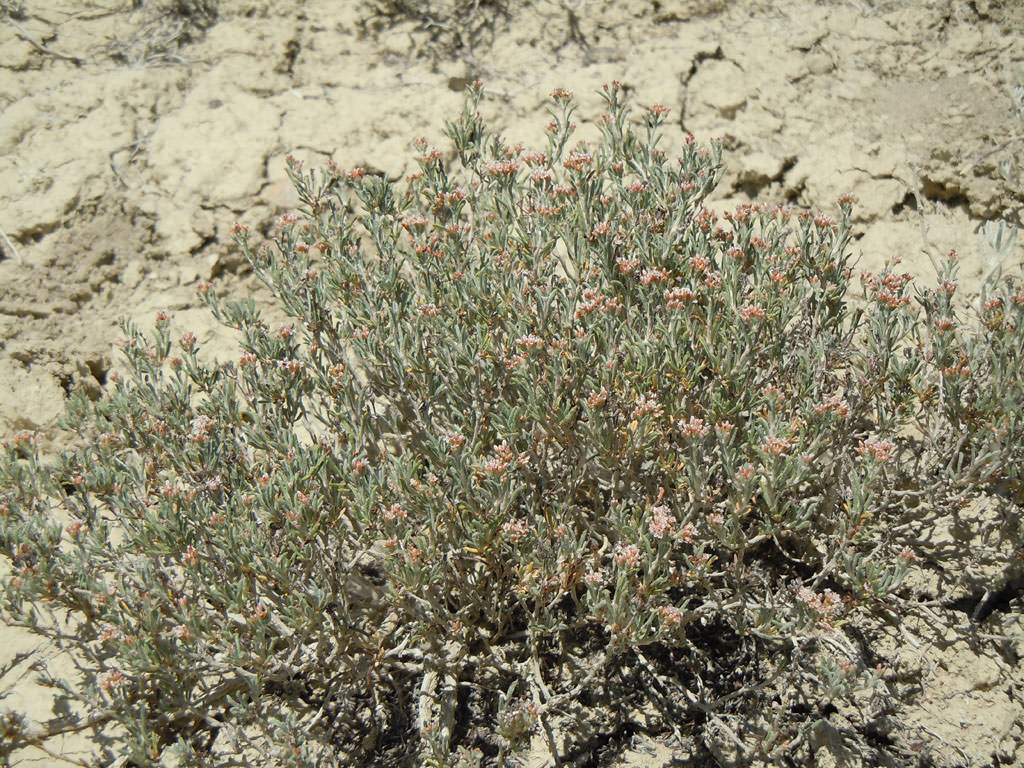
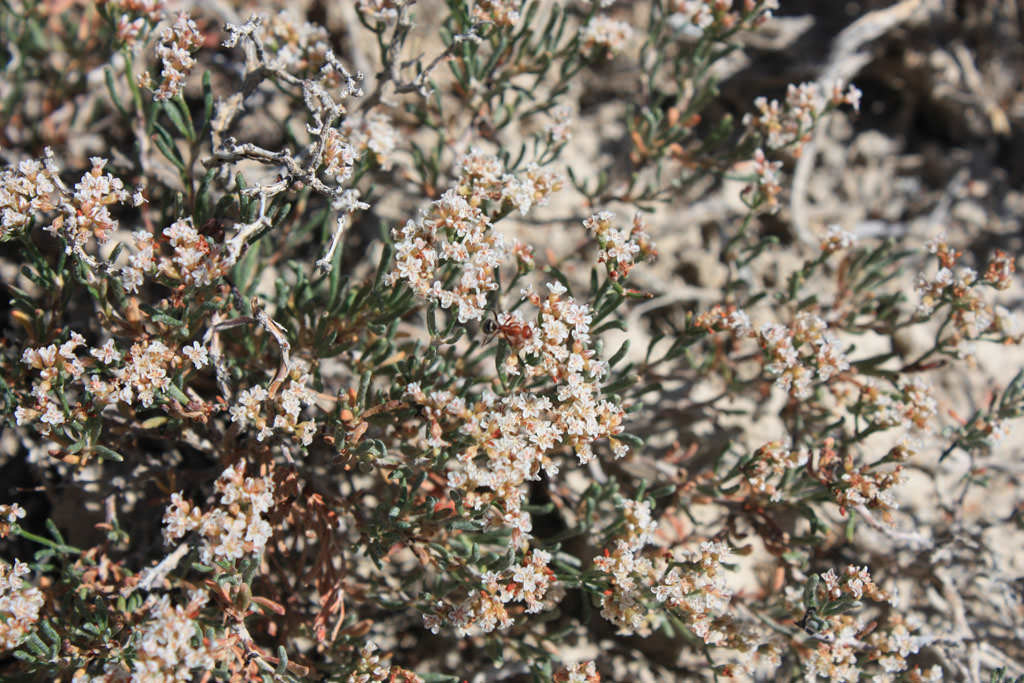
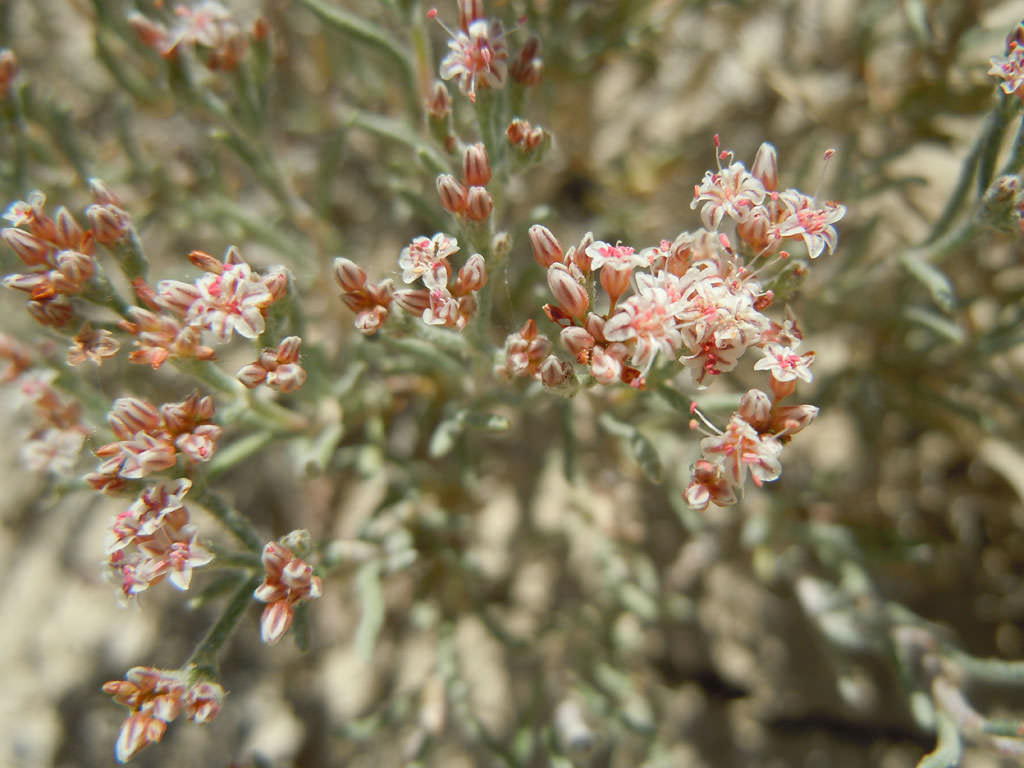
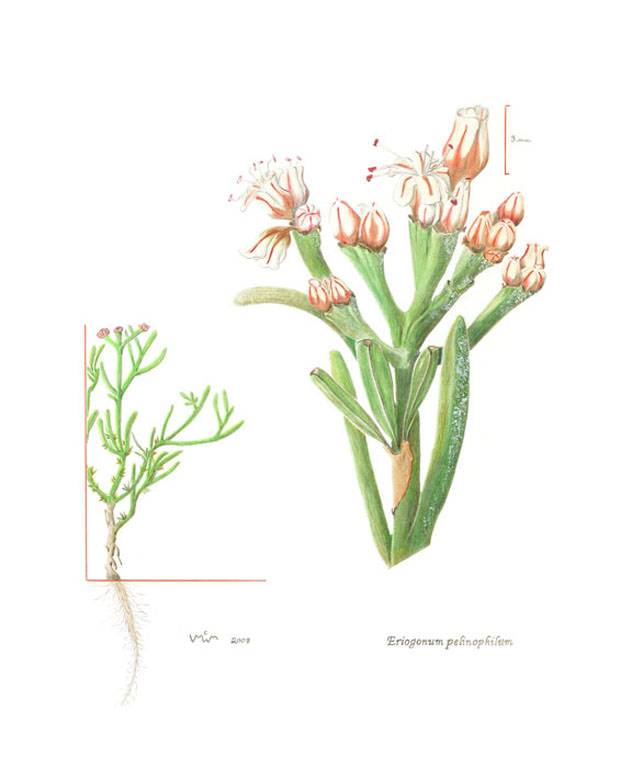
Low rounded heavily branched pulvinate subshrubs 5-10 cm high and 8-15 cm across; lower stems light brown, woody, bark exfoliating in long loose strips or wide plates; leafless, upper branches herbaceous, slender, floccose to glabrous; leaves solitary, scattered along entire length of herbaceous stems, except for the last 5-10 mm, somewhat closely placed and congested to widely spaced, leaf blades oblanceolate, 5-12 mm long, 1-1.5 mm wide, densely white-tomentose below, midveins totally obscured by the tomentum, subglabrous to glabrous and green above, margins entire, revolute and completely enclosing the lower surface, apices and bases acute, leaves persistent, petioles 1 mm long, light yellowish-brown to tan and thinly pubescent when young, becoming glabrous; flowering stems slender, 5-10 mm long, floccose to glabrous; inflorescence cymose, +/- compact and congested, 1-2 cm long and wide, trichotomous, rays 2-5 mm long, floccose to glabrous without, thinly tormentose within, connate at base; peduncles, when present, 1-1.5 mm long, floccose to glabrous, erect; involucres solitary, narrowly turbinate, 3-3.5 mm long, 1-1.5 mm wide, floccose to glabrous without, glabrous within, 5 acute lobes 0.3-0.4 mm long, bractlets oblanceolate, 1.8-2.5 mm long, minutely fringed with capitate gland-shaped cells, pedicels 2.5-4.5 mm long, glabrous; flowers white with reddish-brown midribs and brownish-red bases, 3-3.5 mm long, glabrous within and without except for microscopic glands along the midribs within, tepals similar; achenes 3-3.5 mm long (Peterson 1982).
Look Alikes:
Eriogonum contortum has yellow flowers and occurs further north (Mesa and Garfield Cos.). Eriogonum clavellatum is taller (1-2 dm), has larger involucres (4-4.5 mm long), and is only known from Montezuma Co. (Spackman et al. 1997).
Phenology:
Flowering occurs from mid June to late July, and fruiting in August.
 |
Habitat
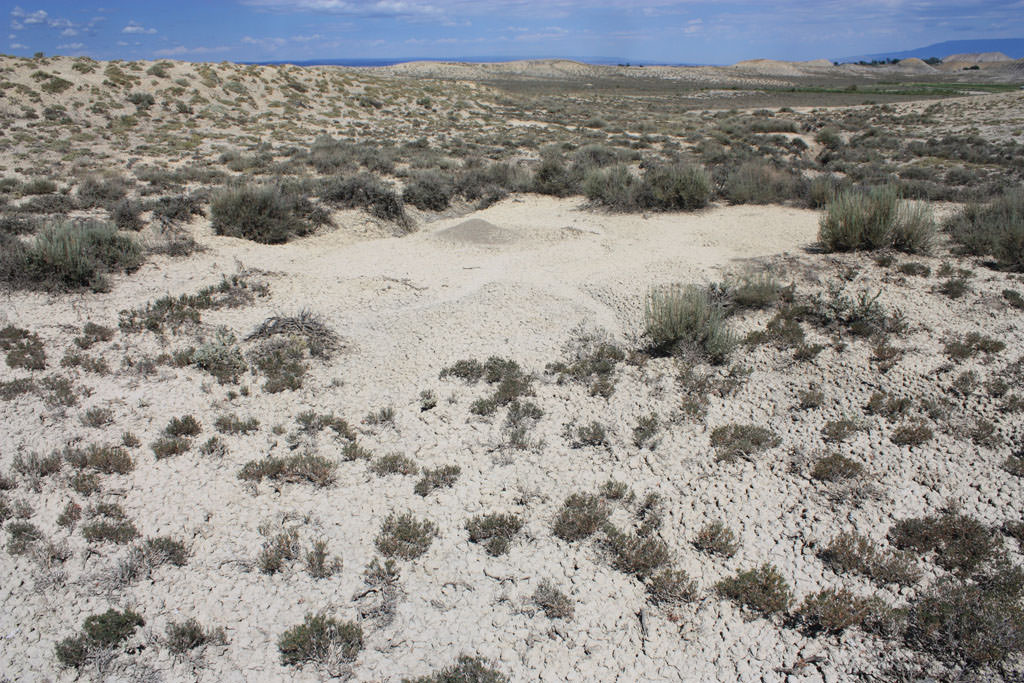
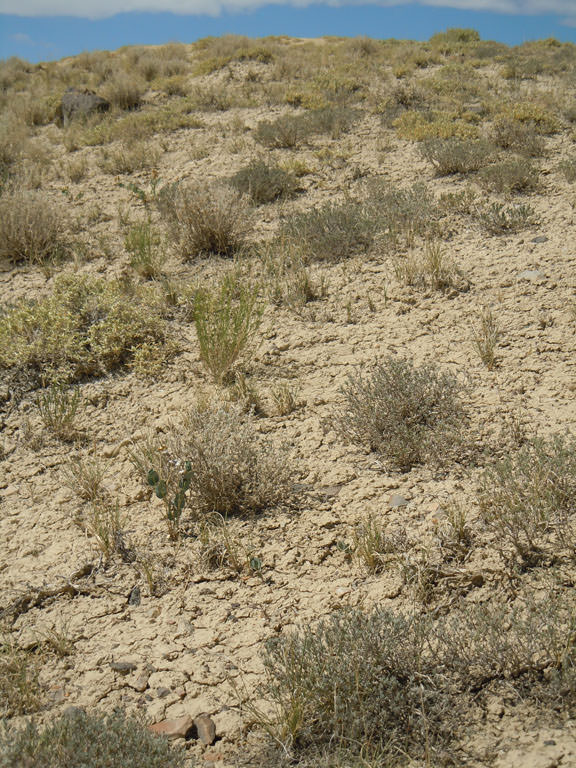
Eriogonum pelinophilum is found in substrates derived from the Mancos Formation shales. The entire area is typified by rolling adobe (clay) hills and flats. Generally, the plants are found in a sharply defined soil microhabitat with shadscale (Atriplex confertifolia), on mid to lower slopes of the hills. The soil types are part of the Billings Series, known for its fine texture and weak and unstable structure. These soils are calcareous throughout and in some places have visible accumulations of calcium carbonate or calcium sulfate (Cline et al. 1967). Steeper barren slopes (badlands) are above, with flatlands below dominated by mat saltbush (A. corrugata) (Cline et al. 1967, U.S. Fish and Wildlife Service 1988). The change from the lower slope soils to the flatland soils is characterized by a jump in soil sulfate level (from <100 ppm to 1650 ppm) and sodium level (Potter et. al. 1985). Clay soils have a high water holding capacity, but this moisture is not readily available to plants (Barbour et. al. 1980, cit. in O'Kane 1985). Rainfall in the E. pelinophilum habitat averages 7-10 inches annually, further contributing to the low moisture availability (Colorado Climate Center 1984). Eriogonum pelinophilum generally prefers swales and bottoms where useable moisture is more available (O'Kane 1985). Because of the low moisture availability, communities in which E. pelinophilum occur are characterized by low species diversity, low productivity and minimal canopy cover. Eriogonum pelinophilum is codominant with other xerophytic shrubs or subshrubs such as shadscale, the rare Penstemon retrorsus, Castle Valley clover (Atriplex cuneata), mat saltbush, black sagebrush (Artemesia nova) and Xylorhiza venusta (Neely 1985, O'Kane 1985). The communities are apparently stable, climax associations, judging from the lack of invading species capable of dominating the sites. Field observations indicate that the species is most abundant where biological soil crust cover is not extensive (Ferguson 2007).
click on image to enlarge
 |
 |
Elevation Range:
5,220 - 6,375 feet (1,591 - 1,943 meters)
Distribution
Colorado Endemic:
Yes
Range:
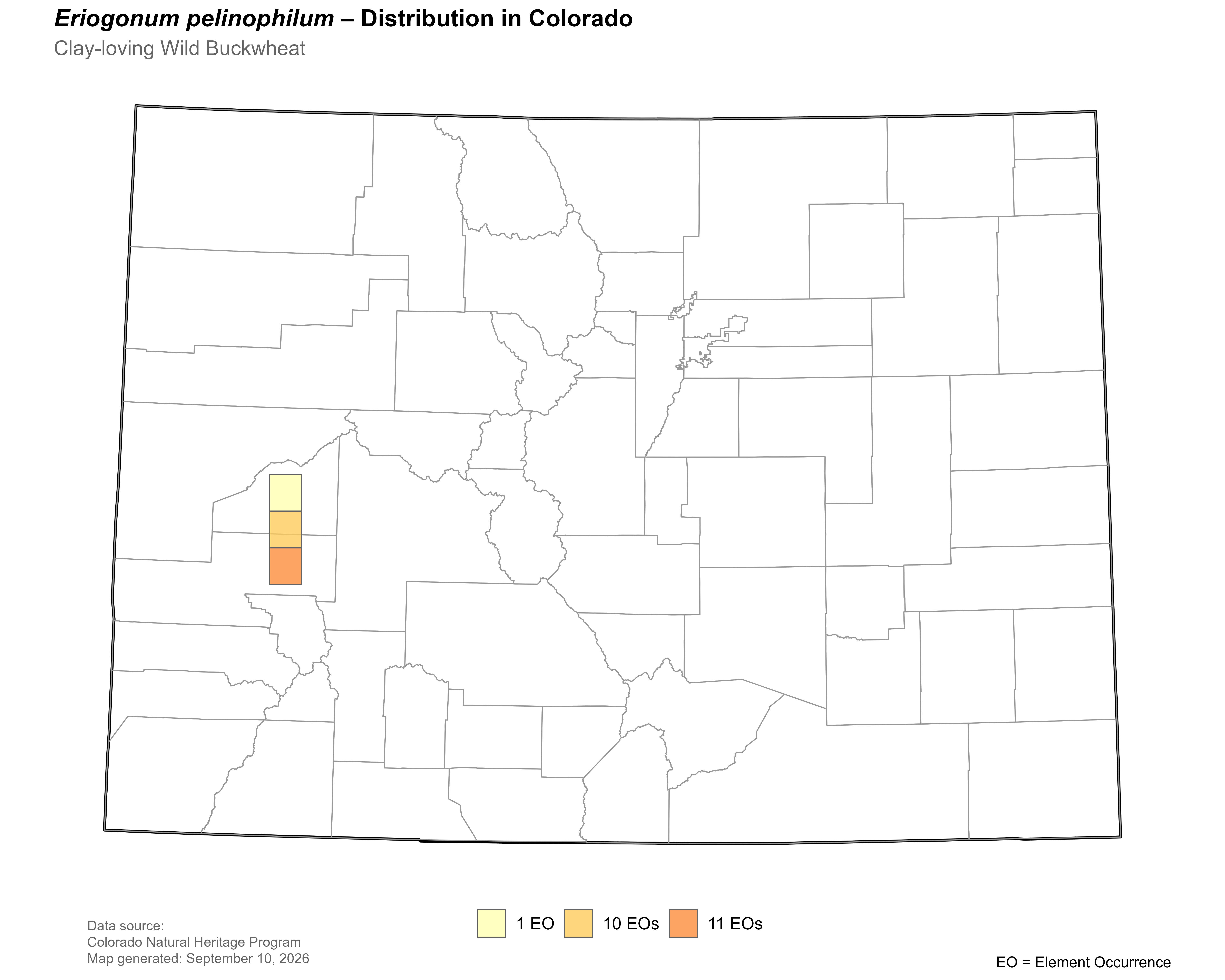
Eriogonum pelinophilum is endemic to Delta and Montrose counties, Colorado, USA. Estimated range extent in Colorado of 421 square kilometers was calculated in GeoCAT using occurrence data provided by the Colorado Natural Heritage Program (2022).
Click on map to enlarge |
Threats and Management Issues
Fragmentation of Eriogonum pelinophilum habitat into small units of possibly nonviable population size has been cited as the greatest threat to this species (FWS 2022). Increasing development, including residential and industrial buildings, power lines, canals and roads, and off highway vehicle (OHV) use continues to fragment and impact the species and its habitat (FWS 2022). In 2009, the U.S. Fish and Wildlife Service estimated that 40% of the E. pelinophilum population had already been impacted by urban development. The human population in Delta and Montrose Counties, Colorado continues to grow, with approximately half of the habitat for this species on private land where minimization and avoidance measures are not required (USFWS 2022). Off highway vehicle use is also prevalent throughout the range of E. pelinophilum on both public and private lands. Although there are limits to OHV use on public lands, non-compliant OHV use remains an issue at several occurrences (USFWS 2009, 2022; CNHP 2022). Off highway vehicle use has also been documented on private lands but the full extent to which OHV use threatens E. pelinophilum on private lands is not fully understood (USFWS 2009, 2022). Irrigation canals and ditches are prevalent throughout the species range, with at least 15 occurrences impacted. The excavation of canals for maintenance can bury plants and suitable habitat (USFWS 2022). Existing transmission lines currently run adjacent to or through occurrences and although utility managers/companies are working closely with land managers to avoid impacting E. pelinophilum plants, this cooperation is not formalized in any way (USFWS 2022). Although invasives species such as Halogeton glomeratus (halogeton), Acroptilon repens (Russian knapweed), Eremopyrum triticeum (annual wheatgrass), and Bromus tectorum (cheatgrass) are prevalent throughout the species? range, no negative impacts from invasive species have been documented in surveys of clay-loving wild buckwheat occurrences. Prolonged drought and habitat alteration due to climate change within the species range are also threats for this species (Handwerk et al. 2015). Consecutive years of hotter and drier than average conditions, as observed from 2017-2021, visually correlated with decreasing E. pelinophilum density and had a pronounced effect on driving the decreasing population trends over the same duration (Krening et al. 2021). This species is considered to have low adaptive capacity and is expected to be extremely vulnerable to climate change under both RCP 4.5 and 8.5 scenarios, as assessed for the 2025 Colorado State Wildlife Action Plan (CNHP 2025).
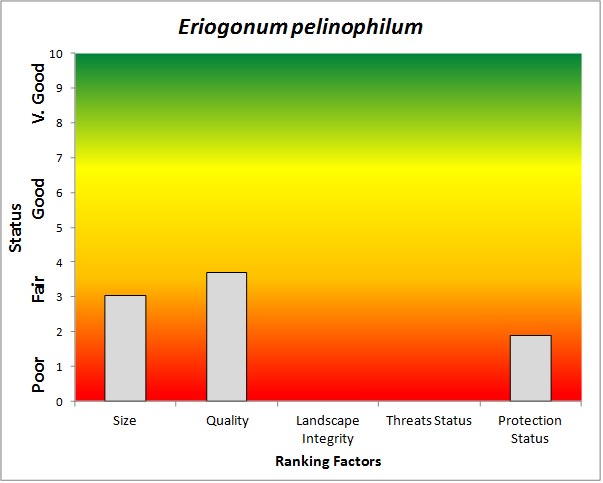
Summary results of an analysis of the status of Eriogonum pelinophilum based on several ranking factors. This species was concluded to be "under conserved. From Rondeau et al. 2011. |
References
- Ackerfield, J. 2012. The Flora of Colorado. Colorado State University Herbarium. 433 pp.
- Bowlin, W.R.,V.J. Tepedino, and T.L. Griswold. 1993. The reproductive biology of Eriogonum pelinophilum (Polygonaceae). Pages 296-302 in R. Sivinski and K. Lightfoot, editors. Southwestern rare and endangered plants. New Mexico Energy, Minerals and Natural Resources Department, Forestry and Resources Conservation Division, Miscellaneous Publication Number 2.
- Carpenter, A. and T. Schultz. 1994. Population Dynamics, Growth and Reproduction of the Clay-loving Wild Buckwheat (Eriogonum pelinophilum) at Wacker Ranch in Montrose County, Colorado.
- Colorado Native Plant Society. 1989. Rare plants of Colorado. Rocky Mountain Nature Association, Colorado Native Plant Society, Estes Park, Colorado. 73 pp.
- Colorado Natural Areas Program (CNAP). Life History Characterisitics and Habitat Requirements for ERIOGONUM PELINOPHILUM and Protection of Known Populations; 3 reports: i) Program Narrative, Undated ii) Performance Report 1987 iii) Performance Report 1988. All unpublished.
- Colorado Natural Heritage Program (CNHP). 2022. Biodiversity Tracking and Conservation System (Biotics 5). Colorado Natural Heritage Program, Colorado State University, Fort Collins.
- Colorado Natural Heritage Program (CNHP). 2025. Climate Change Vulnerability Assessment of Colorado Tier 1 and Tier 2 Plant Species of Greatest Conservation Need (SCGN) for the 2025 Colorado State Wildlife Action Plan. Colorado Natural Heritage Program, Colorado State University, Fort Collins.
- Elliott, B. A., S. Spackman Panjabi, B. Kurzel, B. Neely, R. Rondeau, M. Ewing. 2009. Recommended Best Management Practices for Plants of Concern. Practices developed to reduce the impacts of oil and gas development activities to plants of concern. Unpublished report prepared by the Rare Plant Conservation Initiative for the National Fish and Wildlife Foundation.
- Handwerk, J., L. Grunau, and S. Panjabi. 2015. Colorado Wildlife Action Plan: 2015 Rare Plant Addendum. Colorado Natural Heritage Program, Colorado State University, Fort Collins, Colorado, USA.
- Krening, P. 2022. Clay-loving buckwheat (Eriogonum pelinophilum) Population Trend Monitoring Summary - 2022. Prepared for: Bureau of Land Management - Colorado State Office.
- Krening, P., K. Holsinger, and C. Dawson. 2021. Clay-loving buckwheat (Eriogonum pelinophilum) 2021 Monitoring Summary and Status Report. Bureau of Land Management (BLM), U.S. Department of the Interior.
- Neely, B., S. Panjabi, E. Lane, P. Lewis, C. Dawson, A. Kratz, B. Kurzel, T. Hogan, J. Handwerk, S. Krishnan, J. Neale, and N. Ripley. 2009. Colorado Rare Plant Conservation Strategy, Developed by the Colorado Rare Plant conservation Initiative. The Nature Conservancy, Boulder, Colorado, 117 pp.
- O'Kane, S.L. 1988. Colorado's rare flora. Great Basin Naturalist 48(4): 434-484.
- Reveal, James L. 1973. A new subfruticose Eriogonum (Polygonaceae) from western Colorado. Great Basin Naturalist. 33:120-2.
- Rocky Mountain Society of Botanical Artists. 2009. RARE Imperiled Plants of Colorado, a traveling art exhibition. Exhibition catalogue developed by the Denver Botanic Gardens and Steamboat Art Museum.
- Rondeau, R., K. Decker, J. Handwerk, J. Siemers, L. Grunau, and C. Pague. 2011. The state of Colorado's biodiversity 2011. Prepared for The Nature Conservancy. Colorado Natural Heritage Program, Colorado State University, Fort Collins, Colorado.
- Spackman, S., B. Jennings, J. Coles, C. Dawson, M. Minton, A. Kratz, and C. Spurrier. 1997. Colorado rare plant field guide. Prepared for Bureau of Land Management, U.S. Forest Service and U.S. Fish and Wildlife Service by Colorado Natural Heritage Program.
- Spinks, J. 1991. Clay loving wild buckwheat recovery plan. Unpublished report prepared for the US Fish and Wildlife Service.
- Tepedino, V.J., W.R. Bowlin and T.L. Griswold. 2011. Diversity and pollination value of insects visiting the flowers of a rare buckwheat (Eriogonum pelinophilum: Polygonaceae) in disturbed and 'natural' areas. Journal of Pollination Ecology, 4(8), 2011, pp 57-67.
- U.S. Fish and Wildlife Service (USFWS). 1984. Final rule to determine Eriogonum pelinophilum to be an endangered species. Federal Register 49(136): 28562-28565.
- U.S. Fish and Wildlife Service (USFWS). 1988. Clay-loving Wild-buckwheat Recovery Plan. U.S. Fish and Wildlife Service, Denver, Colorado.
- U.S. Fish and Wildlife Service (USFWS). 2009. Clay-loving Wild-buckwheat 5-year Review. U.S. Fish and Wildlife Service, Denver, Colorado.
- U.S. Fish and Wildlife Service (USFWS). 2022. DRAFT Species status assessment for clay-loving wild buckwheat (Eriogonum pelinophilum). U.S. Fish and Wildlife Service, Region 6. Grand Junction, Colorado.
- USDA, NRCS. 2022. The PLANTS Database. National Plant Data Team, Greensboro, NC 27401-4901 USA.
- Weber, W. A. and R. C. Wittmann. 2012. Colorado Flora, Western Slope, A Field Guide to the Vascular Plants, Fourth Edition. Boulder, Colorado. 532 pp.