

Scientific Name : Eriogonum coloradense
Author : Small NatureServe Explorer
Common Name : Colorado Wild Buckwheat
 Current Research Activities
 1997 profile


☰ Click link below for details.
Taxonomy
Polygonaceae (buckwheat family)
Ranks and Status
State Rank : S3
State Rank Reason : Eriogonum coloradense is endemic to the central Rocky Mountains of Colorado, USA. There are 26 known occurrences, however, over half of those provide little information on size or condition of the sites. Documented threats include motorized and non-motorized recreation and livestock grazing within the species habitat, and the effects of climate change.
U.S. Endangered Species Act : none
Colorado Threatened and Endangered List : none
Other Statuses : SWAP Tier 2, USFS GMUG
Description and Phenology
General Description:
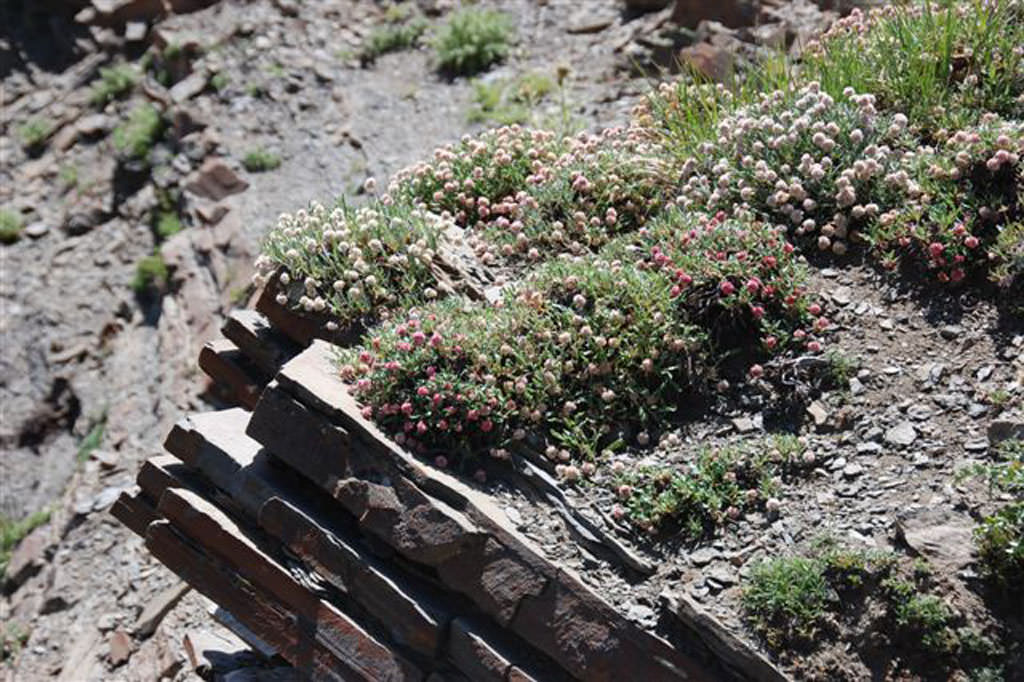
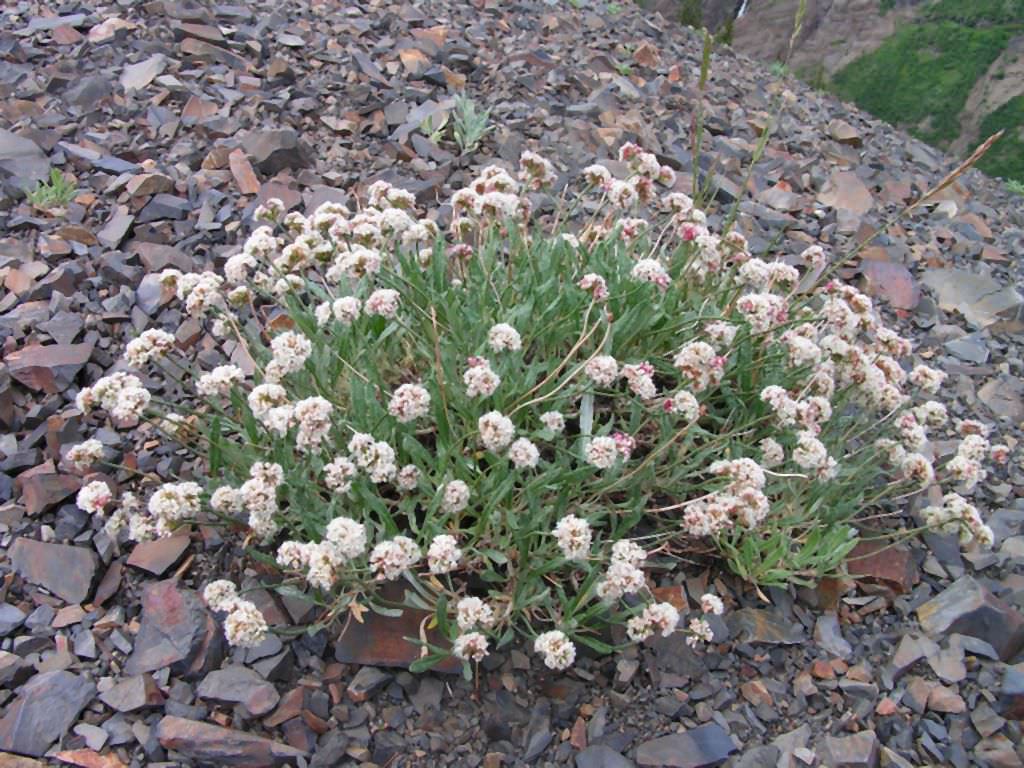
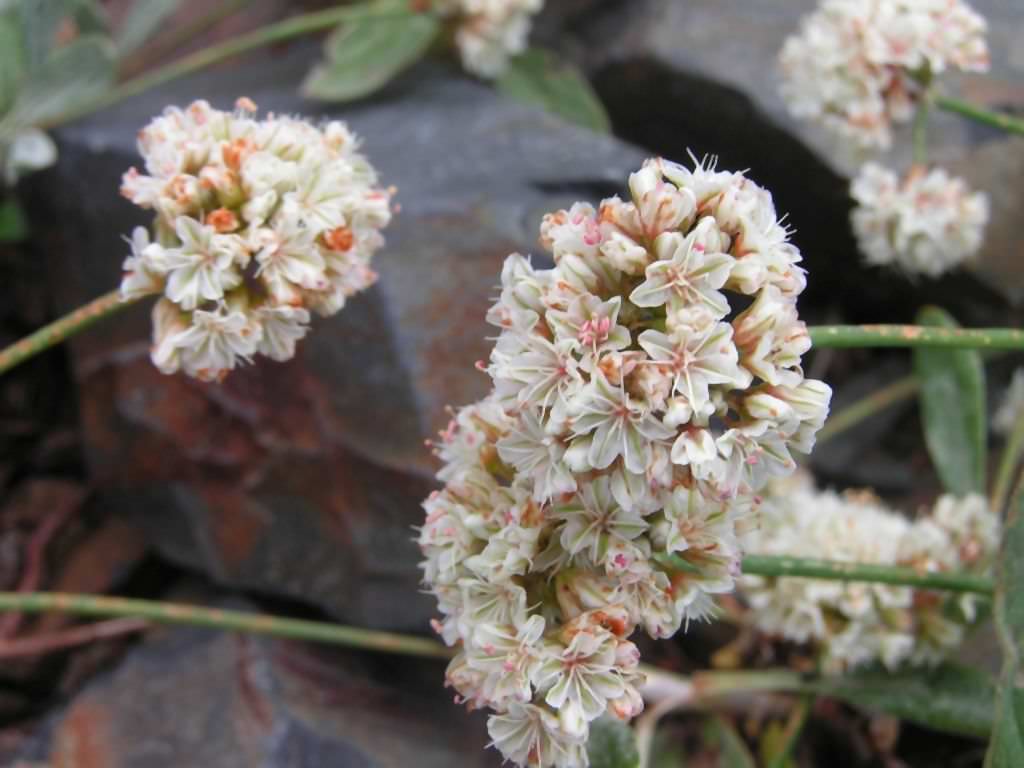
Densely matted perennial, 6-10 cm tall, and with numerous underground caudices. Flowering stems are glabrous, scapose, bearing 3-4 involucres per head. Flowers white to pinkish, 2.5-3.5 mm long, stamens exserted. Peduncles are absent. Leaves are narrowly oblanceolate or lanceolate, 3-9 mm wide, green above, tomentose below, and leaf margins are slightly rolled under, or flat (Spackman et al. 1997, Ackerfield 2012, Weber and Wittmann 2012).
Look Alikes:
Could be confused with Eriogonum lonchophyllum, which is typically found at lower elevations, has relatively longer flowering stems, and multiple flowering heads per stem (personal communication, Dr. C. F. Rick Williams, Department of Biological Sciences, Idaho State University, Pocatello.
Phenology:
Eriogonum coloradense flowers from July to August and bears fruit into September. Plants are green and visible through September (Anderson 2004).
Habitat
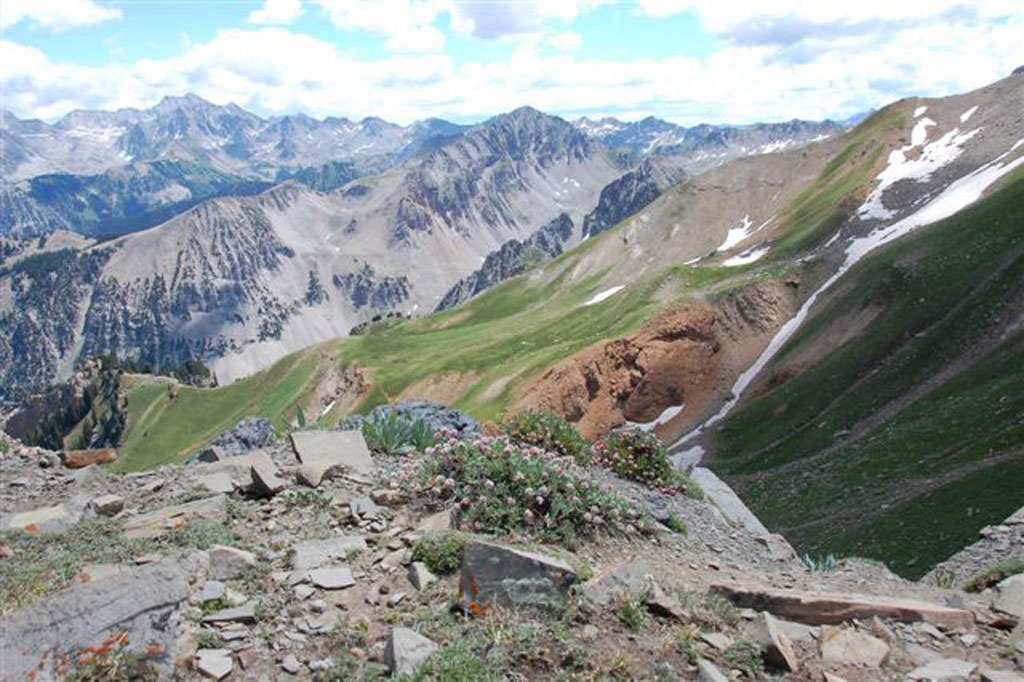
Eriogonum coloradense is unusual in that while it is endemic to the central Rocky mountains of Colorado, it has a wide tolerance of environmental conditions. It has been documented in association with a variety of soil textures, slopes, and aspects, and can be found on sedimentary, granitic, and volcanic substrates. It may grow with Artemisia species (sagebrush) and Bouteloua gracilis (Blue Grama) as well as with alpine cushion plants. It occurs on a variety of geomorphic landforms, usually on talus, fellfields, rock shoots, and ridges, but also on roadsides. Reveal (personal communication 2002) described the habitat as rocky talus on the margins of meadows, grassland communities, high elevation sagebrush, sometimes with montane or subalpine conifers, and on sandy to gravelly flats and slopes. The best information currently available on E. coloradense is from high elevation sites. More work is needed to better understand the specific habitat requirements of E. coloradense at lower elevations throughout its range (Anderson 2004).
click on image to enlarge
 |
Elevation Range:
8,714 - 13,597 feet (2,656 - 4,144 meters)
Distribution
Colorado Endemic:
Yes
Range:
Eriogonum coloradense is endemic to Colorado, USA; it is known from Chaffee, Gunnison, Park, Pitkin, and Saguache counties. Estimated range extent in Colorado of 10,162 square kilometers was calculated in GeoCAT using occurrence data provided by the Colorado Natural Heritage Program (2022).
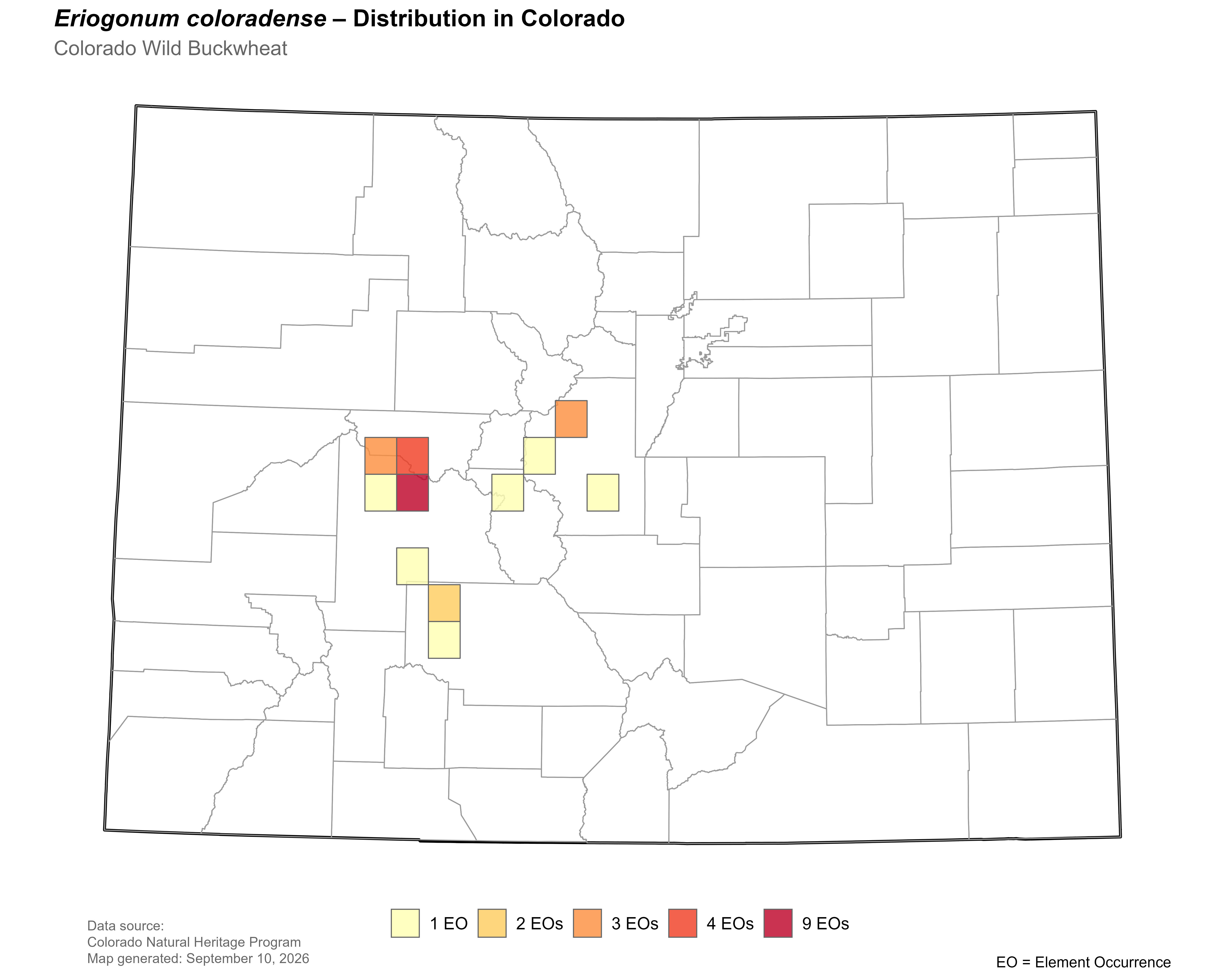
Click on map to enlarge |
Threats and Management Issues
Both motorized and non motorized recreational uses are considered to be the primary threat to Eriogonum coloradense (Anderson 2004, Rondeau et al. 2011, Handwerk et al. 2015). However, 60% of the occurrences provide no information on condition of the sites and threats may be under reported. Trampling of plants and habitat disturbances have been reported from nearly one third of the occurrences. At three locations the species is reported to be threatened by livestock grazing and its secondary effects of soil compaction, and alteration of vegetation composition and structure. This species is considered to have moderate adaptive capacity and is expected to be slightly vulnerable to climate change under both RCP 4.5 and 8.5 scenarios, as assessed for the 2025 Colorado State Wildlife Action Plan (CNHP 2025).
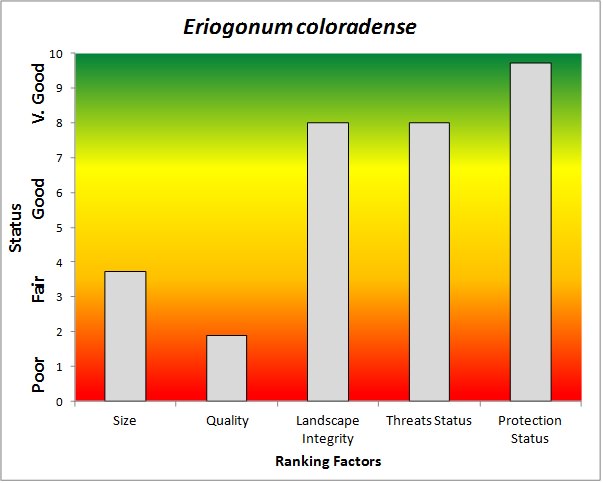
Summary results of an analysis of the status of Eriogonum coloradense based on several ranking factors. This species was concluded to be effectively conserved. From Rondeau et al. 2011. |
References
- Ackerfield, J. 2015. Flora of Colorado. BRIT Press, Botanical Research Institute of Texas, Fort Worth, TX. 818 pp.
- Anderson, D.G. (2004, October 14). Eriogonum coloradense Small (Colorado buckwheat): a technical conservation assessment. [Online]. USDA Forest Service, Rocky Mountain Region. Available: http://www.fs.fed.us/r2/projects/scp/assessments/eriogonumcoloradense.pdf [March 2006].
- Colorado Natural Heritage Program (CNHP). 2022. Biodiversity Tracking and Conservation System (Biotics 5). Colorado Natural Heritage Program, Colorado State University, Fort Collins.
- Colorado Natural Heritage Program (CNHP). 2025. Climate Change Vulnerability Assessment of Colorado Tier 1 and Tier 2 Plant Species of Greatest Conservation Need (SCGN) for the 2025 Colorado State Wildlife Action Plan. Colorado Natural Heritage Program, Colorado State University, Fort Collins, CO.
- Handwerk, J., L. Grunau, and S. Panjabi. 2015. Colorado Wildlife Action Plan: 2015 Rare Plant Addendum. Colorado Natural Heritage Program, Colorado State University, Fort Collins, Colorado, USA.
- Harrington, H. D. 1954. Manual of the Plants of Colorado. Sage Books, Denver, CO. 666 pp.
- Neely, B., S. Panjabi, E. Lane, P. Lewis, C. Dawson, A. Kratz, B. Kurzel, T. Hogan, J. Handwerk, S. Krishnan, J. Neale, and N. Ripley. 2009. Colorado Rare Plant Conservation Strategy, Developed by the Colorado Rare Plant conservation Initiative. The Nature Conservancy, Boulder, Colorado, 117 pp.
- Rondeau, R., K. Decker, J. Handwerk, J. Siemers, L. Grunau, and C. Pague. 2011. The state of Colorado's biodiversity 2011. Prepared for The Nature Conservancy. Colorado Natural Heritage Program, Colorado State University, Fort Collins, Colorado.
- Spackman, S., B. Jennings, J. Coles, C. Dawson, M. Minton, A. Kratz, and C. Spurrier. 1997. Colorado rare plant field guide. Prepared for Bureau of Land Management, U.S. Forest Service and U.S. Fish and Wildlife Service by Colorado Natural Heritage Program.
- USDA, NRCS. 2022. The PLANTS Database. National Plant Data Team, Greensboro, NC 27401-4901 USA.
- Weber, W. A. and R. C. Wittmann. 2012. Colorado Flora, Eastern Slope, A Field Guide to the Vascular Plants, Fourth Edition. Boulder, Colorado. 555 pp.
- Weber, W. A. and R. C. Wittmann. 2012. Colorado Flora, Western Slope, A Field Guide to the Vascular Plants, Fourth Edition. Boulder, Colorado. 532 pp.