

Scientific Name : Eriogonum clavellatum
Author : Small NatureServe Explorer
Common Name : Comb Wash Buckwheat
 Current Research Activities
☰ Click link below for details.
Taxonomy
Polygonaceae (buckwheat family)
This is the record for Eriogonum clavellatum in the narrow sense (not including Eriogonum pelinophilum) following Flora of North America Editorial Committee (2005), Kartesz (1994), and Ackerfield (2015, 2022).
Ranks and Status
State Rank : S1
State Rank Reason : Eriogonum clavellatum is known only from a narrow range in the Four Corners region of southwest Colorado, USA. The majority of occurrences are ranked as historical. The primary threat to the species is thought to be oil and gas development. This species is also considered vulnerable to the effects of climate change.
U.S. Endangered Species Act : none
Colorado Threatened and Endangered List : none
Other Statuses : SWAP SGIN
Description and Phenology
General Description:
Subshrubs, spreading, not scapose, 1-2.5 Ã 3-8 dm, thinly floccose or glabrous, greenish to grayish. Stems spreading, with-out persistent leaf bases, up to 1/ 3 height of plant; caudex stems compact; aerial flowering stems spreading to erect, slender, solid, not fistulose, 0.06-0.2(-2.5) dm, thinly floccose or glabrous. Leaves cauline, 1 per node or fasciculate; petiole 0.05-0.1 cm, tomentose to floccose, rarely glabrous; blade oblanceolate, 1-1.5(-2) Ã 0.08-0.2 cm, densely white-tomentose abaxially, thinly tomentose and grayish or rarely glabrous and green adaxially, margins tightly revolute. Inflorescences umbellate to cymose, compact, 0.5-2 Ã 1-2 cm; branches dichotomous, thinly floccose or glabrous; bracts 3, scalelike, triangular, 1.5-2.5(-3) mm. Peduncles erect, 0.15-0.8 cm, glabrous. Involucres 1 per node, turbinate-campanulate, (3-)3.5-4.5(-5) Ã 2.5-4.5 mm, glabrous; teeth 5, erect, 0.6-0.9(-1.1) mm. Flowers (2.5-)3-3.5 mm; perianth white, glabrous; tepals connate proximal 4- 3, dimorphic, those of outer whorl broadly obovate to nearly fan-shaped, 2-2.5 mm wide, those of inner whorl slightly shorter and oblanceolate to spatulate, 0.9-1.5 mm wide; stamens long-exserted, 3-6 mm; filaments sparsely pilose proximally. Achenes light brown, 3-3.5 mm, glabrous (Flora of North America 1993+).
Look Alikes:
Closely related to Eriogonum bicolor (Welsh 1978) and E. pelinophilum.
Phenology:
Flowering May-June (Colorado Natural Heritage Program 2012).
Habitat
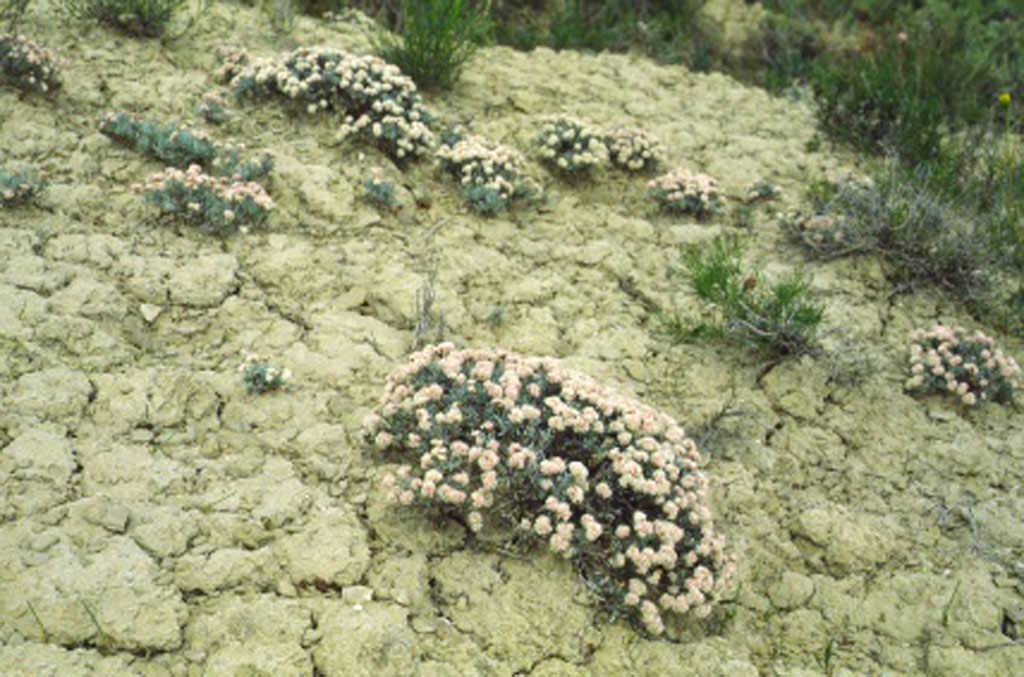
Eriogonum clavellatum occurs on clay or shale slopes (Ackerfield 2022). It is found in sandy to heavy clay washes and slopes, and in saltbush communities (Flora of North America Editorial Committee 2005). This species is found in fine textured soils, sandy silt to clay silt. Dominant plant communities are shadscale and blackbrush associations (Welsh 1978). Associated taxa include Atriplex confertifolia, Coleogyne ramosissma, Astragalus cronquistii, Artemisia spinescens, Stanleya pinnata, Oryzopsis hymenoides, Krascheninnikovia lanata, Chrysothamnus greenei, Sporobolus flexuosus, Sphaeralcea sp., Gutierrezia sarothrae, Hilaria jamesii, Opuntia (CNHP 2023).
click on image to enlarge
Elevation Range:
4,799 - 5,793 feet (1,463 - 1,766 meters)
Distribution
Colorado Endemic:
No
Range:
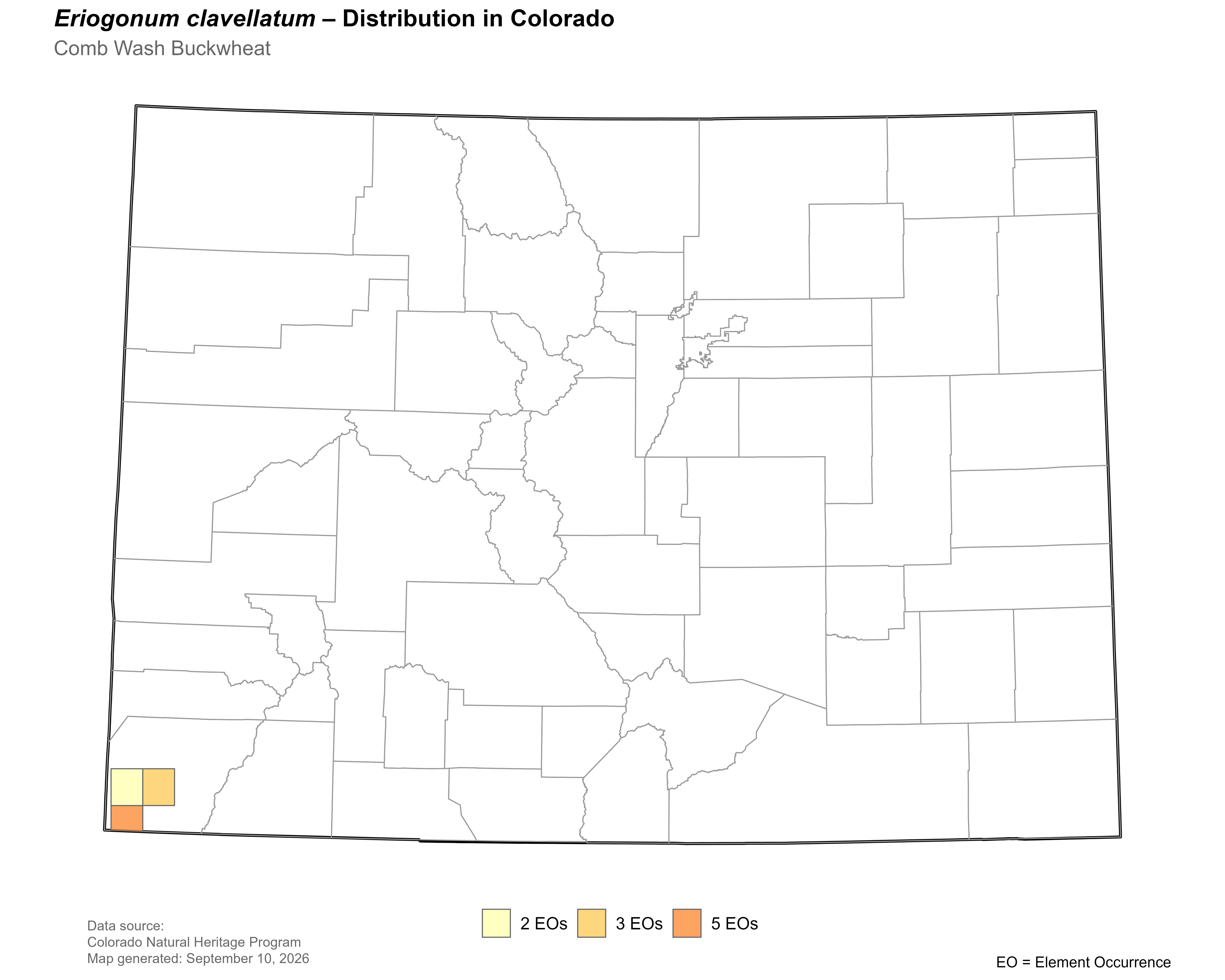
Eriogonum clavellatum is known from Montezuma County in Colorado, USA. Estimated range extent in Colorado of 250 square kilometers was calculated in GeoCAT using occurrence data provided by the Colorado Natural Heritage Program (2023). This species can also be found in New Mexico and Utah, USA.
Click on map to enlarge |
Threats and Management Issues
The primary threat at this time is considered to be oil and gas development (Rondeau et al. 2011). It is not known if all of the occurrences are or are not threatened by these activities. In Colorado, Eriogonum clavellatum is known from Tribal Lands in the southwestern corner of Montezuma County. The area has high potential for oil and gas development (BLM 1998). Populations are also threatened by road construction and gas exploration and by an impending system of canals (O'Kane 1988). This species is considered vulnerable to the effects of climate change (Handwerk et al. 2015).
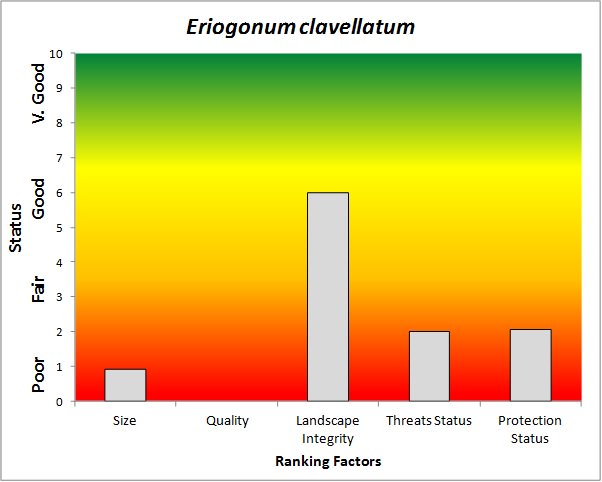
Summary results of an analysis of the status of Eriogonum clavellatum based on several ranking factors. This species was concluded to be Under Conserved. From Rondeau et al. 2011. |
References
- Ackerfield, J. 2015. Flora of Colorado. BRIT Press, Botanical Research Institute of Texas, Fort Worth, TX. 818 pp.
- Colorado Natural Heritage Program (CNHP). 2023. Biodiversity Tracking and Conservation System (Biotics 5). Colorado Natural Heritage Program, Colorado State University, Fort Collins.
- Elliott, B. A., S. Spackman Panjabi, B. Kurzel, B. Neely, R. Rondeau, M. Ewing. 2009. Recommended Best Management Practices for Plants of Concern. Practices developed to reduce the impacts of oil and gas development activities to plants of concern. Unpublished report prepared by the Rare Plant Conservation Initiative for the National Fish and Wildlife Foundation.
- Flora of North America Editorial Committee (FNA). 2005. Flora of North America north of Mexico. Vol. 5. Magnoliophyta: Caryophyllidae: Caryophyllales, Polygonales, and Plumbaginales. Oxford Univ. Press, New York. vii + 656 pp.
- Flora of North America Editorial Committee, ed. (FNA). 1993+. Flora of North America North of Mexico. Oxford Univ. Press, New York, Oxford.
- Handwerk, J., L. Grunau, and S. Panjabi. 2015. Colorado Wildlife Action Plan: 2015 Rare Plant Addendum. Colorado Natural Heritage Program, Colorado State University, Fort Collins, Colorado, USA.
- Heil, K.D., S.L. O'Kane Jr., L.M. Reeves, and A. Clifford, 2013. Flora of the Four Corners Region, Vascular Plants of the San Juan River Drainage; Arizona, Colorado, New Mexico, and Utah. Missouri Botanical Garden Press, St. Louis, Missouri. 1098 pp.
- Heil, K.D., S.L. O'Kane, Jr., and A. Clifford. 2002. Additions to the Flora of New Mexico from the San Juan Basin Flora Project. New Mexico Botanist 24: 1-4. [https://floraneomexicana.files.wordpress.com/2014/08/24.pdf]
- Lavender, A.E., M.M. Fink, S.E. Linn, D.M. Theobald. 2011. Colorado Ownership, Management, and Protection v9 Database. Colorado Natural Heritage Program and Geospatial Centroid, Colorado State University, Fort Collins, CO. (30 September).
- Neely, B., S. Panjabi, E. Lane, P. Lewis, C. Dawson, A. Kratz, B. Kurzel, T. Hogan, J. Handwerk, S. Krishnan, J. Neale, and N. Ripley. 2009. Colorado Rare Plant Conservation Strategy, Developed by the Colorado Rare Plant conservation Initiative. The Nature Conservancy, Boulder, Colorado, 117 pp.
- O'Kane, S. L. 1988. Colorado's Rare Flora. Great Basin Naturalist. 48(4):434-484.
- Reveal, J.L. 1969. A revision of the genus Eriogonum (Polygonacae). Unpublished dissertation, Brigham Young University, Provo, UT.
- Rondeau, R., K. Decker, J. Handwerk, J. Siemers, L. Grunau, and C. Pague. 2011. The state of Colorado's biodiversity 2011. Prepared for The Nature Conservancy. Colorado Natural Heritage Program, Colorado State University, Fort Collins, Colorado.
- Southwest Environmental Information Network (SEINet). 2022. Collections Databases. Online. Available: https://swbiodiversity.org/seinet/collections/index.php (accessed 2022).
- USDA, NRCS. 2022. The PLANTS Database. National Plant Data Team, Greensboro, NC 27401-4901 USA.
- Weber, W. A. and R. C. Wittmann. 2012. Colorado Flora, Western Slope, A Field Guide to the Vascular Plants, Fourth Edition. Boulder, Colorado. 532 pp.
- Welsh, S.L. 1978. Status Report: Erigonum clavellatum. Unpublished manuscript.
- Welsh, S.L., N.D. Atwood, S. Goodrich, and L.C. Higgins. (Eds). 2015. A Utah flora, fifth edition, revised 2015. Monte L. Bean Life Science Museum, Provo, Utah. 987 pp.