

Scientific Name : Erigeron wilkenii
Author : O'Kane NatureServe Explorer
Common Name : Wilken Fleabane
 Current Research Activities
 1997 profile
☰ Click link below for details.
Taxonomy
Asteraceae (sunflower family)
This species is included within the more widely distributed Erigeron nematophyllus in the Flora of Colorado (Ackerfield 2015, 2022). Erigeron wilkenii is recognized as a Colorado endemic in the Flora of North America (2006).
Ranks and Status
State Rank : S1
State Rank Reason : Erigeron wilkenii is only known from small populations within Dinosaur National Monument in western Colorado (USA). Although potential habitat extends into Utah, this currently appears to be a Colorado endemic. There are no direct threats to the verified populations; however, this species is considered to be vulnerable to the effects of climate change.
U.S. Endangered Species Act : none
Colorado Threatened and Endangered List : none
Other Statuses : SWAP SGIN
Description and Phenology
General Description:
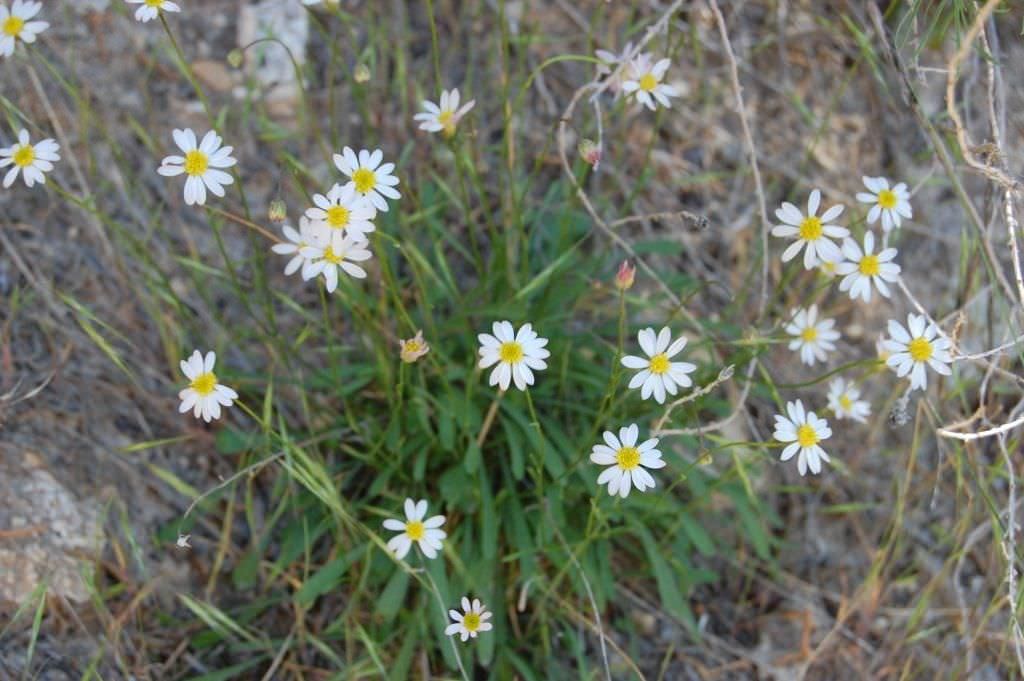
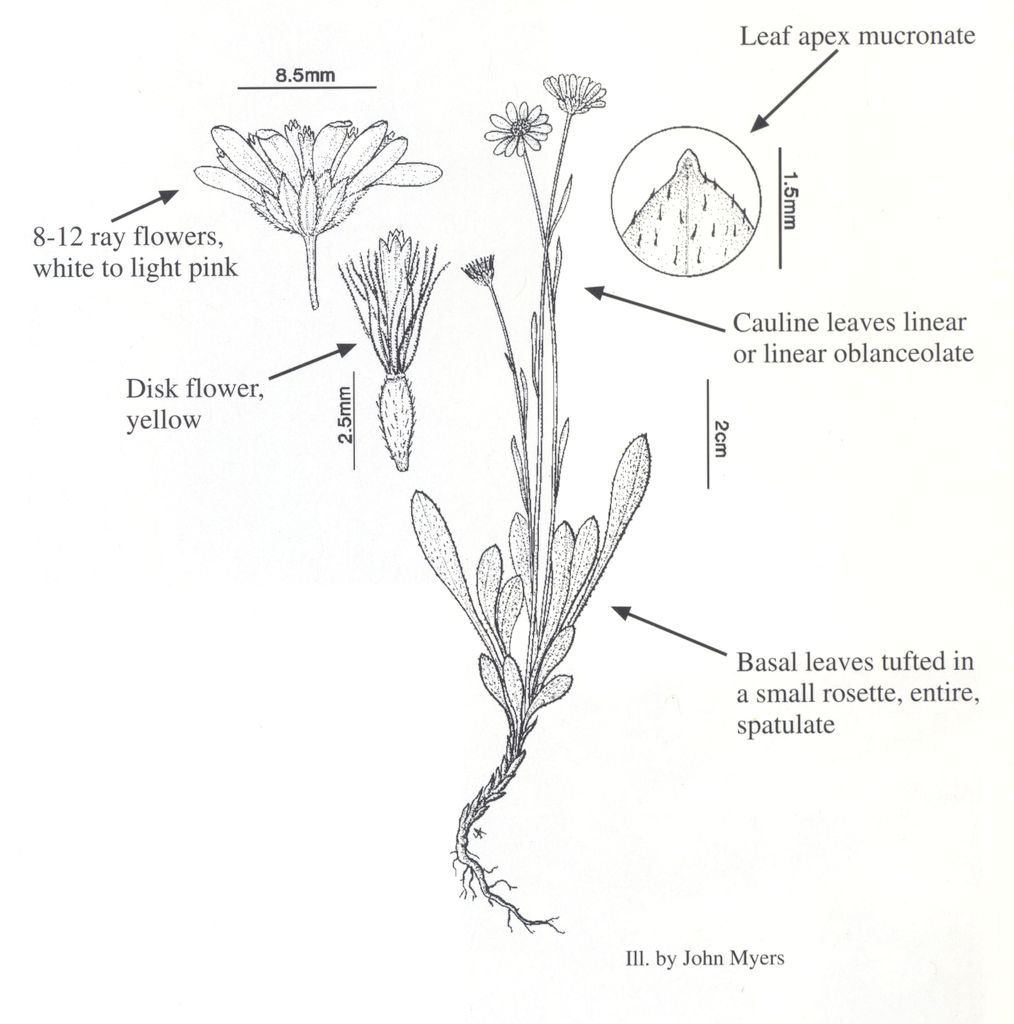
Perennials, 10â20 cm (occurring mostly singly); taprooted, caudices simple or branches relatively slender. Stems erect, sparsely strigillose (hairs white, stiff), eglandular. Leaves mostly basal (persistent); (gray-green) blades narrowly oblanceolate to subspatulate, 9â62 Ã 1â5 mm, cauline linear-bractlike (bases enlarged, purplish-membranous), margins entire, faces sparsely and closely strigose, eglandular. Heads 1. Involucres 3.4â4.6 Ã 6â8.5 mm. Phyllaries in 2â3 series, sparsely hirsute, minutely glandular. Ray florets (8â)11â12; corollas adaxially white, abaxially light pink, 4.5â6 mm, laminae not coiling or reflexing. Disc corollas 2.2â3.5 mm. Cypselae ca. 1.8 mm, 2-nerved, faces sparsely strigose; pappi: outer apparently 0, inner of (12â)20â30 bristles (Flora of North America 1993+).
Look Alikes:
Very close to Erigeron nematophyllus, but tends to have wider leaves (Spackman et al. 1997). It is possible that these are the same species with slight morphological differences resulting from specific growing sites.
Phenology:
Flowers late May through June, fruiting into August.
 |
Habitat
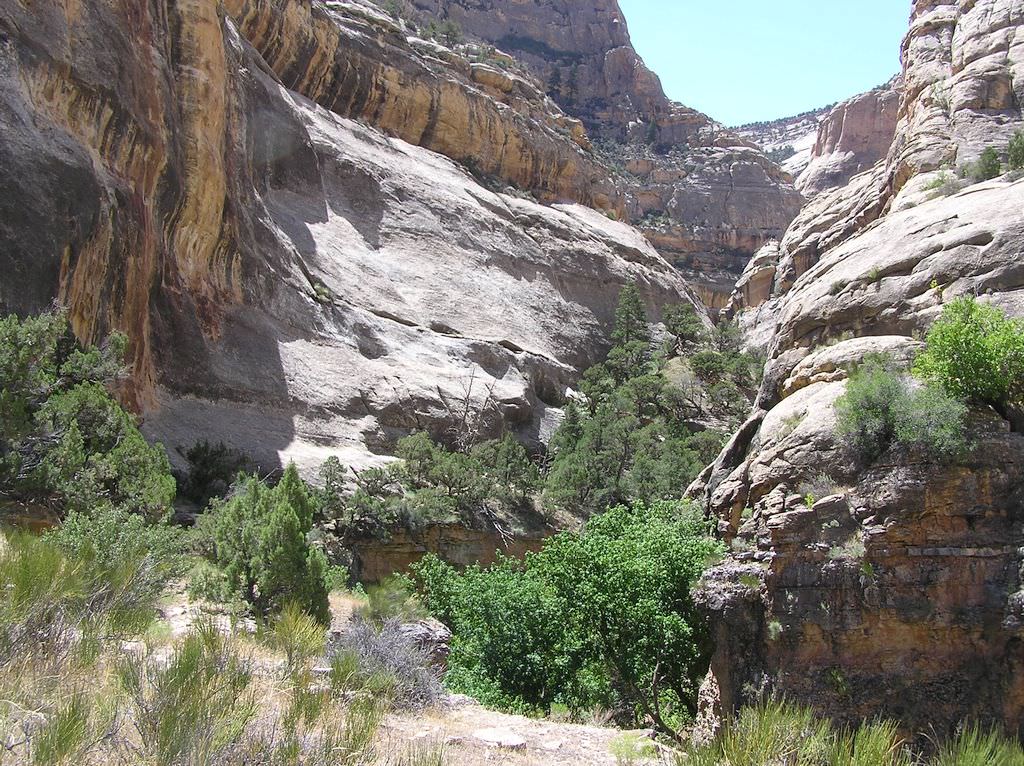
Occurs on soils that are derived from sandstone of the Weber Formation and are composed of sandy alluvium deposited by intermittent Pool Creek and colluvium from cliffs above. Also reported in association with Mississippian Limestone and the Weber-Morgan Formation. Often partially shaded by short statured trees of Pinus edulis and Juniperus osteosperma. Occurs in accumulated duff and often in mats of Selaginella densa (O'Kane 1990). Other associated species include Cercocarpus intricatus, Petrophyton caespitosum, Tetraneuris torreyana, Negundo aceroides, Rosa sp., Seriphidium sp., Phlox hoodii, Leuclene ericoides, Cirsium ownbeyi, Pseudotsuga menziesii, Gutierrezia sarothrae, Philadelphus microphyllus, Pseudoroegneria spicata, Achnatherum hymenoides, Brickellia microphylla, Arabis fernaldiana, Astragalus ceramicus, Phlox longifolia, Stipa comata, Agropyron dasystachyum, Ephedra viridis, Agropyron spicatum, Arabis vivariensis, Leptodactylon sp., and Poa fendleriana.
click on image to enlarge
 |
Elevation Range:
5,242 - 6,003 feet (1,598 - 1,830 meters)
Distribution
Colorado Endemic:
Yes
Range:
Erigeron wilkenii is thought to be endemic to Dinosaur National Monument in Moffat County, Colorado, USA. Estimated range extent in Colorado of 8 square kilometers was calculated in GeoCAT using occurrence data provided by the Colorado Natural Heritage Program (2022). However, there are additional reports pending verification which could slightly expand the range to the north outside of Dinosaur National Monument.
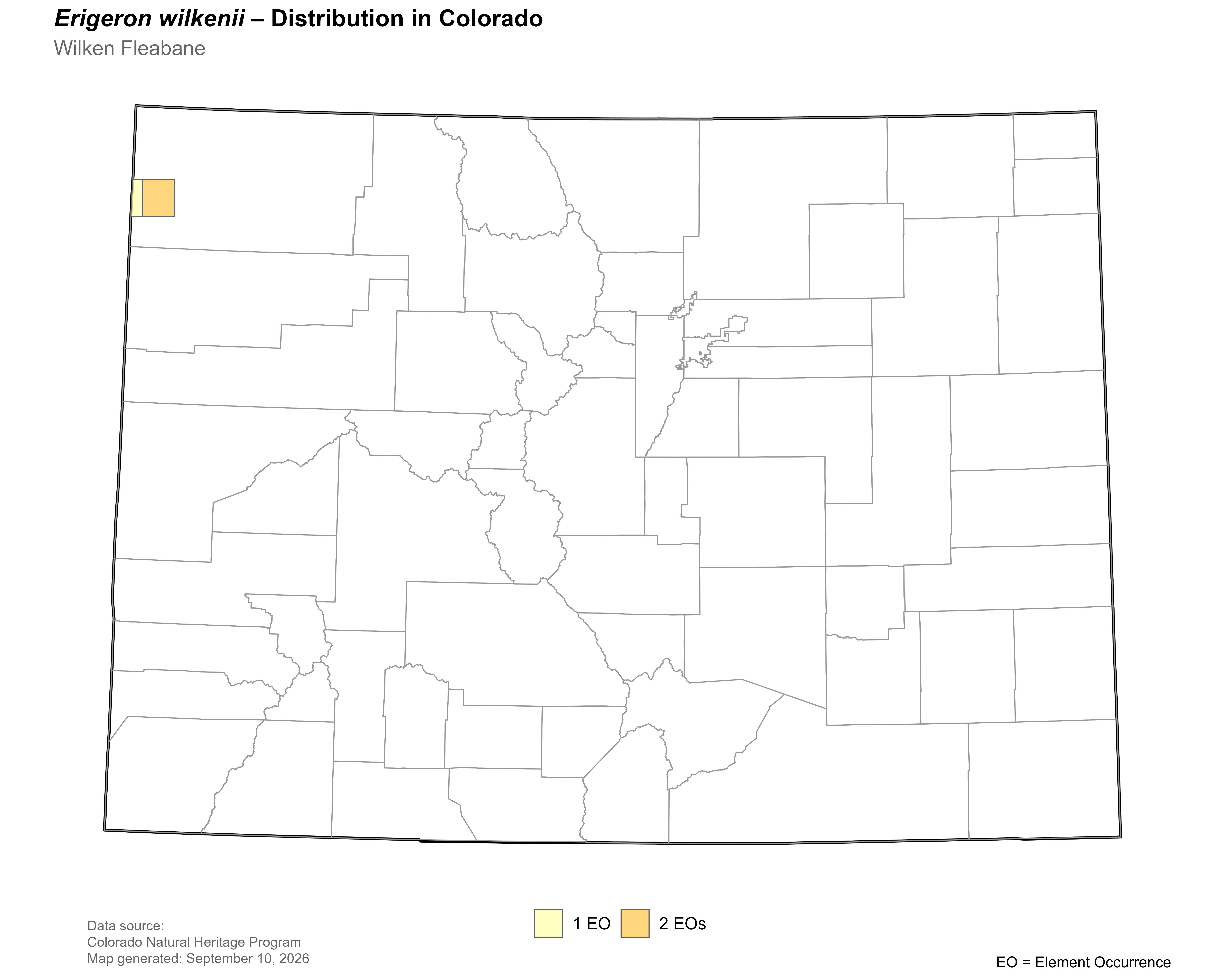
Click on map to enlarge |
Threats and Management Issues
There are no direct threats to the verified populations in Dinosaur National Monument; however, this species is considered to be extremely vulnerable to climate change (Handwerk et al. 2015).
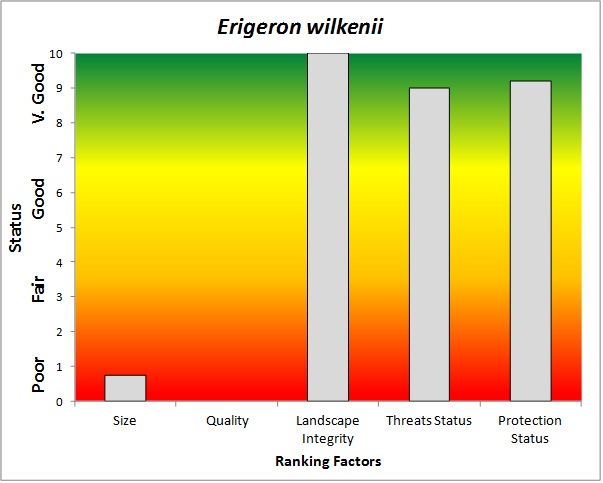
Summary results of an analysis of the status of Erigeron wilkenii based on several ranking factors. This species was concluded to be Moderately Conserved. From Rondeau et al. 2011. |
References
- Ackerfield, J. 2015. Flora of Colorado. BRIT Press, Botanical Research Institute of Texas, Fort Worth, TX. 818 pp.
- Ackerfield, Jennifer. 2022. Flora of Colorado. Second Edition. Bot. Misc. 60. BRIT Press, Fort Worth Botanic Garden/Botanical Research Institute of Texas, U.S.A. 861 pp.
- Colorado Natural Heritage Program (CNHP). 2022. Biodiversity Tracking and Conservation System (Biotics 5). Colorado Natural Heritage Program, Colorado State University, Fort Collins.
- Flora of North America Editorial Committee (FNA). 2006b. Flora of North America north of Mexico. Vol. 20. Magnoliophyta: Asteridae, part 7: Asteraceae, part 2. Oxford Univ. Press, New York. xxii + 666 pp.
- Flora of North America Editorial Committee, ed. (FNA). 1993+. Flora of North America North of Mexico. Oxford Univ. Press, New York, Oxford.
- Handwerk, J., L. Grunau, and S. Panjabi. 2015. Colorado Wildlife Action Plan: 2015 Rare Plant Addendum. Colorado Natural Heritage Program, Colorado State University, Fort Collins, Colorado, USA.
- Neely, B., S. Panjabi, E. Lane, P. Lewis, C. Dawson, A. Kratz, B. Kurzel, T. Hogan, J. Handwerk, S. Krishnan, J. Neale, and N. Ripley. 2009. Colorado Rare Plant Conservation Strategy, Developed by the Colorado Rare Plant conservation Initiative. The Nature Conservancy, Boulder, Colorado, 117 pp.
- O'Kane, S.L. 1990. A new species of Erigeron (Asteraceae: Asteraceae) from Colorado. Madrono 37 (3):184-189.
- Spackman, S., B. Jennings, J. Coles, C. Dawson, M. Minton, A. Kratz, and C. Spurrier. 1997. Colorado rare plant field guide. Prepared for Bureau of Land Management, U.S. Forest Service and U.S. Fish and Wildlife Service by Colorado Natural Heritage Program.
- USDA, NRCS. 2013. The PLANTS Database. National Plant Data Team, Greensboro, NC 27401-4901 USA.
- USDA, NRCS. 2022. The PLANTS Database. National Plant Data Team, Greensboro, NC 27401-4901 USA.
- Weber, W. A. and R. C. Wittmann. 2012. Colorado Flora, Western Slope, A Field Guide to the Vascular Plants, Fourth Edition. Boulder, Colorado. 532 pp.