


Scientific Name : Erigeron kachinensis
Author : Welsh & Moore NatureServe Explorer
Common Name : Kachina Daisy
 Current Research Activities
 1997 profile
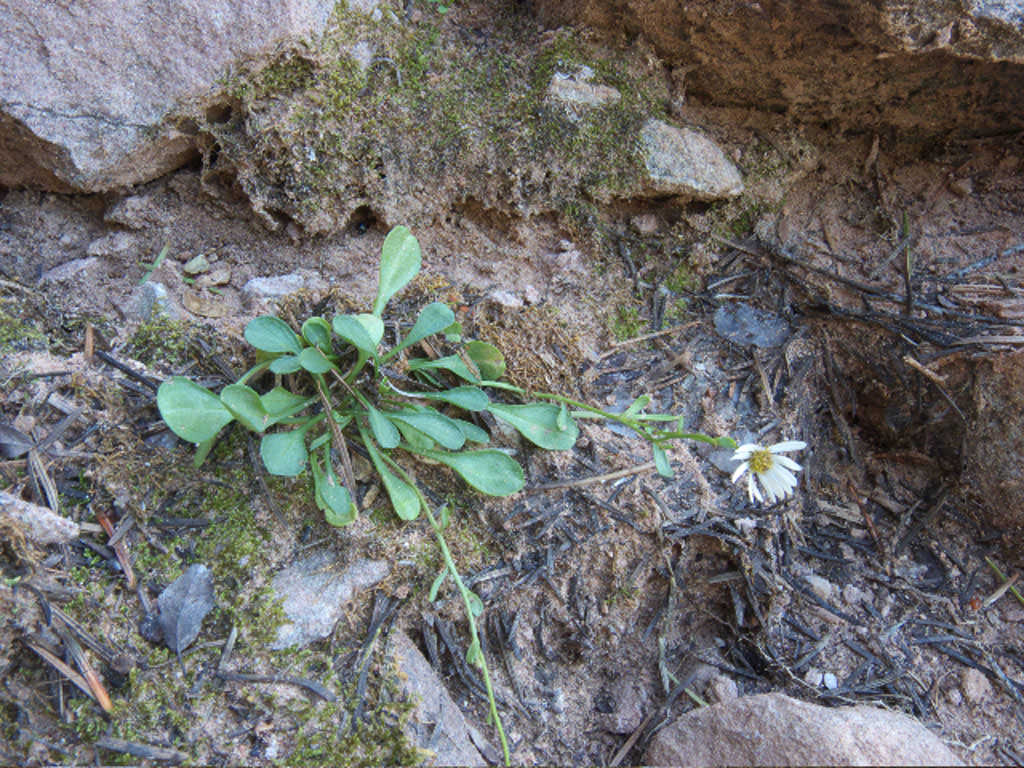
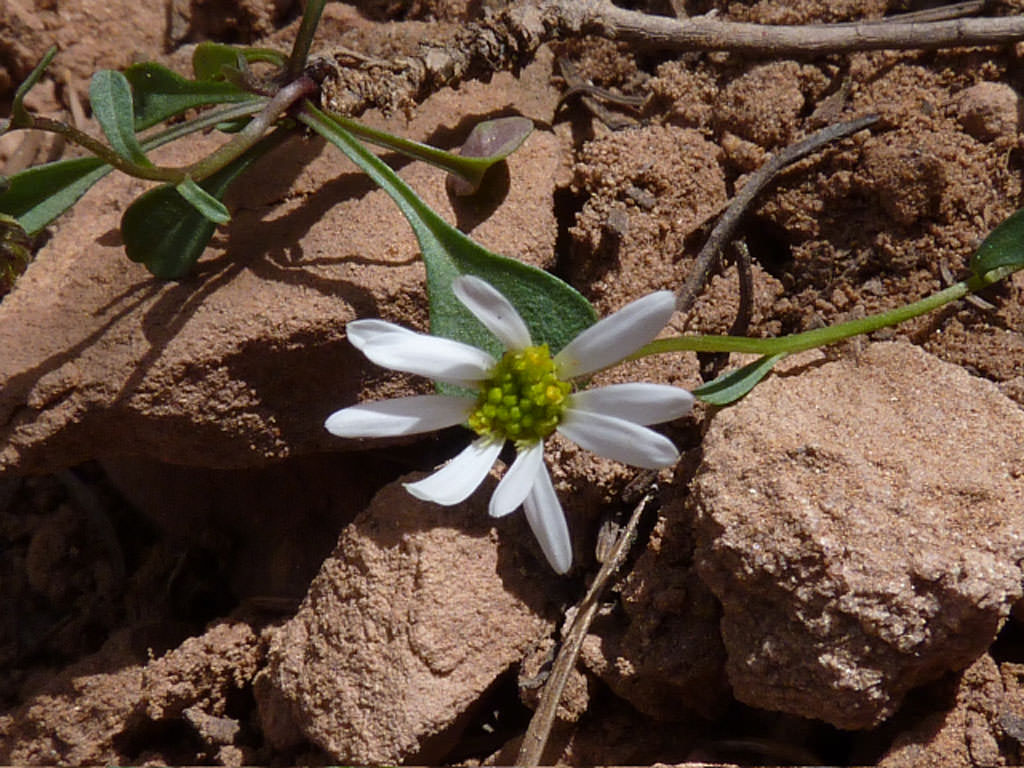


☰ Click link below for details.
Taxonomy
Asteraceae (sunflower family)
Genetic study has evaluated three potential races: typical hanging garden material (Natural Bridges National Monument, San Juan County, Utah), ecologically similar material from the Dolores River drainage (Montrose County, Colorado), and a high elevation (Elk Ridge, San Juan County, Utah) race that might possibly be recognized as a distinct variety (Allphin et al. 1996).
Ranks and Status
State Rank : S1
State Rank Reason : Erigeron kachinensis is known from 3 locations in southwest Colorado, USA; the species habitat provides some natural protection due to its inaccessibility but hydrologic alterations and the effects of climate change are a concern.
U.S. Endangered Species Act : none
Colorado Threatened and Endangered List : none
Other Statuses : BLM, SWAP Tier 2
Description and Phenology
General Description:
Perennial from branching caudex; glabrous; stems several, slender and lax, up to 2 dm long, simple or few-branched above the middle. Stolons form late in the season. Stems are 6-18 cm tall, usually amply leafy, spreading hirsute at least above. Basal leaves are well developed, spatulate, up to 6 cm long and 1.5 cm wide, and rounded at the tips; cauline leaves several but reduced. Flowering heads are 1-several, with yellow disk flowers and white to lavender or pinkish ray flowers (rays 10-25, 4-7 mm long, 1-2.5 mm wide). Involucres are 3-4.5 mm high, less than 8 mm wide, finely glandular or stipitate-glandular to glabrous, imbricate, and greenish. Achenes are inconspicuously 2-nerved; pappus of approximately 15 slender bristles (Spackman et al. 1997, Weber and Wittmann 2012, Culver and Lemly 2013).
Look Alikes:
No other member of the Asteraceae grows in this uncommon habitat of canyon alcoves, seeps and springs (Culver and Lemly 2013).
Phenology:
Flowering occurs in May-August (Colorado Natural Heritage Program 2013). The plants often bloom twice during the year, once in the spring, and again in late summer (Colorado Native Plant Society 1997).
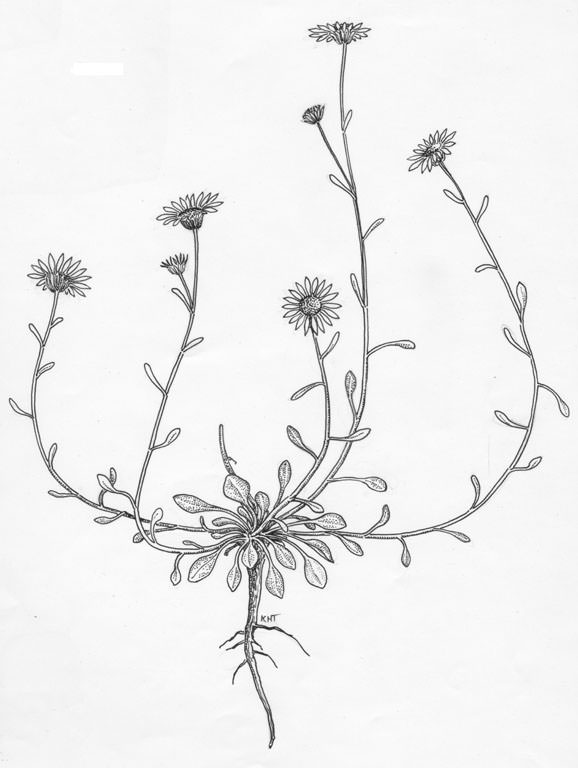 | 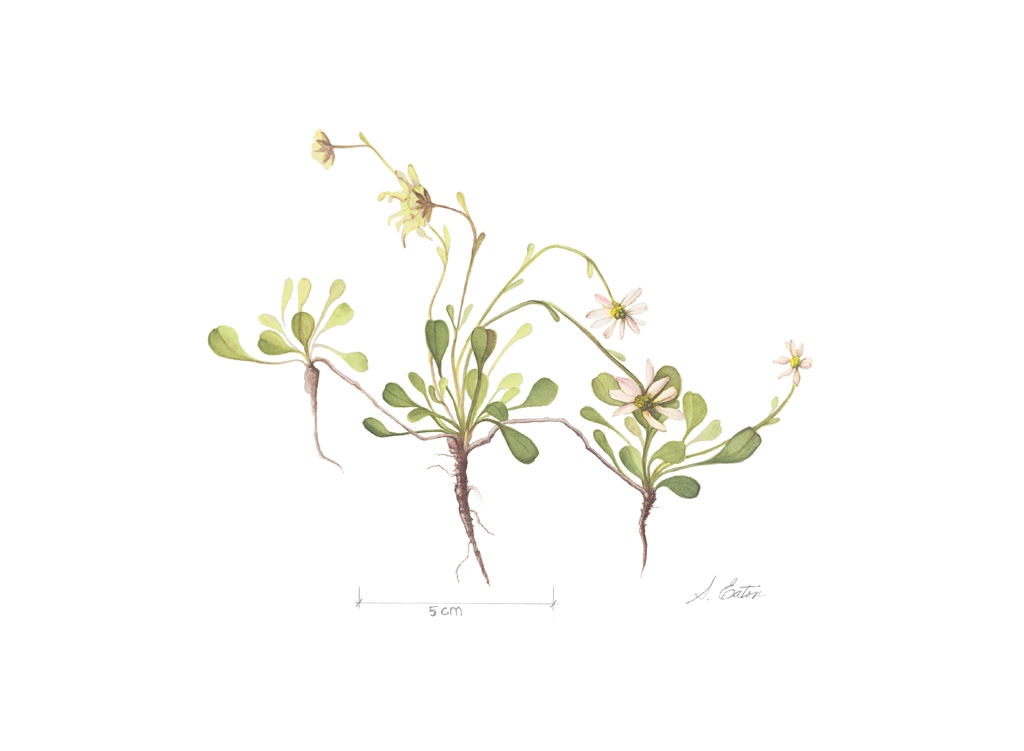 |
Habitat
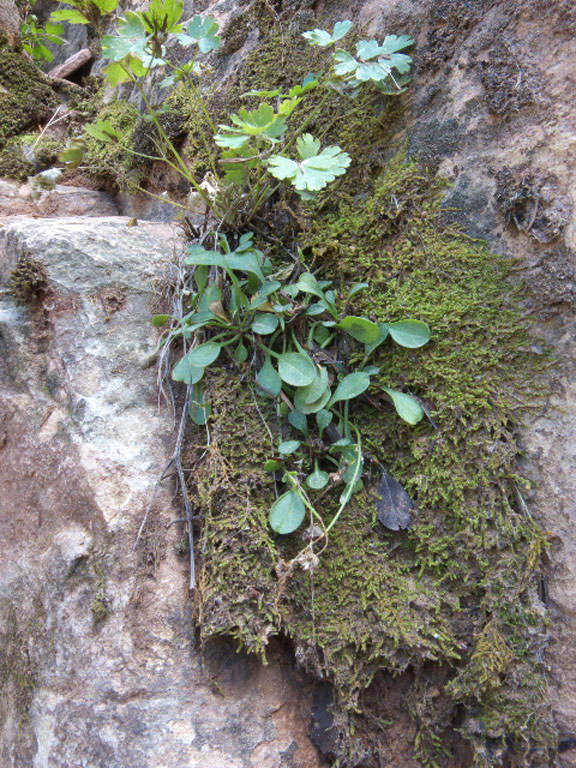
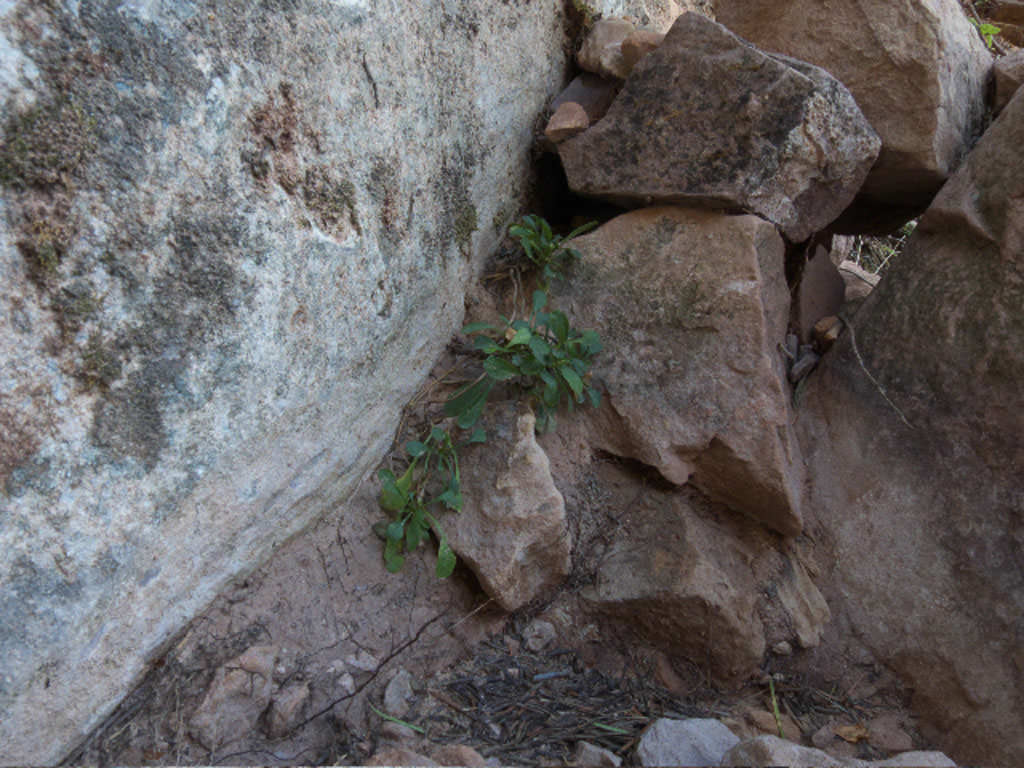
Occurs in wet, saline soils in alcoves, seeps, and hanging gardens on sandstone cliffs and canyon walls (Allphin 1991, Spackman et al. 1997, Ackerfield 2012, Culver and Lemly 2013). Associated species include Epipactis gigantea, Aquilegia micrantha, Mimulus eastwoodiae, and Calamagrostis. Surronding plant communitities include Pinyon-juniper, Fraxinus, and Salix (Colorado Natural Heritage Program 2013).
click on image to enlarge
 |
 |
Elevation Range:
5,046 - 6,654 feet (1,538 - 2,028 meters)
Distribution
Colorado Endemic:
No
Range:
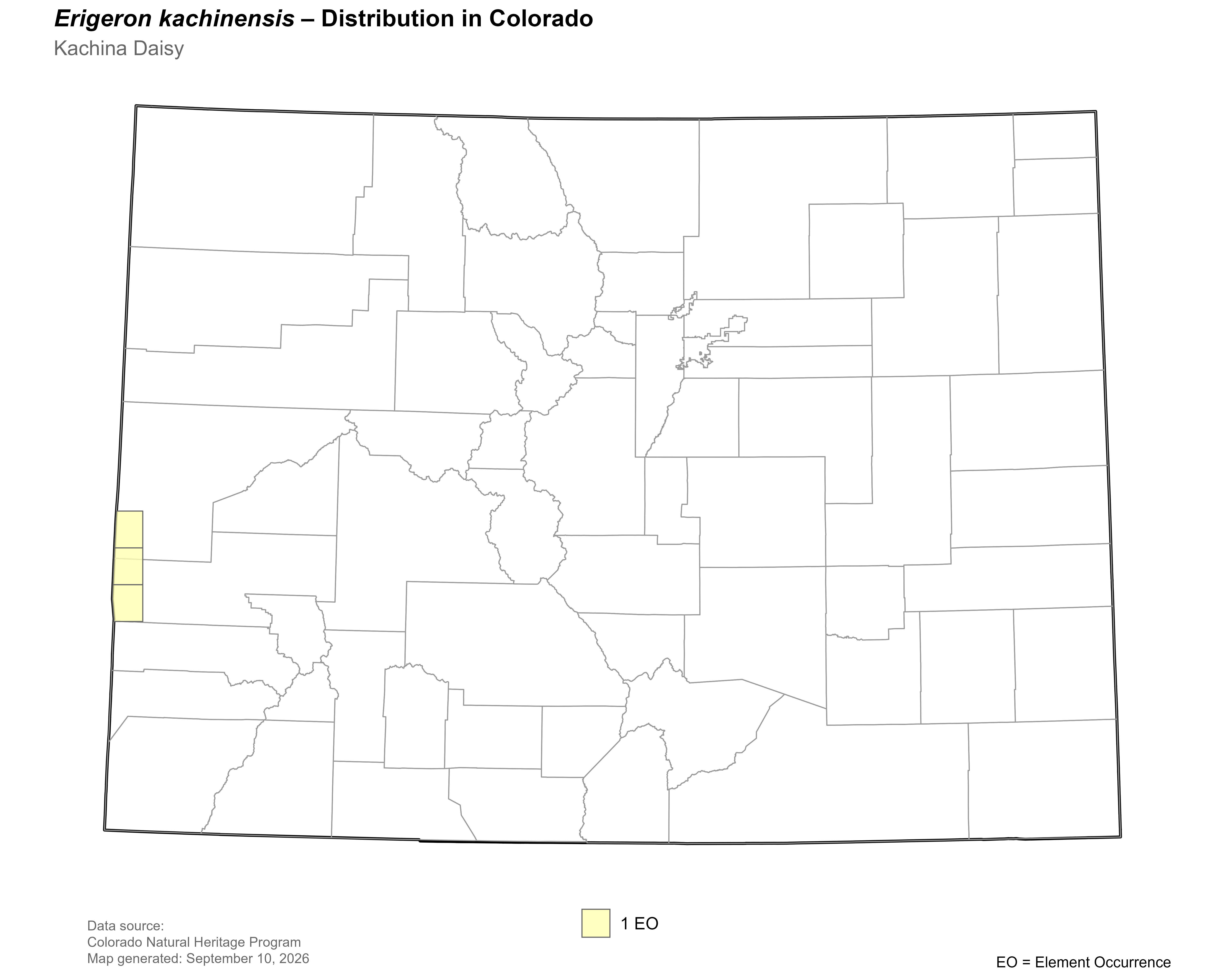
Erigeron kachinensis is known from Mesa and Montrose counties in Colorado, USA. Estimated range extent in Colorado of 244 square kilometers was calculated in GeoCAT using occurrence data provided by the Colorado Natural Heritage Program (2023). This species is also known from Utah, USA.
Click on map to enlarge |
Threats and Management Issues
The primary threat to this species is considered to be hydrologic alteration (Rondeau et al. 2011). Erigerion kachinensis occurs in alcoves at the base of the Wingate sandstone cliffs where water runs off and collects in seeps and springs. Diversion of the mesa top springs and streams to livestock tanks would disrupt this hydrologic system as would changes in hydrology of the mesa tops due to drought. One of the three occurrences is located by a spring that receives much foot traffic and the plants may be subject to trampling, the other sites are relatively inaccessible. This species is considered to have low adaptive capacity and is expected to be extremely vulnerable to climate change under both RCP 4.5 and 8.5 scenarios, as assessed for the 2025 Colorado State Wildlife Action Plan (CNHP 2025).
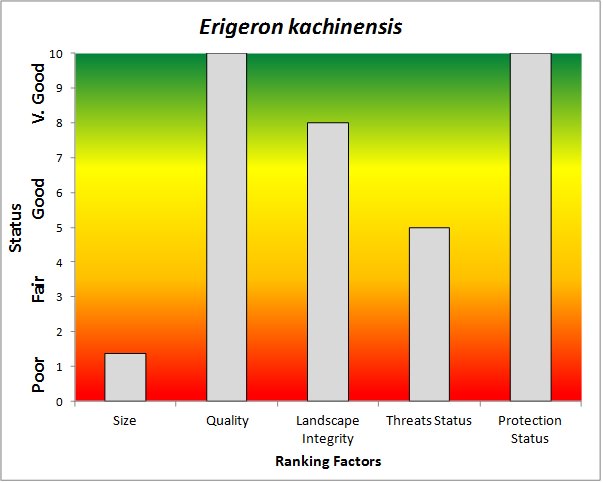
Summary results of an analysis of the status of Erigeron kachinensis based on several ranking factors. This species was concluded to be effectively conserved. From Rondeau et al. 2011. |
References
- Ackerfield, J. 2015. Flora of Colorado. BRIT Press, Botanical Research Institute of Texas, Fort Worth, TX. 818 pp.
- Allphin, L. 1994. Habitat requirements for Erigeron kachinensis, a rare endemic of the Colorado Plateau. Western North American Naturalist. Vol. 54, Issue 3, page 193.
- Allphin, L. and K. Harper. 1997. Demography and Life History Characteristics of the Rare Kachina Daisy (Erigeron kachinensis, Asteraceae). American Midland Naturalist, Vol. 138, No. 1, pp. 109-120.
- Allphin, L., D. Wiens, and K.T. Harper. 2002. The Relative Effects of Resources and Genetics on Reproductive Success in the Rare Kachina Daisy, Erigeron kachinensis (Asteraceae). International Journal of Plant Sciences, Vol. 163, No. 4, pp. 599-612.
- Atwood, D., J. Holland, R. Bolander, B. Frnaklin, D. E. House, L. Armstrong, K. Thorne, and L. England. 1991. Utah Threatened, Endangered, and Sensitive Plant Field Guide. US Forest Service Intermountain Region, National Park Service, Bureau of Land Management, Utah Natural Heritage Program, US Fish and Wildlife Service, Environmental Protection Agency, Navajo Nation, and Skull Valley Goshute Tribe.
- Colorado Native Plant Society. 1989. Rare plants of Colorado. Rocky Mountain Nature Association, Colorado Native Plant Society, Estes Park, Colorado. 73 pp.
- Colorado Natural Heritage Program (CNHP). 2023. Biodiversity Tracking and Conservation System (Biotics 5). Colorado Natural Heritage Program, Colorado State University, Fort Collins.
- Colorado Natural Heritage Program (CNHP). 2025. Climate Change Vulnerability Assessment of Colorado Tier 1 and Tier 2 Plant Species of Greatest Conservation Need (SCGN) for the 2025 Colorado State Wildlife Action Plan. Colorado Natural Heritage Program, Colorado State University, Fort Collins, CO.
- Cronquist, A. 1994. Asterales. In A. Cronquist, A.H. Holmgren, N.H. Holmgren, J.L. Reveal, and P.K. Holmgren. Intermountain flora: Vascular plants of the Intermountain West, U.S.A. Vol. 5. New York Botanical Garden, Bronx. 496 pp.
- Culver, D.R. and J.M. Lemly. 2013. Field Guide to Colorado's Wetland Plants; Identification, Ecology and Conservation. Colorado Natural Heritage Program, Colorado State University, Fort Collins, 694 pp.
- Flora of North America Editorial Committee, ed. (FNA). 1993+. Flora of North America North of Mexico. Oxford Univ. Press, New York, Oxford.
- Handwerk, J., L. Grunau, and S. Panjabi. 2015. Colorado Wildlife Action Plan: 2015 Rare Plant Addendum. Colorado Natural Heritage Program, Colorado State University, Fort Collins, Colorado, USA.
- Heil, K.D., S.L. O'Kane Jr., L.M. Reeves, and A. Clifford, 2013. Flora of the Four Corners Region, Vascular Plants of the San Juan River Drainage; Arizona, Colorado, New Mexico, and Utah. Missouri Botanical Garden Press, St. Louis, Missouri. 1098 pp.
- Neely, B., S. Panjabi, E. Lane, P. Lewis, C. Dawson, A. Kratz, B. Kurzel, T. Hogan, J. Handwerk, S. Krishnan, J. Neale, and N. Ripley. 2009. Colorado Rare Plant Conservation Strategy, Developed by the Colorado Rare Plant conservation Initiative. The Nature Conservancy, Boulder, Colorado, 117 pp.
- Rondeau, R., K. Decker, J. Handwerk, J. Siemers, L. Grunau, and C. Pague. 2011. The state of Colorado's biodiversity 2011. Prepared for The Nature Conservancy. Colorado Natural Heritage Program, Colorado State University, Fort Collins, Colorado.
- Spackman, S., B. Jennings, J. Coles, C. Dawson, M. Minton, A. Kratz, and C. Spurrier. 1997. Colorado rare plant field guide. Prepared for Bureau of Land Management, U.S. Forest Service and U.S. Fish and Wildlife Service by Colorado Natural Heritage Program.
- The Colorado Native Plant Society. 1997. Rare Plants of Colorado, second edition. Falcon Press Publishing Co.,Inc. Helena, Montana. 105pp.
- USDA, NRCS. 2022. The PLANTS Database. National Plant Data Team, Greensboro, NC 27401-4901 USA.
- Utah Native Plant Society. 2003-2013. Utah rare plant guide. A.J. Frates editor/coordinator. Salt Lake City, UT. Utah Native Plant Society. Online. Available: http://www.utahrareplants.org (accessed 2013).
- Weber, W. A. and R. C. Wittmann. 2012. Colorado Flora, Western Slope, A Field Guide to the Vascular Plants, Fourth Edition. Boulder, Colorado. 532 pp.
- Welsh, S.L. 1979. Illustrated manual of proposed endangered and threatened plants of Utah. Brigham Young Univ., Provo, UT. 318 pp.
- Welsh, S.L., N.D. Atwood, S. Goodrich and L.C. Higgins. (Eds.) 2008. A Utah Flora. 4th edition, revised. Brigham Young University, Provo, Utah, U.S.A. 1019 pp.


