


Scientific Name : Draba smithii
Author : Gilg ex O.E. Schulz NatureServe Explorer
Common Name : Smith Whitlow- grass
 Current Research Activities
 1997 profile


☰ Click link below for details.
Taxonomy
Brassicaceae (mustard family)
Ranks and Status
State Rank : S3
State Rank Reason : Draba smithii is known from approximately 30 occurrences in the mountains of southern Colorado, and from one occurrence in New Mexico, USA. About half of the occurrences are thought to be of good viability. The primary threats to D. smithii are trampling by hikers, habitat disturbance from road maintenance and the effects of climate change.
U.S. Endangered Species Act : none
Colorado Threatened and Endangered List : none
Other Statuses : SWAP Tier 2, USFS, USFS RGNF
Description and Phenology
General Description:
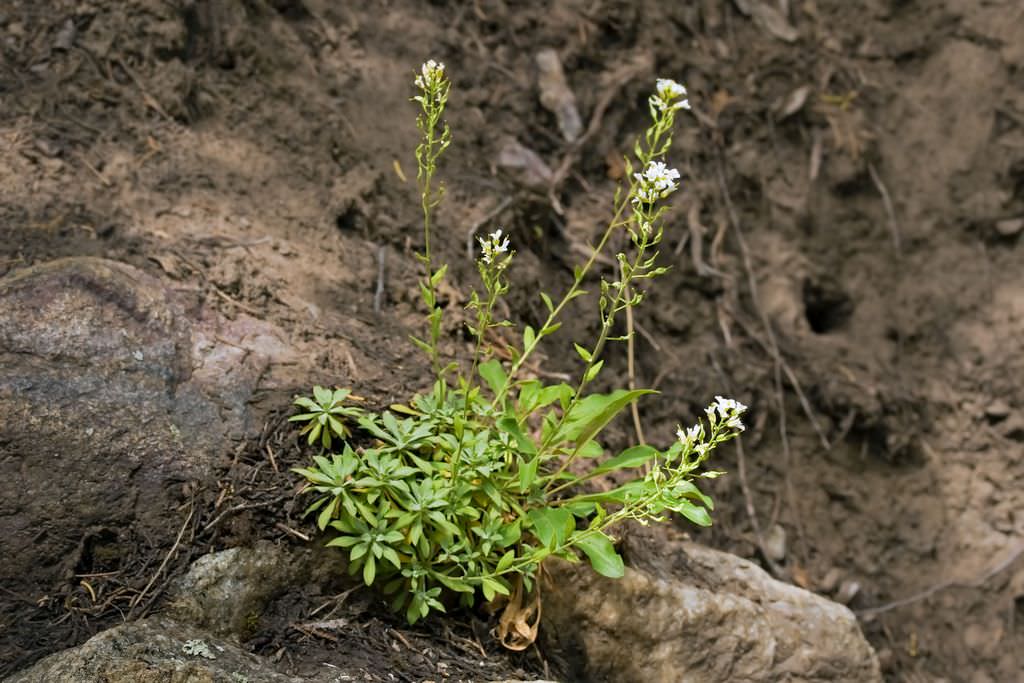
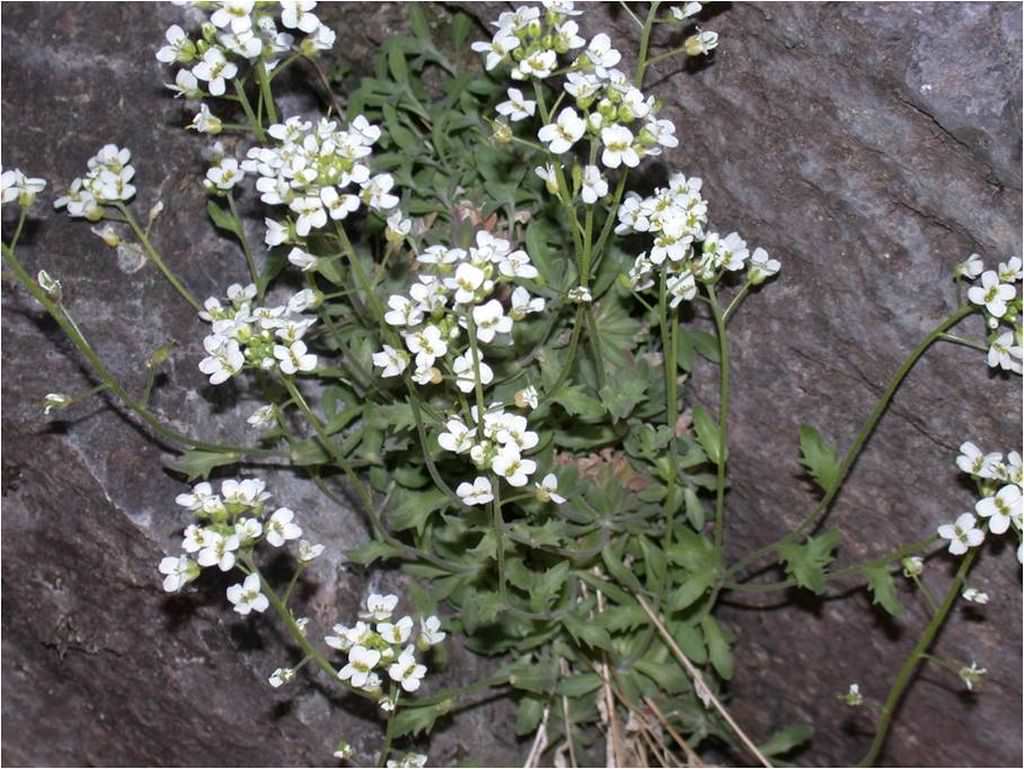
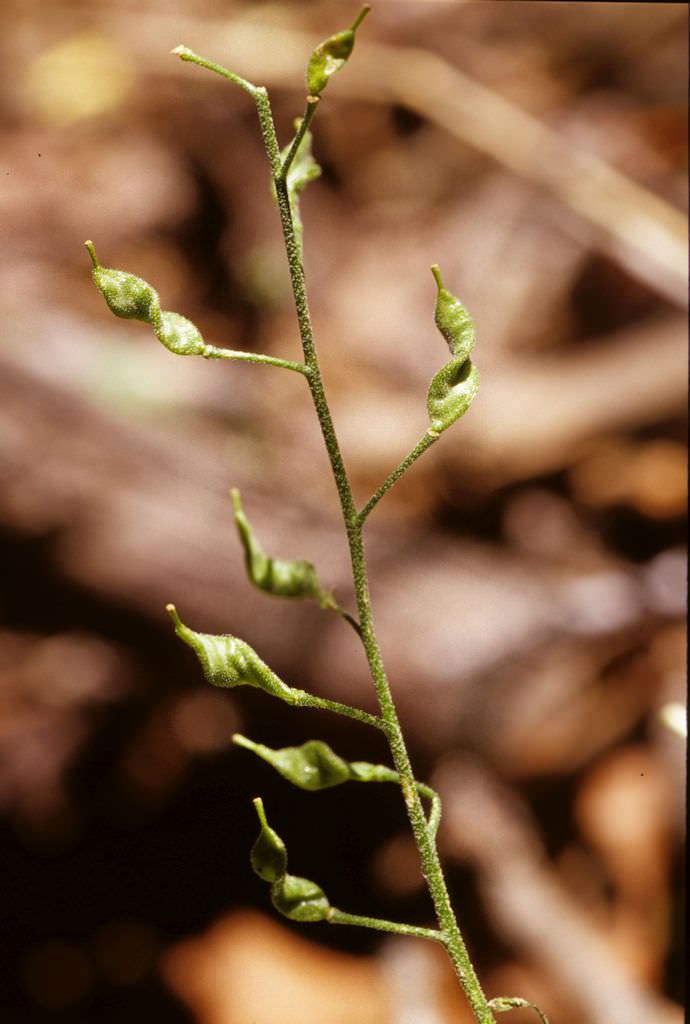
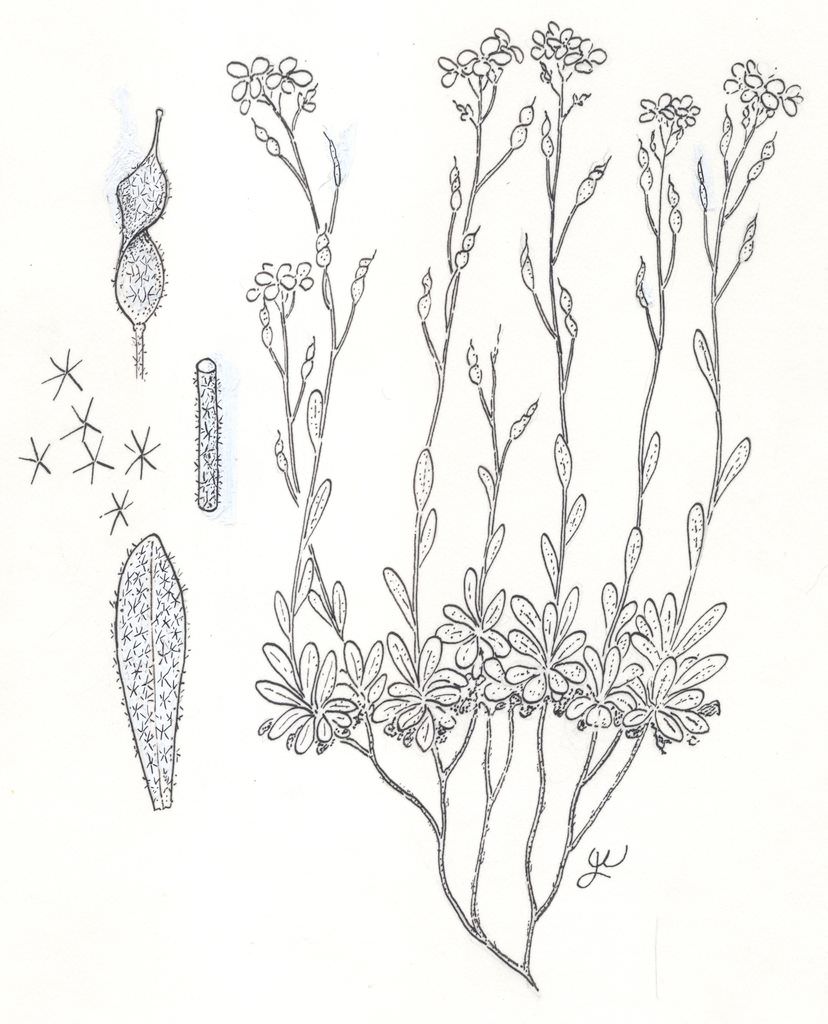
Perennials; (matted); caudex branched (with persistent leaf remains, branches slender, prostrate, sometimes terminating in sterile rosettes); not scapose. Stems usually unbranched, (0.5-) 1-2.4(-3) dm, pubescent throughout, trichomes short-stalked, subdendritic, 4-12- rayed, 0.05-0.2 mm. Basal leaves rosulate; petiole (obscure), usually not ciliate, rarely pubescent proximally, (trichomes simple or spurred, to 0.25 mm); blade obovate to narrowly oblanceolate, 0.5-1.3(-2.5) cm à (1-)2-4(-7) mm, margins usually entire, rarely denticulate, surfaces pubescent with short-stalked, subdendritic, 5-12-rayed trichomes, 0.05-0.3 mm. Cauline leaves (2 or) 3-8; sessile; blade oblong to lanceolate, margins usually entire, rarely denticulate, surfaces pubescent as basal, or, rarely, adaxially with long-stalked, 2-5-rayed trichomes. Racemes 12-28-flowered, ebracteate, elongated in fruit; rachis not flexuous, pubescent as stem. Fruiting pedicels divaricate, straight, (3-)5-10(-13) mm, pubescent as stem. Flowers: sepals ovate, 2-2.5 mm, pubescent; petals white, spatulate, 4-6 à 2-3 mm; anthers ovate, 0.5-0.6 mm. Fruits ovate-lanceolate, twisted, flattened, 5-9 à 2-3 mm; valves pubescent, trichomes simple and short-stalked, 2-4-rayed, 0.05-0.2 mm; ovules 16-20 per ovary; style (0.7-)1-2(-2.3) mm. Seeds oblong, 0.8-1.2 à 0.5-0.7 mm (Flora of North America 1993+).
Look Alikes:
Draba smithii is distinguished from Draba cana in being much more finely and densely stellate-pubescent; also, Draba cana grows in open sites in dry tundra (Kettler et al. 1993).
Phenology:
Flowering and fruiting from June through July (Kettler et al. 1993, Ryke et al. 1994).
 |
Habitat
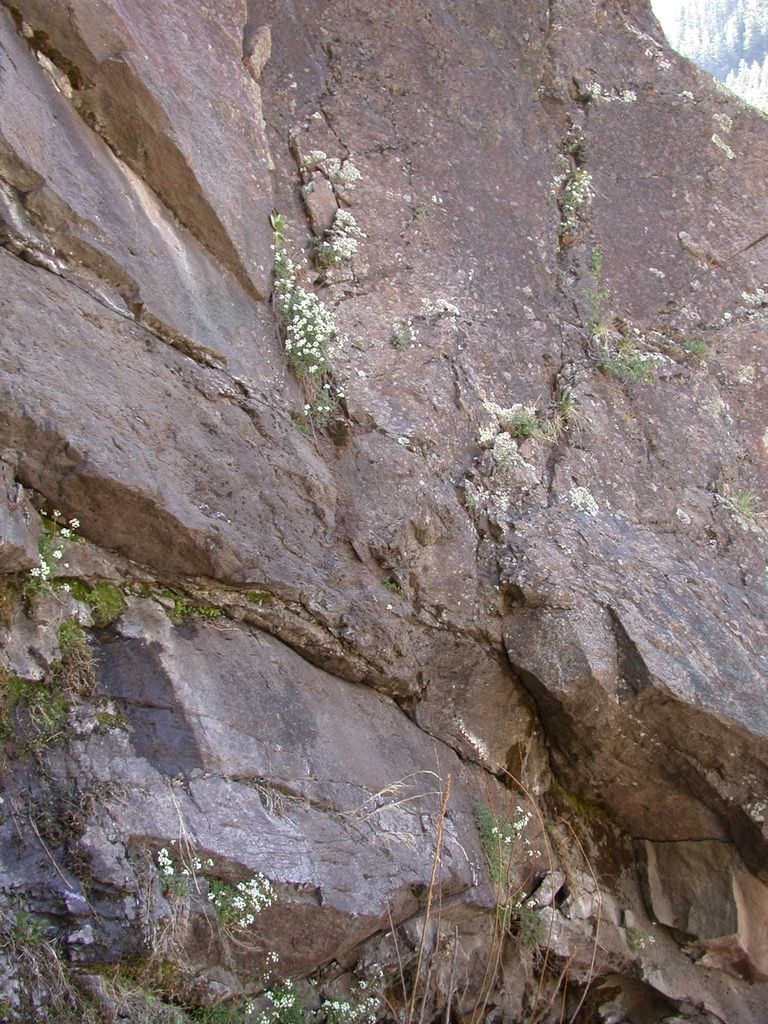
Draba smithii occurs on talus slopes and in rock crevices in shaded, protected sites in upper montane and lower subalpine areas (Hitchcock 1941, Ryke et al. 1994). Associated species include: Ribes cerum, Rhus trilobata, Gilia calcarea, Artemisia tridentata, Potentilla plattensis, Vitis sp., Mertensia ciliata, Symphocarpus spp., Poa pratensis, Pentaphylloides flouribunda, Eriogonum sp., Lepidium montanum, Bouteloua gracilis.
click on image to enlarge
 |
Elevation Range:
7,743 - 12,693 feet (2,360 - 3,869 meters)
Distribution
Colorado Endemic:
No
Range:
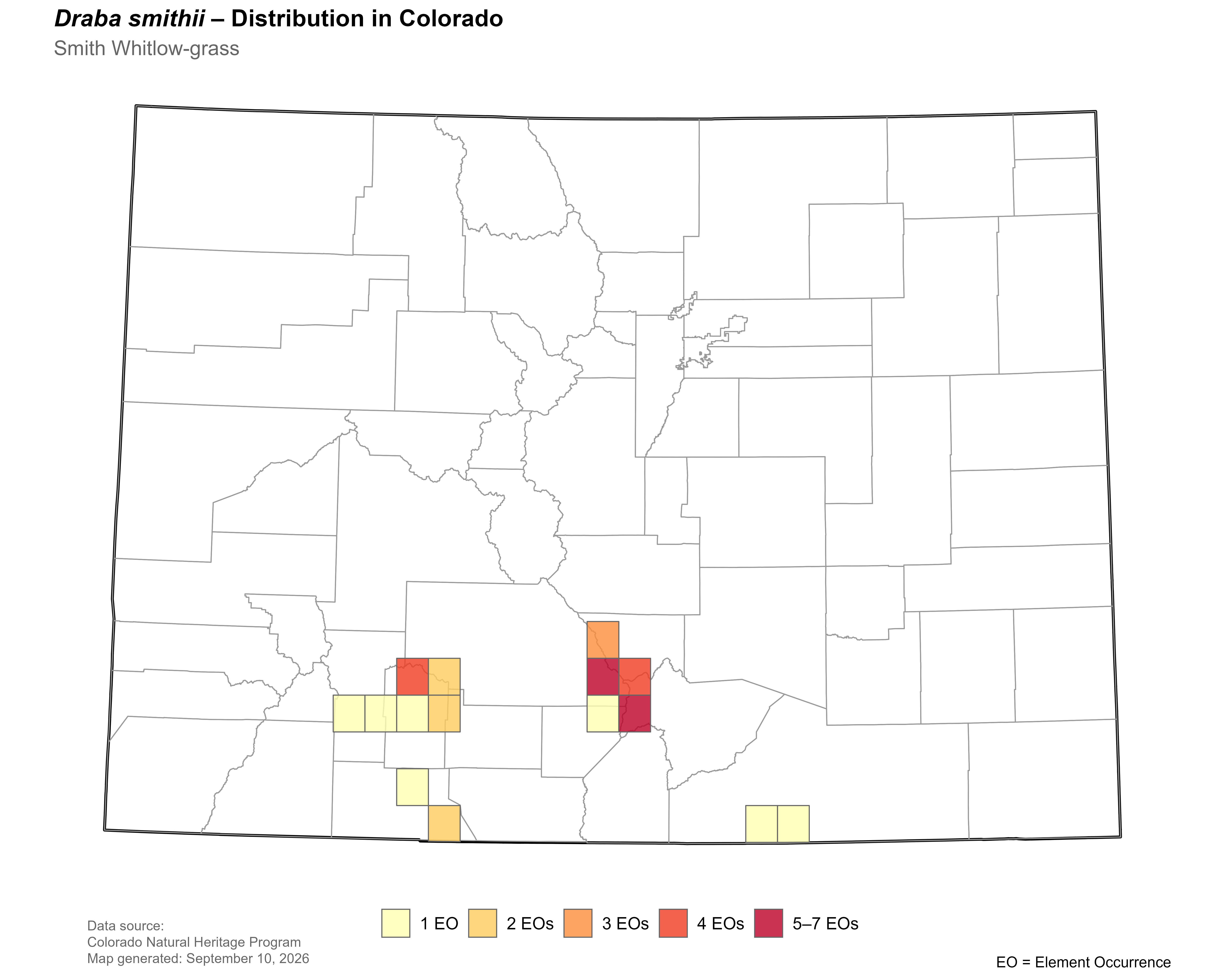
Draba smithii is known from Alamosa, Archuleta, Conejos, Custer, Hinsdale, Las Animas, Mineral, and Saguache counties in southern Colorado, USA. Estimated range extent in Colorado of 19,641 square kilometers was calculated in GeoCAT using occurrence data provided by the Colorado Natural Heritage Program (2022). This species is also known from Taos County, New Mexico.
Click on map to enlarge |
Threats and Management Issues
The most significant threats to Draba. smithii appear to come from habitat modification. Several occurrences are subject to threats from recreational hiking and from permanent habitat modification from development projects such as road construction (CNHP 2022). Modification of the hydrology of occupied habitat may also affect some populations. Livestock grazing, fire, and invasive weedy species are also considered low-level threats. Draba smithii grows in rock cracks and crevices, and thus only the accessible occurrences are vulnerable to large herbivores. Its rocky habitat provides a natural refuge from fire, and weed invasions appear unlikely (Ladyman 2004). Issues related to climate change are also concerning. This species is considered to have moderate adaptive capacity and is expected to be slightly to moderately vulnerable to climate change under both RCP 4.5 and 8.5 scenarios, as assessed for the 2025 Colorado State Wildlife Action Plan (CNHP 2025).
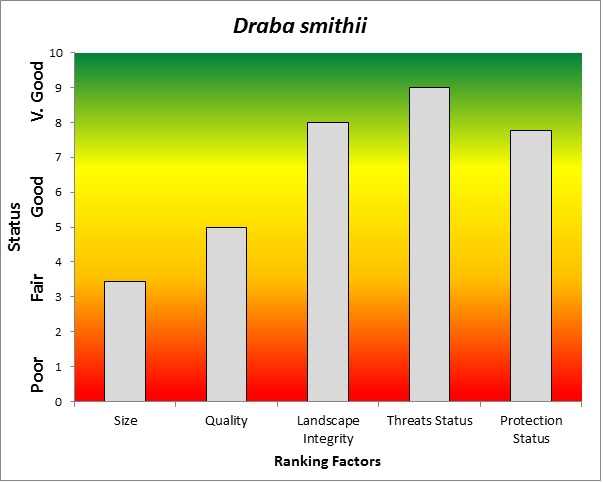
Summary results of an analysis of the status of Draba smithii based on several ranking factors. This species was concluded to be Effectively Conserved. From Rondeau et al. 2011. |
References
- Ackerfield, J. 2015. Flora of Colorado. BRIT Press, Botanical Research Institute of Texas, Fort Worth, TX. 818 pp.
- Colorado Natural Heritage Program (CNHP). 2025. Climate Change Vulnerability Assessment of Colorado Tier 1 and Tier 2 Plant Species of Greatest Conservation Need (SCGN) for the 2025 Colorado State Wildlife Action Plan. Colorado Natural Heritage Program, Colorado State University, Fort Collins, CO.
- Flora of North America Editorial Committee (FNA). 2010. Flora of North America north of Mexico. Vol. 7. Magnoliophyta: Salicaceae to Brassicaceae. Oxford University Press, New York. xxii + 797 pp.
- Flora of North America Editorial Committee, ed. (FNA). 1993+. Flora of North America North of Mexico. Oxford Univ. Press, New York, Oxford.
- Handwerk, J., L. Grunau, and S. Panjabi. 2015. Colorado Wildlife Action Plan: 2015 Rare Plant Addendum. Colorado Natural Heritage Program, Colorado State University, Fort Collins, Colorado, USA.
- Hitchcock, C. L. 1941. A Revision of the Drabas of Western North America. University of Washington Publications in Biology 11:1-132.
- Kettler, S. M., N. D. Lederer, D. Bacher, and S. Spackman. 1993. Final Report: Pike and San Isabel National Forests and Comanche and Cimarron National Grasslands, Plants of Special Concern. Colorado Natural Heritage Program, Fort Collins, CO.
- Ladyman, J.A.R. (2004, February 3). Draba smithii Gilg ex O.E. Schulz (Smiths draba): a technical conservation assessment. [Online]. USDA Forest Service, Rocky Mountain Region. Available: http://www.fs.fed.us/r2/projects/ scp/assessments/drabasmithii.pdf [March 2006].
- Neely, B., S. Panjabi, E. Lane, P. Lewis, C. Dawson, A. Kratz, B. Kurzel, T. Hogan, J. Handwerk, S. Krishnan, J. Neale, and N. Ripley. 2009. Colorado Rare Plant Conservation Strategy, Developed by the Colorado Rare Plant conservation Initiative. The Nature Conservancy, Boulder, Colorado, 117 pp.
- Rollins, R.C. 1993a. The Cruciferae of continental North America: Systematics of the mustard family from the Arctic to Panama. Stanford Univ. Press, Stanford, California. 976 pp.
- Rondeau, R., K. Decker, J. Handwerk, J. Siemers, L. Grunau, and C. Pague. 2011. The state of Colorado's biodiversity 2011. Prepared for The Nature Conservancy. Colorado Natural Heritage Program, Colorado State University, Fort Collins, Colorado.
- Ryke, N., D. Winters, L. McMartin and S. Vest. 1994. Threatened, Endangered and Sensitive Species of the Pike and San Isabel National Forests and Comanche and Cimarron National Grasslands. May 25, 1994.
- USDA, NRCS. 2022. The PLANTS Database. National Plant Data Team, Greensboro, NC 27401-4901 USA.
Biotics Export Date : September, 2026


