

Scientific Name : Draba malpighiacea
Author : Windham & Al-Shehbaz NatureServe Explorer
Common Name : Malpighiaceous Draba
 Current Research Activities
☰ Click link below for details.
Taxonomy
Brassicaceae (mustard family)
Ranks and Status
State Rank : S1?
State Rank Reason : Draba malpighiacea is only known from a restricted range in the mountains of southwest Colorado, USA. Little is known about the size of the populations, condition, or threats. There is also some uncertainty in the identification of the reported occurrences.
U.S. Endangered Species Act : none
Colorado Threatened and Endangered List : none
Other Statuses : SWAP SGIN, USFS GMUG
Description and Phenology
General Description:
Draba malpighiaceae is perennial; 4.5-15 cm tall, with yellow flowers. Plants are pubescent throughout with malpighiaceous (rarely a few simple) trichomes 0.2-0.5 mm long. Fruits are elliptic to elliptic-lanceolate, 5-10 Ã 1.5-2.2 mm, flattened, not twisted, and glabrous; style is 0.8-1.2 mm long (Al-Shehbaz and Windam 2007).
Look Alikes:
Draba malpighiaceae is readily distinguished from all species of Draba in Canada and the United States by having leaves with exclusively straight hairs that taper to free ends and are attached near the middle. These are known as malpighiaceous trichomes (Flora of North America 2010, Al-Shehbaz and Windam 2007).
Phenology:
Flowers are produced June-August (FNA 1993+, Colorado Natural Heritage Program 2012).
Habitat
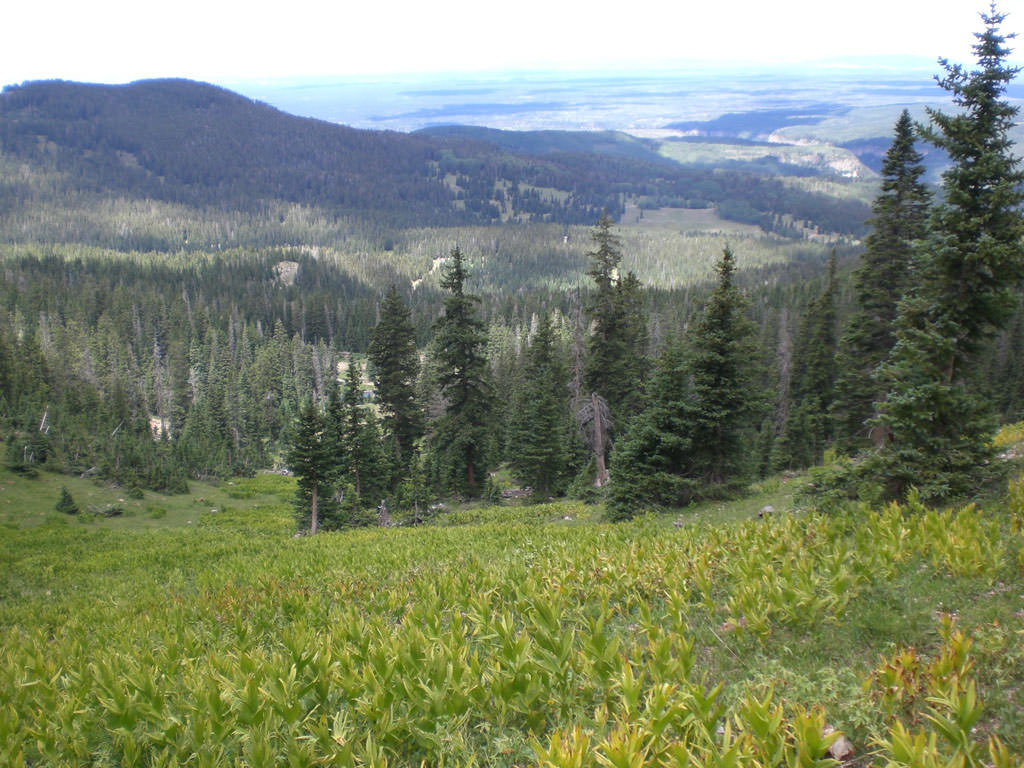
Rock outcrops and rocky slopes on alpine ridgetops and in subalpine conifer forests. Associated species include Lloydia serotina, Polemonium pulcherrimum var. delicatum, Anemone multifida subsp. globosa, and Townsendia rothrockii (Al-Shehbaz and Windham 2007, FNA 2010, CNHP 2012).
click on image to enlarge
 |
Elevation Range:
9,766 - 12,989 feet (2,977 - 3,959 meters)
Distribution
Colorado Endemic:
Yes
Range:
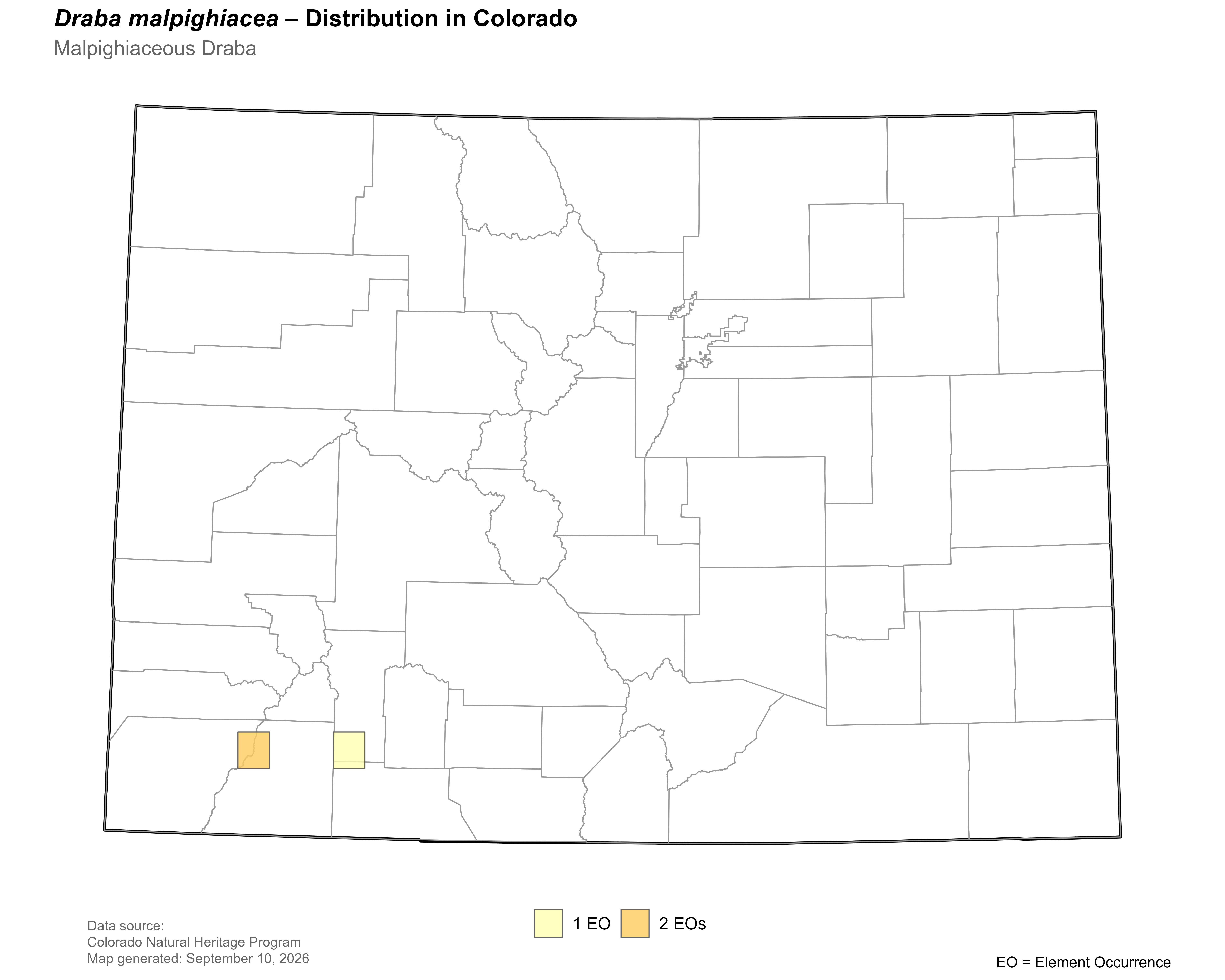
Draba malpighiacea is endemic to Colorado, USA where it is restricted to higher elevations in Hinsdale, La Plata, and Montezuma counties (Al-Shehbaz and Windham 2007). The estimated range extent in Colorado of 2202 square kilometers was calculated in GeoCAT using occurrence data provided by the Colorado Natural Heritage Program (2023). When occurrences with unverified identification are excluded the range extent is reduced to 207 sq km (CNHP 2023).
Click on map to enlarge |
Threats and Management Issues
No threats have been documented but this species is considered to be vulnerable to climate change (Handwerk et al. 2015).
References
- Ackerfield, J. 2012. The Flora of Colorado. Colorado State University Herbarium. 433 pp.
- Al-Shehbaz, I.A., and M. D. Windham. 2007. New or noteworthy North American Draba (Brassicaceae). Harvard Papers in Botany 12(2): 409-419.
- Colorado Natural Heritage Program (CNHP). 2023. Biodiversity Tracking and Conservation System (Biotics 5). Colorado Natural Heritage Program, Colorado State University, Fort Collins.
- Colorado Natural Heritage Program. 2012. Biodiversity Tracking and Conservation System. Colorado State University, Fort Collins, CO.
- Flora of North America Editorial Committee (FNA). 2010. Flora of North America north of Mexico. Vol. 7. Magnoliophyta: Salicaceae to Brassicaceae. Oxford University Press, New York. xxii + 797 pp.
- Handwerk, J., L. Grunau, and S. Panjabi. 2015. Colorado Wildlife Action Plan: 2015 Rare Plant Addendum. Colorado Natural Heritage Program, Colorado State University, Fort Collins, Colorado, USA.
- Lavender, A.E., M.M. Fink, S.E. Linn, D.M. Theobald. 2011. Colorado Ownership, Management, and Protection v9 Database. Colorado Natural Heritage Program and Geospatial Centroid, Colorado State University, Fort Collins, CO. (30 September).
- Neely, B., S. Panjabi, E. Lane, P. Lewis, C. Dawson, A. Kratz, B. Kurzel, T. Hogan, J. Handwerk, S. Krishnan, J. Neale, and N. Ripley. 2009. Colorado Rare Plant Conservation Strategy, Developed by the Colorado Rare Plant conservation Initiative. The Nature Conservancy, Boulder, Colorado, 117 pp.
- Weber, W. A. and R. C. Wittmann. 2012. Colorado Flora, Western Slope, A Field Guide to the Vascular Plants, Fourth Edition. Boulder, Colorado. 532 pp.