


Scientific Name : Draba grayana
Author : (Rydb.) C.L. Hitchc. NatureServe Explorer
Common Name : Gray's Peak Whitlow- grass
 Current Research Activities
 1997 profile
☰ Click link below for details.
Taxonomy
Brassicaceae (mustard family)
Draba grayana is an apomictic species clearly related to D. exunguiculata, with which it is occasionally sympatric (Flora of North America 1993+).
Ranks and Status
State Rank : S3
State Rank Reason : Draba grayana is known from at least 50 occurrences in the alpine areas of the Central Rocky Mountains of Colorado, USA. This species is also known from northern New Mexico, but it is a near Colorado endemic with restricted range and habitat. The inaccessible nature of much of its habitat provides some natural protection, however, some potential threats remain including non-motorized recreation, collecting (for rock-gardens), herbivory by mountain goats, and the effects of climate change.
U.S. Endangered Species Act : none
Colorado Threatened and Endangered List : none
Other Statuses : SWAP Tier 2, USFS, USFS RGNF
Description and Phenology
General Description:
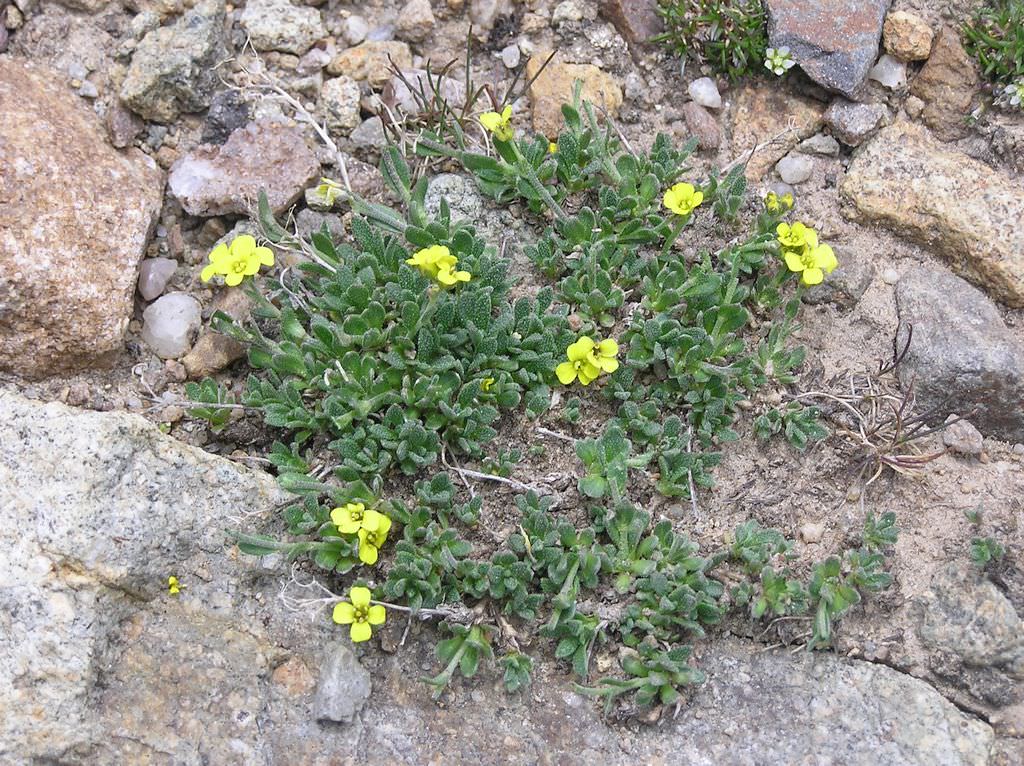
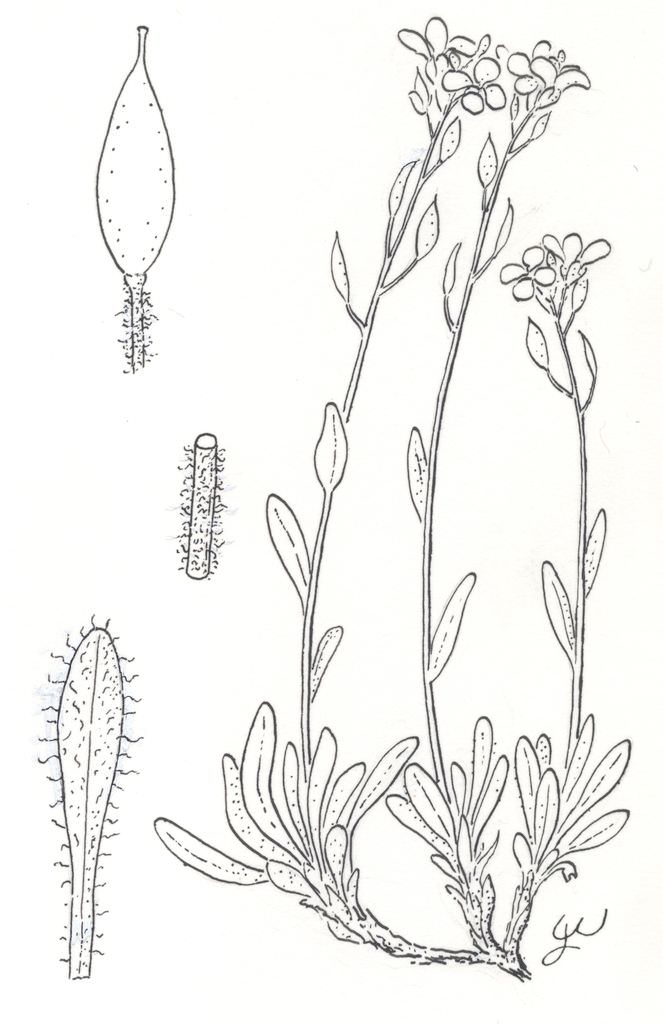
Perennials; (densely cespitose); caudex branched (covered with persistent, somewhat thickened, dry petioles); not scapose. Stems unbranched, 0.08-0.6 dm, densely to moderately pubescent throughout, trichomes simple and stalked, 2- or 3-rayed, 0.2-1 mm. Basal leaves rosulate; petiolate; petiole ciliate, (trichomes simple, 0.2-1 mm); blade linear to linear-oblanceolate, (0.4-)0.6-1.5(-2) cm à 1-2 mm, margins entire, (pubescent as petiole), surfaces pubescent abaxially with simple and stalked, 2- or 3-rayed trichomes, 0.1-0.4 mm, adaxially glabrate or subapically sparsely pubescent with simple trichomes. Cauline leaves 1-4; sessile; blade linear to linear-oblanceolate, margins entire, surfaces pubescent as basal. Racemes 5-12 (-16)-flowered, usually ebracteate, rarely proximalmost flowers bracteate, slightly elongated in fruit; rachis not flexuous, pubescent as stem. Fruiting pedicels divaricate-ascending, straight or slightly curved upward, 1.5-6 mm, pubescent as stem. Flowers: sepals ovate, 1.5-2 mm, pubescent, (trichomes simple and short-stalked, 2- or 3-rayed); petals bright yellow, spatulate, 3-4.5 à 1-2 mm, (flared, clawed); anthers ovate, 0.3-0.5 mm. Fruits lanceolate to oblong-lanceolate, slightly twisted or plane, flattened, 4-12 à 1.5-3 mm; valves glabrous or pubescent, trichomes simple, 0.07-0.2 mm; ovules 16-20 per ovary; style 0.4-1.2 mm. Seeds ovoid, 1-1.4 à 0.7-1 mm. (Flora of North America 1993+).
Look Alikes:
Draba grayana is distinguished from other yellow flowered alpine Drabas having fewer than 4 stem leaves and growing in dry rocky sites as follows: D. grayana has clawed petals exceeding the sepals, and dense, tangled, simple pubescence on stems; D. streptobrachia has stellate or cruciform pubescence; and D. exunguiculata has glabrous stems and clawless petals equalling the sepals; D. crassifolia has a much shorter style (less than .15 mm); D. crassa has semi-succulent basal leaves that are glabrous on the surface (although ciliate-margined) (Kettler et al. 1993).
Draba exunguiculata is about the same size, but is not densely hairy; Draba streptocarpa is hairy, but is usually a considerably larger plant (up to six times as tall); and Draba crassa is also usually taller and its leaves are only sparsely hairy (Ladyman 2004).
Phenology:
Flowers mid-late June through August. Produces fruits from August through September.
 |
Habitat
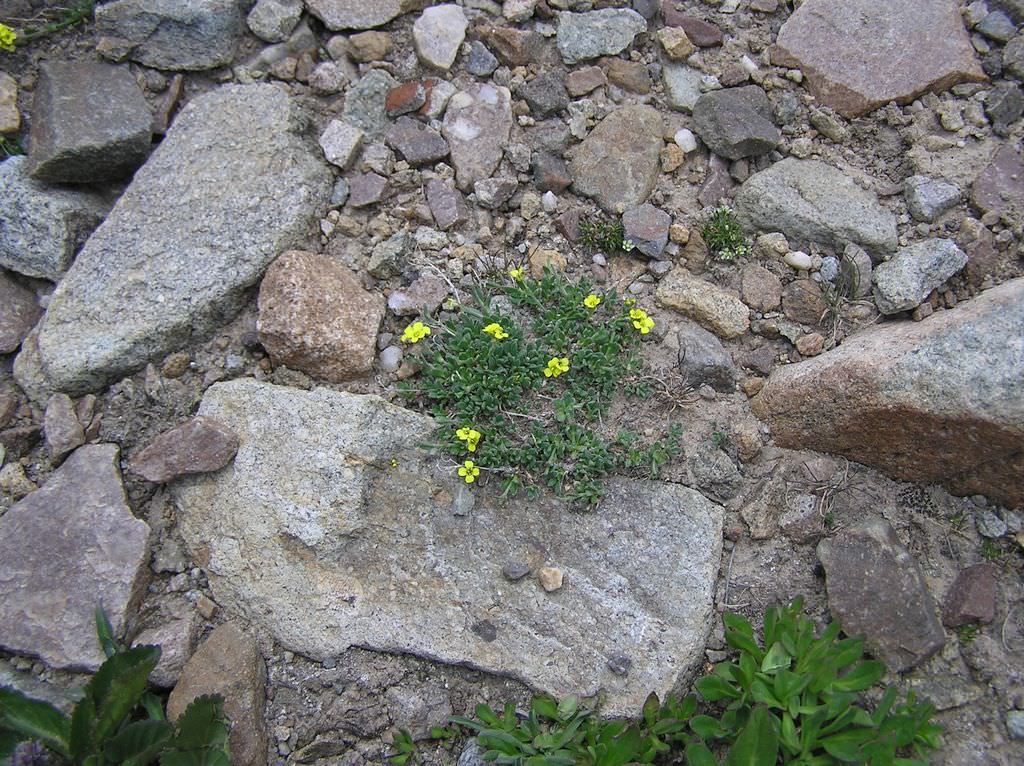
This species can be found on open knolls, steep hillsides, rock crevices, alpine fell-fields, tundra, wet meadows, and gravely or talus slopes (Allred et al. 2020, Ladyman 2004, Spackman et al. 1997, Flora of North America 1993+). It occurs on slopes of 10 to 35 (exceptionally to 50) percent, with 35 to 50 percent bare soil (Ladyman 2004). Common associates include Acomastylis rossii, Trifolium nanum, Mertensia lanceolata, Micranthes rhomboidea, Claytonia megarhiza, Festuca brachyphylla ssp. coloradsnsis, Trisetum spicatum, Carex elynoides, Luzula spicata, Draba aurea, Paronychia pulvinata, Tonestus pygmaea, Potentilla uniflora, Oreoxys alpina, Silene acaulis, Eritrichum aretioides, Phlox sibirca, Poa arctica, Carex rupestris, Festuca baffinensis, Polemonium viscosum, Draba streptobrachia, Eritrichium nanum, Smelowskia calycina, Minuatia obtusiloba, Saxifraga flagellaris, Poa glauca, Besseya alpina, Castilleja occidentalis, Carex misandra, and Chinophila jamesii.
click on image to enlarge
 |
Elevation Range:
10,892 - 14,304 feet (3,320 - 4,360 meters)
Distribution
Colorado Endemic:
No
Range:
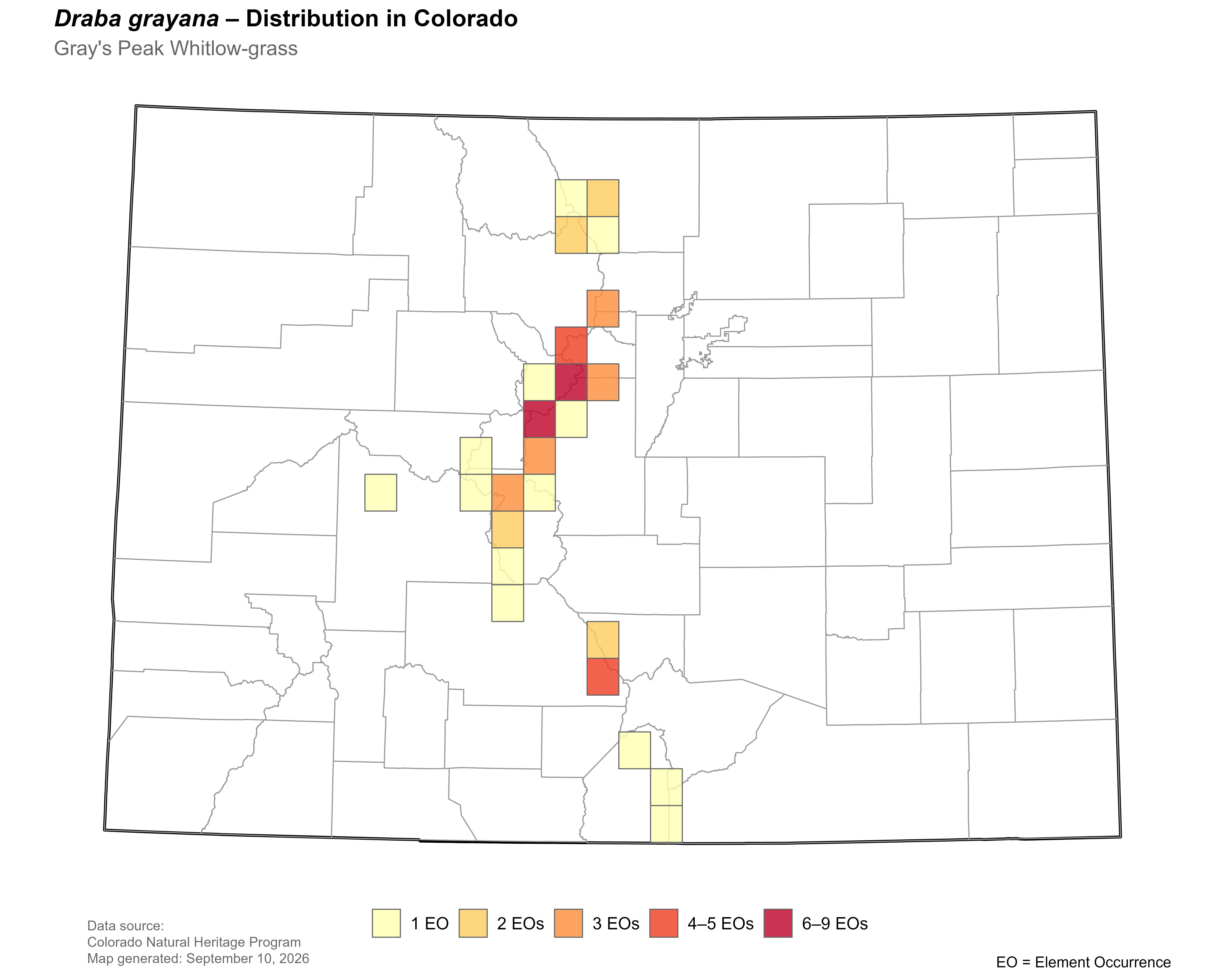
Draba grayana has been documented in a total of 15 Colorado counties: Boulder, Chaffee, Clear Creek, Costilla, Custer, Gilpin, Grand, Gunnison, Huerfano, Jackson, Lake, Larimer, Park, Saguache, and Summit. Estimated range extent in Colorado of 31,075 square kilometers was calculated in GeoCAT using occurrence data provided by the Colorado Natural Heritage Program (2023). This species is also found in New Mexico in the Sangre and Culebras Mountains, USA.
Click on map to enlarge |
Threats and Management Issues
Draba grayana habitat is largely inaccessible and therefore somewhat naturally protected. However, threats may arise from non-motorized recreation, collecting (for rock-gardens), mountain goats, and potentially climate change (Ladyman 2004). Recreational use of habitat, such as foot traffic, poses a threat to some occurrences, particularly those within popular hiking areas such as the Continental Divide Trail, where they may be subjected to trampling. Mining activities are not a perceived threat to any of the currently known occurrences although individual occurrences may have been impacted in the past. However, several occurrences report low level impacts to the species habitat from ORV use on old mining roads. Mountain goats have a negative impact on the habitat for this species in some parts of its range. The magnitude of the impact is related to the size of the mountain goat population. Over-collection for the rock garden trade is also a concern. This species is considered to have moderate adaptive capacity and is expected to be slightly vulnerable to climate change under both RCP 4.5 and 8.5 scenarios, as assessed for the 2025 Colorado State Wildlife Action Plan (CNHP 2025).
References
- Ackerfield, J. 2015. Flora of Colorado. BRIT Press, Botanical Research Institute of Texas, Fort Worth, TX. 818 pp.
- Allred, K.W., E.M. Jercinovic, and R.D. Ivey. 2020. Flora Neomexicana III: An Illustrated Identification Manual, Second Edition. Part 2: Dicotyledonous Plants.
- Colorado Natural Heritage Program (CNHP). 2025. Climate Change Vulnerability Assessment of Colorado Tier 1 and Tier 2 Plant Species of Greatest Conservation Need (SCGN) for the 2025 Colorado State Wildlife Action Plan. Colorado Natural Heritage Program, Colorado State University, Fort Collins, CO.
- Flora of North America Editorial Committee (FNA). 2010. Flora of North America north of Mexico. Vol. 7. Magnoliophyta: Salicaceae to Brassicaceae. Oxford University Press, New York. xxii + 797 pp.
- Flora of North America Editorial Committee, ed. (FNA). 1993+. Flora of North America North of Mexico. Oxford Univ. Press, New York, Oxford.
- Handwerk, J., L. Grunau, and S. Panjabi. 2015. Colorado Wildlife Action Plan: 2015 Rare Plant Addendum. Colorado Natural Heritage Program, Colorado State University, Fort Collins, Colorado, USA.
- Kettler, S. M., N. D. Lederer, D. Bacher, and S. Spackman. 1993. Final Report: Pike and San Isabel National Forests and Comanche and Cimarron National Grasslands, Plants of Special Concern. Colorado Natural Heritage Program, Fort Collins, CO.
- Ladyman, J.A.R. (2004, July 28). Draba grayana (Rydb.) C.L. Hitchcock (Grays draba): a technical conservation assessment. [Online]. USDA Forest Service, Rocky Mountain Region. Available: http://www.fs.fed.us/r2/projects/scp/assessments/drabagrayana.pdf [March 2006].
- Neely, B., S. Panjabi, E. Lane, P. Lewis, C. Dawson, A. Kratz, B. Kurzel, T. Hogan, J. Handwerk, S. Krishnan, J. Neale, and N. Ripley. 2009. Colorado Rare Plant Conservation Strategy, Developed by the Colorado Rare Plant conservation Initiative. The Nature Conservancy, Boulder, Colorado, 117 pp.
- Rollins, R.C. 1993. The Cruciferae of Continental North America:Systematics of the Mustard Family from the Arctic to Panama. Stanford University Press. Stanford, CA.
- Rondeau, R., K. Decker, J. Handwerk, J. Siemers, L. Grunau, and C. Pague. 2011. The state of Colorado's biodiversity 2011. Prepared for The Nature Conservancy. Colorado Natural Heritage Program, Colorado State University, Fort Collins, Colorado.
- USDA, NRCS. 2022. The PLANTS Database. National Plant Data Team, Greensboro, NC 27401-4901 USA.
- Weber, W. A. and R. C. Wittmann. 2012. Colorado Flora, Eastern Slope, A Field Guide to the Vascular Plants, Fourth Edition. Boulder, Colorado. 555 pp.
- Weber, W. A. and R. C. Wittmann. 2012. Colorado Flora, Western Slope, A Field Guide to the Vascular Plants, Fourth Edition. Boulder, Colorado. 532 pp.


