

Scientific Name : Draba exunguiculata
Author : (O.E. Schulz) C.L. Hitchc. NatureServe Explorer
Common Name : Clawless Draba
 Current Research Activities
 1997 profile


☰ Click link below for details.
Taxonomy
Brassicaceae (mustard family)
Draba exunguiculata is closely related to D. grayana, and they are occasionally found together (Flora of North America 1993+).
Ranks and Status
State Rank : S2
State Rank Reason : Draba exunguiculata is an alpine species known from approximately 25 occurrences in the high peaks of the central Rocky Mountains of Colorado, USA. This species is potentially threatened by recreational uses, mining, grazing, and climate change.
U.S. Endangered Species Act : none
Colorado Threatened and Endangered List : none
Other Statuses : SWAP Tier 1, USFS
Description and Phenology
General Description:
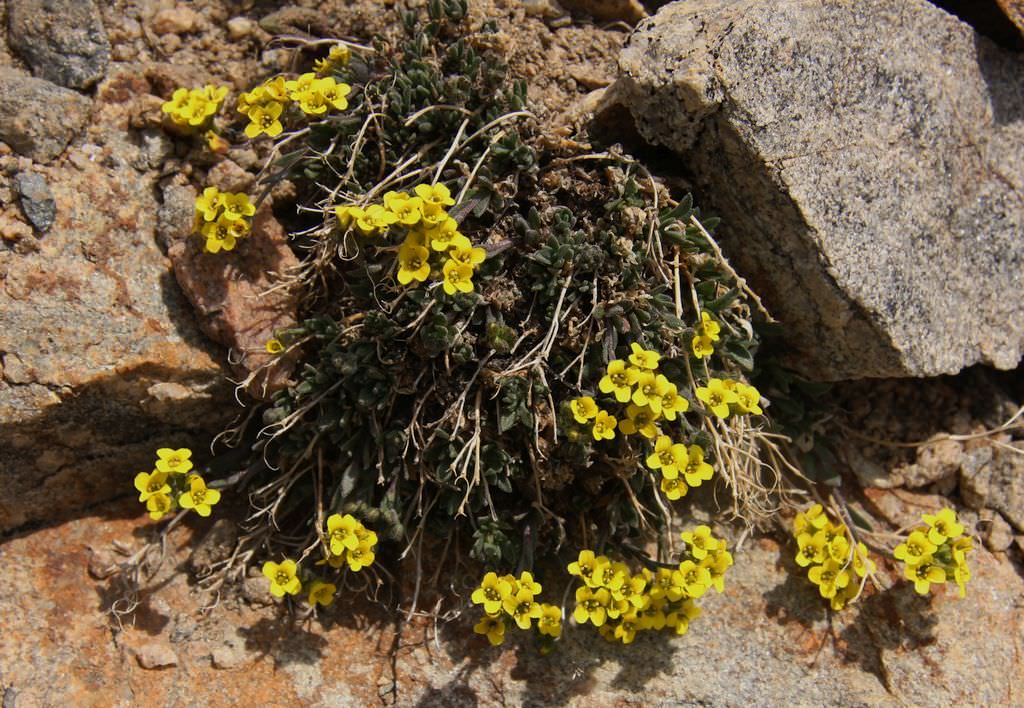
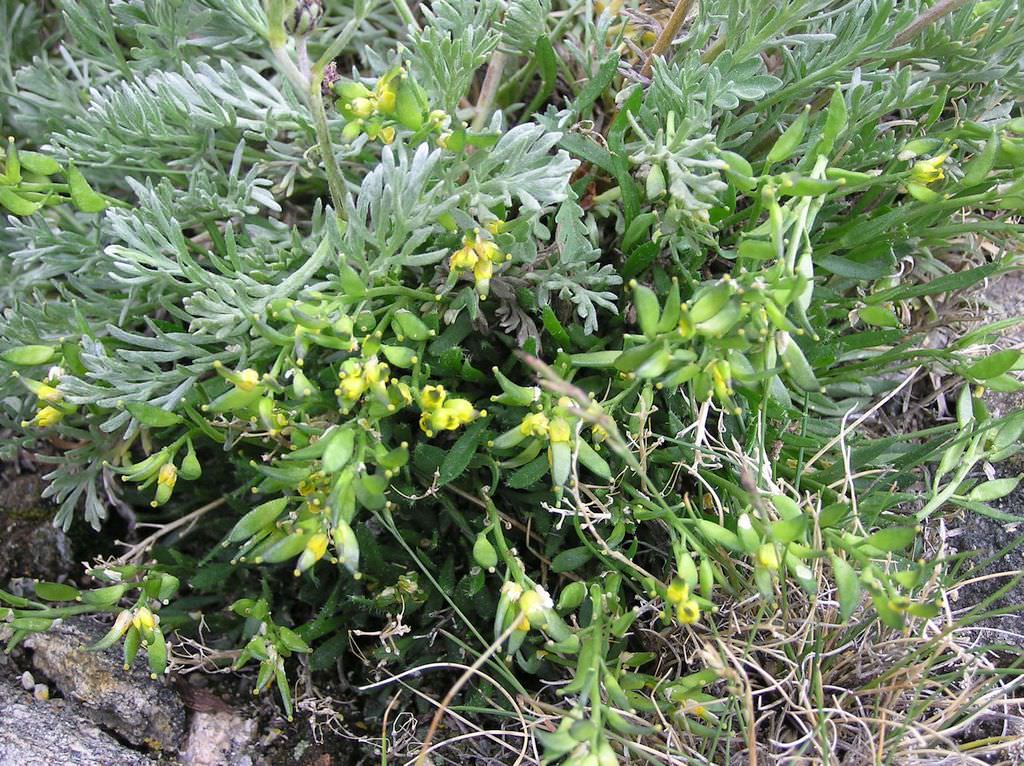
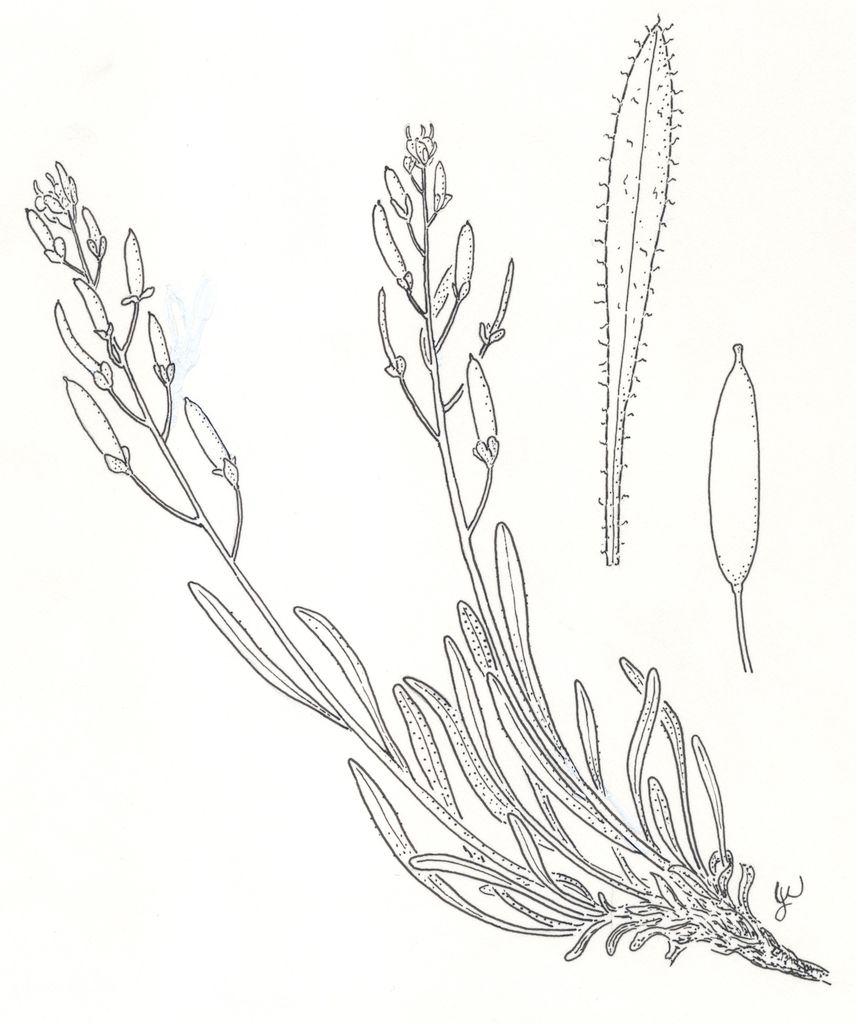
Perennials; (densely cespitose); caudex branched (covered with persistent, somewhat thickened, dry petioles); not scapose. Stems unbranched, 0.15-0.7 dm, glabrous throughout or sparsely pubescent, trichomes simple, 0.3-0.9 mm. Basal leaves rosulate; petiolate; petiole ciliate, (trichomes simple, 0.3-1.1 mm); blade linear to linear-oblanceolate, (0.5-)0.8-2(-2.5) cm × 1-3 mm, margins entire, (pubescent as petiole), surfaces abaxially sparsely pubescent with simple and stalked, 2- or 3-rayed trichomes, 0.1-0.4 mm, adaxially glabrous or subapically sparsely pubescent with simple trichomes. Cauline leaves 1-4; sessile; blade linear to linear-oblanceolate, margins entire, surfaces pubescent as basal. Racemes 4-13(-20)-flowered, ebracteate, elongated in fruit; rachis not flexuous, usually glabrous, rarely sparsely pubescent, trichomes simple, to 1 mm. Fruiting pedicels divaricate-ascending, straight or slightly curved upward, 1-6 mm, usually glabrous, rarely with few, simple trichomes. Flowers: sepals ovate, 2-2.5 mm, pubescent, (trichomes simple); petals (erect), yellow, obovate, 2-2.5(-3) × 1.5-2 mm, (not clawed); anthers oblong, 0.6-0.9 mm. Fruits lanceolate to oblong-lanceolate, plane, flattened, 5-13 × 1.5-3 mm; valves glabrous; ovules 20-24 per ovary; style 0.3-1 mm. Seeds ovoid, 1-1.3 × 0.6-0.8 mm. (Flora of North America 1993+)
Look Alikes:
Distinguished from other yellow-flowered alpine Draba species having fewer than four stem leaves and growing in dry rocky sites as follows: D. exunguiculata has clawless petals, glabrous stems, and simple pubescence; D. grayana has dense tangled simple pubescence on the stems and clawed petals; D. crassifolia has much shorter styles (less than 0.15 mm); D. crassa has a sparsely pubescent stem and semi-succulent basal leaves, and usually has four or more stem leaves. Draba grayana is found in the same general area as D. exunguiculata; both species are apomicts that occasionally grow sympatrically. Draba exunguiculata is easily distin-guished from D. grayana by having stems and fruiting pedicels glabrous or sparsely pubescent with simple trichomes (versus moderately to densely pubescent with simple and 2- or 3-rayed trichomes), and by having erect, non-clawed petals, 2-3 mm and slightly longer than sepals (versus flared, clawed petals 3-4.5 mm and nearly twice as long as sepals; Flora of North America 1993+).
Phenology:
Flowers in late June through August, and fruits in August.
 |
Habitat
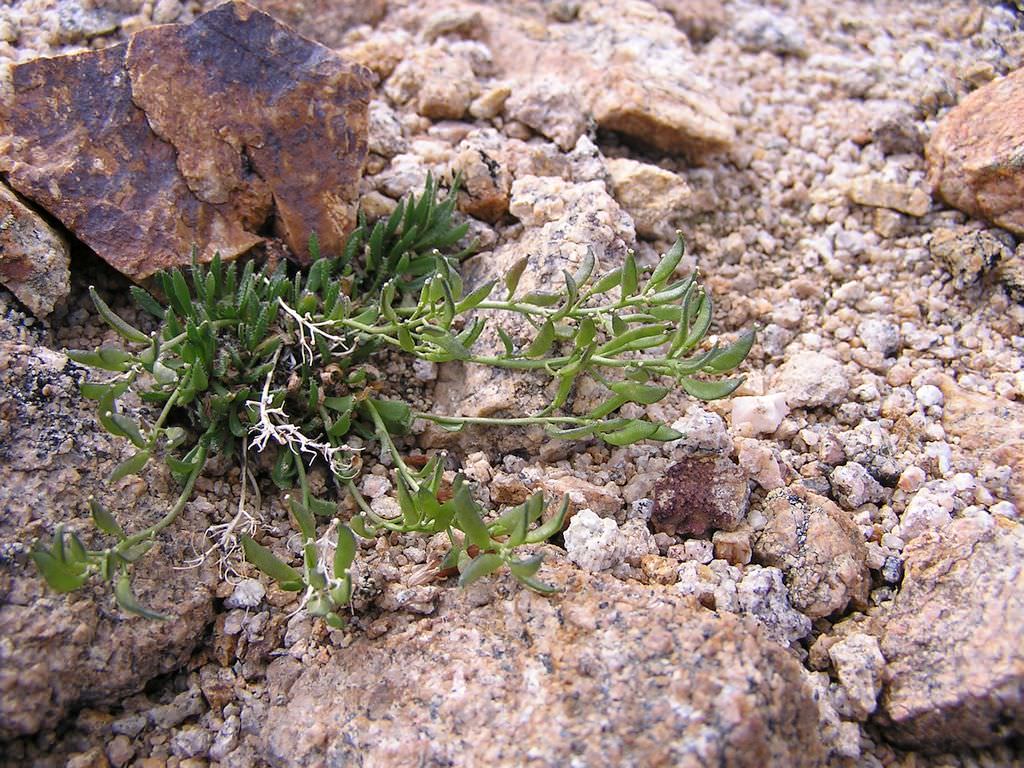
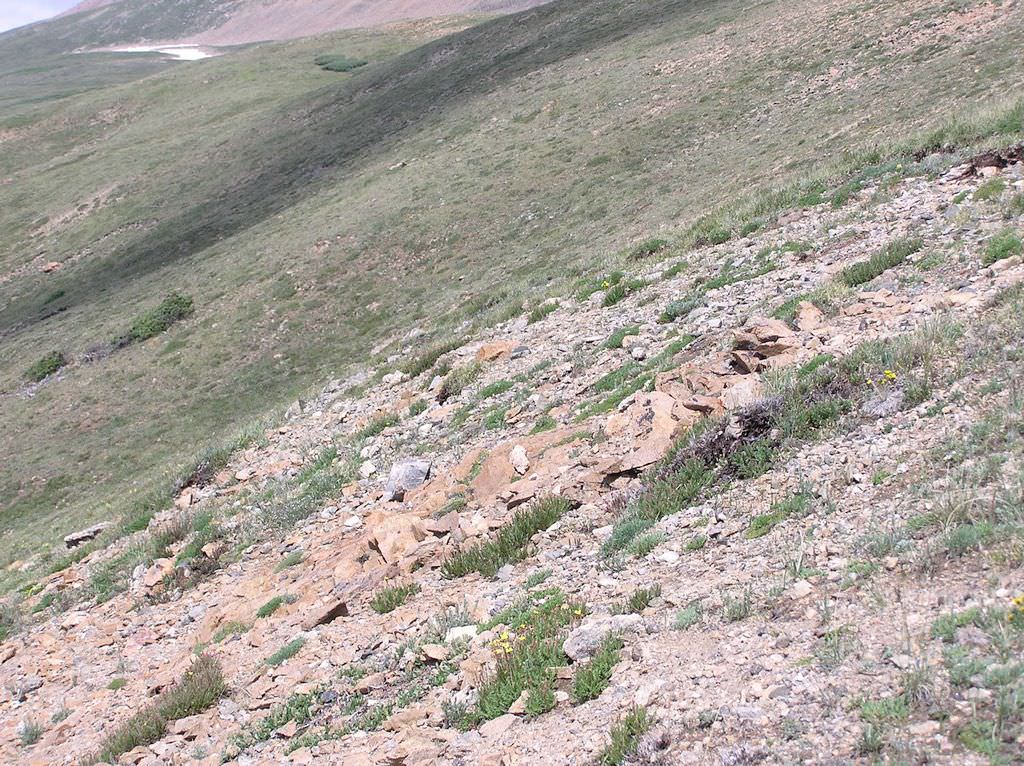
Rocky, gravelly slopes and talus, in alpine areas typically with granitic bedrock (Wiley-Eberle 1980). Associated species include: Acomastylis rossii, Trifolium nanum, Luzula spicata, Silene acaulis ssp. subacaulescens, Lidia obtusiloba, Eritrichum aretiodes, Hirculus serpyllifolia ssp. chrysantha, Carex rupestris ssp. drummondiana Trisetum spicatum, Poa glauca ssp. rupicola, Artemisia scopulorum, Draba grayana, Erigeron pinnatisectus. Paronychia pulvinata, D fladinizensis, Selaginella densa, Festuca brachyphylla sp. coloradensis, Artemisia scopulorum, Potentilla uniflora, Smelowskia calycina, Tonestus pygmaeus, Sedum lanceolatum, Senecio holmii, Besseya alpina, Claytonia megarhiza, Deschampsia cespitosa, Carex rupestris, Luzula spicata, Erigeron simplex, and Castilleja occidentalis.
click on image to enlarge
 |
Elevation Range:
10,665 - 14,105 feet (3,251 - 4,299 meters)
Distribution
Colorado Endemic:
Yes
Range:
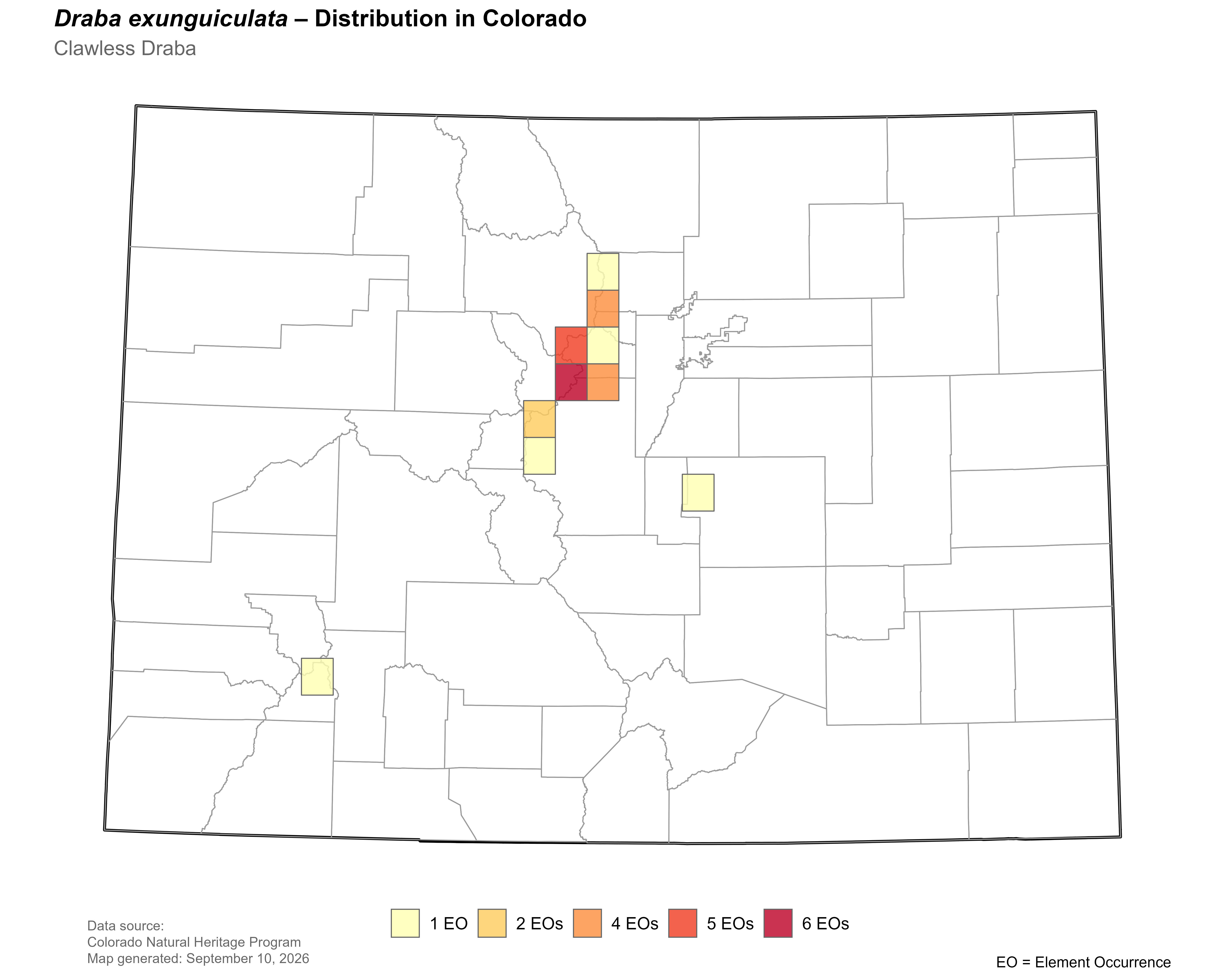
Draba exunguiculata is endemic to Colorado (USA) where it is known from Boulder, Chaffee, Clear Creek, El Paso, Gilpin, Gunnison, Grand, Lake, Park, San Juan and Summit counties. This taxon is limited to the high peaks of the Rocky Mountains, mostly in central and north central Colorado, and also to the south in the San Juan Mountains. The estimated range extent in Colorado of 17,553 square kilometers was calculated in GeoCAT using occurrence data provided by the Colorado Natural Heritage Program (2022).
Click on map to enlarge |
Threats and Management Issues
Threats to Draba exunguiculata include non-motorized recreation, especially along the Continental Divide Trail, mining, grazing, and climate change (Rondeau et al. 2011). At least six occurrences are within popular hiking areas, and may be subjected to trampling by foot traffic (CNHP 2022). As the human population grows in areas within easy access to Draba exunguiculata habitat the impact from these threats may become substantially more significant. Mountain goats (Oreamnos americanus) trample individuals and are also likely to have a negative influence on habitat condition in some parts of its range. The magnitude of the impact is related to the size of the mountain goat population. Over-collection as a desirable rock garden species is also a concern (Ladyman 2004). This species is considered to have moderate adaptive capacity and is expected to be moderately vulnerable to climate change under both RCP 4.5 and 8.5 scenarios, as assessed for the 2025 Colorado State Wildlife Action Plan (CNHP 2025).
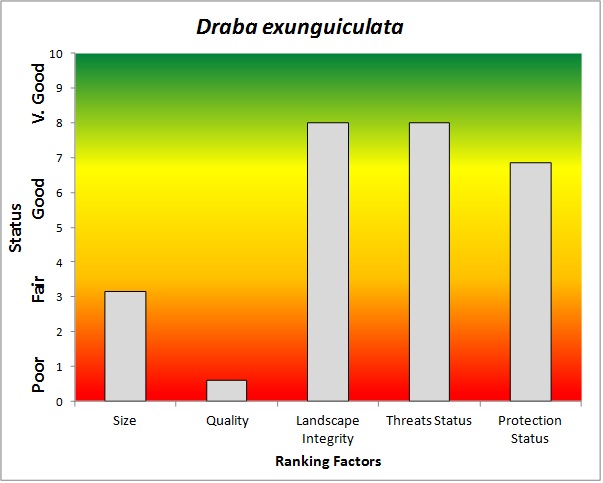
Summary results of an analysis of the status of Draba exunguiculata based on several ranking factors. This species was concluded to be Moderately Conserved. From Rondeau et al. 2011. |
References
- Ackerfield, J. 2015. Flora of Colorado. BRIT Press, Botanical Research Institute of Texas, Fort Worth, TX. 818 pp.
- Colorado Natural Heritage Program (CNHP). 2025. Climate Change Vulnerability Assessment of Colorado Tier 1 and Tier 2 Plant Species of Greatest Conservation Need (SCGN) for the 2025 Colorado State Wildlife Action Plan. Colorado Natural Heritage Program, Colorado State University, Fort Collins.
- Flora of North America Editorial Committee, ed. (FNA). 1993+. Flora of North America North of Mexico. Oxford Univ. Press, New York, Oxford.
- Handwerk, J., L. Grunau, and S. Panjabi. 2015. Colorado Wildlife Action Plan: 2015 Rare Plant Addendum. Colorado Natural Heritage Program, Colorado State University, Fort Collins, Colorado, USA.
- Ladyman, J.A.R. (2004, July 14). Draba exunguiculata (O.E. Schulz) C.L. Hitchcock (Garys Peak draba): a technical conservation assessment. [Online]. USDA Forest Service, Rocky Mountain Region. Available: http://www.fs.fed.us/r2/projects/scp/assessments/drabaexunguiculata.pdf [March 2006].
- Neely, B., S. Panjabi, E. Lane, P. Lewis, C. Dawson, A. Kratz, B. Kurzel, T. Hogan, J. Handwerk, S. Krishnan, J. Neale, and N. Ripley. 2009. Colorado Rare Plant Conservation Strategy, Developed by the Colorado Rare Plant conservation Initiative. The Nature Conservancy, Boulder, Colorado, 117 pp.
- Rollins, R.C. 1993. The Cruciferae of Continental North America:Systematics of the Mustard Family from the Arctic to Panama. Stanford University Press. Stanford, CA.
- Rondeau, R., K. Decker, J. Handwerk, J. Siemers, L. Grunau, and C. Pague. 2011. The state of Colorado's biodiversity 2011. Prepared for The Nature Conservancy. Colorado Natural Heritage Program, Colorado State University, Fort Collins, Colorado.
- Spackman, S., B. Jennings, J. Coles, C. Dawson, M. Minton, A. Kratz, and C. Spurrier. 1997. Colorado rare plant field guide. Prepared for Bureau of Land Management, U.S. Forest Service and U.S. Fish and Wildlife Service by Colorado Natural Heritage Program.
- USDA, NRCS. 2022. The PLANTS Database. National Plant Data Team, Greensboro, NC 27401-4901 USA.
- Weber, W. A. and R. C. Wittmann. 2012. Colorado Flora, Eastern Slope, A Field Guide to the Vascular Plants, Fourth Edition. Boulder, Colorado. 555 pp.
- Wiley-Eberle, K. 1980. Personal communication with Colorado Natural Heritage Inventory from May 1980.