

Scientific Name : Astragalus desperatus var. neeseae
Author : Barneby NatureServe Explorer
Common Name : Horseshoe Milkvetch
 Current Research Activities


☰ Click link below for details.
Taxonomy
Fabaceae (pea family)
Ackerfield (2015, 2022) lists A. equisolensis as a synonym for A. desperatus var. neeseae. Weber and Wittmann (2012) only includes A. desperatus.
Ranks and Status
State Rank : S1
State Rank Reason : Astragalus desperatus var. neeseae is only known from nine small occurrences in Mesa County, Colorado, USA. Road construction and maintenance are a primary concern for this species, although the scope is restricted, it has had direct impacts on occupied habitat. Recreation, primarily non-motorized is widespread in this species habitat but appears to have minimal impacts. The effects of long-term drought and climate change are also a concern.
U.S. Endangered Species Act : none
Colorado Threatened and Endangered List : none
Other Statuses : BLM, SWAP Tier 1
Description and Phenology
General Description:
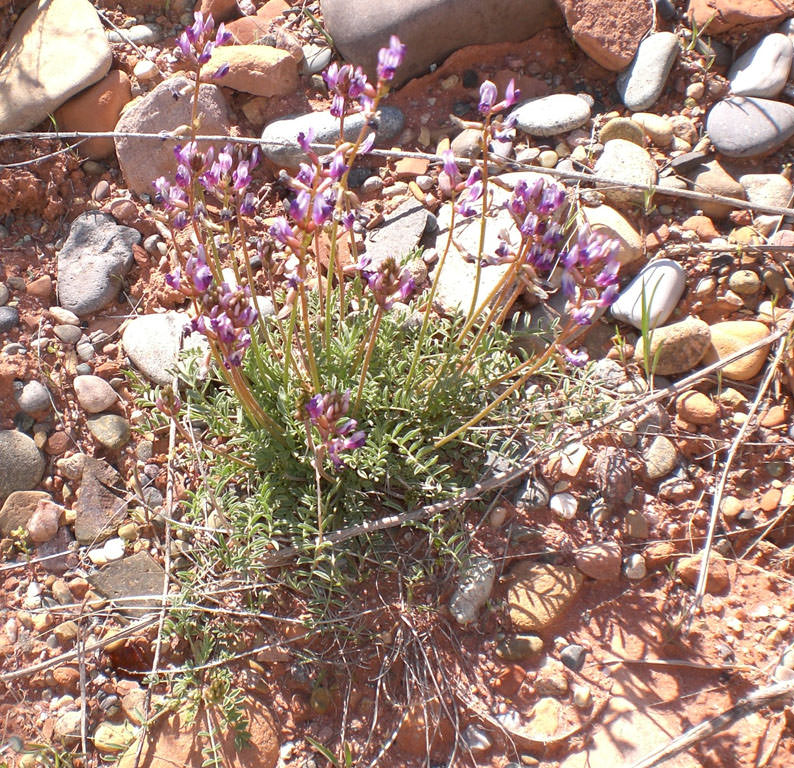
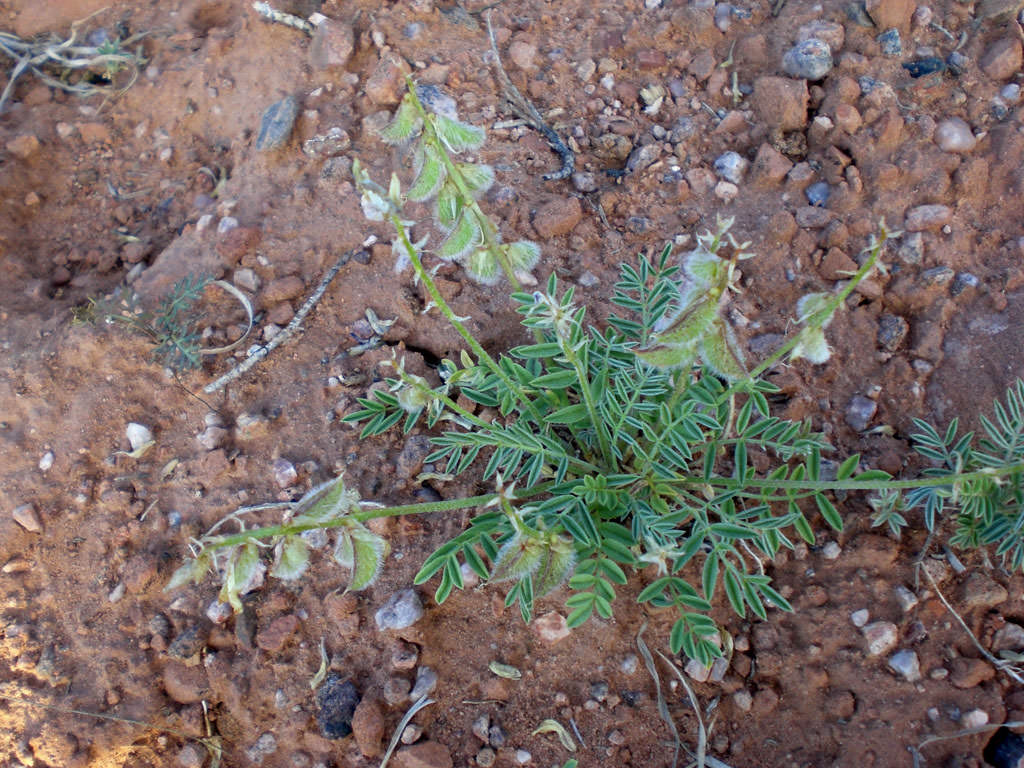
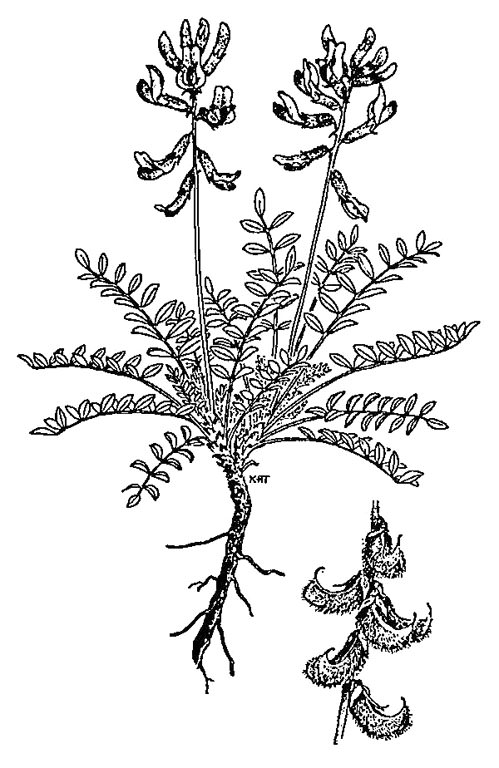
A perennial plant, 5-15 cm tall, with leafless flower stems and typical pea flowers. The wings and keel are purple, while the banner (large top petal) is bicolored--purple with white stripes. Plants are pubescent. Racemes are 4-13 flowered. Pods are declined to deflexed, sessile or stipitate, obliquely ovoid or lance-ellipsoid, lunately curved, dorsiventrally compressed, constricted distally at the beak, laterally compressed, incurved, 10-14 mm long, 3.5-6.5 mm wide, hirsute, and unilocular (Welsh et al. 2003).
Look Alikes:
Not likely to be confused with other Astragalus species as long as the distinctive flowers or fruit are present. Astragalus desperatus has flowers 7-10 mm long, while A. equisolensis flowers are 13-16 mm long (Ackerfield 2012).
Phenology:
Flowers in late April and May, and fruit by the end of May (Colorado Natural Heritage Program 2012). Friuting may continue through mid-summer.
 |
Habitat
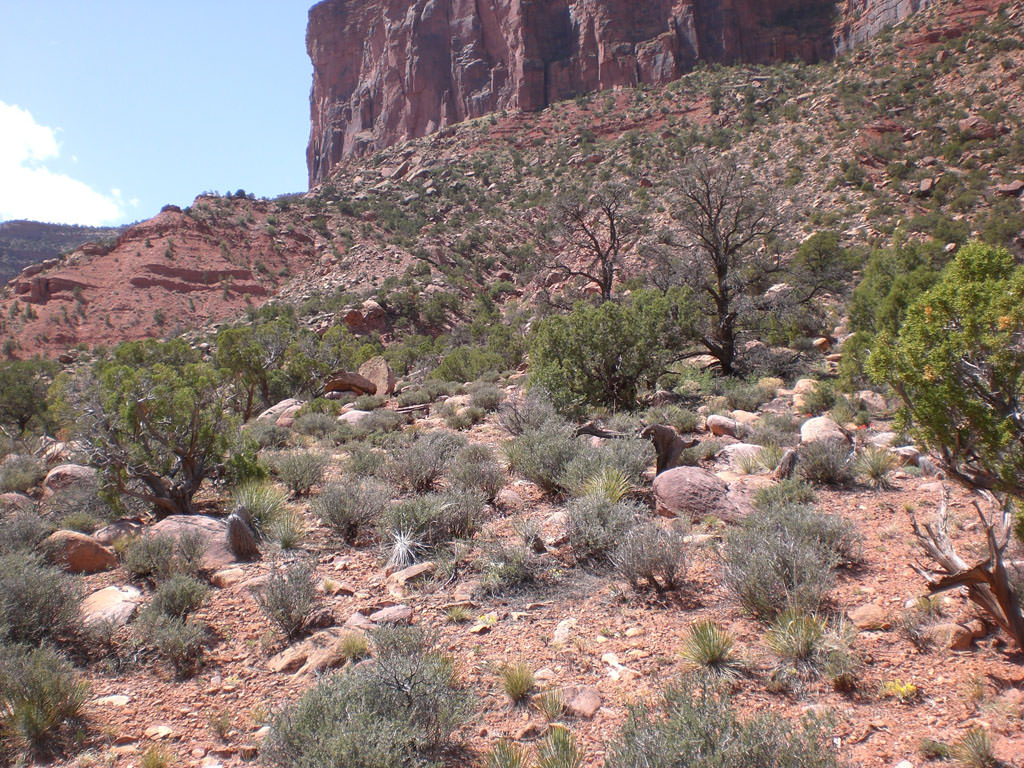
A. equisolensis is associated with mixed desert and salt desert shrub vegetation communities that are generally dominated by sagebrush, shadscale and horsebrush. The populations in Mesa County are in an open juniper/blackbrush community on rocky convex slopes with red soils. Often the plants are found growing under the blackbrush shrubs. Associated species include Juniperus osteosperma, Coleogyne ramosissima, Astragalus amphioxys, Eriogonum microthecum, Hymenopappus filifolius, Cryptantha flavoculata, Arabis pulchra, Cymopterus fendleri, Yucca angustissima, Castilleja scabrida, Cryptantha flava, Townsendia incana, Tetraneuris ivesiana, Aristida purpurea and Astragalus mollissimus.
click on image to enlarge
 |
Elevation Range:
4,513 - 6,026 feet (1,376 - 1,837 meters)
Distribution
Colorado Endemic:
No
Range:
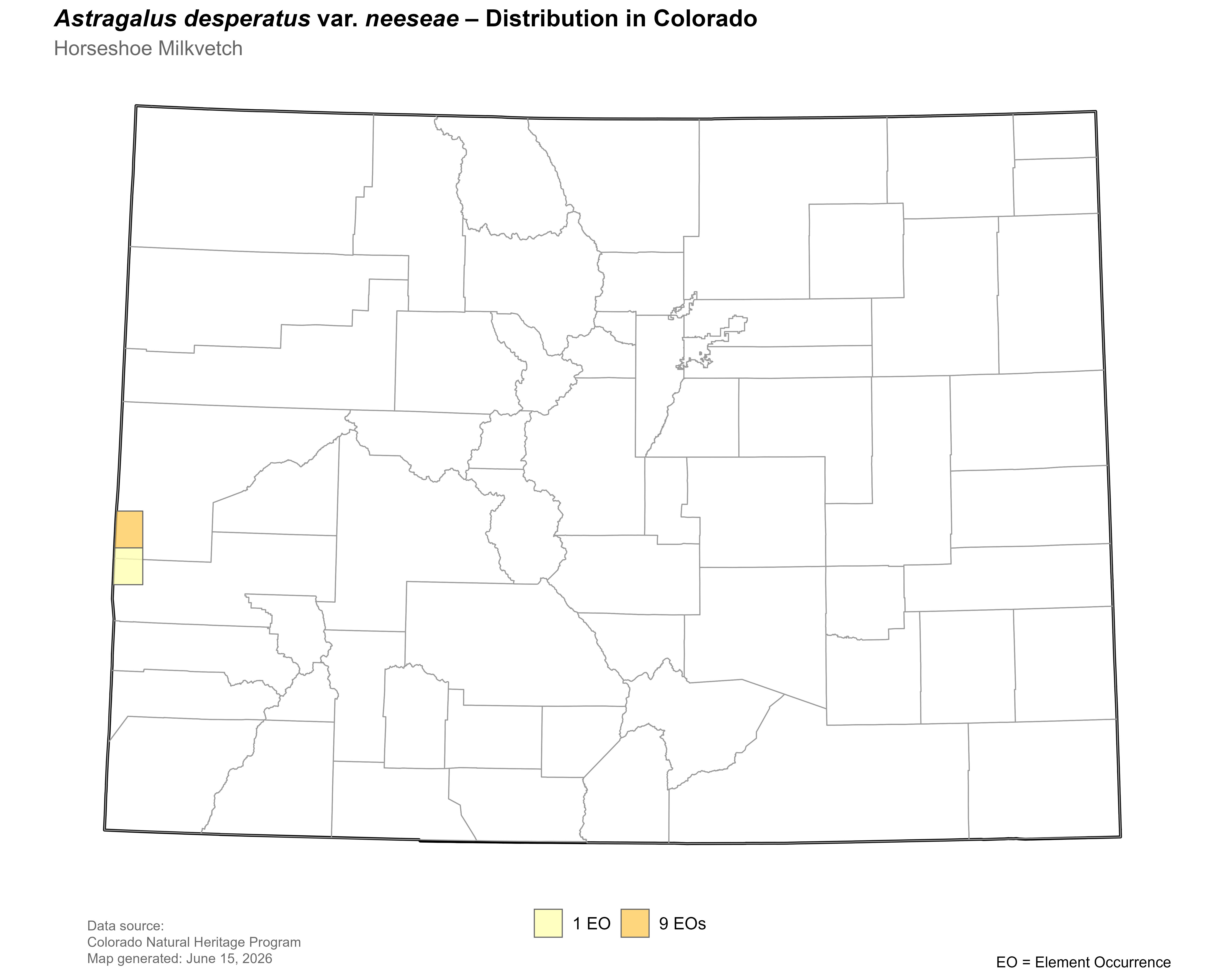
Known from Mesa County in Colorado. The estimated range extent in Colorado of 66 square kilometers was calculated in GeoCAT using occurrence data provided by the Colorado Natural Heritage Program (2023). Also known from Uintah County in Utah, USA.
Click on map to enlarge |
Threats and Management Issues
Road construction and maintenance are a primary concern for this species, although the scope is restricted, it has had direct impacts on occupied habitat. Recreation, primarily non-motorized is widespread in this species habitat but appears to have minimal impacts. Inappropriate livestock grazing and competition from non-native species such as Bromus tectorum are additional management concerns for this species. In the 2006 Candidate Notice of Review (USFWS 2006), the U.S. Fish and Wildlife Service found that listing this species was not warranted and removed it from the candidate list. This species is considered to have low adaptive capacity and is expected to be extremely vulnerable to climate change under both RCP 4.5 and 8.5 scenarios, as assessed for the 2025 Colorado State Wildlife Action Plan (CNHP 2025).
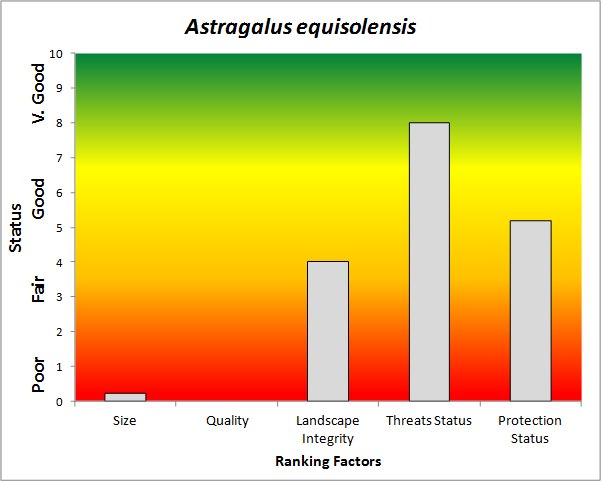
Summary results of an analysis of the status of Astragalus equisolensis based on several ranking factors. This species was concluded to be Moderately Conserved. From Rondeau et al. 2011. |
References
- Barneby, R.C. 1989. Fabales. In A. Cronquist, A.H. Holmgren, N.H. Holmgren, J.L. Reveal, and P.K. Holmgren (eds.). Intermountain flora: Vascular plants of the Intermountain West, U.S.A. Vol. 3, Part B. New York Botanical Garden, Bronx. 279 pp.
- Colorado Natural Heritage Program (CNHP). 2025. Climate Change Vulnerability Assessment of Colorado Tier 1 and Tier 2 Plant Species of Greatest Conservation Need (SCGN) for the 2025 Colorado State Wildlife Action Plan. Colorado Natural Heritage Program, Colorado State University, Fort Collins.
- Colorado Natural Heritage Program. 2008. The Fifth Annual Colorado Rare Plant Symposium: G2 Plants of Colorado. Symposium Minutes. Available on-line http://www.cnhp.colostate.edu/teams/botany.asp#symposia.
- England, L. 2002. March 20-last update. Candidate and Listing Priority Assignment Form: Astragalus equisolensis. U.S. Fish and Wildlife Service, Endangered Species Program. Online. Available: http://ecos.fws.gov/tess/candforms_pdf/r6/astequ.pdf. Accessed 2003, February 7.
- Harrington, H.D. 1954. Manual of the plants of Colorado. Sage Press, Chicago. 666 pp.
- Kartesz, J.T. 1994. A synonymized checklist of the vascular flora of the United States, Canada, and Greenland. 2nd edition. 2 vols. Timber Press, Portland, OR.
- Lavender, A.E., M.M. Fink, S.E. Linn, D.M. Theobald. 2011. Colorado Ownership, Management, and Protection v9 Database. Colorado Natural Heritage Program and Geospatial Centroid, Colorado State University, Fort Collins, CO. (30 September).
- Neely, B., S. Panjabi, E. Lane, P. Lewis, C. Dawson, A. Kratz, B. Kurzel, T. Hogan, J. Handwerk, S. Krishnan, J. Neale, and N. Ripley. 2009. Colorado Rare Plant Conservation Strategy, Developed by the Colorado Rare Plant conservation Initiative. The Nature Conservancy, Boulder, Colorado, 117 pp.
- Panjabi, S., B. Neely and P. Lyon. 2011. Preliminary Conservation Action Plan for Rare Plants in the Gateway Priority Action Areas. Prepared by The Nature Conservancy and the Colorado Natural Heritage Program. Unpublished report prepared for the National Fish and Wildlife Foundation. 29 pp.
- U.S. Fish and Wildlife Service (USFWS). 2004. Species assessment and listing priority assignment form. Astragalus equisolensis. 9 pp.
- U.S. Fish and Wildlife Service (USFWS). 2006. Endangered and Threatened Wildlife and Plants; Review of Native Species That Are Candidates or Proposed for Listing as Endangered or Threatened; Annual Notice of Findings on Resubmitted Petitions; Annual Description of Progress on Listing Actions. Federal Register 71: 53756-53835.
- USDA, NRCS. 2022. The PLANTS Database. National Plant Data Team, Greensboro, NC 27401-4901 USA.
- Welsh, S.L. 2007. North American Species of Astragalus Linnaeus (Leguminosae) A Taxonomic Revision. Brigham Young University, Provo, Utah. 932 pp.
- Welsh, S.L., N.D. Atwood, S. Goodrich and L.C. Higgins. (Eds.) 2003. A Utah Flora. 3rd edition. Brigham Young University, Provo, Utah, U.S.A. 912 pp.