

Scientific Name : Physaria pulvinata
Author : O'Kane & Reveal NatureServe Explorer
Common Name : Cushion Bladderpod
 Current Research Activities


☰ Click link below for details.
Taxonomy
Brassicaceae (mustard family)
Described by O'Kane and Reveal in 2006. Physaria pulvinata was split from P. rectipes (=Lesquerella rectipes), the latter being a variable species (Flora North America vol. 7 2010).
Ranks and Status
State Rank : S1
State Rank Reason : Physaria pulvinata is a long-lived perennial herb that is endemic to Colorado in the western United States. It is known from only San Miguel and Dolores counties, where it is confined to shale outcrops that are often used for road gravel. This species is primarily threatened by inappropriate livestock grazing and recreation (motorized and non-motorized). In addition, P. pulvinata is threatened by competition with non-native plant species (Cirsium arvense, Carduus nutans). This species is expected to be extremely vulnerable to the effects of climate change.
U.S. Endangered Species Act : none
Colorado Threatened and Endangered List : none
Other Statuses : SWAP Tier 1, USFS
Description and Phenology
General Description:
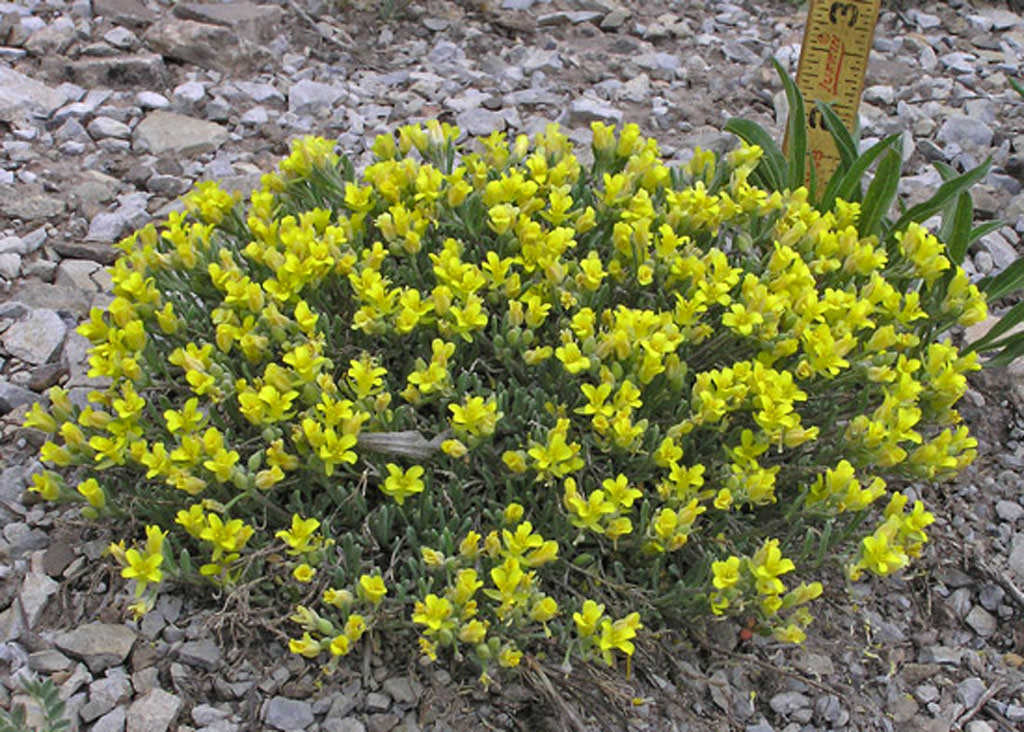
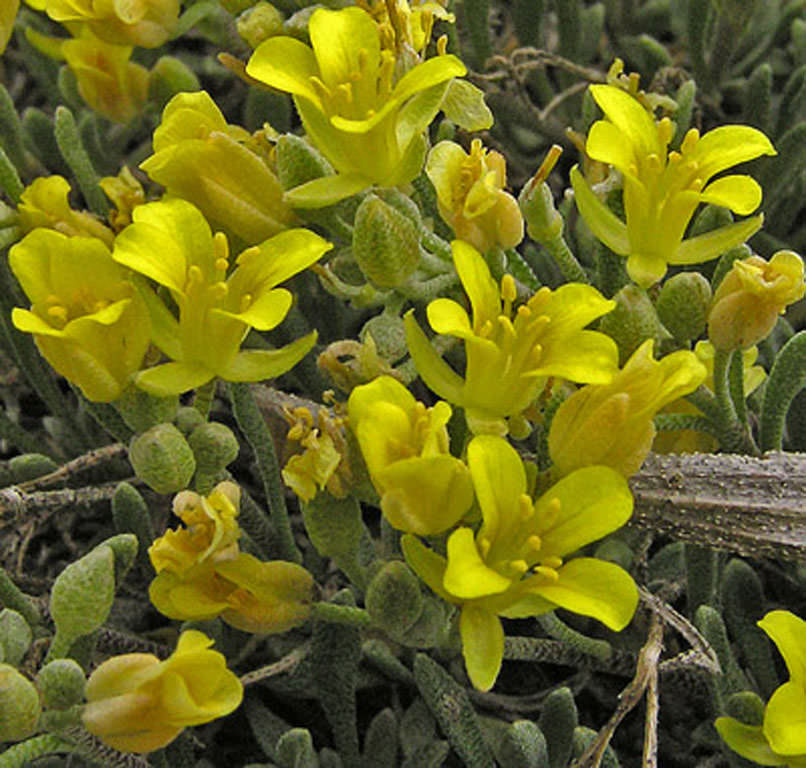
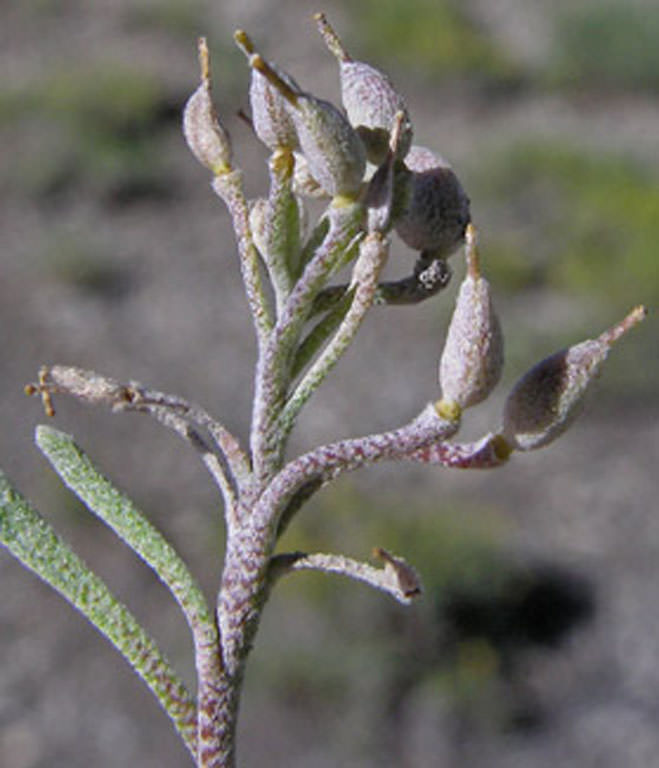
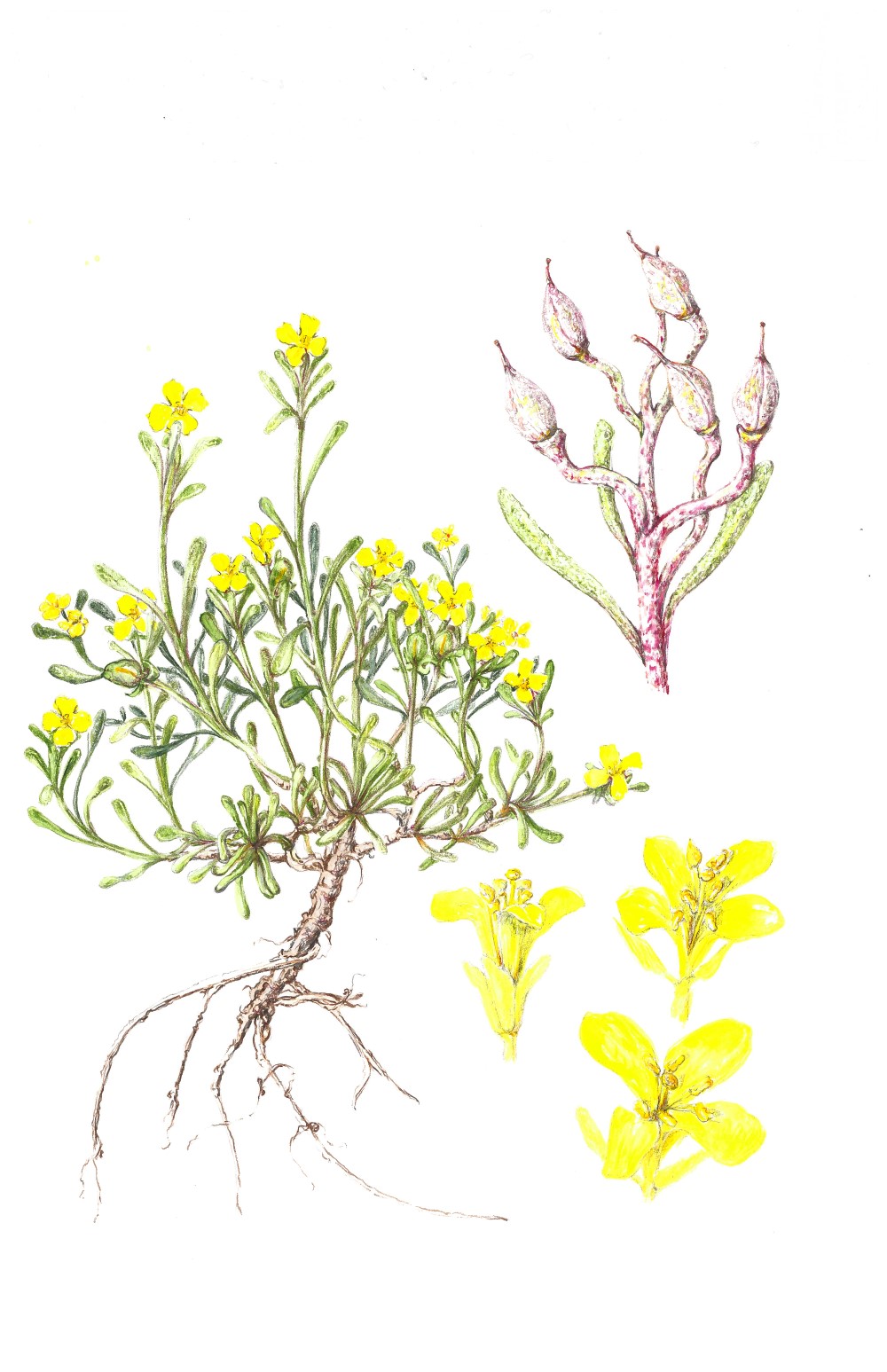
Plants are low and compact, densely matted and densely hairy. A long lived perennial, less that 3 dm across with reddish stems and gray-green foliage arising from a deep-seated taproot terminated by a buried, densely branched caudex system of up to several hundred branches each ending in a tufted cluster of leaves. Flowers are yellow with four narrowly spatulate petals 4-7 mm long. Fruit are ellipsoid, compressed, 4-6 mm long and densely pubescent (O'Kane and Reveal 2006).
Look Alikes:
Not likely to be confused with other species in this habitat in this part of Colorado.
Phenology:
Plants flower in June-July and produce fruit in July-August (Colorado Natural Heritage Program 2012).
 |
Habitat
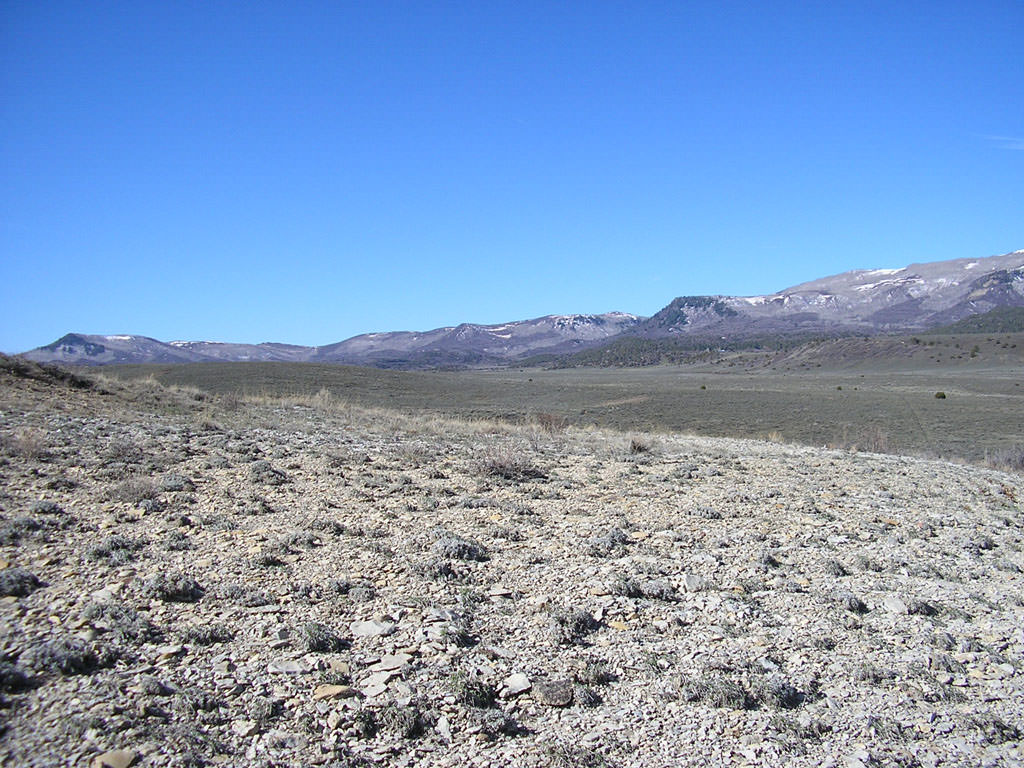
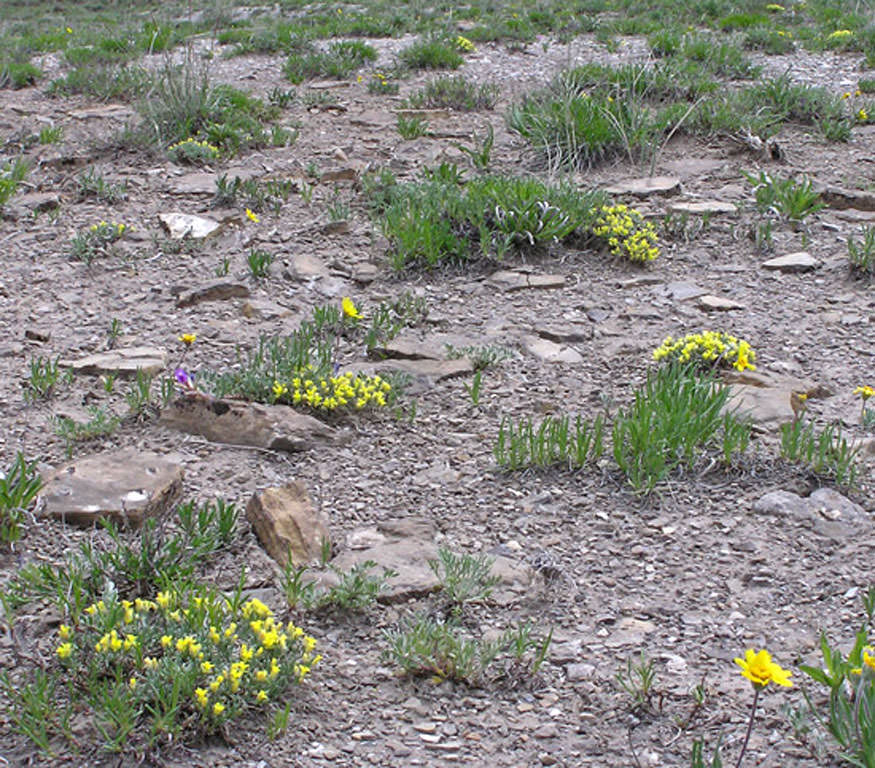
This species is known from widely scattered outcrops of grayish, argillaceous (Mancos) shale. It grows in openings between low shrubs Artemisia nova, Chrysopsis, and Tetraneuris, and forbs Sphaeralcea and Cryptantha (O'Kane and Reveal 2006).
click on image to enlarge
 |  |
Elevation Range:
7,543 - 8,487 feet (2,299 - 2,587 meters)
Distribution
Colorado Endemic:
Yes
Range:
Physaria pulvinata is endemic to Colorado in the western United States. It is known from San Miguel and Dolores counties. Estimated range extent in Colorado of 179 square kilometers was calculated in GeoCAT using occurrence data provided by the Colorado Natural Heritage Program (2023).
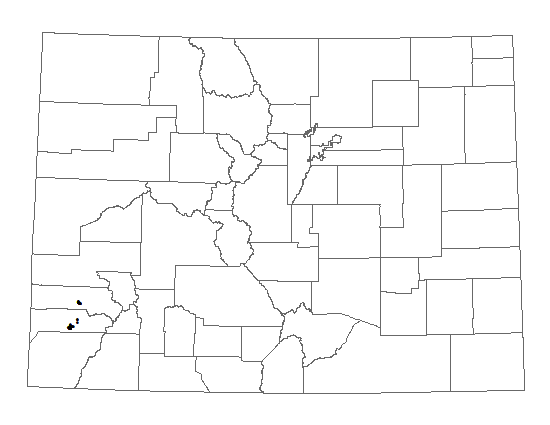 Click on map to enlarge |
Threats and Management Issues
This species is primarily threatened by inappropriate livestock grazing and recreation (motorized and non-motorized). Livestock grazing occurs throughout the species habitat, however, while livestock do not eat the plants, they trample and uproot them, and disturb the soil. Additional potential threats include oil and gas development and roads supporting seismic testing. As of 2011, there was no active oil and gas development but there is potential for that to change. Much of the species occupied habitat is within Lone Mesa State Park, which when opened to the public may increase the potential threats for surface disturbance and trampling by recreationists, however, management plans are likely to address this concern. In addition, P. pulvinata is threatened at some sites by competition with non-native plant species (Cirsium arvense, Carduus nutans), removal of shale for road work, and prolonged drought resulting from climate change (CNHP 2022, Panjabi et al. 2011, O'Kane and Reveal 2006). This species is considered to have low adaptive capacity and is expected to be extremely vulnerable to climate change under both RCP 4.5 and 8.5 scenarios, as assessed for the 2025 Colorado State Wildlife Action Plan (CNHP 2025).
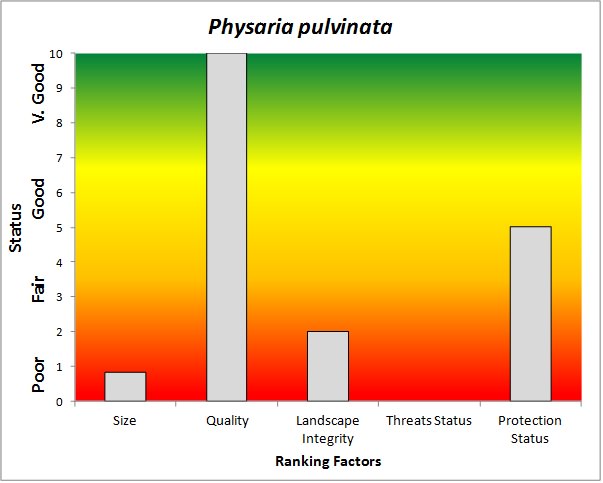 Summary results of an analysis of the status of Physaria pulvinata based on several ranking factors. This species was concluded to be Weakly Conserved. From Rondeau et al. 2011. |
References
- Ackerfield, J. 2012. The Flora of Colorado. Colorado State University Herbarium. 433 pp.
- Colorado Natural Heritage Program (CNHP). 2022. Biodiversity Tracking and Conservation System (Biotics 5). Colorado Natural Heritage Program, Colorado State University, Fort Collins.
- Colorado Natural Heritage Program (CNHP). 2023. Biodiversity Tracking and Conservation System (Biotics 5). Colorado Natural Heritage Program, Colorado State University, Fort Collins.
- Colorado Natural Heritage Program (CNHP). 2025. Climate Change Vulnerability Assessment of Colorado Tier 1 and Tier 2 Plant Species of Greatest Conservation Need (SCGN) for the 2025 Colorado State Wildlife Action Plan. Colorado Natural Heritage Program, Colorado State University, Fort Collins.
- Flora of North America Editorial Committee (FNA). 2010. Flora of North America north of Mexico. Vol. 7. Magnoliophyta: Salicaceae to Brassicaceae. Oxford University Press, New York. xxii + 797 pp.
- Handwerk, J., L. Grunau, and S. Panjabi. 2015. Colorado Wildlife Action Plan: 2015 Rare Plant Addendum. Colorado Natural Heritage Program, Colorado State University, Fort Collins, Colorado, USA.
- Handwerk, J.E., D.G. Malone, and J.P. Smith. 2022. Monitoring Colorado’s SWAP Tier 1 plant species Physaria pulvinata, 2021. Colorado Natural Heritage Program, Colorado State University, Fort Collins, Colorado.
- Lavender, A.E., M.M. Fink, S.E. Linn, D.M. Theobald. 2011. Colorado Ownership, Management, and Protection v9 Database. Colorado Natural Heritage Program and Geospatial Centroid, Colorado State University, Fort Collins, CO. (30 September).
- Neely, B., S. Panjabi, E. Lane, P. Lewis, C. Dawson, A. Kratz, B. Kurzel, T. Hogan, J. Handwerk, S. Krishnan, J. Neale, and N. Ripley. 2009. Colorado Rare Plant Conservation Strategy, Developed by the Colorado Rare Plant conservation Initiative. The Nature Conservancy, Boulder, Colorado, 117 pp.
- O'Kane, S. L., and J. L. Reveal. 2006. Physaria pulvinata (Brassicaceae), a new species from southwestern Colorado. Brittonia 58(1):74-77.
- Panjabi, S., B. Neely and P. Lyon. 2011. Preliminary Conservation Action Plan for Rare Plants in the Plateau Creek and Miramonte Reservoir West Priority Action Areas. Prepared by The Nature Conservancy and the Colorado Natural Heritage Program. Unpublished report prepared for the National Fish and Wildlife Foundation. 28 pp.
- Reveal, J.L. 2005. University of Maryland: An Array of Botanical Images, Physaria pulvinata. http://www.life.umd.edu/emeritus/reveal
- Schneider, A. 2013. Wildflowers, Ferns, and Trees of the Four Corners Regions of Colorado, New Mexico, Arizona, and Utah. Accessed on-line at http://www.swcoloradowildflowers.com.
- Weber, W. A. and R. C. Wittmann. 2012. Colorado Flora, Western Slope, A Field Guide to the Vascular Plants, Fourth Edition. Boulder, Colorado. 532 pp.