

Scientific Name : Astragalus humillimus
Author : Gray NatureServe Explorer
Common Name : Mancos Milkvetch
 Current Research Activities
 1997 profile


☰ Click link below for details.
Taxonomy
Fabaceae (pea family)
Ranks and Status
State Rank : S1?
State Rank Reason : Astragalus humillimus is a narrow endemic of the Four Corners region. All the Colorado populations are in an area being intensively developed for energy resources, although land managers are aware of the locations of the populations and are reported to be actively considering the species during land use planning. This species is also considered to be extremely vulnerable to climate change.
U.S. Endangered Species Act : ESA Endangered
Colorado Threatened and Endangered List : none
Other Statuses : SWAP Tier 1
Description and Phenology
General Description:
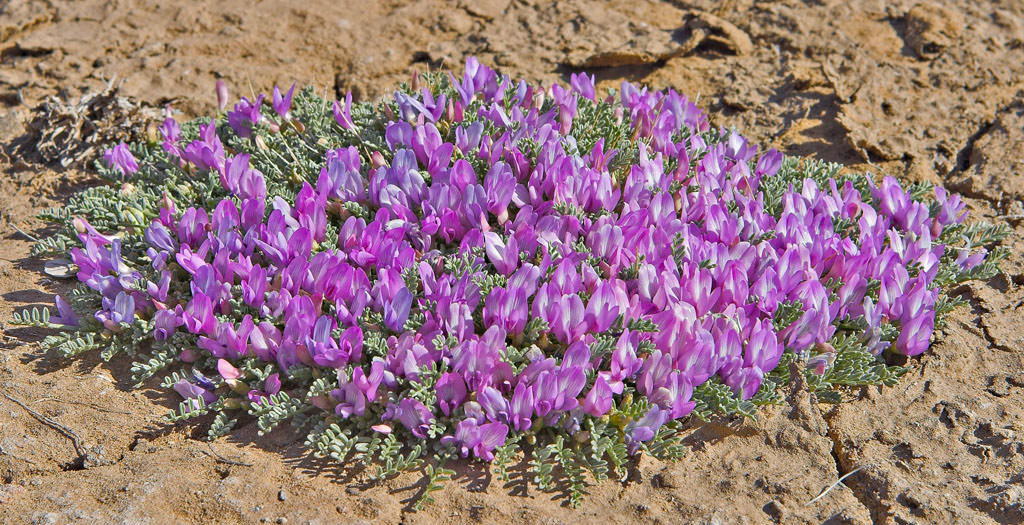
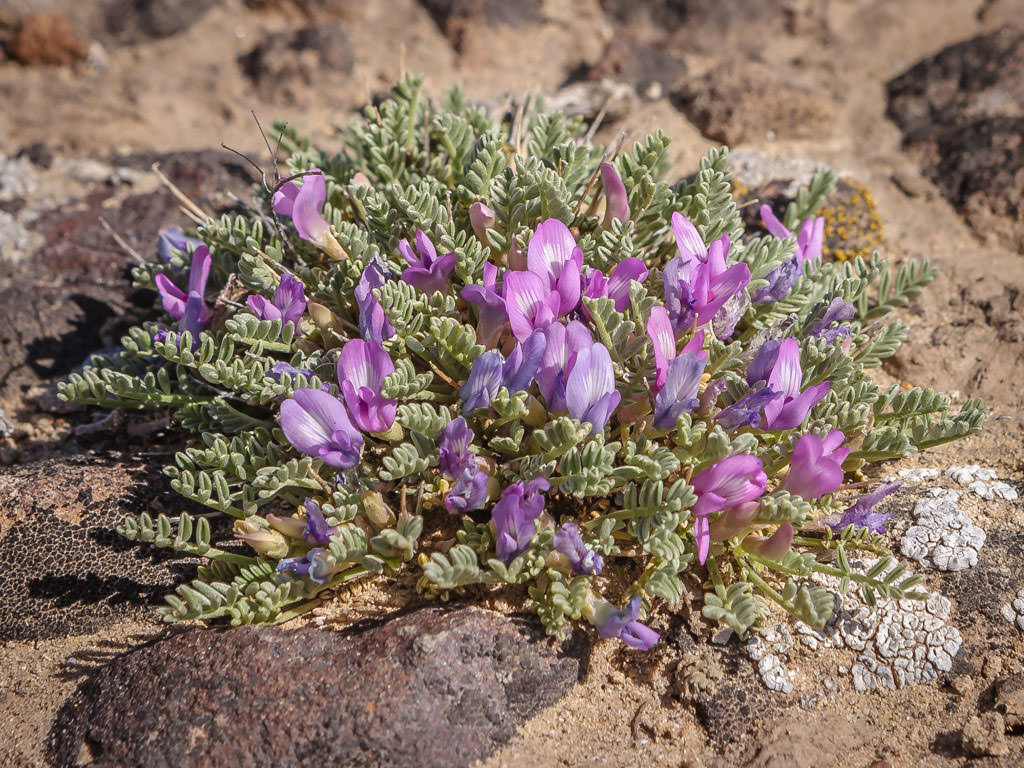
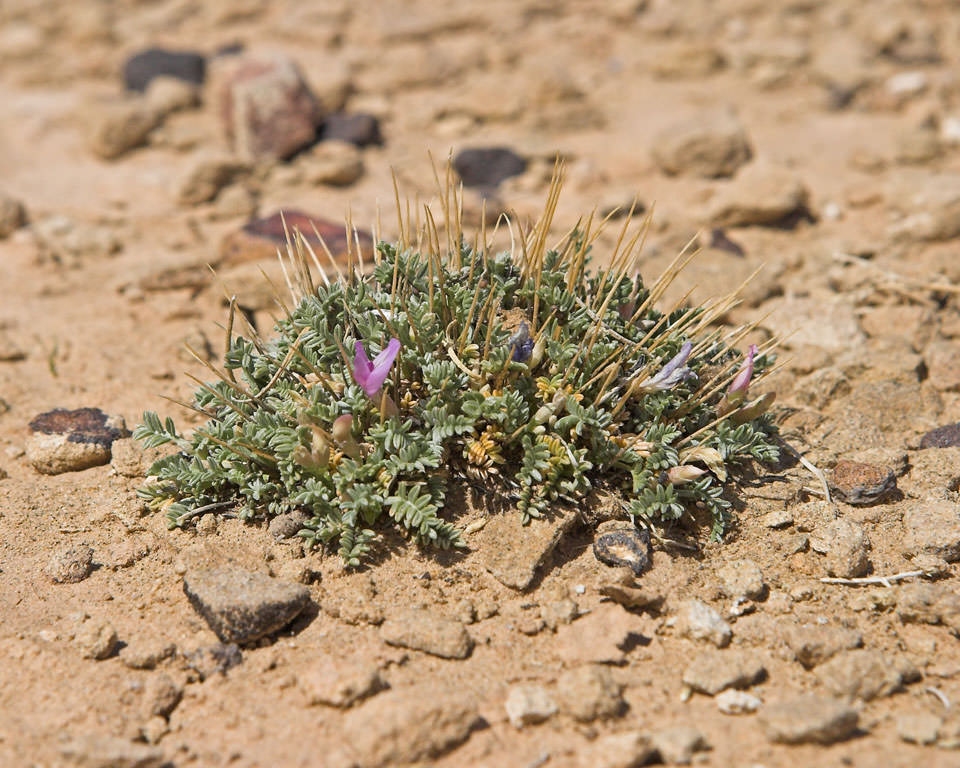
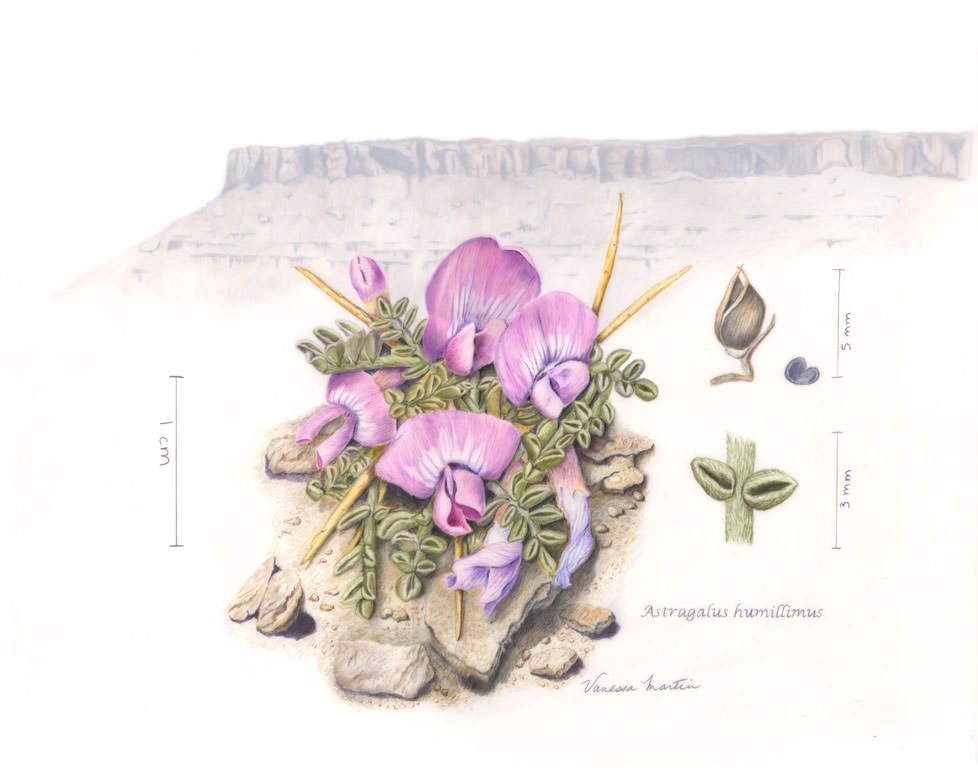
Diminutive, tufted perennial forming clumps up to 30 cm across; crown with persistent, spiny leaf stalks; stems up to 1 cm long, leaves crowded, up to 4 cm long, with 7-11 oval leaflets, these 0.7-2.0 mm long; flower branches short, 1-3 flowers; calyx about 3 mm long, withered leaves persistent as spiny projections from the stem base, petals lavender to purplish, with a conspicuous lighter-colored spot in the throat of the corolla tube; pod spreading, egg shaped, about 4.5 mm long, 2 mm wide (Spackman et al. 1997). The species is reported to have a sweet-pungent smell.
Look Alikes:
No other mat forming Astragalus in this area has persistent spinescent leaf petioles. Astragalus deterior and A. calycosus var. scaposus have flaccid leaf petioles and longer, oblong or narrowly ellipsoid pods (Spackman et al. 1997).
Phenology:
Flowers in late April- early June; fruit in June-early July (Colorado Natural Heritage Program 2012).
 |
Habitat
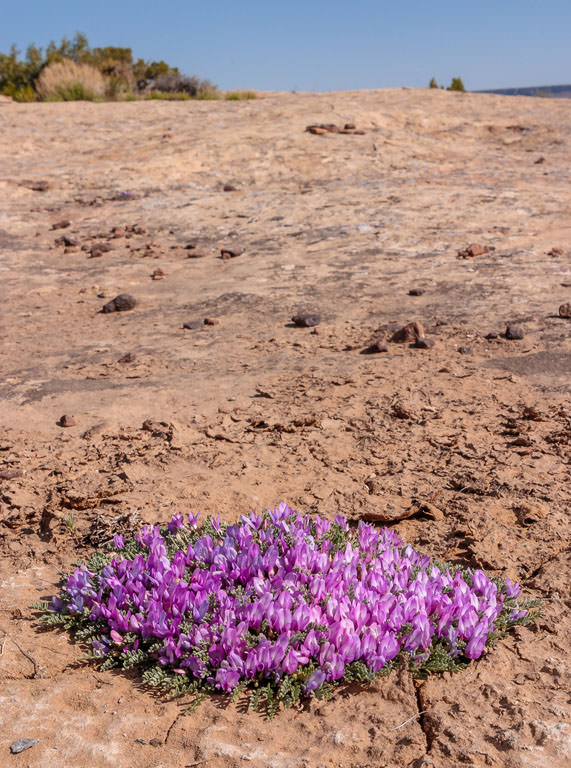
Astragalus humillimus occurs on sandstone rock ledges in the pinyon belt, sometimes submerged in drifting sand or mesa tops, often in cracks in the sandstone substrate or in shallow pockets of sandy soil (Barneby 1964). Possibly also on limestone. Bedrock is exfoliating Lookout Point Sandstone, a very light colored rock of the Mesa Verde Group. Dominant species: Juniperus osteosperma, Oryzopsis hymenoides, Guterrezia sarothrae, Yucca angustissima, Artemesia tridentata (Knight 1989).
click on image to enlarge
 |
Elevation Range:
5,240 - 6,166 feet (1,597 - 1,879 meters)
Distribution
Colorado Endemic:
No
Range:
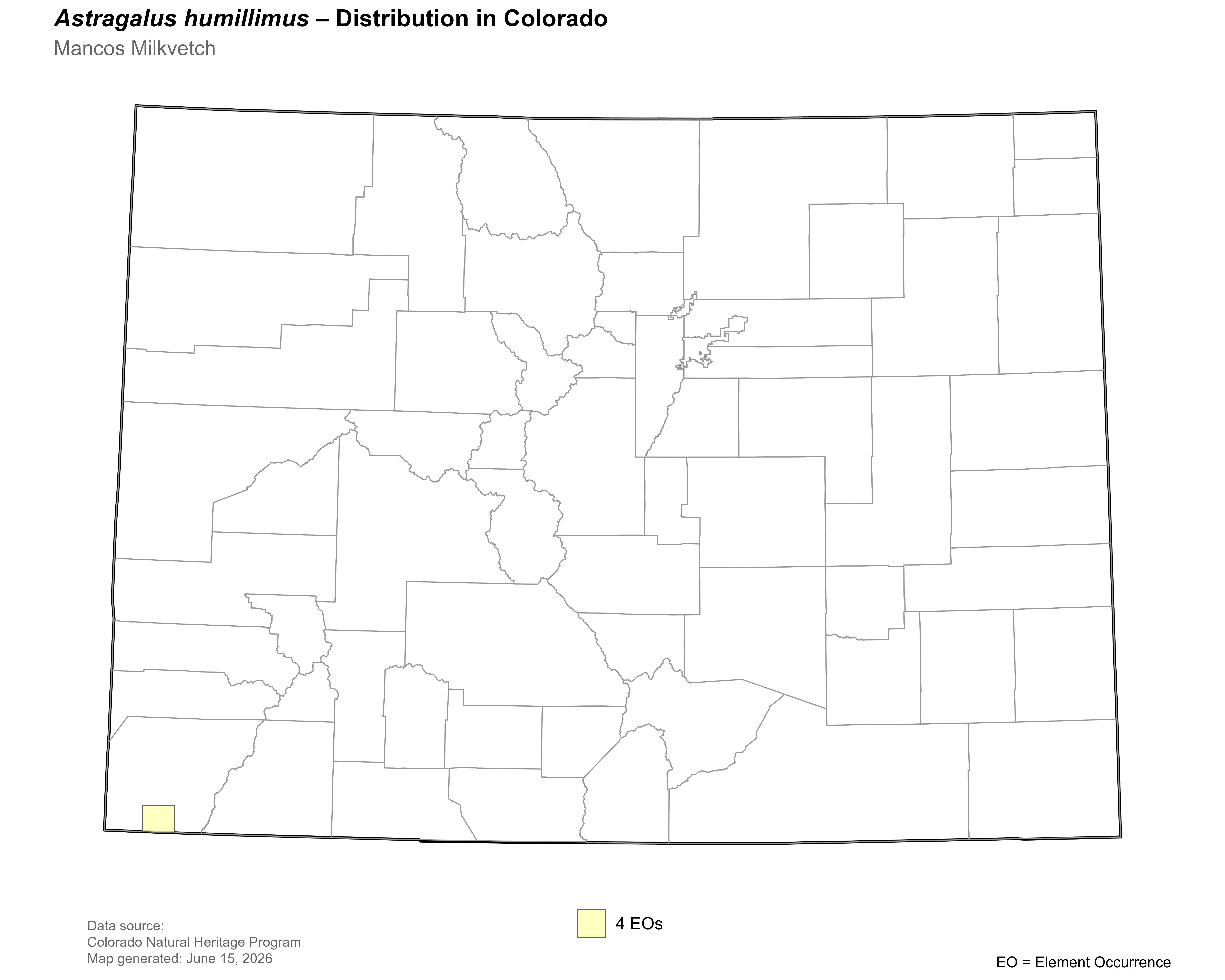
Astragalus humillimus is known from a small area in Montezuma County, Colorado, USA. The estimated range extent in Colorado of 29 square kilometers was calculated in GeoCAT using occurrence data provided by the Colorado Natural Heritage Program (2023). It is also known from San Juan County, New Mexico and the Navajo Nation.
Click on map to enlarge |
Threats and Management Issues
As of 2025, the current threats are not well documented in the occurrences and threats are inferred from USFWS documents. Surface disturbance associated with energy exploration and development is known to be occurring in the Four Corners area, and has had negative impacts on Astragalus humillimus populations in New Mexico (USFWS 2011). Astragalus humillimus habitat occurs in the vicinity of utility corridors/transmission lines, drill pads, oil wells, pipelines, and roads. Most damage occurs after vehicles and heavy equipment drive over and crush individuals plants as well as break apart depressions in the sandstone which are required for seedling establishment (USFWS 2011). The Navajo Indian Tribe, BLM, BIA, and WAPA are aware of the locations of the populations, have acknowledged the potential threats to the species and are actively considering the species during planning (USFWS 1985). This species is considered to have low adaptive capacity and is expected to be extremely vulnerable to climate change under both RCP 4.5 and 8.5 scenarios, as assessed for the 2025 Colorado State Wildlife Action Plan (CNHP 2025).
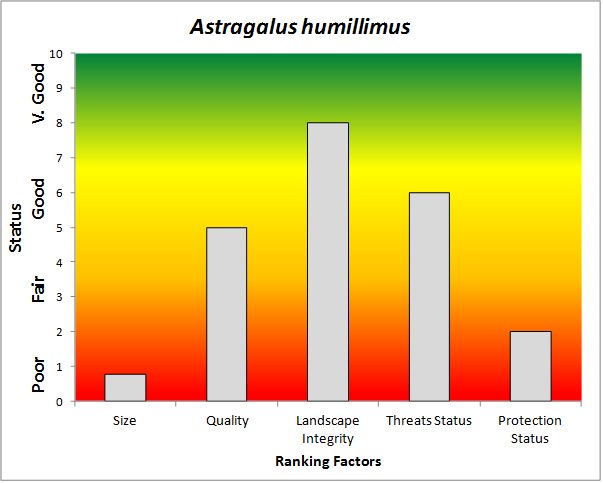
Summary results of an analysis of the status of Astragalus humillimus based on several ranking factors. This species was concluded to be "moderately conserved. From Rondeau et al. 2011. |
References
- Ackerfield, J. 2012. The Flora of Colorado. Colorado State University Herbarium. 433 pp.
- Barneby, R.C. 1964. Atlas of North American Astragalus. 2 Vols. New York Botanical Garden, Bronx, New York. 1188 pp.
- Colorado Natural Heritage Program (CNHP). 2023. Biodiversity Tracking and Conservation System (Biotics 5). Colorado Natural Heritage Program, Colorado State University, Fort Collins.
- Colorado Natural Heritage Program (CNHP). 2025. Climate Change Vulnerability Assessment of Colorado Tier 1 and Tier 2 Plant Species of Greatest Conservation Need (SCGN) for the 2025 Colorado State Wildlife Action Plan. Colorado Natural Heritage Program, Colorado State University, Fort Collins.
- Colorado Natural Heritage Program. 2003. Biological Conservation Datasystem. Colorado State University, Ft. Collins, CO.
- Elliott, B. A., S. Spackman Panjabi, B. Kurzel, B. Neely, R. Rondeau, M. Ewing. 2009. Recommended Best Management Practices for Plants of Concern. Practices developed to reduce the impacts of oil and gas development activities to plants of concern. Unpublished report prepared by the Rare Plant Conservation Initiative for the National Fish and Wildlife Foundation.
- Handwerk, J., L. Grunau, and S. Panjabi. 2015. Colorado Wildlife Action Plan: 2015 Rare Plant Addendum. Colorado Natural Heritage Program, Colorado State University, Fort Collins, Colorado, USA.
- Johnston, B.C. 1979. USFS Summary Sheet. Unpublished manuscript.
- Kartesz, J.T. 1994. A synonymized checklist of the vascular flora of the United States, Canada, and Greenland. 2nd edition. 2 vols. Timber Press, Portland, OR.
- Knight, P., and D. House. 1989. Mancos Milkvetch (Astragalus humillimus) Recovery Plan. Prepared for the U.S. Fish & Wildlife Service, Region 2, Albuquerque, NM.
- Knight, P.J. 1981. Status report - Astragalus humillimus. New Mexico State Heritage Program.
- Natural Heritage New Mexico. 2003. Biological Conservation Data. University of New Mexico, Albuquerque, NM.
- Neely, B., S. Panjabi, E. Lane, P. Lewis, C. Dawson, A. Kratz, B. Kurzel, T. Hogan, J. Handwerk, S. Krishnan, J. Neale, and N. Ripley. 2009. Colorado Rare Plant Conservation Strategy, Developed by the Colorado Rare Plant conservation Initiative. The Nature Conservancy, Boulder, Colorado, 117 pp.
- Neely, E.E. 1987. Astragalus humillimus inventory. Unpublished report prepared for the Colorado Natural Areas Program, Denver, CO.
- New Mexico Native Plant Protection Advisory Committee. 1984. A handbook of rare and endemic plants of New Mexico. Univ. New Mexico Press, Albuquerque. 291 pp.
- O'Kane, S. L. 1988. Colorado's Rare Flora. Great Basin Naturalist. 48(4):434-484.
- Roth, D. 2008. May 15 last update. Species account for Astragalus humillimus. Navajo Natural Heritage Program, Window Rock, AZ. [http://nnhp.nndfw.org/Plants/ashu.pdf]
- Schneider, A. 2013. Wildflowers, Ferns, and Trees of the Four Corners Regions of Colorado, New Mexico, Arizona, and Utah. Accessed on-line at http://www.swcoloradowildflowers.com.
- Sivinski, R., and K. Lightfoot. 1995. Endangered plant study performance report E9. U.S. Fish and Wildlife Service, Albuquerque, New Mexico.
- Spackman, S., B. Jennings, J. Coles, C. Dawson, M. Minton, A. Kratz, and C. Spurrier. 1997. Colorado rare plant field guide. Prepared for Bureau of Land Management, U.S. Forest Service and U.S. Fish and Wildlife Service by Colorado Natural Heritage Program.
- U.S. Fish and Wildlife Service (USFWS). 1985. Final rule to determine Astragalus humillimus to be endangered. Federal Register 50(124): 26568-26572.
- U.S. Fish and Wildlife Service (USFWS). 2011. Mancos milkvetch (Astraglus humillimus) 5-year review summary and evaluation. July 2011. New Mexico Ecological Services Office, Alburquerque, New Mexico. [http://ecos.fws.gov/docs/five_year_review/doc3829.pdf]
- USDA, NRCS. 2022. The PLANTS Database. National Plant Data Team, Greensboro, NC 27401-4901 USA.
- Weber, W. A. and R. C. Wittmann. 2012. Colorado Flora, Western Slope, A Field Guide to the Vascular Plants, Fourth Edition. Boulder, Colorado. 532 pp.