

Scientific Name : Draba globosa
Author : Payson NatureServe Explorer
Common Name : Rockcress Draba
 Current Research Activities
 1997 profile


☰ Click link below for details.
Taxonomy
Brassicaceae (mustard family)
Ranks and Status
State Rank : S1S2
State Rank Reason : In Colorado, USA, Draba globosa is known from less than 15 occurrences in the alpine region of the central Rocky Mountains. The primary threat is trampling and recreational trail disturbance. It is considered to be moderately to extremely vulnerable to the effects of climate change.
U.S. Endangered Species Act : none
Colorado Threatened and Endangered List : none
Other Statuses : SWAP Tier 2
Description and Phenology
General Description:
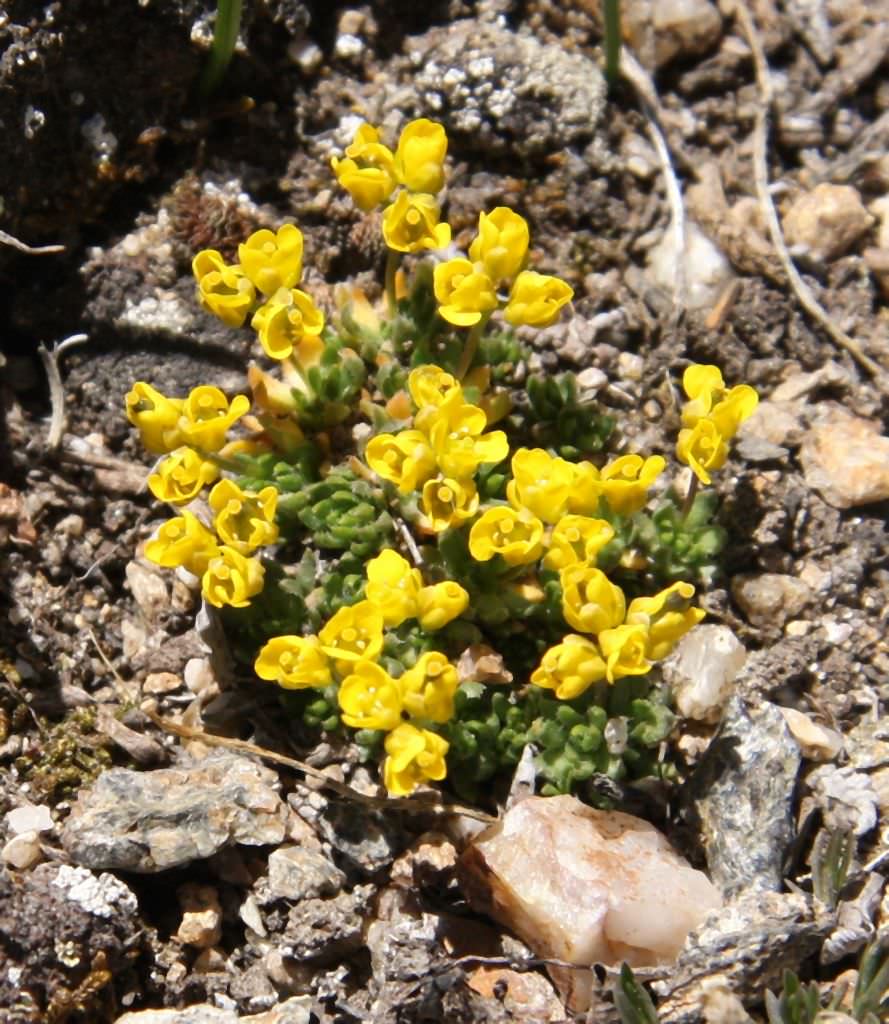
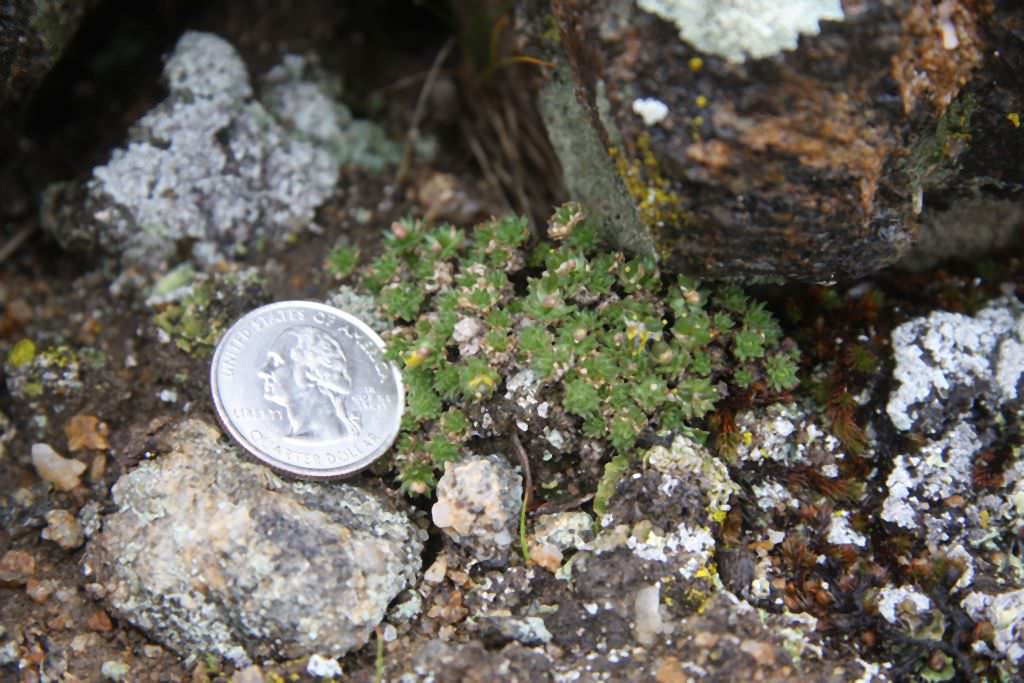
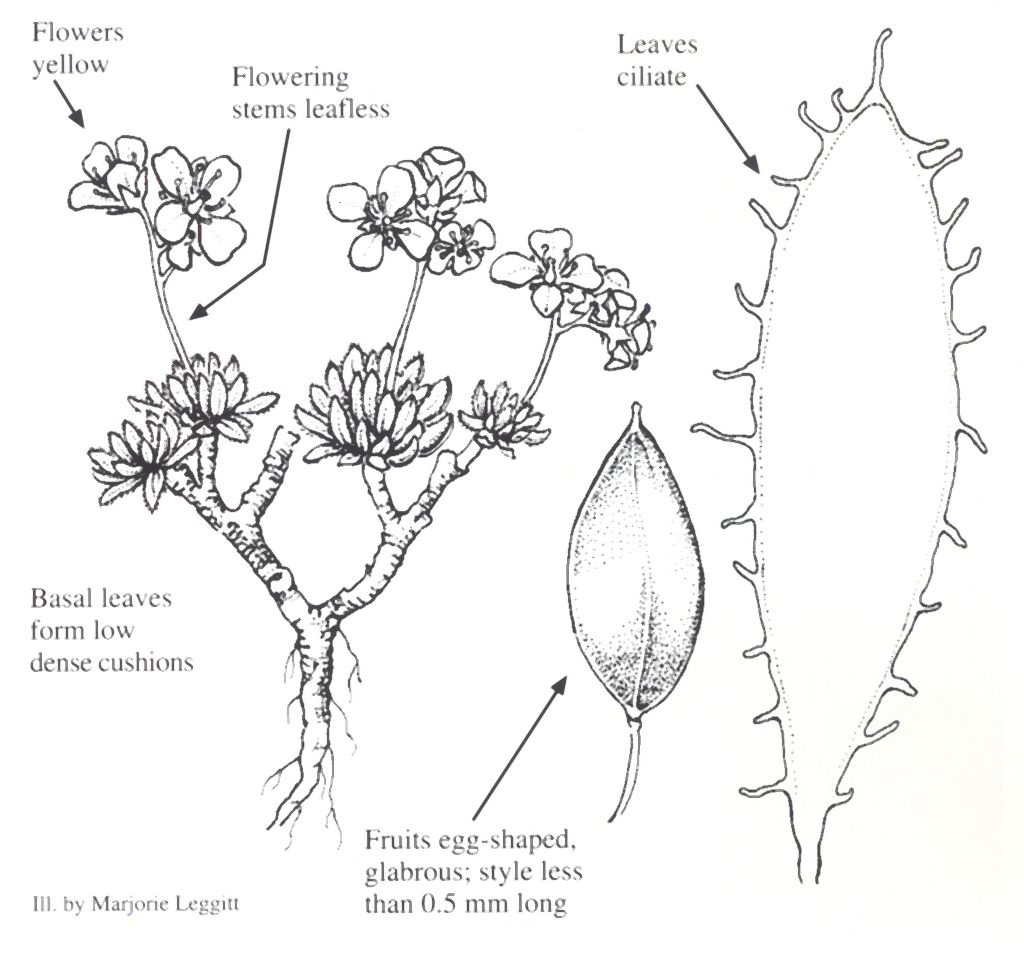
Perennials; (cespitose, pul-vinate); caudex branched (with persistent leaves, branches sometimes terminating in sterile rosettes); scapose. Stems unbranched, 0.1-0.5 dm, glabrous. Basal leaves rosulate; sessile; blade (not fleshy), narrowly oblanceolate or lanceolate to linear, (0.2-)0.3-0.8 cm × 0.5-1.6(-2) mm, margins entire (ciliate, trichomes simple, 0.1-0.8 mm, apex acute, trichomes usually longer), surfaces glabrous, (midvein obscure abaxially). Cauline leaves 0. Racemes 2-5(-7)-flowered, ebracteate, slightly elongated in fruit; rachis not flexuous, glabrous. Fruiting pedicels divaricate-ascending, straight or slightly curved, 2-6 mm, glabrous. Flowers: sepals (persistent to near fruit maturity), ovate to broadly oblong, 2-3 mm, glabrous; petals white to pale yellow, obovate, 2.5-4 × 1.2-2 mm; anthers oblong, 0.4-0.6 mm. Fruits ovate, plane, flattened, 4.5-8 × 2.5-4 mm; valves (distinctly veined), glabrous; ovules 8-16 per ovary; style (0.1-)0.2-0.6 mm. Seeds oblong, 1.1-1.4 × 0.8-1 mm (Flora of North America 1993+).
Look Alikes:
Differs from other yellow flowered alpine Drabas without stem leaves in forming very low dense cushions with many short caudices, each topped by a cluster of broad and short incurved glabrous or ciliate leaves, forming minute cabbage-like heads. The most similar Colorado species, D. oligosperma, has pubescent leaves (Spackman et al. 1997).
Phenology:
Flowers June through August (Colorado Natural Heritage Program 2023).
 |
Habitat
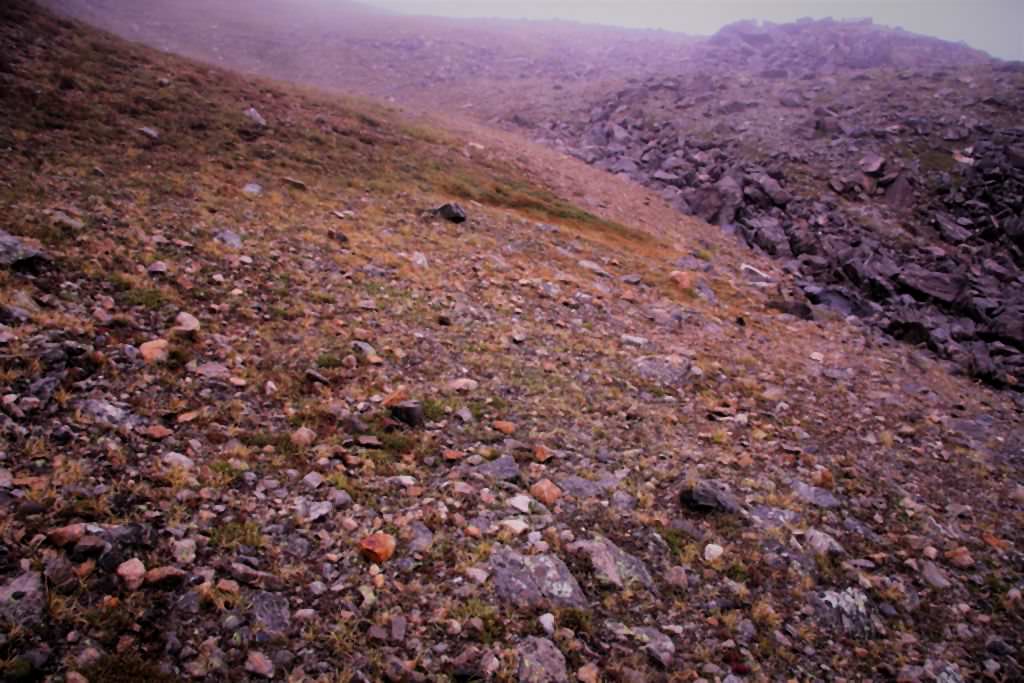
Alpine meadows, granitic talus slopes, and rock crevices (Spackman et al. 1997). Associated species include: Geum rossii, Smelowskia calycina; Eryssimum capitatum, Draba streptobrachia, Draba aurea, Trisetum spicatum, Salix arctica, Dryas octopetala, Paronychia pulvinata, Tryphane rubella, Silene acaulis, Cilaria austromontana, Artemisia arctica, Bistorta bistortoides, Penstemon whippleanus, Trifolium parryi, Artemisia scopulorum, Tonestus pygmaeus,Trifolium nanum, Luzula spicata, Potentilla uniflora, Oreoxys alpina, Poa compressa, Saxifraga rhomboidea, Mertensia lanceolata, Zigadenus elegans, Noccaea fendleri ssp. glauca, Draba crassifolia, Ranunculus adoneus, Sibbaldia procumbens, Caltha leptosepala, Draba crassa, Poa alpina, Castilleja occidentalis, Saxifraga caespitosa, Packera werneriifolia, Cirsium scopulorum, Senecio amplectans, Primula angustifolia, Rhodiola integrifolia, Polygonum viviparum, Minuartia obtusiloba, Trifoium dasyphyllum, Gentiana algida, Eremogone fendleri, Poa glauca.
click on image to enlarge
 |
Elevation Range:
10,561 - 13,376 feet (3,219 - 4,077 meters)
Distribution
Colorado Endemic:
No
Range:
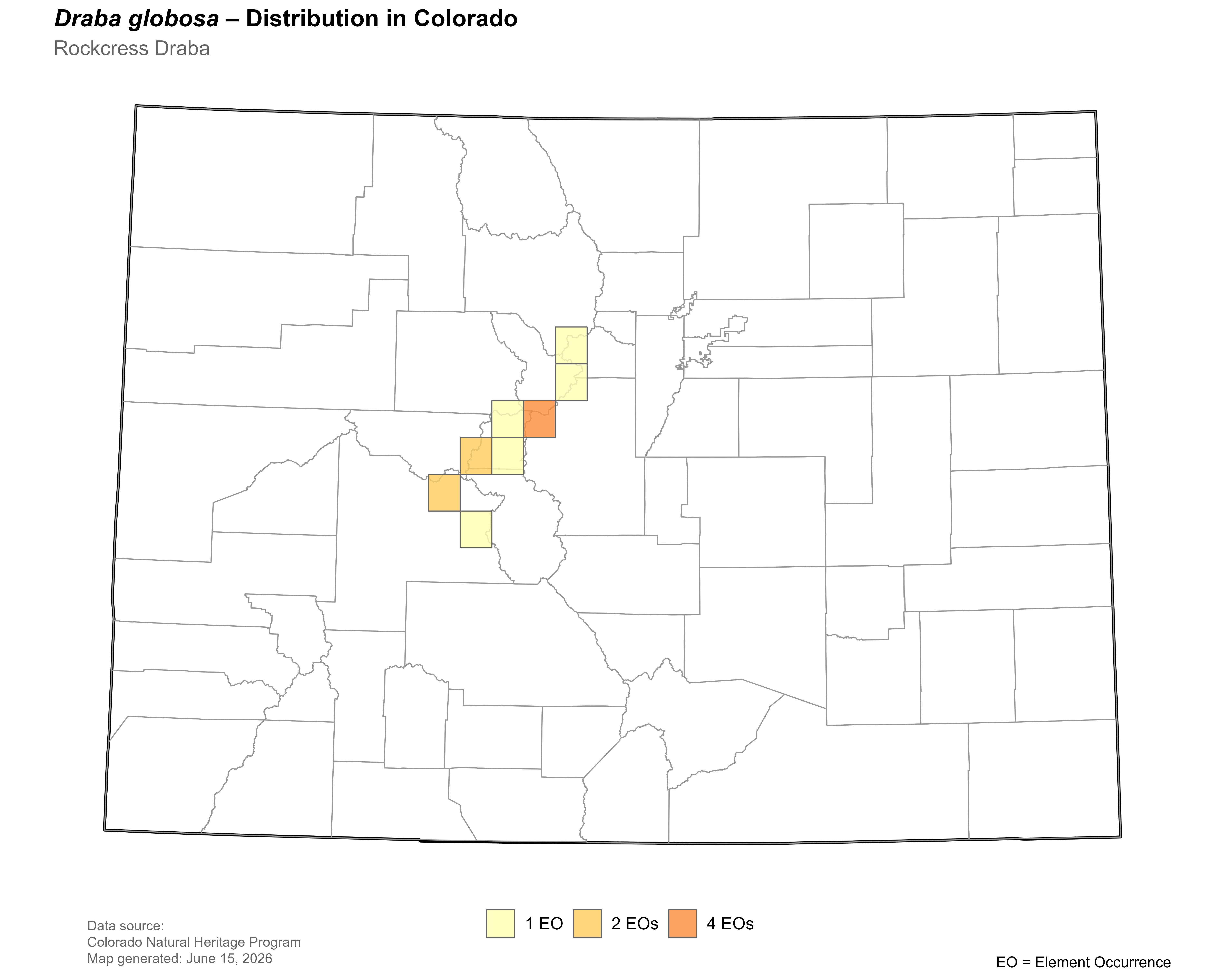
Draba globosa is known from 6 counties in Colorado, USA: Clear Creek, Gunnison, Lake, Park, Pitkin, and Summit. Estimated range extent in Colorado of 2554 square kilometers was calculated in GeoCAT using occurrence data provided by the Colorado Natural Heritage Program (2023). This species can also be found in Idaho, Montana, Utah, and Wyoming.
Click on map to enlarge |
Threats and Management Issues
Primary threats in Colorado are recreational use of habitat, such as foot traffic, and activities related to skiing. These activities may pose a threat to some populations, particularly those adjacent to the high-use Continental Divide Trail. As the human population grows in areas within easy access to Draba globosa habitat and as the recreational use increases, the impacts may become substantially more significant. Mining activities are not perceived as a threat to any of the currently known populations, although individual populations may have been impacted in the past. Introduced mountain goats are also likely to have a negative impact on habitat. Invasive weeds may pose an additional risk to long-term sustainability. Wet nitrogen deposition (acid rain) poses a substantial risk to forb communities in alpine tundra in some regions. Global climate change is a potential threat to all species currently restricted to sub-alpine and alpine-tundra zones (Ladyman 2004). This species is considered to have low adaptive capacity and is expected to be moderately to extremely vulnerable to climate change under both RCP 4.5 and 8.5 scenarios, as assessed for the 2025 Colorado State Wildlife Action Plan (CNHP 2025).
References
- Ackerfield, J. 2015. Flora of Colorado. BRIT Press, Botanical Research Institute of Texas, Fort Worth, TX. 818 pp.
- Colorado Natural Heritage Program (CNHP). 2025. Climate Change Vulnerability Assessment of Colorado Tier 1 and Tier 2 Plant Species of Greatest Conservation Need (SCGN) for the 2025 Colorado State Wildlife Action Plan. Colorado Natural Heritage Program, Colorado State University, Fort Collins.
- Flora of North America Editorial Committee (FNA). 2010. Flora of North America north of Mexico. Vol. 7. Magnoliophyta: Salicaceae to Brassicaceae. Oxford University Press, New York. xxii + 797 pp.
- Flora of North America Editorial Committee, ed. (FNA). 1993+. Flora of North America North of Mexico. Oxford Univ. Press, New York, Oxford.
- Holmgren, N.H., P.K. Holmgren, and A. Cronquist. 2005. Intermountain flora. Volume 2, part B. Subclass Dilleniidae. The New York Botanical Garden Press. 488 pages.
- Ladyman, J.A.R. 2004. Draba globosa Payson (beavertip draba): a technical conservation assessment. [Online]. USDA Forest Service, Rocky Mountain Region. Online. Available: https://www.fs.usda.gov/Internet/FSE_DOCUMENTS/stelprdb5206840.pdf (Accessed 2023).
- Rollins, R.C. 1993. The Cruciferae of Continental North America:Systematics of the Mustard Family from the Arctic to Panama. Stanford University Press. Stanford, CA.
- Spackman, S., B. Jennings, J. Coles, C. Dawson, M. Minton, A. Kratz, and C. Spurrier. 1997. Colorado rare plant field guide. Prepared for Bureau of Land Management, U.S. Forest Service and U.S. Fish and Wildlife Service by Colorado Natural Heritage Program.
- USDA, NRCS. 2013. The PLANTS Database. National Plant Data Team, Greensboro, NC 27401-4901 USA.
- Weber, W. A. and R. C. Wittmann. 2012. Colorado Flora, Eastern Slope, A Field Guide to the Vascular Plants, Fourth Edition. Boulder, Colorado. 555 pp.
- Weber, W. A. and R. C. Wittmann. 2012. Colorado Flora, Western Slope, A Field Guide to the Vascular Plants, Fourth Edition. Boulder, Colorado. 532 pp.